

Local keyword research for small business is the process of identifying location-specific search terms your potential customers type into Google to find services like yours, so you can rank where it counts and convert searches into revenue. Tools like Semrush’s Keyword Magic Tool, Google Keyword Planner, and Google Business Profile (GBP) are the three pillars of any effective local search strategy in 2026. What separates businesses that dominate their local market from those buried on page three is not budget. It is a repeatable keyword system built around real customer language, intent mapping, and AI trust signals. This guide walks you through that system, step by step.
What tools do you need for local keyword research?
The right tools tell you which terms people actually search, how competitive those terms are, and whether a click is likely to turn into a call. A local keyword research tools comparison always starts with three core platforms.
Semrush Keyword Magic Tool surfaces location-specific search terms alongside keyword volume, keyword difficulty percentage, and SERP features data to help you prioritize local terms. That combination matters because a keyword with 200 monthly searches and a difficulty score of 18 is far more valuable to a small business than a 2,000-search term with a difficulty of 74. Semrush also shows whether a keyword triggers a Local Pack result, which signals that Google already treats it as a local query.

Google Keyword Planner adds a layer that Semrush cannot fully replicate. Its geographic filtering lets you estimate search volume by city, ZIP code, or metro area. More importantly, the Top of Page Bid metric signals commercial intent by showing what advertisers pay per click. A plumber searching for keywords should treat a $14 Top of Page Bid as confirmation that a term drives buyer-ready traffic, not just curious browsers.
Google Business Profile Insights rounds out the toolkit by showing the exact search queries people used to find your listing. This data comes directly from real customers in your market, not from a modeled database. Mining GBP and reviews for customer language consistently surfaces phrases that generic tools miss entirely.
| Tool | Best for | Key metric | Cost |
|---|---|---|---|
| Semrush Keyword Magic Tool | Keyword discovery and difficulty | Keyword Difficulty % + SERP features | Paid |
| Google Keyword Planner | Local volume and commercial intent | Top of Page Bid + geographic volume | Free |
| Google Business Profile Insights | Real customer search language | Search queries + impression data | Free |
| LowFruits | Finding weak-competition local spots | SERP Difficulty score | Paid |
Pro Tip: When starting out, use Google Keyword Planner and GBP Insights together before paying for any tool. You will have enough data to build a solid first keyword list at zero cost.
How to build a local keyword research workflow
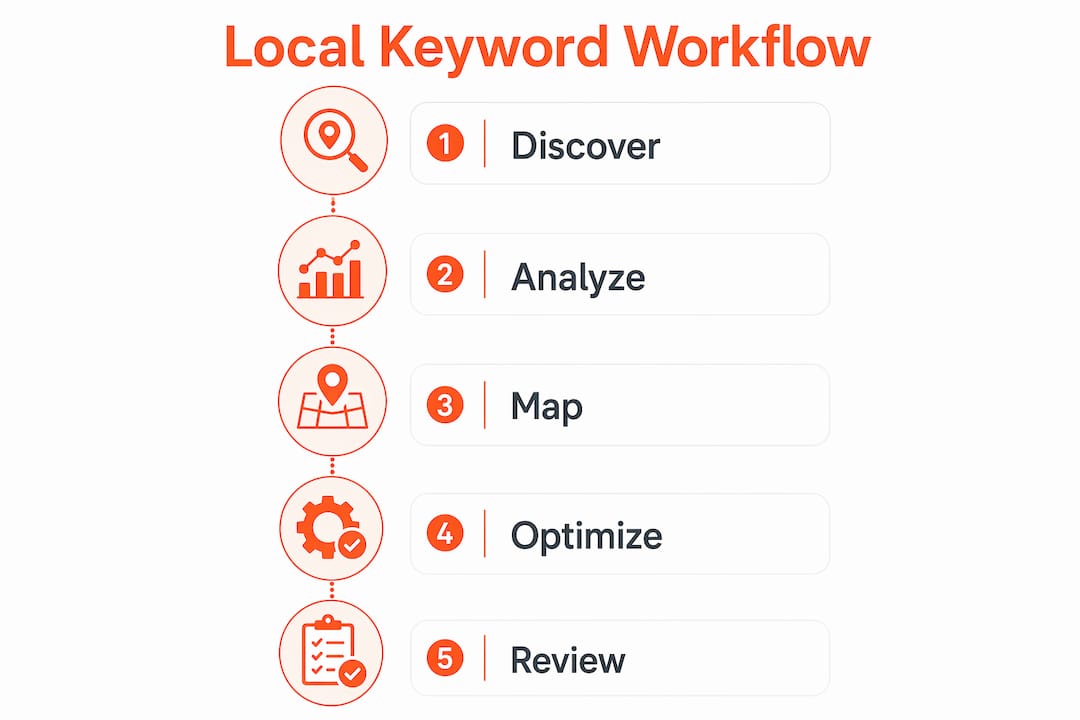
A keyword list sitting in a spreadsheet produces nothing. Keyword research must be operationalized to produce calls, not just lists. Here is the workflow SearchX uses with local business clients.
- Start with seed keywords. Write down 10 to 15 phrases that describe your core services combined with your city or neighborhood. A dental practice in Austin starts with “dentist Austin,” “teeth cleaning Austin,” and “emergency dental Austin.”
- Expand with intent modifiers. Add urgency terms (“same day,” “emergency”), quality signals (“best,” “top-rated”), price signals (“affordable,” “cheap”), and convenience terms (“near me,” “open Sunday”). Each modifier shifts the searcher’s intent and often reduces competition.
- Filter by local intent and rankability. Set a maximum keyword difficulty threshold you can realistically compete at. The LowFruits strategy of setting SERP Difficulty to 1 and scanning for weak-ranking competitors is one of the fastest ways to find quick wins for a new or low-authority site.
- Cluster by intent type. Sort keywords into three buckets: Do (the searcher wants to act now, like “emergency plumber Park Slope”), Go (they want a physical location, like “dog groomer near downtown Tampa”), and Know (they are researching, like “best neighborhoods for dog grooming in Tampa”). Each bucket maps to a different page type and content format.
- Map keywords to pages. Assign each cluster to a specific URL. Homepage gets your primary city service term. Individual service pages get specific service plus location terms. Location pages target neighborhood or suburb variants. Blog posts and FAQ pages handle Know-intent queries.
- Schedule a monthly review. Pull GBP Insights and Google Search Console data every 30 days. Look for new queries you are not yet targeting and drop keywords that have not moved in 90 days.
| Keyword type | Example | Best page type |
|---|---|---|
| Service + city | “HVAC repair Dallas” | Homepage or main service page |
| Service + neighborhood | “HVAC repair Oak Cliff” | Location or neighborhood page |
| Urgency modifier | “emergency HVAC repair Dallas” | Service page with clear CTA |
| Know intent | “how long does HVAC repair take” | Blog post or FAQ |
Pro Tip: Map no more than one primary keyword per page. Competing with yourself across two pages for the same term splits your authority and confuses Google about which page to rank.
How does Google Business Profile support your keyword strategy?
Google Business Profile is not just a directory listing. It is a keyword placement platform that feeds AI-driven local recommendations directly. AI pulls from engagement signals in reviews, responses, and GBP activity to rank local businesses in AI-generated results, not just traditional organic listings.
Place keywords deliberately across every GBP field:
- Business description: Use your primary city service term in the first sentence. Write naturally, but do not leave this field generic.
- Service menu: Name each service exactly as customers search for it. “Residential Roof Repair” beats “Roofing Services” if that is how your market searches.
- Q&A section: Seed your own questions using real customer queries, then answer them with keyword-rich responses.
- Posts: Publish weekly posts tied to seasonal or promotional keywords. A landscaper in Phoenix should post about “spring lawn aeration Phoenix” in February, not April.
- Review responses: Reply to every review using one or two natural keyword phrases. “Thank you for choosing our Austin plumbing team for your water heater installation” reinforces both the service and the location.
Consistent weekly GBP activity of keyword-rich posts and review responses builds the ongoing AI trust signals that local visibility now depends on. Scheduling tools like Semrush’s GBP management feature or a simple content calendar can maintain that cadence without requiring daily attention.
“Keyword research for local businesses in 2026 must generate ongoing trust signals through off-site engagement, not just on-page optimization.” — Search Engine Journal
For a deeper breakdown of GBP field optimization, the SearchX guide on optimizing your Google Business Profile covers every section in detail.
Pro Tip: Mine your one-star and two-star reviews for keyword gold. Unhappy customers often describe your service in precise, search-ready language that your happy customers never use.
What mistakes kill local keyword research results?
The most common failure in small business keyword planning is building a long list and never filtering it. Overbroad keyword lists targeting unrankable terms waste resources when not paired with intent and difficulty filtering. A solo electrician in Cleveland cannot rank for “electrician” any more than a local coffee shop can rank for “coffee.” The fix is specificity, not volume.
Three other mistakes consistently undermine results:
- Ignoring intent type. Sending a Do-intent searcher to a blog post instead of a service page with a phone number costs you the conversion even if you rank. Match the page format to the intent bucket every time.
- Keyword stuffing on GBP. Forcing keywords unnaturally into your business name field or cramming them into review responses reads as spam to both Google and real customers. Natural placement in context always outperforms forced density.
- Skipping performance review. Keyword research must be treated as an operating system with repeated measurement, not a one-time task. Rankings shift, competitors enter your market, and seasonal demand changes your priority keywords every quarter.
If you have done everything right and rankings still stall, check three things: your page’s geographic relevance signals (NAP consistency across citations), the strength of your GBP relative to competitors, and whether your page actually matches the search intent behind the keyword. A service page optimized for “affordable kitchen remodel Denver” needs pricing signals, photos, and a clear call to action. Without them, Google will not trust it to satisfy that query.
Use the local SEO checklist from SearchX to audit each of these factors systematically before assuming a keyword is simply too competitive.
Pro Tip: Run a quick SERP check before targeting any keyword. If the top three results are all national directories like Yelp or Angi, that is actually good news. It means no local competitor has claimed the organic spots yet.
Key takeaways
Effective local keyword research for small businesses requires a repeatable system that connects discovery, intent mapping, page assignment, and monthly performance review to produce real customer actions.
| Point | Details |
|---|---|
| Use three core tools | Semrush, Google Keyword Planner, and GBP Insights together cover discovery, intent, and real customer language. |
| Filter before you build pages | Set a keyword difficulty threshold and filter by local intent before assigning any keyword to a page. |
| Map keywords to intent types | Do, Go, and Know intent each require a different page format to convert the searcher. |
| Treat GBP as a keyword platform | Place keywords in descriptions, service menus, Q&A, posts, and review responses to build AI trust signals. |
| Review monthly, not annually | Pull Search Console and GBP Insights data every 30 days to catch new opportunities and drop dead weight. |
Why most small businesses get local keyword research backwards
After working through local SEO strategies with businesses ranging from single-location bakeries to multi-site service contractors, one pattern stands out clearly. Most owners start with tools and end with a list. The ones who actually rank start with customer conversations and end with a system.
The shift that matters most right now is treating Google Business Profile as an active keyword publishing platform, not a static listing. Every review response is a keyword placement opportunity. Every post is a signal to AI systems about what your business does and where. The businesses I have seen move fastest in local search are not the ones with the biggest keyword lists. They are the ones posting consistently, responding to every review within 24 hours, and updating their service menus quarterly.
The other thing worth saying plainly: do not chase volume. A 50-search-per-month keyword in your specific neighborhood, owned by you on a well-optimized page, is worth more than a 5,000-search term you will never rank for. Small business keyword planning is about finding the terms where you can actually win, then building authority in that lane before expanding. That is how you get calls, not just impressions.
Reviews also carry more weight than most owners realize. The role of reviews in local SEO rankings goes well beyond star ratings. The language inside reviews, and inside your responses, feeds directly into how AI systems categorize and recommend your business.
— SEO
How SearchX can accelerate your local keyword strategy
SearchX builds local keyword strategies that connect directly to revenue, not just rankings. The agency’s approach starts with a full audit of your current keyword footprint, then maps every target term to the right page, GBP field, and content asset. For small business owners who want a proven framework without spending months learning SEO tools, SearchX’s keyword research techniques and strategies resource covers the full methodology the agency applies to client campaigns. From Google Business Profile optimization to performance tracking and review management, every component works together to build the kind of local visibility that generates qualified leads and measurable sales growth.
FAQ
What is local keyword research for small businesses?
Local keyword research is the process of finding location-specific search terms your potential customers use to find services in your area. The goal is to rank for those terms on Google and convert that visibility into calls, visits, and purchases.
How do I find the best keywords for local marketing?
Start with Google Keyword Planner using geographic filters to estimate local volume, then cross-reference with Semrush’s Keyword Magic Tool for difficulty scores. Add GBP Insights data to surface real customer search language your tools may not show.
How often should I update my local keyword list?
Review your keyword performance monthly using Google Search Console and GBP Insights. Refresh your priority list quarterly to account for seasonal demand shifts and new competitor activity in your market.
What is the difference between Do, Go, and Know local keywords?
Do keywords signal immediate purchase intent, like “emergency plumber Park Slope.” Go keywords indicate someone wants a physical location. Know keywords reflect research behavior and are best served by blog posts or FAQ pages rather than service pages.
Does Google Business Profile really affect keyword rankings?
Yes. AI-driven local recommendations pull from keyword-rich signals in GBP activity, review responses, and posts. Consistent keyword placement across your GBP fields directly influences how Google categorizes and surfaces your business in local results.