

Evergreen content in finance SEO is content that remains relevant and useful over the long term. Think of topics like "How does compound interest work?" or "Steps to create a monthly budget." These topics consistently attract searches because they address timeless questions.
For finance, this type of content is especially important due to Google’s YMYL (Your Money or Your Life) guidelines, which demand high levels of trust and accuracy. Strong evergreen content not only improves search rankings but also reduces customer acquisition costs by driving consistent traffic over time.
Here’s a quick breakdown of how to create and maintain effective evergreen finance content:
- Choose Evergreen Topics: Focus on questions that stay relevant (e.g., "How to build a credit score") and avoid time-sensitive trends (e.g., "Current mortgage rates for May 2026").
- Validate Search Demand: Use tools like Google Trends and SEO keyword research services to confirm stable search interest over 24+ months.
- Ensure Compliance: All content should meet legal and regulatory standards, with disclaimers and verified data.
- Structure Content Clearly: Use headings, short paragraphs, and examples to make content easy to read. Separate timeless principles from variable details.
- Optimize for SEO: Add metadata, schema markup, and mobile-friendly design to improve visibility and usability.
- Regular Updates: Review content periodically (e.g., every 6–24 months) to update data, regulations, and search trends.
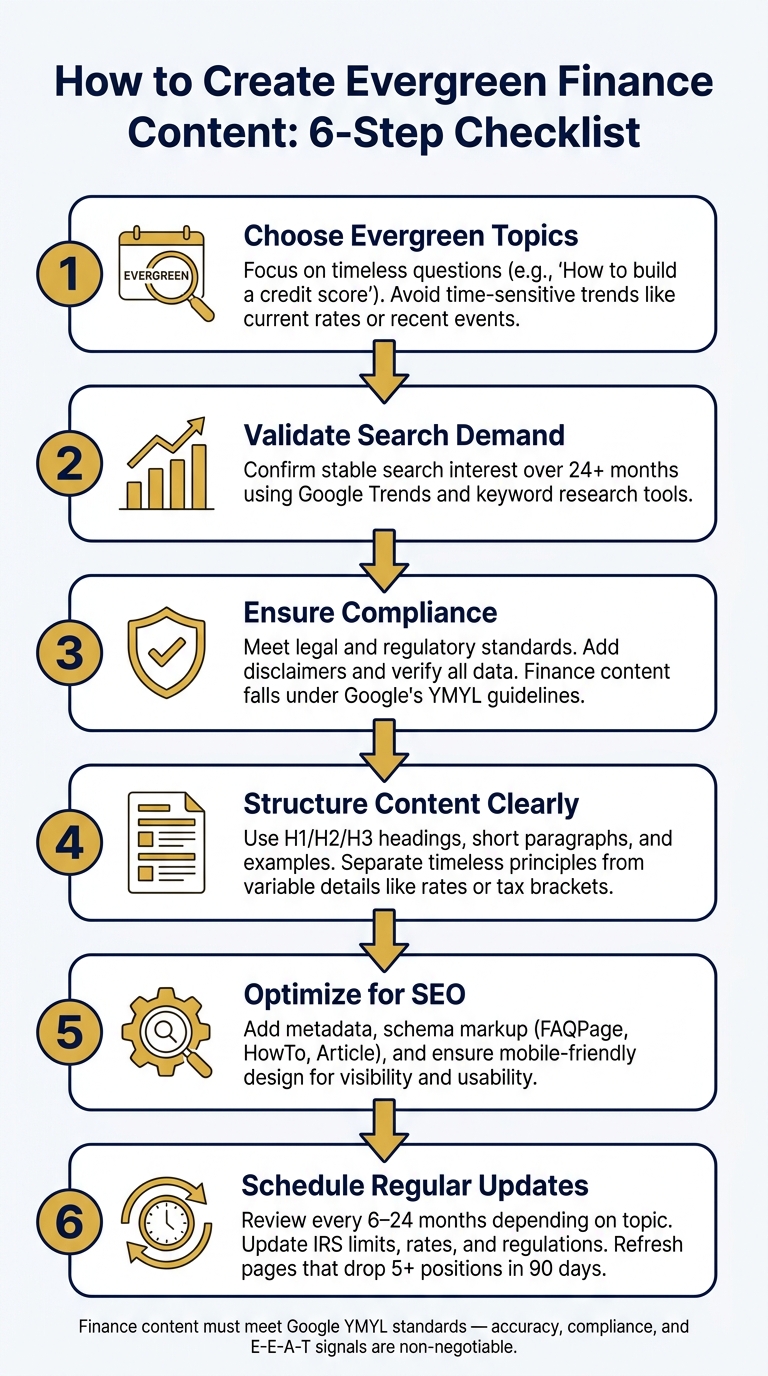
Evergreen Finance Content Checklist: 6-Step Creation Process
Research and Topic Validation Checklist
Checking If a Topic Is Truly Evergreen
To determine if a topic is evergreen, ask yourself: Will people still search for this two years from now? For example, questions like "How does a 401(k) work?" have consistently been relevant and will continue to be. On the other hand, topics tied to specific events – like "Current mortgage rates for May 2026" or "Impact of the latest Fed rate hike" – experience temporary spikes before fading away.
You can confirm a topic’s longevity using Google Trends. Look at five years of data: a flat or steadily rising trend indicates evergreen potential, while a "heartbeat" pattern – sharp peaks followed by drops – signals a fleeting trend. Another great resource is your own site analytics. Pages that consistently attract traffic over several months are strong candidates for evergreen content expansion.
Here’s a tip many overlook: customer support logs and FAQs. If your team repeatedly fields the same questions, regardless of current events, those questions likely have evergreen search demand.
| Evergreen Finance Topic | Non-Evergreen (Time-Sensitive) Topic |
|---|---|
| How to build a credit score | Best credit card offers for Summer 2026 |
| How to open a savings account | This week’s stock market performance |
| How to choose a life insurance policy | 2026 changes to insurance regulations |
| Retirement planning for your 40s | Impact of the latest Fed rate hike |
| What is a mortgage? | Current mortgage rates for May 15, 2026 |
Once you identify evergreen topics, the next step is validating their search demand.
Search Demand and Keyword Competition
After confirming a topic’s evergreen nature, dive into its search demand. Review at least 24 months of search volume data to ensure the topic has stable monthly interest. Avoid keywords that spiked once and then disappeared. Another important factor is the SERP (Search Engine Results Page) stability. If the top five results for a keyword have remained consistent for two to three years, it’s a good sign the topic has lasting demand.
"A consistently top-ranked page over three years is more valuable than a high-volume keyword that frequently changes positions." – The Seo Engine
Focus on long-tail, intent-driven keywords. These are specific phrases like "how to improve credit score for mortgage" or "what is a Roth IRA vs traditional IRA." Long-tail keywords often have lower competition, higher intent, and better conversion potential, making it easier for smaller sites to rank.
Tools like SearchX’s keyword research services can help pinpoint long-tail finance terms with steady demand and realistic ranking opportunities, so you’re not competing for high-volume keywords already dominated by major players.
Compliance and Risk Checks for Finance Content
Finance content falls under Google’s YMYL (Your Money or Your Life) category, which requires a higher level of accuracy and trust. To avoid issues, topics should go through a compliance check early on. Involving legal or compliance teams during the briefing stage can save time and prevent expensive rewrites later.
Always include a disclaimer stating that the content is not financial, tax, or legal advice, and encourage readers to consult qualified professionals. Additionally, ensure all statistics and data come from credible sources. As Max Mykal, Co-Founder of Lengreo, emphasizes:
"In the financial services sector, every sentence can be audited. Every offer needs a disclaimer. Compliance teams are often gatekeepers, and for good reason."
Author credentials are also crucial. Content written or reviewed by an SEC-registered advisor or a FINRA member firm strengthens E-E-A-T signals (Expertise, Experience, Authoritativeness, Trustworthiness) for Google. Displaying professional qualifications, licenses, and a "last updated" timestamp on the page builds trust with both readers and search engines.
These steps lay the groundwork for creating finance content that’s both authoritative and evergreen.
How to Structure and Draft Evergreen Finance Content
Content Structure and Information Flow
When writing evergreen finance content, it’s important to organize your ideas in a way that naturally guides readers through the material. Start with a solid foundation by defining key concepts, then dive into the details. Use a clear heading hierarchy (H1, H2, H3) to make the content scannable and easy to navigate for readers who might be searching for specific information.
A useful tip: separate timeless principles from details that may change over time. For instance, the basics of how compound interest works will always hold true, but figures like the national average savings rate or annual contribution limits can vary. To make updates easier, keep core explanations stable and place variable data – like interest rates or tax brackets – in sections clearly marked for quick revisions.
Avoid using phrases like "as of today" or other time-specific references. This helps keep the content relevant for longer periods.
Clarity and Accuracy in Financial Writing
Finance readers expect precision and depth. As Vincent Nguyen, Founder of Perceptric, explains:
"Shallow content doesn’t work in this space. To engage them, you need writing that’s clear, useful, and grounded in the technical realities of your product."
Define any technical terms the first time they appear. For example, if you’re discussing loan amortization, walk readers through a concrete example. Take a $300,000 30-year fixed mortgage at 6.5% interest, and show how early payments are mostly applied to interest rather than principal. Using real numbers makes abstract topics easier to grasp.
Accuracy is crucial – double-check all figures and calculations. Errors in financial content can quickly undermine trust, especially under Google’s YMYL (Your Money or Your Life) guidelines.
Adding interactive tools like mortgage calculators or ROI estimators can also elevate your content. These tools not only provide extra value but also encourage readers to return and link back to your site, boosting long-term search performance. For more analytics-driven growth tips, visit our blog.
Writing for U.S. Readers
Once your content is well-structured and factually accurate, focus on tailoring it specifically for a U.S. audience. Localization goes beyond spelling "check" instead of "cheque." It means using terms, accounts, and programs that U.S. readers encounter daily. Examples include 401(k) employer matching, traditional versus Roth IRAs, FICO scores, or the mortgage pre-approval process.
Pay attention to currency formatting – $50,000 is the standard, not "50,000 USD" or "USD50,000." Small details like this signal that the content is written with U.S. readers in mind, which builds trust with your audience and search engines alike. Incorporating culturally relevant examples and U.S.-specific financial habits ensures your content resonates and feels native, an important factor in earning credibility in such a high-stakes field.
On-Page Structure and Technical Readiness
Page Layout and Navigation
Once your content is written and localized, it’s time to make sure it’s easy for readers to navigate. For finance-related guides, a table of contents (TOC) at the top of the page is a smart addition. This allows users to jump straight to the sections they care about – whether it’s breaking down FICO scores or learning about Roth IRA conversions – without wading through long blocks of text.
To improve readability, keep paragraphs short and use clear H2 and H3 headings to define each section. Highlight key points with bold text, and use bullet points to help mobile users skim the content quickly. When setting up URLs, avoid including dates. For example, a URL like /retirement-planning-guide/ stays relevant over time, while /retirement-planning-2025/ might become outdated and lose valuable backlinks if updated later. These small design choices not only enhance user experience but also support better technical performance.
Metadata and Schema Markup
Good metadata and structured data are essential for boosting content visibility in search results. Title tags and meta descriptions should be accurate, keyword-focused, and highlight benefits to the reader. Keep title tags under 60 characters and meta descriptions under 160 characters to avoid truncation. Avoid referencing outdated information – such as "2024 data" in 2026 – as this can undermine credibility.
Structured data, or schema markup, is especially useful for finance content. For example, adding FAQPage schema to Q&A sections or HowTo schema to step-by-step guides (like “How to open a traditional IRA”) can help your content appear as rich snippets in search results. This not only improves visibility but also attracts more clicks. Here’s a quick breakdown of common schema types and their uses:
| Schema Type | Best Use Case | Key Benefit |
|---|---|---|
| FAQPage | Answering common questions (e.g., loans, taxes) | Occupies more SERP space and targets long-tail queries |
| HowTo | Step-by-step guides (e.g., opening an IRA) | Boosts visibility for instructional searches |
| Article | Detailed finance explainers and guides | Strengthens E-E-A-T signals for YMYL content |
| Organization | Business details and memberships (e.g., FINRA) | Builds brand authority and trustworthiness |
Before publishing, always validate your schema using tools like Google’s Rich Results Test. Broken structured data can harm your content’s performance more than having none at all.
Mobile and Page Performance
With most users accessing content on mobile devices, ensuring mobile compatibility is non-negotiable. Buttons should be easy to tap, and fonts should be readable without requiring zoom. Interactive tools – like mortgage calculators or ROI estimators – must load quickly and perform well on smaller screens.
Page speed is another critical factor. Finance readers are unlikely to wait more than three seconds for a page to load, and delays can lead to audience drop-offs. Regularly test your site’s performance using tools like Google PageSpeed Insights or GTmetrix to identify and fix slow-loading elements. Additionally, since financial content often involves sensitive information, having an SSL certificate is a must. It not only protects user data but also signals trust to both readers and search engines. Together, fast page loading, mobile optimization, and secure browsing create a smooth and reliable user experience.
Keeping Evergreen Finance Content Accurate Over Time
Update Schedules and Content Ownership
Creating evergreen finance content is just the beginning – keeping it accurate and relevant over time is where the real work lies. Regulatory changes, outdated data, and evolving search trends can quickly make even the best content obsolete. To avoid this, assign a specific team or individual to own the responsibility of updating content. Without clear ownership, updates can fall through the cracks, leaving outdated information that damages your credibility.
The frequency of updates should depend on how quickly the topic changes. For example, financial regulations and tax laws often shift rapidly, so these pages should be reviewed every six months. On the other hand, topics like "how compound interest works" are more stable and can be revisited every 18–24 months. Using a content tracker or internal calendar helps streamline this process, ensuring nothing slips through the cracks.
Another key indicator to monitor is search performance. If a page drops more than five positions in search rankings over a 90-day period, treat it as an urgent signal for a refresh – no matter where it stands in your scheduled review cycle.
Regulatory and Data Updates
Finance content can become outdated quickly, especially when it comes to numbers. Annual changes to IRS contribution limits, federal interest rates, and tax brackets mean that stale figures can erode trust with readers. Every review cycle should include cross-checking numbers against reliable sources like IRS.gov or Federal Reserve data.
In addition to updating figures, check for broken external links and replace statistics older than two years. Swapping outdated data for fresh insights not only improves accuracy but also boosts your content’s E-E-A-T (Experience, Expertise, Authoritativeness, and Trustworthiness) signals. This is particularly important for YMYL (Your Money or Your Life) topics, which Google evaluates rigorously.
One important tip: only update a page’s "last modified" date if you’ve made meaningful changes. Small tweaks, like fixing typos, don’t justify signaling freshness.
Tracking Content Quality and Search Performance
Once you’ve established clear content ownership and a process for data updates, the next step is monitoring performance. Tools like Google Search Console can reveal which pages are losing impressions or click-through rates, while Google Analytics 4 (GA4) provides insights into engaged sessions, scroll depth, and conversions. Together, these tools offer a comprehensive view of your content’s performance.
Pay close attention to pages ranking between positions 4–20 that show a decline in traffic over three months. These pages often have strong backlinks and require only targeted updates to regain momentum. In fact, well-executed refreshes can lead to a 20–40% traffic increase within 30–60 days.
| Tool | Primary Use |
|---|---|
| Google Search Console | Monitor impressions, click-through rates, and query visibility |
| Google Analytics 4 | Track engaged sessions, conversions, and traffic sources |
| Semrush / Ahrefs | Analyze keyword rankings and identify content gaps |
| Screaming Frog | Identify broken links and technical SEO issues |
Ignoring even a small monthly traffic drop – just 5% – can snowball into a 62% annual decline. Prevent this by setting up weekly rank tracking alerts or conducting quarterly performance reviews. By catching issues early, you ensure your evergreen finance content remains a valuable asset long after its initial publication. These steps create a strong foundation for maintaining both accuracy and performance over time.
♻️ Self-Updating Content: The Future of Evergreen SEO
Conclusion: Building a Long-Term Evergreen Content Plan
Creating evergreen finance content demands ongoing effort. The process – from topic validation and initial drafting to regular updates – serves as the backbone of a lasting content strategy. Each step in this cycle plays a role: strong topic validation leads to well-structured drafts, which then become easier to refresh and maintain over time.
Since Google categorizes finance as a YMYL (Your Money or Your Life) topic, the content must meet exceptionally high standards. Every piece needs to be accurate, compliant, and backed by reliable, authoritative sources right from the beginning.
One effective way to maximize the value of evergreen content is through repurposing. For instance, a detailed guide on retirement contribution limits can be transformed into various formats like a downloadable checklist, a short video walkthrough, or even an interactive calculator. Repurposing not only extends the content’s lifespan but also broadens its impact across multiple platforms – all without starting from scratch.
"Evergreen content is like that unicorn blog post that you wrote back in 2015 that people still go back to… supplying seemingly endless organic traffic, conversions, and backlinks." – Katlyn Edwards, Writer, Search Engine Land
A single high-quality evergreen piece can continue generating leads for years, significantly reducing customer acquisition costs (CAC) by lessening the need for expensive, short-term paid campaigns. For finance brands striving for consistent organic growth, this compounding benefit is invaluable. If building and maintaining such a strategy feels overwhelming, SearchX specializes in finance-focused SEO services, from keyword research to content creation.
FAQs
How can I tell if a finance topic is truly evergreen?
A finance topic stands the test of time when it remains relevant year after year, needs little updating, and consistently draws organic traffic. Think of core subjects like financial planning or risk management – these are timeless compared to fleeting trends or news. By centering on enduring principles, you can deliver lasting value to your audience.
What does Google YMYL mean for finance SEO content?
Google YMYL (Your Money or Your Life) applies to content that can influence someone’s financial well-being, health, or safety. In the world of finance SEO, this means your content needs to showcase trustworthiness, precision, and expertise. These qualities are essential not just to meet Google’s quality benchmarks but also to ensure the information provided doesn’t lead to harm.
How often should I update evergreen finance pages?
Evergreen finance pages thrive on staying current and reliable. To achieve this, make it a habit to update them regularly. This could mean adding fresh insights, reflecting shifts in the market, or polishing older, outdated details. Keeping these pages up-to-date not only ensures they remain helpful to readers but also boosts their performance in search rankings.