

Competitor engagement metrics reveal how users interact with rival websites and provide insights to refine your SEO strategy. These metrics include bounce rate, dwell time, pages per visit, and conversion rates. They help identify why competitors rank well and guide adjustments to your content, user experience, and technical SEO basics.
Here’s the key takeaway: SEO success today is less about keywords and more about user behavior and engagement signals. Tools like SearchX, Semrush, and Sentinel help analyze these metrics. While agencies like SearchX offer full-service solutions starting at $3,000/month, SaaS tools provide affordable, self-service options for teams with in-house expertise.
Key Points:
- Google’s focus: User engagement and intent-driven content now outweigh simple keyword matching.
- Competitor insights: Tools help track bounce rates, click-through rates (CTR), and SERP behavior to identify gaps.
- Options: Choose between full-service agencies (e.g., SearchX) or DIY tools (e.g., Semrush, Sentinel) based on budget and expertise.
- Emerging trend: Monitoring AI-driven content visibility is becoming as important as traditional SEO metrics.
Quick Tip: Regularly review engagement data (every 3-6 months) to stay ahead of competitors.
SEO Competitor Analysis Explained (With Real Examples) + FREE Tool Access
1. SearchX
SearchX takes a different approach to SEO by focusing heavily on competitor engagement metrics. Instead of just analyzing keyword gaps or backlink profiles, they dig into behavioral signals like dwell time, pogo-sticking (users returning to the search results after visiting a page), and click-through rates. By doing so, they uncover weaknesses in competitor strategies and gain a clearer understanding of user behavior on search engine results pages (SERPs).
One of their standout tools is the On-SERP Behavior Analysis, which monitors how users interact with competitor listings both before and after clicking. This includes examining title tags, meta descriptions, and SERP rankings to identify which pages users trust and which ones they abandon quickly. For example, pages with high pogo-sticking rates often indicate a mismatch between content and user intent, making them ripe for optimization opportunities.
In addition, SearchX uses an Engagement Analytics Suite to measure critical metrics like dwell time and return-to-SERP patterns. These insights are especially valuable as Google’s algorithm increasingly prioritizes user engagement over traditional on-page factors. Armed with this data, SearchX refines content and makes targeted technical SEO improvements, ensuring every change is backed by hard numbers.
SearchX provides three flexible plans – Starter, Growth, and Enterprise – designed to cater to different levels of competitive research needs. Whether you’re just starting out or need advanced tools for deep-dive analysis, there’s an option for you:
| Plan | Monthly Cost | Competitor Analysis Included |
|---|---|---|
| Starter | $3,000 | Light keyword tracking |
| Growth | $6,000 | Competitor keyword & backlink analysis |
| Enterprise | $12,000+ | Full competitive intelligence with custom dashboards |
2. Competitor SEO Tools and Agencies
Most SEO tools rely on clickstream data and third-party analytics to estimate hidden metrics like bounce rates, session durations, and pages per visit. Popular platforms such as Semrush and Ahrefs are widely used for gathering broad competitive intelligence. These tools help uncover traffic sources, analyze competitor on-page SEO, and identify keyword gaps. For instance, Semrush’s Traffic Analytics module provides insights into metrics like visit duration, bounce rate, and traffic journey. This feature can even highlight where users go after leaving a competitor’s site, potentially revealing partnership or advertising opportunities. While these platforms offer a broad overview, other tools focus on more specific behavioral patterns.
Take Sentinel, for example. This tool zeroes in on soft ranking signals like dwell time and pogo-sticking, using specialized bots to track SERP-level user behaviors. Sentinel emphasizes the importance of strategy over imitation:
"The goal is not to copy competitors – it is to understand their strategy and execute yours better."
This focus on on-SERP behavior is becoming increasingly important as Google’s algorithm prioritizes user engagement signals over traditional on-page factors.
For those looking to test these tools, Semrush and Sentinel both offer 7-day free trials. Other platforms provide limited free features: Similarweb‘s browser extension delivers basic traffic estimates, SpyFu reveals a domain’s top six organic pages, and Ubersuggest allows one free search per day.
Here’s a quick breakdown of key metrics, their strategic significance, and the tools that provide them:
| Metric | What It Tells You | Tool Example |
|---|---|---|
| Bounce Rate | Highlights content/intent mismatch | Semrush Traffic Analytics |
| Dwell Time | Suggests content depth that aligns with Google’s preferences | Sentinel Dwell Time Bot |
| Pages / Visit | Shows how effective a site’s navigation and internal linking are | Semrush Traffic & Market Toolkit |
| Traffic Journey | Identifies user pathways, revealing ad and partnership opportunities | Semrush Traffic Analytics |
| CTR | Low CTR flags weak meta titles or descriptions | Sentinel SERP Analysis |
A new trend is also reshaping how competitive insights are gathered. Beyond traditional metrics, brands are now tracking their visibility within AI-generated content. Tools like ChatGPT, Gemini, and Perplexity are being monitored to measure how often a brand is cited in AI-driven answers. This "share of voice" in AI environments is quickly becoming a key indicator of authority and is beginning to appear alongside standard engagement metrics in competitive reports.
Pros and Cons
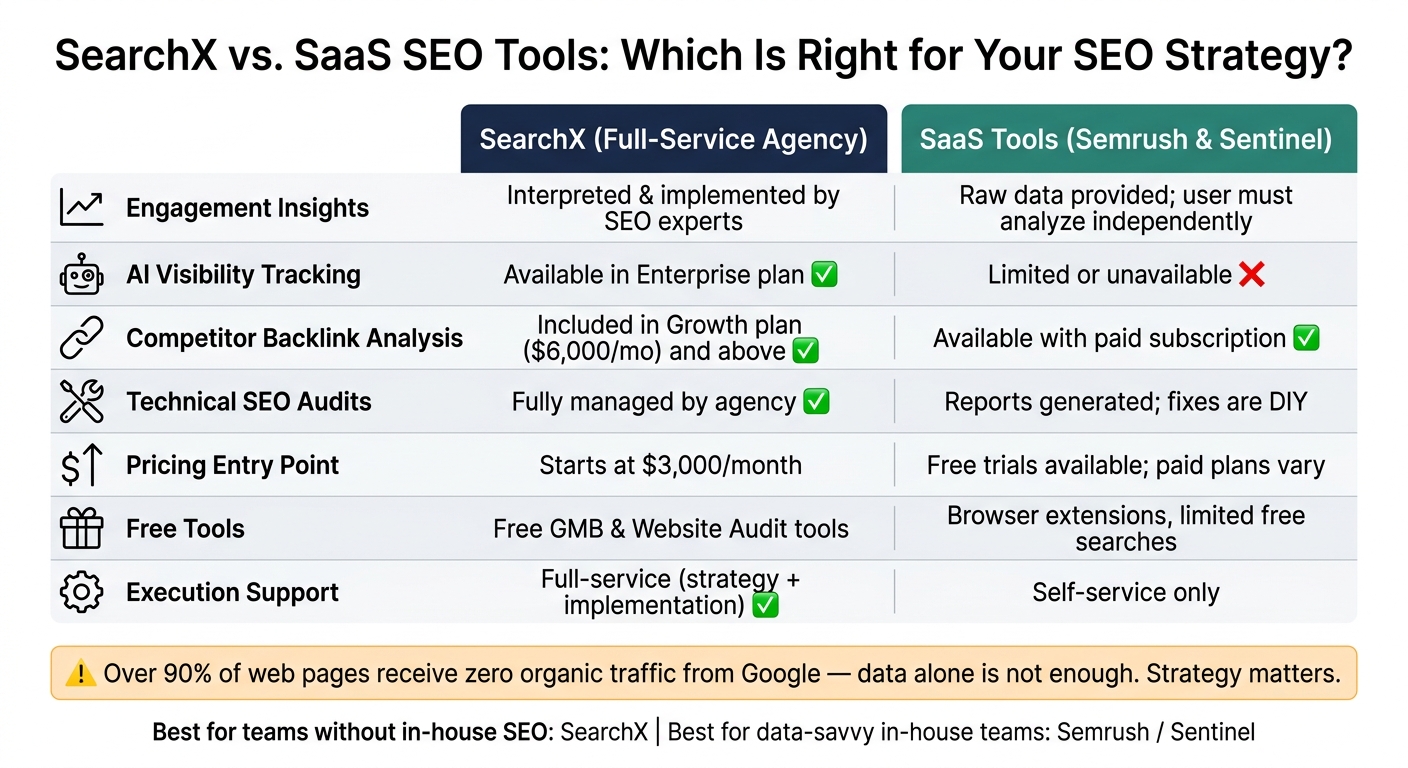
SearchX vs. SaaS SEO Tools: Competitor Engagement Metrics Comparison
Deciding between a full-service SEO agency like SearchX and standalone SaaS tools comes down to your team’s specific needs – whether you require a fully managed strategy or prefer hands-on access to raw data.
SearchX offers more than just data collection. It turns competitor engagement metrics into actionable SEO strategies. Features in its Growth and Enterprise plans include competitor keyword and backlink analysis, AI visibility tracking, and custom dashboards. These tools are designed to not only deliver insights but also help with implementation. The Enterprise tier (starting at $12,000/month) even tracks how your brand appears in AI-driven search results, helping you measure your competitive presence in an increasingly AI-focused digital world. This approach is particularly valuable for businesses without an in-house SEO team, as it bridges the gap between raw data and effective execution.
On the other hand, SaaS tools like Semrush and Sentinel provide direct access to raw metrics – such as bounce rates, dwell time, and traffic patterns – at a more affordable price. Most of these tools offer free trials (usually 7 days), making them accessible to teams that can analyze and act on data independently.
Here’s a quick comparison of the two approaches for competitor content analysis:
| Factor | SearchX | SaaS Tools (Semrush, Sentinel) |
|---|---|---|
| Engagement Insights | Interpreted and implemented by SEO experts | Raw data provided; user must analyze and act |
| AI Visibility Tracking | Available in Enterprise plan | Limited or unavailable |
| Competitor Backlink Analysis | Included in Growth ($6,000/month) and higher plans | Available with subscription |
| Technical SEO Audits | Fully managed by the agency | Reports generated; fixes are DIY |
| Pricing Entry Point | Starts at $3,000/month (Starter plan) | Free trials available; paid plans vary |
| Free Tools | Free GMB and Website Audit tools | Browser extensions, limited free searches |
| Execution Support | Full-service (strategy + implementation) | Self-service only |
The biggest drawback of using an agency like SearchX is the cost – starting at $3,000 per month, it may be out of reach for smaller businesses. Meanwhile, SaaS tools are far more budget-friendly, but they require expertise to interpret and implement the data effectively. It’s worth noting that over 90% of web pages receive zero organic traffic from Google, which underscores the fact that having access to data alone isn’t enough. A well-thought-out strategy is crucial for turning insights into tangible results.
The next section will explore how these insights can shape actionable SEO strategies.
Conclusion
Competitor engagement metrics play a crucial role in refining your SEO strategy. Metrics like bounce rate, average visit duration, and keyword overlap don’t just tell you that competitors rank – they help explain why they rank. Considering that organic search accounts for over 50% of website traffic across industries, understanding these behaviors is key to creating a sustainable and effective SEO plan.
Your approach will largely depend on your resources and expertise. If your team is comfortable handling analysis, paid tools can help identify competitor keyword gaps and backlink opportunities. For those just starting out, free tools such as the Similarweb Browser Extension or Ubersuggest’s daily search limits can offer a solid foundation.
Not interested in doing it all yourself? A full-service agency like SearchX can handle the heavy lifting, from competitor analysis to technical audits and content strategies. This can be particularly effective in adapting to the evolving SERP landscape, where even high-ranking pages may lose visibility to AI-driven summaries.
The key is turning data into actionable strategy. As Ibby Syed, Founder of Cotera, wisely puts it:
"Consistency within one tool beats accuracy across three."
Stick with a single approach and review your competitive metrics regularly – every three to six months or sooner if you notice a drop in rankings. Staying focused on engagement data will help you fine-tune your strategy and keep you ahead of the competition.
FAQs
Which competitor engagement metrics matter most for SEO?
When analyzing competitors in SEO, a few key metrics can provide valuable insights:
- Organic traffic trends: These trends give you a clear picture of how well a competitor is performing in search rankings. Are they gaining momentum or losing visibility? This can help you understand their overall SEO effectiveness.
- Keyword overlap on high-value terms: By identifying shared keywords, especially those tied to revenue, you can spot areas where you can outperform them or find gaps to exploit. It’s about understanding where you stand in comparison.
- Content publishing activity: Tracking how often competitors publish content and what topics they focus on reveals their strategy for increasing visibility. Are they ramping up their efforts, or are there opportunities to outpace them?
By focusing on these metrics, you can fine-tune your own SEO strategy and position yourself to achieve better results.
How can I estimate competitors’ bounce rate and dwell time without their analytics?
Estimating your competitors’ bounce rate and dwell time without direct access to their analytics can be tricky, but it’s not impossible. You can rely on indirect methods to gather some insights.
For example, traffic analysis tools can help you understand engagement patterns, including traffic sources and user behavior trends. Additionally, examining the length and structure of their content can give you clues about dwell time. Pages that are longer and well-organized often keep visitors engaged for a longer period.
While these methods won’t give you exact numbers, they can provide a general sense of how users interact with your competitors’ sites.
How do I turn competitor engagement data into SEO changes that improve rankings?
Take a close look at how your competitors are performing by analyzing key engagement metrics like audience retention, social shares, and comments. These numbers can reveal what truly connects with their audience. Are their videos keeping viewers hooked until the end? Are their guides sparking conversations and shares? This data is gold for understanding what works.
Now, compare their results to your own. Are there areas where you’re falling short? Maybe their how-to guides are getting shared like crazy, while yours aren’t gaining traction. Or perhaps their videos are pulling in comments, while yours are going unnoticed. Identifying these gaps gives you a clear direction to refine your strategy.
Focus on content formats that consistently drive high engagement – like videos or in-depth guides. Use this knowledge to fine-tune your own content, ensuring it not only matches but surpasses what your competitors are doing. You can also use these insights to align with trending topics, improving your visibility and boosting your search rankings.
By making these adjustments, you’ll create a better experience for your audience and stay ahead in the game.