

Growing a med spa to multiple locations? Here’s the challenge: Each location needs its own multi-location SEO strategy to rank in local searches. Google treats every branch as a separate entity, so skipping key steps like tailored landing pages, consistent business information, and optimized Google Business Profiles (GBPs) can hurt your visibility and revenue.
Key takeaways:
- Local SEO is critical: 88% of mobile users visit or contact a business within 24 hours of a local search.
- Avoid common mistakes: Duplicate content, inconsistent business details (NAP), and keyword cannibalization can tank rankings.
- 2026 SEO trends to watch: AI-driven search summaries, voice search growth, and Google’s focus on entity-based ranking demand precise, well-structured content.
What works:
- Create unique, location-specific landing pages with service + city keywords (e.g., "Botox Dallas").
- Maintain consistent NAP data across directories and profiles.
- Optimize each GBP with accurate categories, local phone numbers, and regular updates (e.g., photos, reviews, and posts).
SEO For Med Spas | SEO Strategy for Single & Multi-Location Med-Spas
How to Optimize Google Business Profiles for Multiple Locations
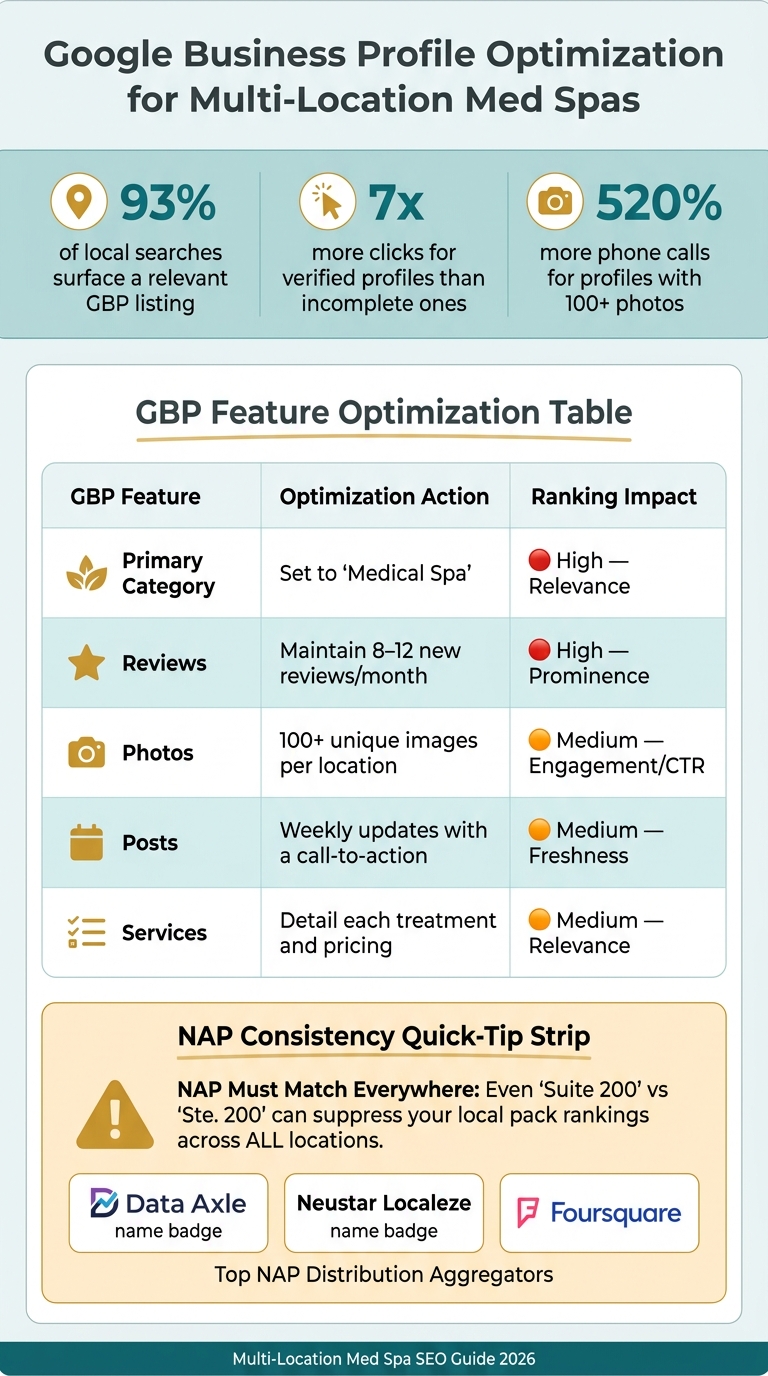
Multi-Location Med Spa SEO: GBP Optimization Ranking Factors & Impact
Your Google Business Profile (GBP) is often the first impression potential clients get of your business before they even visit your website. Since GBP listings appear in 93% of local searches where a business is relevant, having a well-maintained profile is essential. Verified and complete profiles tend to perform much better, receiving seven times more clicks than incomplete ones. For med spas with multiple locations, this difference can be a game-changer. Here’s how to effectively manage and optimize each GBP to establish local authority.
Taking the time to optimize each location’s GBP not only builds individual authority but also strengthens your brand’s overall credibility.
Claiming, Verifying, and Managing Each Location’s GBP
Start by claiming each location’s profile at business.google.com using your legal business name. Google will typically verify the listing through a postcard, video, or phone call, depending on the specific address.
When setting up your profile, select "Medical Spa" as the primary category for all locations. Then, add secondary categories like "Laser Hair Removal Service", "Skin Care Clinic", or "Cosmetic Surgery Clinic" to capture more targeted search traffic. This step is essential:
"The primary GBP category is widely considered the single most influential local ranking factor, so getting it right is non-negotiable." – Adwave Team
Managing multiple locations can get tricky, especially when you have ten or more. To simplify updates, use the Google Business Profile Manager for bulk edits or the Business Profile API for programmatic changes. Assign "Site Manager" roles for local-level updates while keeping "Owner" access at the corporate level to avoid accidental changes to critical information.
Keeping NAP Information Consistent Across All Locations
NAP – short for Name, Address, and Phone number – needs to be 100% consistent across all platforms. Even minor inconsistencies, like writing "Suite 200" in one place and "Ste. 200" in another, can confuse Google and hurt your rankings.
"Inconsistent NAP data confuses Google about which listing to trust, suppressing local pack rankings for all locations." – Digital Applied
Each location’s GBP should link to its dedicated landing page (e.g., yoursite.com/locations/dallas) rather than your homepage. Use a local phone number with the appropriate area code for each profile – steer clear of toll-free or call-tracking numbers, as they can weaken local relevance signals.
To streamline this process, submit your business data to major aggregators like Data Axle, Neustar Localeze, and Foursquare. These platforms distribute your information to 50–150 directories within 60–90 days, ensuring consistency. Tools like Whitespark or BrightLocal can help you perform monthly citation audits to catch any discrepancies before they become a problem.
Keeping NAP data consistent across all profiles also helps prevent issues like keyword cannibalization and data drift, which can undermine your multi-location SEO efforts.
Using GBP Features to Attract Med Spa Clients
Claiming your profile is just the beginning. The real difference between average and high-performing profiles lies in how actively they are managed. Beyond maintaining accurate information, engaging with your GBP can significantly boost client interaction. For instance, profiles with at least 100 photos get 520% more phone calls than those with fewer images. Aim to upload 15–25 unique photos per location, including exterior shots to help clients identify the building and interior images to build trust before their first appointment. Always ensure you have written consent for client photos and comply with advertising regulations.
| GBP Feature | Optimization Action | Ranking Impact |
|---|---|---|
| Primary Category | Set to "Medical Spa" | High – Relevance |
| Reviews | Maintain 8–12 new reviews/month | High – Prominence |
| Photos | 100+ unique images per location | Medium – Engagement/CTR |
| Posts | Weekly updates with a call-to-action | Medium – Freshness |
| Services | Detail each treatment and pricing | Medium – Relevance |
Fill the Q&A section with at least 10 common questions per location. Examples include "Do you offer payment plans?" or "Is parking available?" This strategy allows you to control the narrative, integrate relevant keywords, and reduce repetitive client inquiries. Additionally, publish one GBP post per week for each location to keep profiles fresh. Align posts with seasonal trends, like promoting laser hair removal packages as spring approaches.
"A competitor who updates their GBP weekly, earns ten reviews a month, and has dedicated pages for each service will outrank a med spa with a better reputation and better results every time." – Aditi Goyal, Zoca
How to Build a Website Structure That Supports Multiple Locations
A well-structured website is essential for achieving strong search rankings across various locations. Setting up the right framework from the beginning makes it much easier to scale up to 5, 10, or even 20+ locations.
Creating Dedicated Landing Pages for Each Location
Each physical med spa location should have its own dedicated landing page instead of relying on a single, generic "Locations" page. These pages should focus on "Service + City" keywords, such as "med spa in Scottsdale" or "Botox Scottsdale." Include these keywords in the H1, meta description, and URL for maximum impact.
Use a subfolder URL structure like yourmedspa.com/locations/scottsdale/. This setup allows the page to inherit domain authority from the main site. Avoid subdomains (e.g., scottsdale.yourmedspa.com), as search engines treat them as separate entities, starting with no authority.
To avoid duplicate content penalties, make sure each location page is unique. Add locally relevant details such as staff bios, testimonials, FAQs, and an embedded Google Map. The map not only helps users but also signals local relevance to search engines.
It’s worth noting that localized landing pages have a 4.1x higher conversion rate compared to generic pages.
Once your location pages are set, take it a step further by creating service-specific pages targeting local keywords.
Organizing Service Pages by Location
A clear structure for service pages strengthens local relevance and prevents competition between your locations. Instead of having one generic "Botox" page for all locations, create pages like yourmedspa.com/locations/scottsdale/botox/ to directly target high-intent local keywords like "Botox Scottsdale." This approach avoids keyword cannibalization and ensures search engines know exactly which page to rank for each market.
| Structure Level | URL Example | SEO Purpose |
|---|---|---|
| Root Domain | yourmedspa.com |
Builds overall brand authority |
| Locations Index | yourmedspa.com/locations/ |
Serves as a hub, distributing authority to branches |
| Location Landing Page | yourmedspa.com/locations/scottsdale/ |
Targets "Med Spa Scottsdale" and includes local NAP and map |
| Location Service Page | yourmedspa.com/locations/scottsdale/botox/ |
Targets high-intent keywords like "Botox Scottsdale" |
If your business spans multiple states, consider adding a state-level layer (e.g., /locations/arizona/scottsdale/) to better organize authority flow and improve crawlability.
Using Internal Links to Distribute Domain Authority
Once you’ve created dedicated pages, use internal linking to ensure your site’s authority flows effectively across all locations. A Hub-and-Spoke model works well: the main locations index page links to each city page, and each city page links to its service pages. This structure makes it easier for search engines to navigate your site and distributes link equity from high-authority pages to newer or lower-authority ones.
Here are additional tips to enhance performance:
- Add links to nearby locations at the bottom of each location page. For instance, if a user is on the Dallas page, include a link to the Fort Worth page. This helps pass local authority between branches and shows Google your full geographic reach.
- Link from high-authority blog posts to specific location pages within the first 100 words. Use keyword-rich anchor text like "Botox treatments in Scottsdale" to further boost rankings.
These internal links not only improve navigation for users but also consolidate your med spa’s authority across all locations.
"The real value of multi-location SEO isn’t ranking in more places – it’s that every location you add makes every other location harder to outrank. You’re not climbing a ladder. You’re building a moat." – The SEO Engine
Finally, breadcrumb navigation (e.g., Home > Locations > Scottsdale) reinforces this hierarchy for both users and search engines. It ensures Google can index every location and service page accurately, improving your website’s overall performance.
Building Local Authority With Reviews and Citations
Once your website structure is solid, the next step is boosting local authority through reviews and citations. These external factors play a crucial role in improving your Map Pack rankings and work hand-in-hand with the on-site and Google Business Profile (GBP) optimizations discussed earlier.
How to Get and Manage Reviews Across Platforms
To streamline the process, automate review requests via SMS or email within 24–48 hours after an appointment. Include a direct link to the location’s GBP review page for convenience. When asking for feedback, encourage reviewers to be specific. For example, a comment like "laser hair removal at the Scottsdale location" carries more weight for keyword and location relevance than a generic review.
Make it a priority to respond to all reviews within 24–48 hours. Google favors businesses that actively engage with their customers. Additionally, keep an eye on review velocity – aim for 8–12 new reviews per month per location to maintain strong local rankings. Aditi Goyal of Zoca explains the importance of consistency:
"A med spa with 200 reviews, the last of which was posted eight months ago, will often rank lower than a competitor with 80 reviews and a consistent 10 per month."
Beyond reviews, ensuring your citation data is accurate is another key step in reinforcing your local authority.
Keeping Local Citations and Directory Listings Accurate
Citations are online mentions of your business’s Name, Address, and Phone number (NAP). For multi-location businesses, keeping this information accurate can be challenging, as third-party aggregators often revert to outdated details. To combat this, conduct quarterly audits using tools like BrightLocal or Whitespark.
Building citations across three tiers can help:
| Citation Tier | Source Examples | SEO Purpose |
|---|---|---|
| Tier 1: Core Aggregators | Data Axle, Neustar Localeze, Foursquare | Distributes NAP to many downstream sites |
| Tier 2: Industry-Specific | Healthgrades, Zocdoc, RealSelf, WebMD | Establishes relevance within the medical/aesthetic field |
| Tier 3: Hyperlocal | Chamber of Commerce, local news, event sites | Strengthens geographic trust and local recognition |
Aim for 50–100 citations per location to boost your business’s legitimacy. Joining a local Chamber of Commerce is a smart move – it typically costs $300–$600 annually per location and provides a high-authority local link and citation.
How Reviews and Citations Affect Map Pack Rankings
By 2026, the Local Pack dominates "near me" searches for booking intent. Following Google’s removal of AI Overviews from local healthcare searches in late 2025, reviews and citations have become two of the most powerful tools for improving local visibility.
Google evaluates reviews based on factors like quantity, velocity, rating, and sentiment. Businesses in the top three Map Pack results typically average a 4.2-star rating. Furthermore, 31% of consumers in 2026 will only consider businesses with a 4.5-star rating or higher – up from 17% in the previous year. On the citation side, prominence signals contribute to roughly 40% of Google Maps rankings. Fixing NAP inconsistencies across directories can lead to a 16% boost in rankings.
Consistent, high-quality reviews signal that your business is active and trustworthy, while accurate citation data validates your presence across platforms. Together, these elements create a strong local authority that competitors will find hard to match.
"The businesses winning at local search in 2026 aren’t doing one thing well – they’re orchestrating a system." – Guy Sheetrit, CEO, Over The Top SEO
For a deeper dive into specialized growth tactics, explore our comprehensive guide on medical spa SEO.
Technical SEO for Multi-Location Med Spa Websites
As your med spa network expands, keeping your technical SEO in check becomes essential for maintaining local visibility. Irina Shvaya, Founder & Marketing Consultant at eSEOspace, emphasizes the importance of technical structure:
"The technical architecture of your website becomes exponentially more important as you add locations."
Core Web Vitals: Key Fixes for Location Pages
One of the biggest risks when scaling is letting location pages slow down or malfunction. Did you know that over 50% of mobile users will leave a site if it takes longer than three seconds to load? That’s a direct loss in potential bookings.
To avoid this, audit every location page individually – not just your homepage. Tools like Microsoft Clarity can help you analyze heatmaps and session recordings for each page. For instance, compare user behavior on your Austin page versus Denver to identify where visitors are dropping off. Pair this with Google Tag Manager to consistently track form submissions and bookings across all pages.
Also, ensure your site is optimized for mobile and voice searches to capture the growing number of conversational queries.
Mobile and Voice Search Optimization for Med Spas
Most med spa searches happen on mobile devices, often through voice commands. Queries like "med spa near me open now" or "best Botox in [neighborhood]" are hyper-local and conversational. To rank for these, integrate neighborhood-specific keywords and proximity phrases, such as "laser hair removal near the Pearl District in Portland."
For voice search, focus on short, clear sentences that directly answer common questions. This can help your content appear in zero-click search results, which are becoming increasingly relevant. For guidance, check out SearchX’s mobile keyword research guide to identify the best conversational keywords for location-based pages.
Leveraging Local Schema Markup for Each Location
Schema markup is often overlooked but incredibly powerful for multi-location SEO. By 2026, AI-driven search tools like Google’s AI Overviews rely heavily on structured data to provide local business details in search results.
Here’s how to set it up:
- Use
Organizationschema for your homepage. - Apply
MedicalBusinessorHealthAndBeautyBusinessschema on individual location pages. - Nest
Servicetype details for specific treatments like "Botox" or "Microneedling" to signal intent.
Including GeoCoordinates (latitude and longitude) for each location is key, especially in urban areas or multi-suite buildings. This ensures Google correctly maps each page to the right physical location. Additionally, make sure your OpeningHoursSpecification in the schema exactly matches your Google Business Profile (GBP). Even minor inconsistencies can erode trust and hurt rankings.
"In competitive local markets, ambiguity costs visibility. Schema markup removes that ambiguity." – LocalMighty
Validate your schema using tools like Google’s Rich Results Test and Schema Markup Validator. For a detailed guide, SearchX’s tutorial on adding local business schema markup provides step-by-step instructions in plain language.
Conclusion: How to Grow to More Locations Without Losing SEO Authority
Scaling a med spa network requires a deliberate, well-organized approach to maintain SEO strength while expanding. The key takeaway? Focus on building a solid structure rather than rushing to launch new locations. Strategies like hub-and-spoke site architecture, dedicated location pages, proper GBP management, citation consistency, and schema markup all play a role in ensuring every new location thrives without compromising the authority you’ve already established.
The difference between brands that grow successfully and those that struggle lies in having a repeatable system. Fahim Ludin, CEO of Macro Digital, explains it well:
"Multi-location SEO fails when businesses treat it as a checklist. Sustainable visibility comes from a repeatable structure – clear site architecture, consistent GBP management and standardized review processes."
To achieve long-term success, focus on building credibility for each location. This means maintaining a steady flow of reviews, ensuring fast-loading location pages, and creating 40%–60% unique content for each one. Engage with local communities by joining Chambers of Commerce, sponsoring events, and earning backlinks tied to specific geographic areas. Tools like Data Axle can help automate NAP management and prevent inconsistencies as your network grows.
FAQs
How can I prevent my locations from competing in Google search results?
If you have multiple business locations, it’s crucial to avoid them competing against each other in Google search results. The solution? Create a dedicated, fully optimized page for each location. This means each page should feature unique, locally relevant content and target specific keywords related to that area.
Additionally, make sure every Google Business Profile is individually optimized. Consistency is key here – ensure the NAP (Name, Address, Phone) information is identical across all listings. By doing this, you help search engines clearly differentiate your locations, which boosts their visibility and reduces the chances of them competing with one another.
What should each location page include to rank locally?
Each location page should showcase unique, locally tailored content. Include detailed descriptions of services offered and highlight what makes your business stand out from competitors in the area. Incorporate primary keywords paired with the city or region name to optimize for local searches.
Make sure to display accurate NAP details (Name, Address, Phone number) prominently. Adding customer reviews can further build trust and credibility. To enhance local visibility, don’t forget to implement schema markup – this helps search engines better understand your page and boosts your chances of appearing in local search results.
How do I manage NAP and GBPs at scale without mistakes?
To handle NAP (Name, Address, Phone number) and Google Business Profiles (GBPs) effectively at scale, focus on maintaining consistent and accurate details across all platforms. A centralized database can simplify this process by allowing you to track and update information across multiple listings in one go.
Enhance each GBP by including location-specific elements – think customer testimonials, staff introductions, or other personalized content that resonates with the local audience. Regular audits are essential to catch inconsistencies or outdated information. Additionally, use tools to monitor performance metrics and automate updates when possible. This approach helps reduce errors and keeps your profiles accurate and up-to-date.