
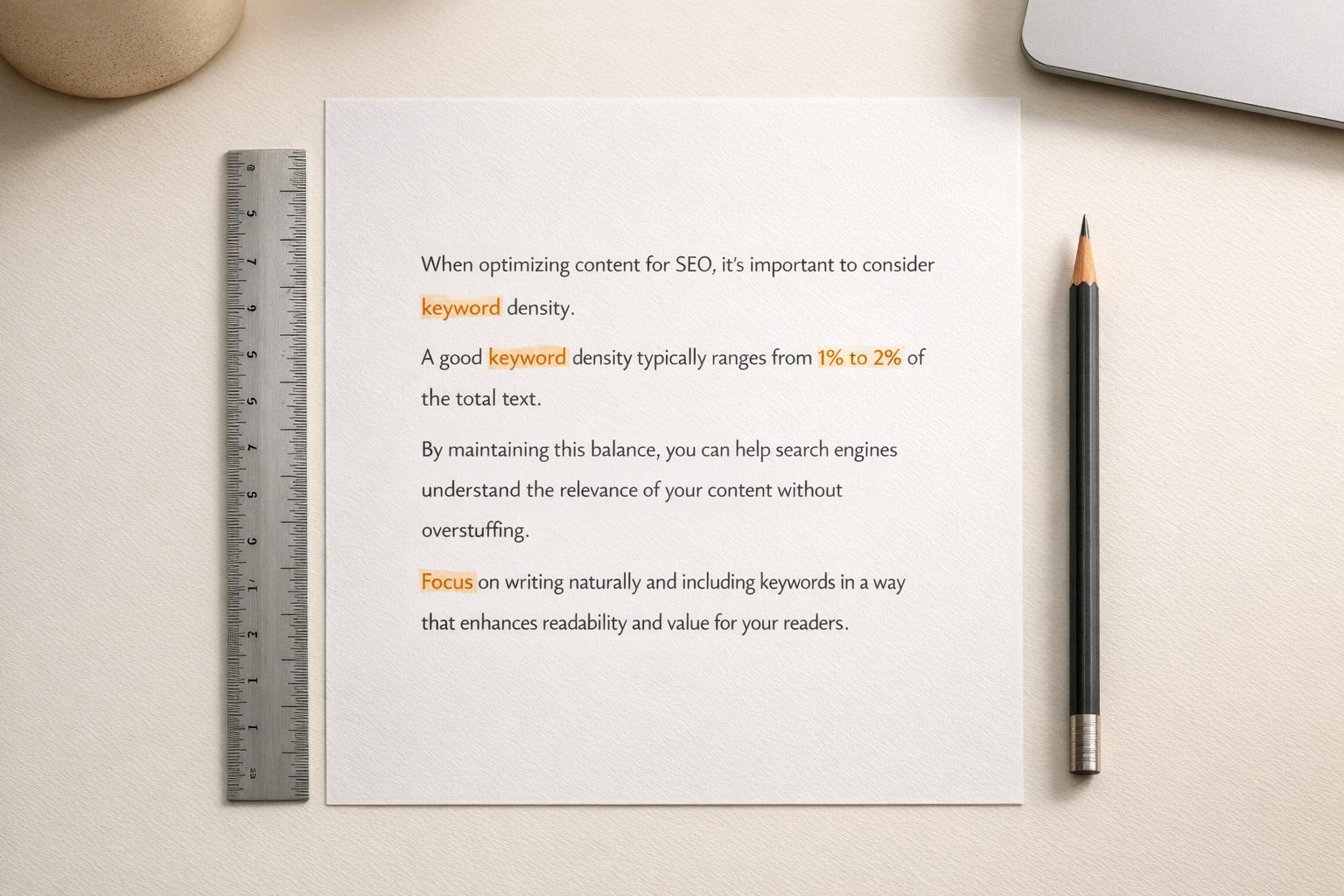
Keyword density matters, but not like it used to. By 2026, search engines prioritize context, user intent, and topic depth over simple keyword repetition. Here’s what you need to know:
- Ideal Range: Keep primary keyword density between 1% and 2%. Below 0.5%, search engines may miss your focus. Above 3%, you risk penalties.
- Adjust by Content Type: Informational guides work well with 0.5%–1.5%, while transactional pages can go up to 2%.
- Use Synonyms & Related Terms: Avoid repeating the same word. Blend in variations and related concepts naturally.
- Strategic Placement Matters: Prioritize keywords in the title, first 100 words, headings, and URL slug for maximum impact.
- Write for Readers First: High-ranking content focuses on user value, not keyword stuffing.
- SEO Tools Help: Tools like Semrush and Ahrefs simplify density checks and competitor analysis.
- Analytics Are Key: Use Google Search Console and Analytics to monitor performance and refine your strategy.
The takeaway? Focus on quality content that covers your topic thoroughly, while keeping keyword usage natural and strategic.
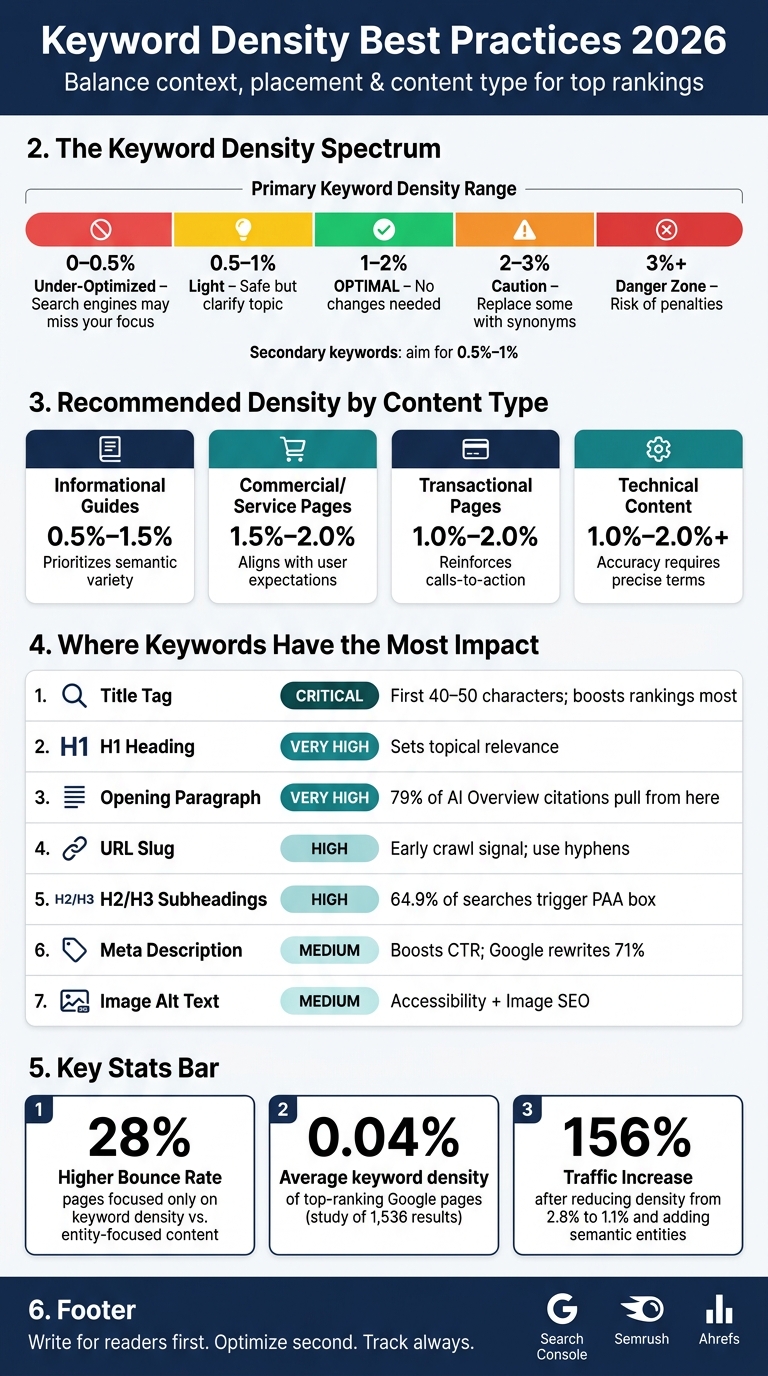
Keyword Density by Content Type & On-Page Placement Impact (2026)
Lesson 13: Keyword Density – How to Calculate and Optimize It for Search
1. Keep Keyword Density Between 1% and 2%
Sticking to a keyword density of 1–2% strikes the right balance: it signals relevance to search engines without coming across as manipulative. Once you’ve established relevance, adding more repetitions can backfire, increasing the risk of penalties without offering any extra benefit.
If your density drops below 0.5%, search engines might struggle to understand your content’s focus. On the other hand, exceeding 3% could make your content seem spammy and trigger penalties. Staying in the 1–2% range helps you avoid both extremes.
Tailoring Density to Content Types
Different types of content require slightly different keyword strategies. Here’s a quick breakdown:
| Content Type | Recommended Density | Why It Works |
|---|---|---|
| Informational guides | 0.5% – 1.5% | Prioritizes semantic variety over repetition. |
| Commercial/service pages | 1.5% – 2.0% | Frequent mentions align with user expectations. |
| Transactional pages | 1.0% – 2.0% | Clear keywords reinforce calls-to-action (CTAs). |
| Technical content | 1.0% – 2.0%+ | Accuracy requires repeating precise terms. |
By adjusting keyword density to match the content’s purpose, you ensure your writing feels natural while meeting on-page SEO goals.
Secondary Keywords: A Supporting Role
For secondary keywords, aim for 0.5% to 1%. This range is usually enough to add semantic depth without overshadowing your primary keyword.
The Read-Aloud Test
A quick way to check if you’ve overdone it? Read your content out loud. If it feels repetitive or clunky, you’re probably overusing your keywords – even if the percentage looks fine. Try swapping in synonyms or rephrasing sentences to maintain flow while staying on track.
"The 1–2% Rule of Thumb: For your primary keyword, aim for 1–2% density. For secondary keywords, 0.5–1% is plenty." – Reza Razm, Founder & CEO, Hand On Web
2. Write for Your Readers First
A study of 1,536 Google search results revealed that the average keyword density on top-ranking pages is just 0.04%. This shows that high-performing content focuses on meeting reader needs rather than cramming in keywords.
Search engines today, powered by advanced AI systems like BERT, MUM, and Gemini, prioritize content that delivers meaningful context and addresses user intent instead of relying on basic keyword matching. Pages overly optimized for keyword density tend to perform poorly, with a 28% higher bounce rate and a 19% lower average time-on-page compared to content crafted with readers in mind. These engagement metrics are critical for search rankings.
"The writers who consistently rank well are the ones writing for readers first." – Snappy Tools
Here’s a practical tip: start writing without obsessing over keywords. Focus on delivering clear explanations and answering your audience’s questions. After finishing your draft, do a light review to ensure your primary keyword appears in strategic spots like the title, the first 100 words, and key headings. This "write first, optimize second" method keeps your content natural while still making it relevant to search engines.
Once you’ve mastered writing for your readers, the next step is to weave keywords into your content in a way that feels natural.
3. Use Synonyms and Related Terms
Using the same keyword over and over can make your content feel stiff and unnatural – and search engines pick up on that. Instead of relying on exact matches, blend in synonyms and related terms. This approach not only makes your writing more engaging but also helps search engines understand the broader context of your content, a core principle of technical SEO basics.
Search engines like Google rely on advanced AI models such as BERT, MUM, and Gemini to grasp the intent behind your words, not just the literal text. For example, Google recognizes that terms like "link building", "quality backlinks", and "authority-building tactics" all revolve around the same core idea. Incorporating these variations naturally into your content signals to Google that your page is a well-rounded resource, not just a keyword-stuffed post.
To strengthen this even further, consider LSI (Latent Semantic Indexing) keywords. These are terms that commonly appear alongside your main keyword in natural conversations or real-world contexts. For instance, if you’re writing about "coffee brewing", related terms like "extraction", "grind size", and "water temperature" add depth and context. A simple way to uncover these terms? Look at Google’s "People also ask" section or autocomplete suggestions for your primary keyword.
Here’s a guideline to follow: include your primary keyword 3–5 times and secondary keywords 2–4 times throughout your content. Spread them naturally across the introduction, body, and conclusion. For best results, place your primary keyword in the title, H1, and within the first 100 words to set a clear focus. Then, use synonyms and related terms to reinforce your message without overloading it.
"Keywords communicate topical relevance, but relevance requires context, not repetition." – Ben Lowe, CEO of Bright Forge SEO
4. Place Keywords Where They Have the Most Impact
Where you place your keywords can make or break your SEO strategy. Some areas on your webpage carry more weight than others. For instance, a keyword in the title tag can significantly boost your rankings compared to the same keyword buried in the middle of a paragraph. As SEO-IO puts it, "A single strategic mention in your title tag is worth more than ten mentions buried in body paragraphs.". These placements amplify your content’s SEO effectiveness without overloading it.
To get the most out of your keywords, include your primary keyword in the title tag within the first 40–50 characters. This ensures it’s visible in search results. Pair that with a variation of the keyword in your H1 heading to provide search engines with extra context. Another key spot? The first 100 words of your opening paragraph. Interestingly, 79% of AI Overview citations pull directly from this section. This placement not only boosts relevance but also keeps your keyword usage intentional instead of repetitive.
Other impactful areas for keywords include your URL slug, subheadings (H2/H3), and image alt text. Use a short, hyphen-separated URL since Google treats hyphens as word separators, unlike underscores, which it reads as a single word. For subheadings, framing them as questions can work wonders. Why? Because 64.9% of Google searches trigger a "People Also Ask" box, making question-based H2s a great way to capture that traffic.
Here’s a quick breakdown of where to prioritize your keywords:
| On-Page Element | Primary Function | Impact Level |
|---|---|---|
| Title Tag | Keyword match + CTR | Critical |
| H1 Heading | Topical relevance | Very High |
| Opening Paragraph | AI Overview/Snippet extraction | Very High |
| URL Slug | Early crawl signal | High |
| H2/H3 Subheadings | Semantic structure + PAA trigger | High |
| Meta Description | CTR optimization | Medium (Indirect) |
| Image Alt Text | Accessibility + Image SEO | Medium |
While the meta description can help improve your click-through rate (CTR) by highlighting keywords in bold, keep in mind that Google rewrites 71% of meta descriptions. So, while it’s worth optimizing, don’t rely on it as your sole focus.
Up next, see how covering your topic thoroughly works hand-in-hand with these keyword placement strategies.
5. Focus on Topic Coverage, Not Exact Keyword Counts
If you’re still obsessing over how many times a keyword appears in your content, it’s time to rethink your on-page SEO strategy. Modern search algorithms like Google’s BERT, MUM, and Gemini are way beyond simple keyword counting. These algorithms are designed to understand whether your content truly addresses a topic, focusing on concepts and their relationships rather than just word repetition. For example, MUM is reported to be 1,000 times more powerful than BERT and can process content across 75 languages. That’s a game-changer.
Google even uses an entity salience score – ranging from 0 to 1 – to measure how central a concept is to your content. To score above 0.5, you need to frame your primary topic with related terms and subtopics, showing a deeper understanding of the subject. This isn’t just theory; it’s something we see in action.
Take this case study: An article on "Cloud Computing Security" initially had a keyword density of 2.8% but only managed an entity salience score of 0.38. After a rewrite that reduced keyword density to 1.1% and added specific entities like the NIST Cybersecurity Framework, Zero Trust Architecture, and ISO 27001, the results were dramatic. Organic traffic jumped by 156% in just 90 days. The page began ranking for over 340 keyword variations (up from 89) and even secured three featured snippet positions.
So, what’s the takeaway? Instead of counting keywords, use advanced keyword research techniques to ensure your content covers the entire landscape of the topic. For example, a page about "project management" should also touch on related areas like Agile, Scrum, and resource allocation. This approach not only demonstrates expertise but also improves user engagement. In fact, pages that prioritize comprehensive topic coverage see a 28% lower bounce rate and a 14% higher conversion rate compared to those fixated on keyword density. It’s clear: depth and relevance matter far more than repetition.
6. Use SEO Tools to Check Keyword Density
Once you’ve strategically placed your keywords, it’s time to fine-tune your content using SEO tools. These tools are indispensable for checking keyword density accurately, especially when dealing with lengthy articles. Manually calculating density for a 2,000-word piece is time-consuming and prone to error. SEO tools simplify the process with a straightforward formula: (keyword count ÷ total words) × 100. This provides you with a clear percentage, covering not just single keywords but also two- and three-word phrases, which can help identify patterns that might trigger spam filters.
A standout feature in many modern SEO tools is stop word filtering. This removes common words like "the", "is", and "at" from the analysis, ensuring your density report focuses on terms that matter to search engines. To get the most accurate results, configure your tool to exclude title tags and meta descriptions, which could otherwise skew the data. This approach complements the earlier discussion on maintaining a natural keyword flow.
When it comes to over-optimization, Google’s internal KeywordStuffingScore is worth noting. This score ranges from 0 (no stuffing) to 127 (maximum stuffing). Tools often flag keyword densities above 3% as a warning sign. As Reza Razm, Founder & CEO of Hand On Web, explains:
"Google has an explicit keyword stuffing detection algorithm… The score ranges from 0 to 127 – there are degrees of severity."
To help you interpret your density results, here’s a quick guide:
| Density | Status | What to Do |
|---|---|---|
| 0–0.5% | Under-optimized | Add more mentions or related terms |
| 0.5–1% | Light | Generally safe; ensure your topic is clear |
| 1–2% | Optimal | No changes needed; keep the natural flow |
| 2–3% | Caution | Replace some instances with synonyms or related terms |
| 3%+ | Danger Zone | Reduce keyword usage to avoid penalties |
These recommendations align with the earlier emphasis on keeping your content natural and reader-friendly.
Beyond just checking density, many SEO tools offer competitor benchmarking features. By analyzing the top 3–5 ranking pages for your target keyword, you can uncover related phrases that Google currently favors. This gives you a data-driven approach to refine your content.
For this type of analysis, tools like Semrush (starting at $119.95/month) and Ahrefs (starting at $29/month) are excellent choices. If you’re looking for a free option, SEO Review Tools can provide quick insights without the cost.
7. Avoid Keyword Stuffing
Once you’ve optimized your content with the right keywords, it’s important not to go overboard by cramming them in everywhere.
Keyword stuffing happens when keywords are repeated excessively or unnaturally throughout your content. This can look like repeating the same phrase over and over, listing keywords without meaningful context, or even hiding text by matching its color to the background. Modern search engines are too advanced to be tricked by these tactics, and they make your content less enjoyable to read.
Sticking to proper keyword density is crucial. Overusing keywords not only frustrates readers but can also harm your rankings. Google’s algorithms are designed to spot manipulative practices like this, and content that feels robotic will turn users away, negatively impacting engagement and rankings. This is why striking a balance in keyword usage is so important.
As Google Search Central explains:
"The first one or two times you mention a word, then that might help with your ranking, absolutely. But just because you say it seven or eight times, that doesn’t mean it will necessarily help your rankings."
If your keyword density exceeds 3%, it’s a sign to rework your content and naturally rephrase some instances.
8. Track Content Performance with Analytics
Once you’ve refined your keyword strategy, the next step is keeping a close eye on how your content performs. Crafting optimized content is only part of the process – tracking its performance and making adjustments based on analytics is where the real magic happens. For more analytics-driven growth tips, check out our latest insights.
A great place to begin is Google Search Console (GSC). It provides insights into which queries are driving impressions and clicks to your pages, how your rankings fluctuate over time, and whether your content is performing well for both primary and secondary keywords. Pair this with Google Analytics 4, which lets you track time on page and scroll depth – two key indicators of how engaged readers are with your content.
These metrics are especially useful for spotting over-optimization. For example, a high bounce rate often points to content that feels overly mechanical or difficult to read – common signs of keyword stuffing. On the other hand, strong scroll depth suggests that readers find your content helpful and thorough. Regularly reviewing these analytics helps ensure your content stays natural and user-friendly.
"Keyword density is a diagnostic tool, not a target. Aim for natural, comprehensive writing that genuinely answers the query." – Snappy Tools
Analytics also serve as a feedback loop after updating content. If you reduce keyword usage on a page and rankings improve, it likely means the content was previously over-optimized. Conversely, if traffic declines after an edit, you might have gone too far in the other direction. Here’s a breakdown of key metrics and what they reveal about your keyword strategy:
| Metric | Tool | Indicates |
|---|---|---|
| Impressions & CTR | Google Search Console | Effectiveness of titles and meta descriptions in attracting clicks |
| Time on Page | Google Analytics 4 | Whether readers find the content relevant and engaging |
| Keyword Rankings | top SEO tools | Visibility of your primary and secondary keywords |
| Bounce Rate | Google Analytics 4 | If content feels unnatural due to over-optimization |
| Scroll Depth | Google Analytics 4 | How well the content addresses the topic |
To keep your content in top shape, audit your highest-traffic pages monthly. This helps you catch any shifts in keyword usage early. Over-optimization isn’t a simple yes-or-no issue – it’s a spectrum. By tracking these metrics regularly, you can fine-tune your content and maintain both quality and search visibility.
9. Adjust Keyword Density Based on Content Type
Different types of content call for different keyword strategies. Fine-tuning keyword density based on the type of content you’re creating can significantly improve your overall approach.
Two key factors to consider are content length and user intent. For example, a 500-word landing page with a keyword used 10 times results in a 2% density – right at the higher end of typical recommendations. But if the same keyword appears 10 times in a 3,000-word guide, the density drops to about 0.3%, which might not convey enough relevance for search engines. The table below offers a quick reference for keyword strategies tailored to specific content types:
| Content Type | Keyword Recommendations | Strategy Focus |
|---|---|---|
| Blog Posts | 1 primary + 2–5 secondary | Deep exploration and related terms |
| Product Pages | 5–10 keywords | Emphasize features and benefits |
| Landing Pages | 3–5 focused keywords | Clear, concise, and offer-driven |
| Long-form Guides | 1 primary + multiple keyword clusters | Cover topics thoroughly, add FAQs |
| Homepages | Multiple strategic keywords | Highlight core services and brand topics |
Beyond just numbers, it’s essential to align your keywords with the intent of the user. Informational content, like how-to articles or tutorials, benefits from casting a wide semantic net – using related terms to cover follow-up questions or additional details. On the other hand, transactional content, such as product or landing pages, should focus tightly on the offer, using clear, action-oriented language and emphasizing key features.
These keyword density ranges are guidelines, not rigid rules. Always adapt them to suit your content’s purpose and ensure your writing flows naturally while staying aligned with best practices.
10. Work with SearchX for Keyword Optimization

Putting all the earlier tips into action – like avoiding over-optimization and ensuring natural keyword placement – takes careful planning and consistent effort. That’s where working with an SEO expert can make all the difference.
SearchX specializes in advanced keyword research techniques, offering services that go beyond just finding keywords. Their keyword research services create a detailed keyword map that includes primary terms, secondary keywords, long-tail phrases, and even question-based queries. This approach aligns with how Google’s AI models, such as BERT, MUM, and Gemini, interpret content based on meaning and context rather than simple keyword repetition. To help maintain the right balance, SearchX also provides tools that automate keyword density management.
One standout advantage of SearchX is its focus on minimizing risks. Instead of leaving businesses guessing about their content’s optimization, their on-page optimization services actively monitor keyword density. If pages start approaching the caution zone (2%–3% keyword density), their strategy adapts by incorporating semantic variations to steer clear of penalties.
"We don’t have a specific keyword density formula. We try to understand the content overall." – John Mueller, Search Advocate, Google
This philosophy drives SearchX’s approach. By strategically placing primary and secondary keywords, they ensure content flows naturally while still improving rankings. Their method ties directly to the best practices discussed earlier, resulting in content that performs well without sounding forced. If you’re aiming for high-ranking, natural content, SearchX provides the tools and expertise to make it happen.
Conclusion
By 2026, keyword density is all about balance – providing enough context for search engines while keeping the reader’s experience front and center. The sweet spot? Aim for a primary keyword density of 1% to 2%, placing keywords strategically and blending in synonyms and related terms naturally.
A study from 2024, analyzing 320 websites, revealed that pages focusing solely on keyword density had a 28% higher bounce rate and a 19% lower average time-on-page compared to those built around entity-focused content. These engagement metrics are crucial because they directly impact rankings. Google’s AI systems now prioritize understanding meaning and context over simple keyword repetition, making high-quality content more important than ever.
Think of keyword density as a helpful checkpoint, not the ultimate goal. It can flag potential overuse (above 3%) or indicate when your topic might be underrepresented (below 0.5%). Using AI keyword research tools can help identify these gaps early. Once you hit the 1%–2% range, shift your focus to enriching your content. Dive into subtopics, answer related questions, and use natural language to showcase your expertise. The real key to success? Crafting content that’s both engaging for readers and optimized for search engines.
FAQs
How do I calculate keyword density?
To figure out keyword density, you’ll need to divide the number of times a keyword shows up in your content by the total word count, then multiply the result by 100 to express it as a percentage.
Here’s how to do it:
- Step 1: Count the total number of words in your content.
- Step 2: Count how many times the keyword appears.
- Step 3: Plug those numbers into this formula:
(Keyword count ÷ Total word count) × 100 = Keyword Density (%)
For instance, if your keyword appears 15 times in a 1,000-word article, the keyword density would be 1.5%.
What’s the fastest way to fix over-optimized content?
The fastest way to address over-optimized content is by reducing keyword density to a natural range – typically around 1–2%. Make sure keywords flow seamlessly within well-written, engaging content. Start by using a keyword density checker to identify areas where keywords are overused. Then, rework those sections by replacing repetitive keywords with synonyms or related phrases. Prioritize readability and relevance to meet SEO guidelines and steer clear of penalties for over-optimization.
How do I choose good related terms for my main keyword?
To select related terms that work well, prioritize semantic relevance and ensure they blend naturally into your content. Look for synonyms, alternative phrases, and long-tail keywords that align with your topic. By applying semantic SEO techniques, you can ensure these terms fit the context seamlessly, enhancing both user experience and search engine understanding. Use them naturally to highlight your content’s relevance without overloading it, which helps boost its perceived authority.