

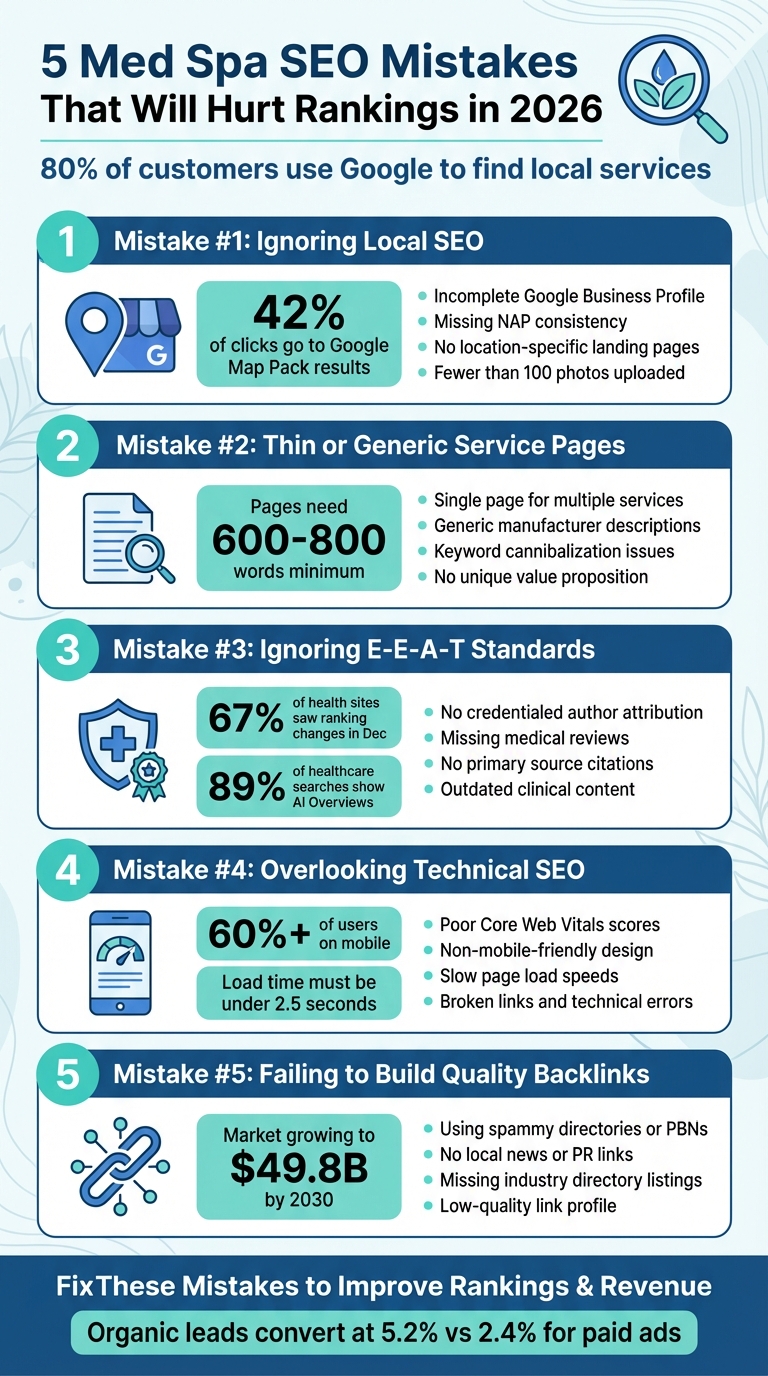
In 2026, med spas face fierce online competition, with up to 80% of customers using Google to find local services. Yet, many businesses still make SEO errors that hurt their rankings and revenue. Here’s what you need to know:
- Google Business Profile Neglect: An incomplete or outdated profile can cost you local visibility. Regular updates, detailed service descriptions, and consistent NAP info are vital.
- Weak Service Pages: Thin, generic content fails to rank. Create detailed, service-specific pages with 600–800 words and strong keywords.
- Ignoring E-E-A-T Standards: Google prioritizes content from credible, experienced professionals. Add credentials, medical reviews, and trustworthy sources to your site.
- Technical SEO Issues: Slow load times, poor mobile design, and broken links can tank rankings. Optimize Core Web Vitals and ensure mobile usability.
- Lack of Quality Backlinks: Spammy or low-quality links harm credibility. Focus on earning links from local news, industry directories, and PR opportunities.
These mistakes can leave your med spa invisible to potential clients. Fixing them is essential to improving rankings, attracting customers, and boosting revenue.
5 Critical Med Spa SEO Mistakes That Hurt Rankings in 2026
MED SPA SEO AUDIT REVEALS CRITICAL MISTAKES Costing You Clients! | LIVE Case Study
Mistake #1: Ignoring Local SEO
Your Google Business Profile (GBP) acts as your digital storefront, and if it’s incomplete or outdated, you’re essentially handing potential clients to competitors. With nearly 80% of U.S. consumers searching online for local businesses every week – and 42% of those clicks going to Google Map Pack results – it’s clear how important your GBP is for attracting local clients. For med spas, this profile is often the first impression potential clients have before deciding to book.
Unfortunately, many med spas set up their GBP and then forget about it. This leads to generic service listings, overused stock photos, and infrequent updates. Meanwhile, Google’s local algorithm considers over 48 ranking factors. If a competitor regularly updates their profile, gathers reviews, and provides detailed service entries, they’ll outrank you – even if your services are better.
Incomplete or Outdated Google Business Profile
A strong GBP starts with selecting the right primary category – choose "Medical Spa" instead of "Day Spa" to align with what clients are searching for. Then, go beyond the basics by listing each service individually with detailed descriptions. For example, instead of a vague "Botox" listing, use specific entries like "Botox for Forehead Lines" to match search queries like "lip filler near me". Use the full 750-character limit in your business description to highlight your treatments.
Consistency across platforms is critical. NAP consistency (Name, Address, Phone) ensures your information matches across your website, GBP, and other directories. Even a small difference – like writing "Suite 200" on your website but "Ste 200" on your GBP – can hurt your rankings.
To stand out, upload at least 100 high-quality, non-stock photos of your clinic, staff, and treatment rooms. Profiles with more authentic photos see higher engagement and conversions. Post weekly updates featuring offers, educational content, or before-and-after results to show that your business is active and engaged.
While a well-maintained GBP is crucial, having location-specific landing pages can help capture even more local traffic.
Missing Location-Specific Landing Pages
If you want to rank for terms like "Botox in Miami", you need more than just a generic "Services" page. Dedicated landing pages for each service and location are essential for Google to understand your offerings. These pages should include the service name and city in the page title, H1 heading, and naturally throughout the content. Aim for 600–800 words of useful, focused content that answers potential clients’ questions without unnecessary filler.
"Google cannot rank a page for ‘botox near me’ if that page is also trying to rank for ‘laser hair removal,’ ‘CoolSculpting,’ and ‘microneedling’ at the same time." – Aditi Goyal
To avoid keyword cannibalization, use the "site:yourwebsite.com [keyword]" search to check if multiple pages are competing for the same term. If duplicates exist, consolidate them into one comprehensive page. Add LocalBusiness schema markup and embed a Google Map to strengthen your local search signals. Enhance these pages with before-and-after photos, videos of your providers, and clear "Book Now" calls to action to convert visitors into clients.
Mistake #2: Publishing Thin or Generic Service Pages
If you’re aiming for strong rankings, detailed service content is just as important as optimizing your local pages.
Relying on a single “Services” page that lists treatments like Botox, fillers, laser hair removal, and CoolSculpting weakens your keyword strategy. When one page tries to cover several services, Google has a hard time determining which treatment the page should rank for.
"If you cannot write 600 words about your Botox service without repeating yourself, you are not giving potential clients or Google enough information to make a confident decision." – Aditi Goyal
Thin content – typically less than 600 to 800 words – can hurt your credibility. For medical content, which falls under Google’s "Your Money or Your Life" (YMYL) guidelines, this lack of depth makes it harder to establish authority. Copying generic descriptions from manufacturers doesn’t help either – it adds no unique value and could even lead to penalties.
Fast forward to 2026, and AI search tools like ChatGPT, Perplexity, and Google’s AI Overviews depend on rich, well-structured content to generate answers. Thin or generic service pages risk being ignored by these tools. On the other hand, competitors with detailed pages that cover procedure specifics, candidacy, recovery timelines, and pricing are gaining both traditional search traffic and AI-driven visibility.
To stand out, create a dedicated page for each core service with a minimum of 800 words of original, informative content. Use the "Frankenstein" approach: research the top three to five competitors, note their standout features – like videos, FAQs, or before-and-after photos – and combine the best elements into your own page. Don’t forget to include provider credentials, clear calls-to-action, and upfront pricing to turn visitors into booked appointments.
Mistake #3: Ignoring E-E-A-T Standards for Medical Content
Why E-E-A-T Matters in Medical SEO
Overlooking E-E-A-T (Experience, Expertise, Authoritativeness, and Trustworthiness) standards in medical content can significantly hurt your med spa’s online visibility. While addressing technical and local SEO issues is important, and our SEO blog offers additional growth tips, ensuring that your content meets E-E-A-T standards is critical for building credibility in the competitive world of medical SEO.
Treatments like injectables and laser therapies fall under Google’s "Your Money or Your Life" (YMYL) category because they directly affect health and well-being. Google has strict quality expectations for YMYL content to weed out unreliable information sources.
The December 2025 Core Update highlighted just how crucial E-E-A-T is for medical SEO. Following the update, about 67% of health-related websites experienced ranking changes, with volatility peaking at 8.7/10 – the highest in the year. Websites lacking credible authorship were pushed down in rankings, while those showcasing clinical expertise gained traction. SEO strategist Lily Ray commented, "Really wild to see authoritative health publishers who have dominated in SEO for many years get hit so hard by this last core update".
Adding to the challenge, Google AI Overviews now appear in nearly 89% of healthcare-related searches, leading to a 61% drop in organic click-through rates. AI tools like ChatGPT and Perplexity aggregate information from an average of 21 sources per medical query, prioritizing content with verified clinical authority. If your med spa content doesn’t demonstrate credible expertise, it risks being ignored by both traditional search engines and AI-driven tools.
"Google strongly urges healthcare businesses to have doctors and physicians write medical content if at all possible." – John Mueller, Google Search Advocate
These evolving dynamics make it clear: without credible content, staying visible in search results will only get harder.
How to Build Authority Through Credible Content
To establish trust and authority in your med spa’s content, make sure every clinical article is attributed to a credentialed professional. Include their full name, medical degree, and board certifications to signal expertise. Adding a "Medically Reviewed By" section with the reviewer’s credentials and the date of the review reinforces credibility for both Google and potential clients.
Enhance author bios by detailing their years of experience, certifications, and professional affiliations. Verify these credentials through sources like LinkedIn or medical board directories. When citing information, link directly to primary sources such as PubMed studies, WHO guidelines, or official .gov and .edu websites instead of secondary blogs. Regularly update your clinical content – ideally every 6 to 12 months – to ensure it remains accurate and trustworthy, as outdated information can harm your reputation.
Also, ensure your website has HTTPS security, a clear privacy policy, HIPAA compliance, and a physical address to build trust. Use schema markup like MedicalWebPage, Physician, and Author to help search engines and AI tools validate your credentials. As Google’s Search Quality Rater Guidelines emphasize, "For all pages, Trustworthiness is the most important member of the E-E-A-T family".
Mistake #4: Overlooking Technical SEO Basics
For med spas, technical SEO is just as important as having accurate local citations and well-crafted content when trying to attract high-intent local searches. Even if your content is engaging and your local citations are on point, poor technical SEO – especially on mobile – can sink your rankings. With Google’s mobile-first indexing, your mobile site is the primary version considered for search rankings. So, if your desktop site looks great but your mobile site is clunky, you could lose out on the 60%+ of web users who browse on their phones.
Core Web Vitals are a must. Your mobile site needs to hit these key performance benchmarks:
- Load critical elements (like your hero image or service description) in under 2.5 seconds (Largest Contentful Paint).
- Respond to user interactions (like tapping a "Book Now" button) in under 200 milliseconds (Interaction to Next Paint).
- Keep layout shifts minimal, with a Cumulative Layout Shift score below 0.1.
Failing to meet these standards doesn’t just hurt your rankings – it can cost you conversions. For reference, the beauty and personal care industry sees conversion rates as high as 7.82% when users experience smooth, fast-loading sites.
Mobile Optimization Is Required
Google penalizes sites with small, hard-to-tap buttons, tiny fonts, and horizontal scrolling. To improve mobile usability:
- Ensure clickable elements are at least 48×48 pixels with 8 pixels of spacing.
- Use a minimum font size of 16 pixels for body text.
- Include the proper meta viewport tag:
<meta name="viewport" content="width=device-width, initial-scale=1.0">
Avoid intrusive full-screen popups that appear immediately when users land on your site – Google frowns on these. Additionally, if your mobile site hides important content (like service details or headings) that’s visible on your desktop version, that content won’t be indexed. This can create a "rankings gap." Make sure click-to-call phone numbers and Google Maps links are easy to find, especially since 76% of local mobile searches result in an in-person visit within 24 hours. And don’t forget – site speed is equally important for keeping visitors engaged.
Site Speed Affects Rankings and Conversions
While mobile usability focuses on design and functionality, overall site speed is critical for both SEO and user experience. If your site takes longer than 2.5 seconds to load, it fails Core Web Vitals and risks driving visitors away. This "pogo-sticking" behavior – where users leave your site quickly – signals to Google that your site isn’t meeting expectations.
To improve site speed:
- Compress images and use modern formats like WebP or AVIF.
- Implement responsive image techniques (e.g.,
srcset) so mobile users get appropriately sized visuals. - Minimize JavaScript, remove unnecessary scripts, and use a Content Delivery Network (CDN) to speed up content delivery.
- For Single Page Applications, use Server-Side Rendering (SSR) to ensure crawlers can access complete HTML right away.
Regular site audits to fix broken links and clean up technical clutter are also essential.
Investing in professional technical SEO services for your med spa can cost between $1,000 and $2,000 per month, but the return is worth it. Organic leads convert at 5.2%, compared to just 2.4% for paid ads.
Mistake #5: Failing to Build Quality Backlinks
Local SEO and technical optimizations are essential for establishing a strong online presence, but if you’re neglecting quality backlinks, you’re leaving a crucial piece of the puzzle out. In 2026, only high-quality backlinks will move the needle for med spa rankings. Unfortunately, many med spas either skip link building entirely or rely on questionable sources like spammy directories or private blog networks (PBNs). This approach can backfire, as Google’s local algorithm weighs over 48 ranking factors, and a strong backlink profile is critical for maintaining credibility in the competitive med spa industry.
AI tools like ChatGPT, Gemini, and Perplexity are increasingly prioritizing content endorsed by trusted sources. A weak or spammy backlink profile could render your site invisible to these tools. Ricky Shockley, Owner of Med Spa Magic Marketing, sums it up perfectly:
"The defining word for 2026 is Authenticity. Whether it’s Google or an AI engine, these tools are getting better at finding the most reputable, trustworthy businesses."
Risks of Low-Quality Links
Low-quality backlinks do more harm than good. These links act as "votes of confidence" for your website, but when they come from unreliable sources like PBNs, link farms, or irrelevant directories, they send the wrong signals to search engines. This can lead to lower rankings or even penalties.
Inconsistent business information across low-quality directories adds to the confusion, making it harder for search engines to trust your website. On the other hand, high-authority links from reputable publications like Forbes or Real Simple are not only hard for competitors to replicate but also carry significant weight in boosting your rankings. Cutting corners with cheap link-building services is a short-sighted approach that could cost you visibility in the long run, especially in an industry projected to grow from $18.6 billion to $49.8 billion by 2030.
How to Earn High-Quality Backlinks
Instead of chasing quantity, focus on earning links from reputable sources. Here’s how:
- Local News and Industry-Specific Directories: Start by targeting local news outlets and high-authority industry directories like RealSelf, Healthgrades, Zocdoc, and the American Med Spa Association. These carry more weight than generic directories and align with your niche.
- Competitor Analysis: Use tools like Moz, Ahrefs, or Semrush to analyze where your competitors are earning backlinks. Look for opportunities in local blogs, trade directories, or community sponsorships that you can tap into.
- PR and Media Opportunities: Platforms like Quoted, Connectively (formerly HARO), and SourceBottle connect you with journalists looking for expert insights. By sharing your expertise on skincare trends or aesthetic treatments, you can secure mentions in high-profile publications like Forbes, GQ, or Everyday Health. These backlinks are tough for competitors to replicate and add significant credibility. As Ricky Shockley explains:
"Journalists writing about 2026 skincare trends need expert quotes to lend credibility. By providing insights, we have secured features for clients in Forbes, GQ, Everyday Health, and Real Simple. These links are incredibly hard for competitors to replicate and add massive reputational weight."
- Local Sponsorships and Partnerships: Collaborate with nearby gyms, salons, and wellness centers for cross-promotions and link exchanges. This not only boosts your backlink profile but also increases your visibility among potential clients. Additionally, sharing professional treatment photos on stock libraries can earn you attribution backlinks whenever your images are used.
Investing in professional SEO services, which typically cost between $1,000 and $2,000 per month, can help you implement these strategies effectively. The ROI from a strong, trustworthy backlink profile will far outweigh the initial costs, especially when paired with solid technical and local SEO practices.
Conclusion: Update Your SEO Strategy to Stay Competitive
After exploring common SEO pitfalls, it’s clear that refreshing your strategy is essential to stay ahead – especially in the rapidly growing med spa industry. With the market projected to reach $83.9 billion by 2033 and growing at an annual rate of 15.7%, standing out online is non-negotiable. Considering that 80% of customers search online for local businesses, your visibility can make or break your success.
SEO isn’t a one-and-done task. Google updates its ranking algorithms about twice a year, and tools like ChatGPT and Perplexity are changing how potential patients find providers. The difference between ranking in the top three search results and landing on page two? It’s often the difference between a packed schedule and empty treatment rooms.
To reclaim your rankings and stay competitive, focus on the strategies outlined here. Regularly audit your Google Business Profile (GBP), create detailed 600+ word landing pages for each treatment, and aim for 8–12 new reviews every month. Optimize your site for mobile by ensuring it loads within three seconds, implement LocalBusiness schema markup, and build backlinks from trusted sources like local news outlets and industry directories.
These efforts can have a direct impact on your bottom line. With conversion rates in the beauty industry averaging 7.82%, even small gains in SEO can lead to significant revenue increases – far exceeding the $5.70 cost per click typical of paid ads.
Think of SEO as a long-term investment. The returns, when done right, will far outpace those of short-term paid advertising campaigns.
FAQs
Which SEO fixes should my med spa prioritize first for 2026?
To help your med spa stand out in local searches in 2026, focus on three key areas: optimizing your Google Business Profile, creating location-specific service pages, and earning fresh reviews consistently. These steps are crucial for improving your local search rankings. By concentrating on these strategies, you’ll enhance your online presence and draw in more local clients effectively.
How can I tell if my pages are competing for the same keyword?
To determine if your pages are competing for the same keyword, start by examining their content and SEO elements. Pay close attention to page titles, headings, and meta descriptions to identify overlapping keywords. You can use SEO tools or even perform manual searches to check if multiple pages are ranking for the same terms. If you discover overlap, it’s time to refine your strategy. Make sure each page has a clear, distinct focus to avoid keyword cannibalization and boost your rankings.
What’s the fastest way to prove E-E-A-T on med spa service pages?
To quickly build E-E-A-T (Experience, Expertise, Authoritativeness, and Trustworthiness) on med spa service pages, start by optimizing your Google Business Profile. Make sure all details are accurate and complete, and include high-quality photos that showcase your services. Another key step? Regularly collect fresh, positive reviews. These reviews not only enhance trust but also signal authority to Google.