

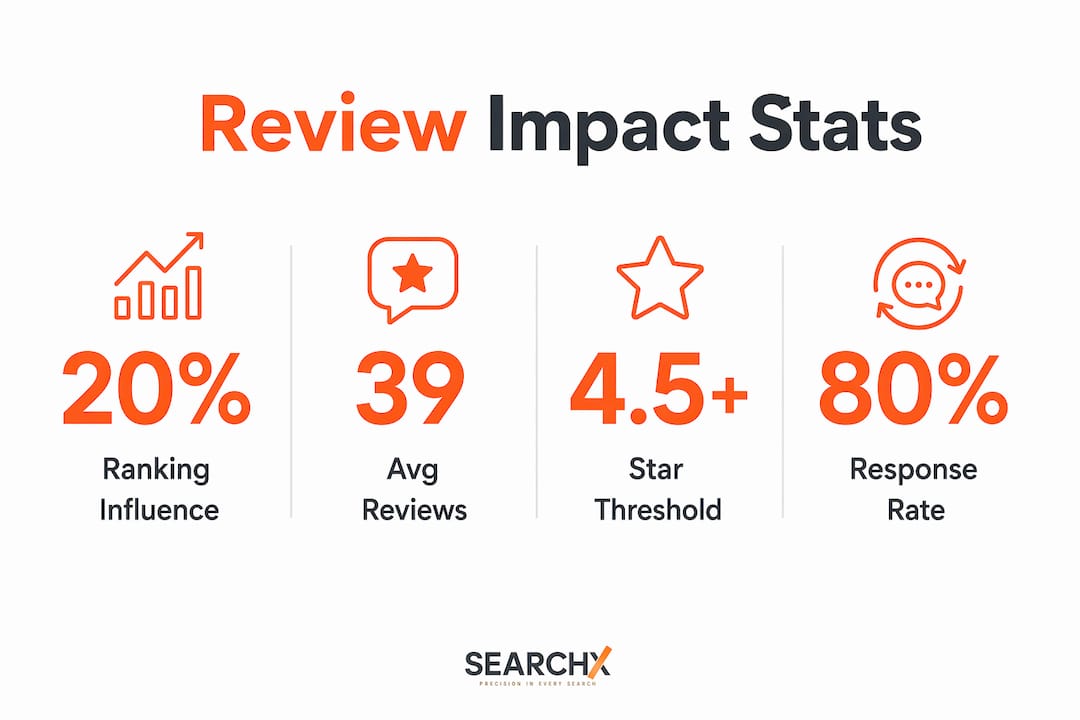
Customer reviews are a top-three local ranking factor in 2026, directly shaping where your business appears in Google’s local pack and organic results. According to Whitespark’s 2026 survey, review signals account for 20% of total local pack ranking influence. That makes them as consequential as your Google Business Profile optimization or your backlink profile. Platforms like Google Business Profile, BrightLocal, Whitespark, and Yotpo all confirm the same pattern: businesses that treat reviews as a managed system consistently outrank those that treat them as an afterthought. The role of reviews in local SEO extends beyond rankings. Reviews drive click-through rates, consumer trust, and conversions in ways that most small business owners have not fully measured.
What review signals does Google use to rank local businesses?
Google does not simply count your stars and move on. It evaluates your review profile across at least five distinct signals, each carrying different weight in local search results.
Volume and competitive benchmarks set the baseline. The average local business carries 39 reviews, while top-three ranking competitors average 47. That gap looks small, but it is enough to push a competitor above you in the local pack. In highly competitive categories like restaurants, legal services, or home improvement, top performers maintain 8 to 15 new reviews every month.
Recency and velocity matter more than most owners realize. Google treats fresh reviews as a signal of an active, relevant business. Stale review profiles cause ranking declines even when total review counts are high, because recency can weigh reviews from the last 30 days approximately four times more than those 18 months old. A business with 200 reviews but nothing new in six months will often rank below a competitor with 60 reviews and a steady monthly flow.

Star rating thresholds have shifted significantly. 31% of consumers will only use a business rated 4.5 stars or higher, up from 17% the previous year. That jump means your rating is now a hard filter for nearly a third of your potential customers, not just a soft preference.
Sentiment and keyword relevance in review text give Google additional ranking data. Google’s AI parses review content for service-specific keywords and location references, using that text to validate your business’s relevance for specific searches. A review mentioning “emergency plumber in Austin” carries more local SEO weight than a generic “great service” comment.
Owner response rates close the loop. Responding to 80% or more of your reviews correlates with stronger local pack presence and can increase conversion rates by up to 16.4%. Google reads active owner engagement as a trust signal.
| Review signal | Effect on local SEO |
|---|---|
| Review volume | Higher counts improve prominence; gap of 8+ reviews vs. competitors affects rankings |
| Recency and velocity | Fresh reviews weighted 4x more than 18-month-old reviews; stale profiles decline |
| Star rating | Ratings below 4.5 now filter out 31% of consumers before they click |
| Keyword-rich review text | Location and service keywords in reviews boost “near me” relevance signals |
| Owner response rate | 80%+ response rate correlates with stronger pack presence and higher conversions |
Pro Tip: Set a recurring calendar reminder every Monday to respond to any reviews from the prior week. Consistency in response timing signals ongoing engagement to Google, not just occasional activity.
How do reviews affect click-through rates and customer conversion?
Rankings get you on the page. Reviews determine whether anyone clicks. This distinction matters because many local businesses optimize for position without realizing that a competitor two spots below them is capturing more clicks through a stronger review profile.
Rich snippets with star ratings increase organic click-through rates by 20 to 30%. When your listing displays a star rating alongside the search result, it draws the eye away from competitors who lack that visual signal. This is why review optimization qualifies as a technical SEO strategy, not just a reputation management task. Structured data markup and indexable review widgets make your review content crawlable and eligible for rich snippet display.
The conversion impact compounds beyond the click. Consider what happens when a potential customer lands on your Google Business Profile and sees 80 reviews averaging 4.7 stars versus a competitor with 12 reviews at 4.2. The higher-volume profile communicates that many people have trusted this business, which reduces the perceived risk of a first purchase.
Here is what the data shows about specific behaviors that drive or kill conversions:
- Businesses that respond to negative reviews publicly recover consumer trust faster than those that ignore complaints. Customers read owner responses as evidence of accountability.
- Review responses that address the customer by name and reference their specific experience outperform generic “thank you for your feedback” replies in building confidence.
- Keyword-rich reviews improve “near me” search visibility by 40%, meaning the content of your reviews directly affects which searches surface your listing.
- AI-powered search engines like ChatGPT now treat review volume and freshness as authority signals, equating them with backlinks in traditional SEO. This means your review profile now influences whether AI tools recommend your business in generated answers.
The practical implication: a business with a well-managed review profile is not just ranking better. It is converting a higher percentage of every impression it earns.
What practical strategies can local businesses use to build reviews?
Most businesses that struggle with reviews have a process problem, not a customer satisfaction problem. Their customers are happy but never asked. Fixing that requires a system, not a one-time push.
-
Automate review requests within 24 hours of a transaction. Send an SMS or email while the experience is still fresh. Tools like Birdeye, Podium, or even a simple Google Business Profile review link embedded in a post-service message work well. The 24-hour window captures peak satisfaction before attention moves elsewhere.
-
Guide customers toward specific language without scripting them. Ask something like: “When you leave a review, it really helps if you mention the specific service you received and the neighborhood you’re in.” This prompt naturally produces keyword-rich, location-specific content that strengthens your relevance signals. Guided customer prompts increase keyword-rich reviews without crossing into fake or scripted territory.
-
Maintain consistent velocity rather than chasing volume in bursts. Consistent monthly acquisition of even 1 to 3 reviews outperforms a one-month surge of 30 followed by silence. Google’s algorithm treats sudden spikes as suspicious and may discount them.
-
Respond to at least 80% of reviews with personalized replies. Avoid templated responses like “Thanks for the great review!” Reference the customer’s specific comment, mention your business name and location naturally, and keep the tone warm but professional. This approach serves both the customer and Google’s parsing of your engagement quality.
-
Use schema markup and indexable review widgets on your website. Review content that Google can crawl contributes to your site’s relevance signals and qualifies your listings for rich snippets. Platforms like Yotpo and Trustpilot offer embeddable widgets with built-in structured data. For a full checklist of local optimization steps, the local SEO checklist from SearchX covers review management alongside the other factors that drive nearby customer acquisition.
-
Avoid over-focusing on perfect ratings. A business with 4.6 stars and 150 reviews is more credible than one with 5.0 stars and 8 reviews. Consumers are skeptical of flawless profiles. A handful of critical reviews, handled well with thoughtful responses, actually builds trust.
Pro Tip: Create a short “review guide” card or digital message that tells customers exactly which platform to use and what to mention. Removing friction from the review process increases completion rates significantly.
How do review strategies differ across industries?
Not every business needs the same review volume to rank. The threshold that wins in a low-competition market will fall short in a dense urban category. Understanding your industry benchmark is the starting point for setting realistic targets.
Restaurants and hospitality businesses face the highest volume expectations. Top-ranking restaurants in major cities often carry hundreds of reviews, with monthly velocity in the double digits. Healthcare providers operate under different dynamics. Patients are less likely to leave reviews spontaneously, so even modest volumes carry more weight relative to competitors. B2B service businesses typically see lower overall counts but benefit disproportionately from detailed, keyword-rich reviews that describe specific outcomes.
| Industry | Competitive review volume | Monthly velocity target | Key signal priority |
|---|---|---|---|
| Restaurants and hospitality | 200 to 500+ | 15 to 40 | Volume, recency, star rating |
| Home services (plumbing, HVAC) | 50 to 150 | 8 to 15 | Keywords, recency, responses |
| Healthcare and dental | 30 to 100 | 3 to 8 | Star rating, sentiment, responses |
| Legal services | 20 to 80 | 3 to 10 | Sentiment, keyword relevance |
| B2B professional services | 10 to 40 | 1 to 5 | Detail, keyword richness |
The reactive approach, waiting for customers to leave reviews organically, works only in low-competition markets. Systematic acquisition, where every transaction triggers a review request, is the standard for businesses competing in dense categories. SearchX’s analysis of NYC small business local SEO shows that smaller businesses consistently close the gap with larger competitors by out-executing on review velocity, not by matching their overall volume overnight.
For businesses in specific markets, understanding how reviews impact local rankings in Austin or other competitive cities provides useful context for calibrating your own targets.
Key takeaways
Reviews function as a managed ranking system, and businesses that treat them as one consistently outperform those that rely on organic accumulation alone.
| Point | Details |
|---|---|
| Reviews drive 20% of ranking influence | Review signals are among the top three local pack factors per Whitespark’s 2026 data. |
| Recency outweighs total volume | Reviews from the last 30 days carry roughly four times the weight of older reviews. |
| Star rating is now a hard filter | 31% of consumers exclude businesses rated below 4.5 stars before clicking. |
| Response rate lifts conversions | Responding to 80%+ of reviews can increase conversion rates by up to 16.4%. |
| Keyword-rich reviews boost relevance | Location and service-specific language in reviews improves “near me” visibility by 40%. |
Why I stopped treating reviews as a reputation metric
After working with local businesses across dozens of markets, the clearest pattern I have seen is this: owners who treat reviews as a reputation metric manage them defensively. Owners who treat reviews as a ranking asset manage them offensively. The difference in outcomes is significant.
The businesses that grow fastest are not chasing five-star perfection. They are building velocity. A dental practice that goes from two new reviews a month to eight does not just improve its rating. It signals to Google that the business is active, trusted, and growing. That signal compounds over time in a way that a one-time review push never does.
What I find most underappreciated is the AI search dimension. Reviews now fill the authority role that backlinks traditionally played for local businesses. When ChatGPT or Perplexity recommends a local service provider, review volume and freshness are among the inputs shaping that recommendation. Businesses that built strong review profiles for Google are now benefiting in AI-generated answers without doing anything extra.
The one mistake I see repeatedly is over-investing in responses to negative reviews while neglecting positive ones. Responding to a one-star review is damage control. Responding to a five-star review with a personalized, keyword-rich reply is a ranking tactic. Both matter, but the second one gets ignored far too often. For a deeper look at how reviews influence search rankings, the mechanics are worth understanding before you build your outreach process.
— SEO
How SearchX helps local businesses turn reviews into rankings
SearchX works with local small business owners and marketing teams to build review acquisition systems that produce consistent ranking gains, not just better ratings. The approach starts with a full audit of your current review profile across Google Business Profile and other relevant platforms, benchmarked against your top local competitors. From there, SearchX builds a custom strategy covering velocity targets, response frameworks, schema markup implementation, and keyword guidance for customer prompts.
If you want to see where your review profile stands right now, the SEO score calculator gives you a fast baseline across the signals that matter most. For businesses ready to move from reactive to systematic, SearchX’s local SEO services provide the structure and execution support to make that shift stick.
FAQ
How much do reviews affect local SEO rankings?
Reviews account for approximately 20% of local pack ranking influence according to Whitespark’s 2026 survey, making them one of the top three local search ranking factors alongside Google Business Profile signals and on-page SEO.
How many reviews does a local business need to rank well?
The average local business has 39 reviews, while top-three competitors average 47. In competitive categories like restaurants or home services, maintaining 8 to 15 new reviews per month is the threshold for sustained top rankings.
Do responses to reviews help SEO?
Responding to 80% or more of reviews correlates with stronger local pack presence and can increase conversion rates by up to 16.4%. Google reads active owner engagement as a trust and relevance signal.
What should customers mention in their reviews?
Customers should mention the specific service they received and the location or neighborhood. Reviews containing location-specific keywords and service details improve “near me” search visibility by 40% by strengthening Google’s relevance signals for your business.
Do reviews help with AI search results like ChatGPT?
AI search engines now treat review volume and freshness as authority signals, functioning similarly to backlinks in traditional SEO. Businesses with strong, recent review profiles are more likely to be cited in AI-generated local recommendations.