
With the med spa industry projected to grow from $21.47 billion in 2025 to $83.9 billion by 2033, competition is fierce – especially in metro areas where clinics are opening at rates of 15–20% annually. To stand out, top-performing clinics leverage local SEO strategies that prioritize visibility in Google’s Map Pack, optimize Google Business Profiles, and target high-intent keywords like “Botox near me.” These efforts are essential, as 76% of local searches on smartphones lead to a business visit within 24 hours, with 28% resulting in a purchase.
Key Takeaways:
- Google Map Pack: Captures 42% of clicks for local searches.
- Google Business Profile: Optimize with accurate NAP (Name, Address, Phone), 5-star reviews, and location-specific content.
- Local Keywords: Combine service, location, and modifiers (e.g., "affordable Botox in [City]").
- Schema Markup: Use structured data to improve search visibility and enable rich snippets.
- Dedicated Service Pages: Create unique, location-specific pages for each treatment to improve rankings.
- Technical SEO: Fix crawl errors, optimize for mobile, and improve site speed for better rankings.
SEO isn’t optional for med spas – it’s the difference between a full schedule and empty treatment rooms. Clinics that consistently apply these strategies see measurable growth in bookings and conversions, often within 60–90 days.
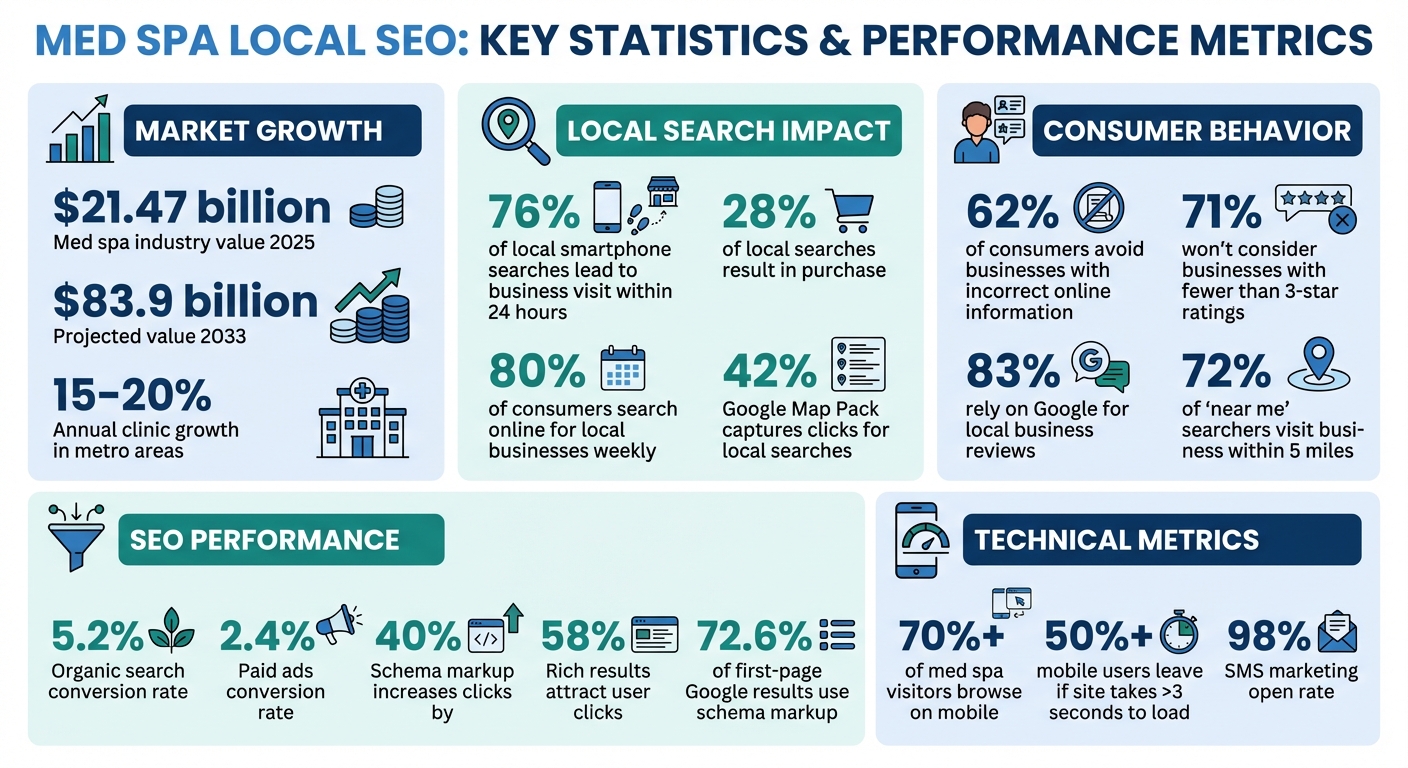
Med Spa Local SEO Statistics and Key Performance Metrics
SEO For Med Spas | SEO Strategy for Single & Multi-Location Med-Spas
Local SEO Strategies for Med Spas
Local SEO is key to attracting ready-to-book clients. Searches like "Botox near me" often lead users to the Google Map Pack, which accounts for 42% of all clicks. To claim one of these coveted spots, med spas need to show Google they’re the most relevant and reliable option for local searchers.
Start by claiming and optimizing your Google Business Profile. Choose "Medical Spa" as your primary category, ensure your NAP (Name, Address, Phone number) is consistent across all platforms, and encourage reviews. Adding local keywords to your website content and implementing schema markup helps search engines better understand your services and location.
When combined, these strategies strengthen your local rankings and bring in high-intent clients.
How to Optimize Your Google Business Profile
The first step is selecting "Medical Spa" as your primary category. Avoid categories like "Day Spa" or "Beauty Salon", as they don’t align with the specific services your audience is searching for. You can also add up to nine secondary categories, such as "Laser Hair Removal Service" or "Skin Care Clinic", to expand your reach.
Fill out every field in your profile completely. Use all 750 characters in the business description to highlight services like Botox, microneedling, or dermal fillers, mention your team’s credentials, and list the neighborhoods you serve. Consistency is crucial – 62% of consumers avoid businesses with incorrect online information. Double-check that your NAP details are identical everywhere they appear.
Photos are another major factor. Upload 100+ authentic, on-site images of your facility, staff, and treatment spaces. Listings with this volume of photos get more clicks and direction requests. Make sure these images are taken on-site to include location metadata, which Google uses to verify authenticity. Avoid stock photos – Google’s algorithms prioritize genuine, location-specific visuals.
Keep your profile active by posting weekly updates. Announce seasonal offers, new services, or educational content. These regular updates signal to Google that your business is active and relevant. Use the Q&A section to answer common questions with keyword-rich responses, such as "Do you offer Botox specials in [City]?".
Reviews play a massive role in local SEO. 71% of consumers won’t consider a business with fewer than three stars, and 83% rely on Google for local business reviews. Make it easy for clients to leave feedback by placing QR codes at your front desk or on receipts. Respond to all reviews – positive or negative – within 24 to 48 hours to show professionalism and build trust.
| Optimization Factor | Impact Level | Key Action |
|---|---|---|
| Primary Category | High | Set to "Medical Spa" |
| Review Count/Score | High | Respond to all reviews within 48 hours |
| NAP Consistency | High | Audit citations for exact matches |
| Photos/Videos | Medium | Upload 100+ high-quality, on-site images |
| Google Posts | Medium | Share weekly updates or seasonal offers |
| Q&A Section | Low/Medium | Add FAQs with keyword-rich responses |
Finding and Using Local Keywords
Once your profile is optimized, focus on local keyword research techniques to improve search relevance.
Local keywords combine three elements: a modifier (e.g., "best" or "affordable"), a core service (like "Botox" or "lip filler"), and a location (your city, neighborhood, or ZIP code). Examples include "best Botox in Dallas" or "affordable microneedling near Downtown Chicago."
"Local keywords are fundamental for connecting potential patients with your med spa services."
- Neil Patel, Co-Founder of NP Digital
To find these keywords, use tools such as Google Keyword Planner, Ubersuggest, and Google Trends. You can also type your service into Google and see what autocomplete suggests – phrases like "CoolSculpting near me" or "Botox deals in [City]" highlight real searches. Study the title tags and headers of top-ranking competitors to identify which keywords they’re targeting.
Create dedicated service pages for each treatment you offer. For example, format URLs as /botox-dallas or /microneedling-chicago instead of grouping all services on one page. This allows you to target specific high-intent searches. Naturally incorporate keywords into page titles, meta descriptions, H1 headers, and content, but avoid overloading your pages with repetitive phrases.
Use local variations throughout your site by including nearby landmarks, neighborhood names, and city nicknames (like "The Big Apple" for New York). For internal links, use location-specific anchor text such as "our med spa in [City]" to strengthen your geographic relevance.
Group your keywords based on search intent:
- Informational: "What is microneedling?"
- Transactional: "Book Botox near me."
- Local: "Med spa in Chicago."
Review keyword performance every three months to stay on top of trends and new treatment popularity.
Adding Local Business Schema Markup
Schema markup is another powerful tool for improving your visibility in search results.
This structured data code, often written in JSON-LD, helps search engines understand your business details beyond on-page text. For med spas, it highlights your name, address, phone number, hours, and services.
Schema enables rich snippets in search results, which can display star ratings, images, and price ranges directly in Google. This can significantly improve click-through rates – websites using schema markup have seen a 40% increase in clicks, and rich results attract 58% of user clicks compared to standard listings.
Use specific schema subtypes like MedicalBusiness, DaySpa, or HealthAndBeautyBusiness instead of the general LocalBusiness tag. Add Service schema for individual treatments like Botox or laser hair removal to align with high-intent searches. Including Review and AggregateRating schema can also display star ratings, building trust at first glance.
Before publishing, test your schema code using Google’s Rich Results Test or the Schema Markup Validator from schema.org to ensure accuracy. Make sure the data matches your Google Business Profile and website footer – any inconsistencies can hurt your rankings.
Schema markup is becoming increasingly important for visibility in AI-driven tools like ChatGPT, Gemini, and Perplexity, as well as voice assistants like Siri and Google Assistant. In fact, 72.6% of first-page Google results now use schema markup. Without it, your med spa risks being overlooked in these emerging technologies.
Building Location-Specific Pages
If your med spa operates in multiple areas, creating separate, dedicated pages for each location is a must. Trying to rank a single homepage for multiple locations is like casting a net too wide – you’ll end up catching nothing. Each location page should have its own unique content that reflects its connection to the community it serves.
"A single homepage trying to rank for every area will rank for none of them." – vaza.ai
To organize your site effectively, use a hub-and-spoke structure. The homepage should link to a central "Locations" page, which then branches out to individual pages for each clinic. This setup helps search engines understand your site’s layout and ensures the right pages rank for the right searches. By aligning with local SEO strategies, these pages help establish your business as a trusted part of each community.
Follow the earlier NAP (Name, Address, Phone number) guidelines by displaying contact details in crawlable text that matches your Google Business Profile. Embed a Google Map and use LocalBusiness schema with geo-coordinates and operating hours to further validate each location.
Make sure to include a "Book Now" or "Schedule Consultation" button prominently at the top of each page. Since 76% of people searching for something nearby on a smartphone visit a business within 24 hours, and 28% of those searches lead to a purchase, it’s crucial to make conversions easy and fast. Ensure these pages load quickly and are mobile-friendly, as most "near me" searches happen on phones.
What to Include on Each Location Page
For each location page, include elements that make it specific, useful, and engaging for potential patients.
- Highlight the team members and practitioners at that location, including their credentials, specialties, and availability. This fosters trust and builds a connection with future patients.
- Showcase unique photos of the clinic, like exterior signage, reception areas, treatment rooms, and any standout features. High-quality, location-specific images make a big difference.
- Add hyper-local details by mentioning nearby landmarks, neighborhoods, or towns. Include practical information like parking options and suite navigation to make visits easier. Instead of a generic "Areas We Serve" list, explain why patients from those areas choose your clinic or how close it is to key neighborhoods.
- Write 3–5 FAQs tailored to that location. Address common concerns like parking validation, evening hours, or specific treatments available at that branch.
- Use location names in key areas like title tags, H1 headings, and the body text. URLs should be clear and direct, such as
/locations/dallasor/locations/downtown-chicago. Craft unique title tags and meta descriptions for each page, like "Botox and Fillers in [Neighborhood Name] | [Brand Name]", to avoid competing with your own pages in search results.
How to Avoid Duplicate Content
To rank well in local searches, each page must have unique content. Copying and pasting generic descriptions across pages won’t cut it. Instead, write 2–4 unique sentences per location that highlight what sets it apart. For instance, if your Dallas clinic is known for subtle Botox results and your Austin clinic specializes in combination treatments, make sure those differences are clear. Only list services actually offered at a specific location – don’t mention treatments that aren’t available there.
While your brand voice can remain consistent, each page should include unique details that reflect its local community. Mention nearby neighborhoods, describe the view from the waiting room, or note proximity to popular spots like shopping malls or business centers. These small, personal touches make the page more valuable to both users and search engines.
NAP consistency is critical. Use the same format (e.g., "123 Main St. Suite 100") across all platforms. Even minor discrepancies can hurt your rankings, as 62% of consumers avoid businesses with incorrect information online.
Finally, connect each location page to the specific services offered there, and link service pages back to the corresponding locations. Use descriptive anchor text like "our med spa in Scottsdale" instead of generic phrases like "click here". This internal linking strategy makes your site easier to navigate for both users and search engines.
Keyword Research for Med Spa Services
With organic search boasting a 5.2% conversion rate – more than double the 2.4% rate of paid ads, selecting the right keywords can significantly boost your bookings.
Focus on long-tail keywords such as "Botox for forehead lines in Houston" or "lip filler cost Dallas." These phrases typically face less competition and attract users with higher booking intent. In highly competitive areas, neighborhood-specific keywords like "Botox in [Neighborhood Name]" can outperform broader city-based terms.
"Local and long-tail phrases like ‘Botox in [city]’ or ‘best lip filler near me’ have far less competition and are searched by people who are ready to book, not just browse." – NeurDigital
To refine your strategy, segment keywords by intent – informational, navigational, transactional, and local. Start with 10–15 primary keywords and supplement them with long-tail variations. Update your keyword list quarterly to keep up with emerging trends and changes in search behavior.
Tools for Finding Keywords
Here are some tools to help you discover and validate high-intent keywords:
- Google Keyword Planner: Free and reliable for checking search volume and competition levels.
- Autocomplete Suggestions: Type a service like "microneedling" into Google Search to see real, location-specific queries.
- AnswerThePublic: Great for uncovering trending questions like "What is the recovery time for laser skin resurfacing?".
- Ahrefs and Semrush: These premium tools (starting at $99/month) are ideal for identifying keyword gaps and analyzing competitor strategies.
- AI-driven platforms: These tools can generate thousands of localized keyword variations, offering a broader scope than traditional methods.
For example, Sonterra Dermatology in San Antonio partnered with DoctorLogic in 2022 to implement AI-powered SEO tools. This approach led to a 48% increase in conversions and a 60-times boost in online reviews, thanks to a shift from generic keywords to hyper-local ones.
| Tool | Primary Use Case | Price Range |
|---|---|---|
| Google Keyword Planner | Search volume and competition analysis | Free |
| AnswerThePublic | Finding trending questions in aesthetics | Free – $99/month |
| Ahrefs / Semrush | Keyword research, competitor analysis, gap identification | $99 – $999/month |
| BrightLocal | Local SEO tracking and citation building | $35 – $125/month |
Once you’ve identified your keywords, organize them into clusters to create focused, high-ranking service pages.
Grouping Keywords by Topic
Structure your keywords into topic clusters based on the treatments you offer – Injectables, Laser Hair Removal, Body Contouring, Facials, and more. This approach allows you to create dedicated service pages that outperform generic "all treatments" pages.
For each service page, aim to target three to five primary keywords and support them with long-tail variations in related blog posts. For instance, your Botox page could target "Botox [city]", "Botox cost [city]", and "Botox for wrinkles [neighborhood]", while blog posts explore topics like "how long does Botox last" or "Botox vs. fillers."
Incorporate natural synonyms (e.g., "facial rejuvenation" instead of "anti-aging treatments") to improve semantic relevance. This aligns with phrase-based indexing, where search engines match queries based on context rather than exact keywords.
"Using the right keywords in your content is like putting your spa on the map for potential clients." – Lori Werner & Sherry Sbraccia, Medical Marketing Whiz
Finally, link related service pages using descriptive anchor text. For example, connect your microneedling page to your PRP page or your body contouring page to weight loss treatments. This internal linking strategy strengthens your site’s authority and improves its overall SEO performance.
Creating Service and Treatment Pages
Each individual treatment – whether it’s Botox, CoolSculpting, or laser hair removal – deserves its own dedicated page with 600–800 words of original content. Start with an easy-to-understand treatment overview, then dive into details like the benefits, a step-by-step explanation of the process (from consultation to recovery), and the criteria for who qualifies, including any contraindications. Highlight provider credentials, certifications, FDA approvals, and other safety-related details to establish trust and professionalism. Pair this with high-quality before-and-after galleries, complete with captions and timeframes. These visual elements can boost conversion rates by 15–20%.
Make sure every page has a unique title tag and H1 header featuring both the treatment name and the location (e.g., "Botox Injections in Miami"). Use MedicalProcedure schema markup to help search engines accurately identify the services you provide. This complements the use of local business schema, strengthening your site’s technical credibility. Additionally, optimize your images with descriptive filenames like "botox-forehead-results.jpg" and include alt text that specifies the treatment and targeted area.
"Every service page needs a unique title tag, H1, and 800+ words – thin pages with duplicate content won’t rank." – Prospelle
Consider adding treatment-specific pricing ranges on these pages. Transparent pricing not only builds trust but also helps attract leads who are already price-qualified, reducing unnecessary inquiries.
Designing Pages for Mobile Users
Your service pages should perform flawlessly on mobile devices. Over half of mobile users will leave a site if it takes more than three seconds to load. To prevent this, compress images to reduce load times while maintaining quality, and use responsive design to ensure the layout adjusts seamlessly across different smartphone screens. Make sure buttons for phone numbers and scheduling are large enough to tap easily, and position your practice’s contact number with a clear call-to-action above the fold, eliminating the need for users to scroll.
For example, Diamond Aesthetics in New York City revamped their service pages in March 2026 with a mobile-first design and automated lead follow-up. This approach allowed them to shift away from paid ads and instead rely on a steady stream of high-value organic leads.
Placing Effective Calls-to-Action
Once your service pages are optimized and mobile-friendly, focus on guiding visitors with clear, targeted calls-to-action (CTAs). Use a tiered strategy to cater to different levels of user readiness. Primary CTAs such as "Schedule Your Consultation" encourage immediate bookings, while secondary options like "Download Our Treatment Guide" appeal to those seeking more information. For visitors who are undecided, soft CTAs like "Call for Pricing" offer a low-commitment option, and social CTAs like "View Results on Instagram" build credibility through social proof.
For mobile users, implement a "sticky" booking button that stays visible as they scroll through the page. Since nearly 70% of customers prefer to book appointments online, integrating scheduling software directly into your site (rather than redirecting to a third-party platform) can provide a smoother experience. Keep the booking process simple, requiring no more than two or three clicks to confirm an appointment.
Responding to digital inquiries promptly is crucial. Leads that receive a reply within minutes are far more likely to convert. For instance, in September 2022, Sonterra Dermatology in San Antonio partnered with DoctorLogic to implement AI-driven SEO and automated review software. This resulted in a 48% increase in conversions and a 60-times increase in client reviews.
Link Building to Improve Domain Authority
Building quality links is one of the most effective ways to boost your domain authority and improve rankings. Think of backlinks as digital votes of confidence – each link from a reputable source tells Google that your med spa is trustworthy and relevant. For local med spas, the quality of links matters far more than quantity. A single link from a respected local news outlet can outweigh dozens of low-value directory listings.
"One quality link from a local news outlet beats 50 spammy directory links." – Mohanraj Reddy
Focus on securing links from sources that enhance your local relevance. These might include local wellness blogs, beauty editors, health directories, or partnerships with community organizations. Platforms like RealSelf, Healthgrades, Zocdoc, and the American Med Spa Association are particularly effective. They attract high-intent users actively searching for treatments like Botox or CoolSculpting, making them ideal for healthcare SEO strategies. Together, a strong internal linking strategy and carefully chosen external backlinks create a powerful foundation for SEO success.
Improving Internal Links
Internal linking is essential for helping search engines understand your site’s structure while guiding visitors to the information they’re looking for. Start by linking your homepage directly to your primary service pages. Then, create connections between related treatments. For instance, link your microneedling page to your PRP therapy page – patients interested in one often want to learn about the other.
To keep everything running smoothly, use tools like Screaming Frog to identify and fix broken links. A well-organized internal linking structure should connect your main service pages with location-specific pages, strengthening your site’s SEO foundation. Once you’ve optimized your internal links, you can shift focus to earning high-quality external backlinks.
Getting Quality Backlinks
A strong internal structure is just the start. To build external authority, reach out to local wellness blogs and beauty editors with offers to guest post or provide expert insights for their articles. Use tools like Ahrefs to analyze the backlink profiles of top-ranking med spas in your area. This can help you identify link sources that are already working for your competitors.
Additionally, optimize your profiles on authoritative directories like Healthgrades, Zocdoc, and the American Med Spa Association. These platforms not only boost your visibility but also provide a solid citation foundation for your business.
Avoid shortcuts like purchasing cheap backlinks. Low-quality, spammy links can lead to search engine penalties and hurt your rankings. Instead, focus on earning links that align with Google’s E-E-A-T (Experience, Expertise, Authoritativeness, and Trustworthiness) guidelines. For med spas, this means publishing accurate, expert-level content and ensuring practitioner credentials are clearly listed. By prioritizing credibility and quality, you can build a backlink profile that enhances both your authority and your reputation.
Technical SEO for Med Spa Websites
Technical SEO forms the backbone of your online presence. Even with the best content and authoritative backlinks, your efforts can fall flat if Google’s crawlers can’t access your pages or if your site loads too slowly. For med spas operating in competitive markets, addressing technical issues is not just helpful – it’s a must. This foundational work complements your local and service-specific SEO strategies, ensuring your site performs at its best.
"Crawl errors aren’t just ‘technical bugs.’ They’re messages from Google’s AI – telling you where your site health, content depth, or authority is lacking." – Sheikh Sobuj, SEO Specialist
The stakes are high. If Google can’t crawl a page, that page has no chance of ranking. For instance, if 40% of your site’s pages go uncrawled, you’re losing a huge slice of SEO potential. A great example of the benefits of addressing technical SEO comes from Sonterra Dermatology in San Antonio. In September 2022, they partnered with DoctorLogic to tackle technical challenges and content gaps using AI-powered SEO tools. The results? A 48% boost in conversions and a 60-times increase in patient reviews.
Fixing Crawl Errors and Metadata Issues
Start by identifying crawl errors that could be holding your site back. Head to Google Search Console and check the "Pages" section. Pay attention to reports like "Crawled – currently not indexed" and "Discovered – currently not indexed." Common problems include:
- DNS errors: When Google can’t connect to your server.
- 404 errors: Broken links that need redirects.
- robots.txt blocks: Files that accidentally block Google from crawling important pages.
Use Google Search Console’s URL Inspection Tool to see how Googlebot views specific pages. The "Test Live URL" feature lets you identify rendering issues. Mobile rendering errors should be fixed immediately since Google uses mobile-first indexing, meaning your mobile site determines your rankings. Regular technical audits with tools like Screaming Frog can help you catch and resolve issues quickly.
Metadata also plays a key role. Replace vague titles like "Welcome to [Med Spa Name]" with keyword-rich options like "Medical-Grade Botox & Fillers in Austin, TX". For pages with high impressions but low clicks, consider rewriting meta descriptions to make them more engaging. Once you’ve made changes, use the "Request Indexing" feature in Google Search Console to speed up the process.
Improving Core Web Vitals
One critical metric to monitor is Time To First Byte (TTFB), which measures how quickly your server responds when someone visits your site. Aim for a TTFB under 200ms – ideally closer to 100ms. If your response time exceeds 500ms, Googlebot may reduce how often it crawls your site. To improve response times, consider:
- Using caching
- Implementing load balancing
- Leveraging a Content Delivery Network (CDN)
Mobile performance is equally important. Around 72% of users searching for "med spa near me" visit a business within five miles. Use Google Search Console to identify and fix mobile usability problems immediately. If your site relies on frameworks like React or Next.js, consider enabling Server-Side Rendering (SSR) to ensure essential content appears as static HTML. AI crawlers like GPTBot and ClaudeBot don’t process JavaScript well, so client-side rendered content might not be visible to them.
Keep an eye on your "Crawl Stats" report in Google Search Console. If you notice TTFB spikes above 500ms, address them promptly. By optimizing these metrics, you not only improve your site’s accessibility but also strengthen its ranking potential. For med spas that require more in-depth technical help, technical SEO services can provide targeted solutions to resolve these issues effectively.
Content Marketing for Med Spas
Content marketing lays the groundwork for building long-term visibility in highly competitive markets. It’s about creating value by teaching first and selling second – answering the real questions patients are asking rather than bombarding them with constant promotions. This educational approach works hand in hand with your medical SEO strategies and local tactics, keeping high-intent clients engaged.
"If your med spa isn’t consistently showing up online with valuable, educational content – you’re invisible to most of your ideal patients." – ClinicGrower
With tools like ChatGPT and Perplexity now pulling answers from structured, well-sourced local content, establishing your business as an educational authority is more important than ever. For example, in 2026, Diamond Aesthetics in New York City transitioned from heavy ad spending on Google and Instagram to an organic SEO strategy. By prioritizing educational content and automating lead follow-ups, the clinic achieved a steady stream of high-value clients – without ongoing ad costs.
Let’s dive into how blog posts can answer patient questions and improve engagement.
Writing Blog Posts for Patients
The best blog posts directly address the questions your potential clients are typing into search engines. Topics like "How long does Botox last?" or "Morpheus8 vs. Microneedling" attract people actively researching treatments. Each post should thoroughly explain the treatment process, costs, expected results, number of sessions, and recovery time.
Structure your content to align with the patient’s journey:
- Awareness: Introduce treatments and explain their benefits.
- Consideration: Compare options and address common concerns, like whether fillers will look unnatural.
- Decision: Include before-and-after photos and highlight provider credentials to help patients choose your clinic.
Aim for posts between 600 and 800 words to strike the right balance between depth and readability for both search engines and human readers [12,29].
Localization is key – use city-based keywords in your titles, headers, and the first 100 words. For instance, "Botox in Austin, TX: What to Expect" will perform better than a generic "Botox Guide". Since over 70% of med spa website visitors browse on mobile devices, keep paragraphs short (two to three lines) and include clear calls-to-action like "Book a free consultation" or "Download our treatment checklist".
Once you’ve created informative blog content, you can repurpose it to amplify your reach across multiple channels.
Sharing Content Across Channels
One blog post can fuel a variety of marketing efforts. Many top-performing clinics use a "one-to-many" approach, repurposing a single article into social media posts, short videos, and email content. For example, in 2025, 7Q Spa Laser & Aesthetics created an "expectation vs. reality" video based on a blog post, which racked up 2.4 million views and 188,600 likes on social media.
Shortened versions of your blog posts can also be shared on your Google Business Profile. Regular updates keep your profile active, boost local map rankings, and provide searchers with more reasons to choose your clinic. Cross-channel integration is essential – use insights from social media engagement to guide future blog topics, and reference recent social posts in email campaigns to keep your audience engaged.
Consistency is key, and batching content creation can help you stay on track. Set aside time to write two blog posts, film four short videos, and schedule ten social media posts all at once. For time-sensitive offers, SMS marketing is highly effective, with text messages boasting a 98% open rate – far higher than email. Don’t forget to automate review requests via text or email within 24 to 48 hours of appointments, when clients are most likely to provide feedback.
Measuring Your SEO Results
Once you’ve implemented your technical and content strategies, the next step is measuring your SEO results to ensure steady growth. Tracking the right metrics is critical, especially in competitive markets. With 80% of customers using Google Search to locate local businesses and 49% relying on Google Maps, understanding your visibility is non-negotiable.
Key metrics fall into three main categories: visibility, engagement, and conversion. Start by analyzing your local pack rankings – the top three map results grab about 42% of all searcher clicks. Tools like Google Search Console can help you track organic traffic, impressions, and click-through rates. It’s also essential to monitor keyword rankings, focusing on both high-intent commercial terms (e.g., "Botox cost Austin") and more specific, informational queries.
While visibility metrics are important, conversion data carries more weight. Keep an eye on appointment bookings, form submissions, and phone calls generated through your Google Business Profile. To measure long-term ROI, compare your cost per acquisition with the $5.70 average cost-per-click for beauty ads.
These metrics provide a foundation for understanding how users engage with your business and how effectively your efforts translate into conversions.
Metrics to Track
Leverage Google Search Console to monitor clicks, impressions, and page performance, and use Google Analytics to identify which treatment pages perform best and where users drop off. Creating dedicated service pages for each treatment – like Botox, CoolSculpting, or laser hair removal – makes it easier to see which services generate the most interest organically.
Your Google Business Profile is another key tool. Check monthly for clicks, website visits, and calls. Pay attention to review volume and sentiment, as Google factors these into local rankings. Aim for a star rating of 4.9 or higher to stay competitive. For example, Sonterra Dermatology in San Antonio partnered with DoctorLogic in 2022 to integrate AI-powered SEO tracking, resulting in a 48% increase in website conversions and a 60x rise in patient reviews.
"Understanding your online analytics is vital to growing your business. Look at which pages on your website bring in the most traffic." – Meevo
Don’t overlook "quick win" opportunities. Use Search Console to find pages ranking in positions 11–20; these can often be optimized to break into the top 10, boosting visibility. Also, track your presence on a hyper-local level – not just city-wide – to identify specific areas for improvement.
By analyzing these metrics, you can make informed adjustments to your strategy. Regular audits will help ensure that your efforts stay on track.
Setting Up Regular Audits
Monthly reviews of rankings, clicks, and bookings can help you identify trends early. During these reviews, confirm that your business name, address, and phone number (NAP) are consistent across platforms like Google, Yelp, and Healthgrades. Inconsistent information can drive 63% of consumers to choose a different provider.
Conduct quarterly technical audits with tools like Screaming Frog to spot broken links, duplicate titles, or slow-loading pages. Monthly checks of Core Web Vitals are also essential, especially since over half of local searches happen on mobile devices, making mobile SEO audits essential. Make sure your site loads quickly on both desktop and mobile.
A simple audit checklist can streamline this process. Include tasks like verifying your Google Business Profile details, reviewing your top-performing content, analyzing landing page conversion rates, and checking for crawl errors. For businesses serious about growth, professional SEO services typically cost $1,000 to $2,000 per month, with hourly consulting rates ranging from $100 to $150. For those who prefer a DIY approach, tools like Google Search Console and Google Analytics are free, while platforms like Ahrefs range from $99 to $999 monthly.
Conclusion
DIY SEO for med spas isn’t just a one-time effort; it’s an ongoing process that can make the difference between a packed schedule and empty treatment rooms. With 80% of U.S. consumers searching online for local businesses every week and 76% of smartphone users visiting a business within a day of performing a nearby search, your online presence directly impacts your bookings.
The strategies outlined – like optimizing your Google Business Profile, creating detailed service pages, managing reviews, and maintaining your website’s technical health – work together to establish a strong online foundation. The best part? SEO generates leads without the recurring costs of paid ads. Unlike ads that stop working as soon as you stop paying, SEO provides long-term results.
"The honest challenge is consistency… doing all of them consistently, indefinitely, while also running your business and performing treatments is where most med spa owners fall short." – Zoca
Google’s local algorithm evaluates over 48 ranking factors, and your competitors are constantly working to improve their own rankings. As this guide highlights, every small update – whether it’s a technical tweak or a new review – plays a role in improving your visibility. Clinics that treat SEO as a continuous effort, rather than a one-time task, will see results. Most med spas notice movement in the Map Pack within 60 to 90 days and improvements in organic rankings within three to six months, but only with consistent work.
FAQs
What’s the fastest way to improve my Google Map Pack ranking?
To boost your ranking in the Google Map Pack, start by refining your local SEO efforts. First, ensure your Google Business Profile is fully updated with accurate and detailed information. Double-check that your Name, Address, and Phone (NAP) details remain consistent across all platforms. Incorporate relevant local keywords into your profile and website to align with search queries.
Another important step is to encourage happy customers to leave 5-star reviews, as positive feedback significantly boosts your credibility. Lastly, consider adding local schema markup to your website to improve search engine visibility. These steps can make a noticeable difference in attracting more local clients and climbing the rankings.
How do I create location pages without duplicate content issues?
To prevent duplicate content on location pages, make sure each page includes unique, locally specific details. Incorporate elements like the name of the city or neighborhood, customized service descriptions, and original photos or testimonials tied to that area. Avoid reusing the same content across multiple pages. Instead, focus on showcasing what sets each location apart. Additionally, use local keywords naturally in both the metadata and the content to enhance its relevance for users and search engines.
Which SEO metrics best show booking growth from organic traffic?
To measure booking growth from organic traffic effectively, focus on conversion rate and local search visibility.
- Conversion rate tells you the percentage of visitors who take the step to book an appointment. It’s a direct indicator of how well your site turns traffic into action.
- Local search visibility includes metrics like your rankings in the Google Map Pack and organic search results. Better visibility means more organic traffic, which can lead to more bookings.
Tracking these metrics helps you understand how your SEO efforts impact appointment bookings.