

TL;DR:
- Enterprise SEO involves optimizing large websites through multi-team coordination, technical strategies, and revenue-focused metrics. It differs from traditional SEO by managing scale, governance, and automation, focusing on business outcomes like revenue and share of voice. Success depends on governance, automation, and embedding SEO into engineering workflows to maintain scalability and drive measurable growth.
Enterprise SEO is the practice of optimizing large, complex websites with thousands or millions of pages by coordinating multi-team efforts, advanced technical strategies, and outcome-driven metrics to improve search visibility and drive measurable business results. Unlike standard search engine optimization, enterprise search engine optimization operates at a scale where a single misconfigured URL parameter can waste crawl budget across hundreds of thousands of pages. Lorenz Esposito, CEO of SearchX, puts it directly: “Enterprise SEO is not just bigger SEO. It is a different discipline that requires governance, automation, and a clear line from search performance to revenue.” The stakes are higher, the teams are larger, and the margin for error is smaller.
What is enterprise SEO and how does it differ from traditional SEO?
Enterprise SEO improves search visibility for large, complex sites with thousands or millions of pages. That scale alone changes everything about how SEO is practiced.
Traditional SEO is largely a one-team effort. A small group handles keyword research, content, and technical fixes. Enterprise SEO requires coordinating marketing, engineering, product, legal, and content teams simultaneously. Standard SEO practices break down at large scale because structural complexity demands governance and prioritization frameworks that go far beyond tactical keyword work.
The table below shows the sharpest contrasts between the two disciplines.
| Factor | Traditional SEO | Enterprise SEO |
|---|---|---|
| Site size | Hundreds to thousands of pages | Hundreds of thousands to millions of pages |
| Team structure | Small, centralized team | Cross-functional, multi-department |
| Technical focus | On-page and basic technical fixes | Crawl budget, indexation, URL architecture |
| Governance | Informal | SEO councils, RACI frameworks |
| Measurement | Traffic and rankings | Revenue impact, share of voice, OKR alignment |
There is no single definition of enterprise SEO, but Google’s crawl budget guidance around one million pages is a common threshold. Operational complexity, including multiple regions, languages, and teams, defines enterprise SEO as much as raw page count does.
The key differences in practice come down to three areas:
- Scale: Multi-region and multi-language sites require standardized workflows that a small team cannot manage manually.
- Governance: Without a formal operating model, SEO recommendations get lost in engineering backlogs or overridden by product decisions.
- Automation: Repetitive tasks like metadata updates, redirect management, and reporting must be automated to maintain consistency across millions of URLs.
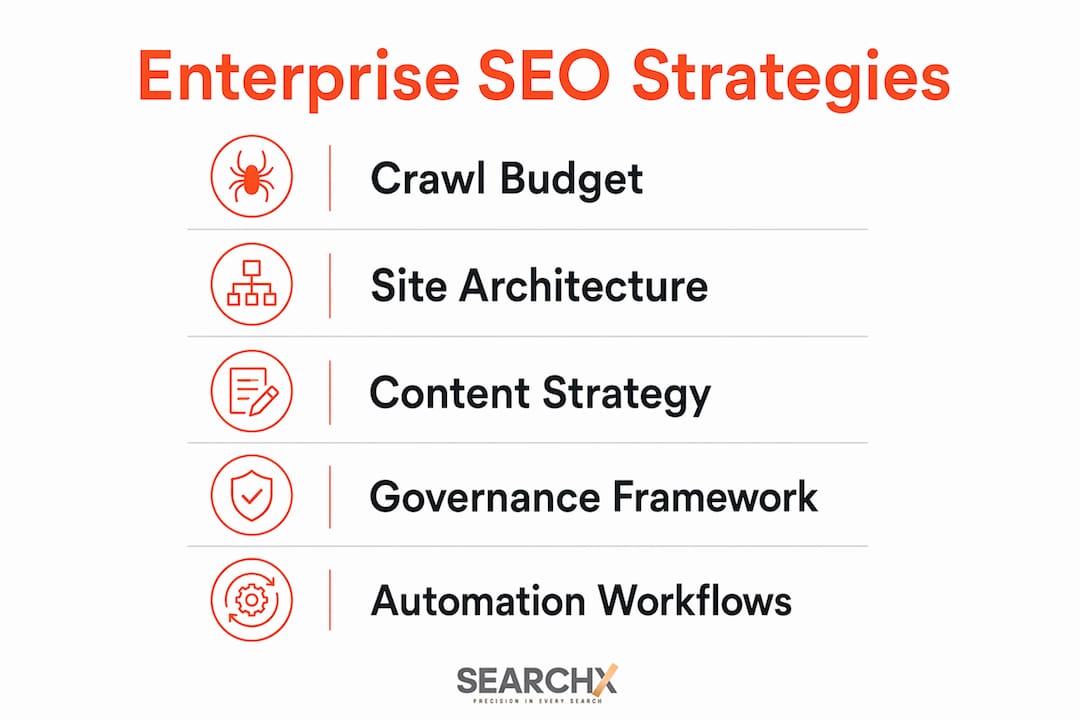
Core enterprise SEO strategies for managing scale and complexity
Crawl budget is the most underestimated technical challenge in enterprise SEO. Crawl budget management focuses on preventing waste from duplicate, parameterized, and faceted URLs. When search engine bots spend time on low-value pages, they delay indexing of new and high-value content. The fix involves robots.txt adjustments, canonical tags, and careful management of URL parameters and pagination.

Site architecture is equally critical. A flat, logical structure reduces the number of clicks from the homepage to any given page. For e-commerce sites with millions of product pages, this means category hierarchies must be planned before launch, not retrofitted after traffic drops.
Content strategy at enterprise scale uses topic cluster models. A central pillar page targets a broad keyword, and supporting pages target specific subtopics. This structure distributes authority across the site and signals topical depth to Google. For multilingual sites, structured data for multilingual SEO ensures that language variants are indexed correctly and served to the right audiences.
Pro Tip: Use Google Search Console’s crawl stats report to identify which URL types consume the most crawl budget. If parameterized or faceted URLs dominate the report, block them via robots.txt before they dilute your index.
Governance frameworks prevent SEO from becoming reactive. SEO councils and RACI frameworks coordinate multiple teams for consistent execution. A RACI model assigns Responsible, Accountable, Consulted, and Informed roles to every SEO task. This eliminates the common scenario where an engineering team deploys a site update that removes canonical tags across 50,000 pages without notifying the SEO team.
Enterprise SEO requires standardized workflows and automation tailored to complex, multi-location or multi-language sites. Tools like Screaming Frog, Botify, and Semrush Enterprise provide the crawling, log file analysis, and reporting capabilities that manual audits cannot match at scale. Pairing these tools with workflow automation for SEO reporting reduces the time teams spend on data collection and increases time spent on analysis.
How do you measure enterprise SEO success?
Enterprise SEO measurement focuses on business outcomes, specifically revenue impact and share of voice, not just traffic or rankings. This distinction matters because a CMO does not care that organic sessions increased by 12%. They care that organic revenue grew by $2.4 million in Q2.
The most effective enterprise SEO KPIs connect directly to company OKRs:
- Revenue from organic search: Tracked in Google Analytics 4 or a business intelligence platform like Looker or Tableau.
- Share of voice: The percentage of total search impressions your brand captures across a defined keyword set.
- Conversion influence: How organic traffic contributes to pipeline, not just last-click conversions.
- Crawl coverage rate: The percentage of priority URLs indexed versus total URLs submitted.
- Page experience scores: Core Web Vitals performance across key landing page templates.
Custom reporting frameworks serve different stakeholders differently. Engineers need technical dashboards showing crawl errors and index coverage. Executives need a one-page summary showing revenue attribution and competitive share of voice. Building both from the same data source prevents conflicting narratives.
Lorenz Esposito of SearchX emphasizes this point: “The teams that win executive buy-in for enterprise SEO are the ones that speak the language of the business. Show the CFO a revenue number, not a keyword ranking.” Aligning SEO KPIs with business goals is not optional at the enterprise level. It is the difference between a well-funded program and one that gets cut during the next budget cycle.
Early wins matter for sustaining momentum. Identifying quick technical fixes that produce visible ranking improvements within 60 to 90 days gives leadership a reason to keep investing. Pair those wins with a clear narrative about the longer-term program to maintain credibility.
How to coordinate cross-team SEO efforts at scale
Cross-team coordination is where most enterprise SEO programs fail. Governance is essential in enterprise SEO because many moving parts and multiple stakeholders require coordinated processes beyond technical fixes alone.
The most common failure mode is SEO living entirely within the marketing team while engineering controls the website. Recommendations sit in a backlog for months. By the time a fix is deployed, the competitive window has closed. The solution is to embed SEO requirements into the engineering release process itself.
A practical approach to cross-team coordination involves four steps:
- Map all SEO touchpoints across teams. Identify every workflow where a non-SEO decision can affect search performance, including site migrations, CMS updates, and product page redesigns.
- Assign RACI roles for each touchpoint. Every SEO-critical task needs a named owner, not a team label.
- Create SEO acceptance criteria for engineering tickets. Before any code ships, a checklist confirms that canonical tags, metadata, and structured data are intact.
- Hold a monthly SEO council meeting with representatives from marketing, engineering, product, and content. Review the backlog, resolve conflicts, and align on priorities.
Pro Tip: Treat SEO like a quality assurance gate in your release pipeline. If a deployment fails the SEO checklist, it does not ship. This single process change prevents the most common and costly technical regressions.
Aligning SEO narratives with business outcomes is equally important for internal communication. Framing SEO recommendations in terms of revenue risk, not ranking loss, gets faster responses from product and engineering leadership.
What does enterprise SEO look like in 2026?
AI and automation have fundamentally changed enterprise SEO workflows. AI and automation enable enterprise SEO to maintain consistency and efficiency across large sites. Generative AI tools now assist with content briefs, meta description generation at scale, and internal linking recommendations across millions of pages.
The most significant shifts shaping enterprise search engine optimization in 2026 include:
- AI-assisted content audits: Tools can now analyze thousands of pages for quality signals and flag underperforming content faster than any manual process.
- Search intent modeling: Enterprise teams use behavioral data from Google Search Console and session analytics to map intent shifts across keyword clusters and update content accordingly.
- Mobile-first indexing maturity: Google indexes the mobile version of pages first. Enterprise sites with inconsistent mobile templates face indexation gaps that compound at scale.
- Voice and conversational search: Query patterns are shifting toward longer, question-based searches. Enterprise content strategies now include FAQ schema and conversational page structures to capture these queries.
- Multi-location SEO management: Brands with hundreds of physical locations need location-specific pages that meet both local and national search intent simultaneously.
Continuous governance evolution is not optional. The teams that treat their SEO operating model as a living document, updating it as tools and algorithms change, consistently outperform those that set a strategy once and revisit it annually.
Key Takeaways
Enterprise SEO succeeds when governance, technical precision, and revenue-aligned measurement work together across every team that touches the website.
| Point | Details |
|---|---|
| Scale requires governance | SEO councils and RACI frameworks prevent technical regressions and keep multi-team execution consistent. |
| Crawl budget is a priority | Block low-value URLs via robots.txt and canonical tags to protect indexing of high-value pages. |
| Measure revenue, not rankings | Connect organic performance to revenue impact and share of voice to earn and keep executive support. |
| Embed SEO in engineering workflows | Add SEO acceptance criteria to release checklists to stop costly technical errors before they ship. |
| Automation is non-negotiable | Tools like Botify, Semrush Enterprise, and Screaming Frog are required to manage SEO at millions-of-pages scale. |
The governance gap nobody talks about
Most enterprise SEO articles focus on the technical side. Crawl budget, site architecture, structured data. Those things matter. But in my experience, the biggest reason enterprise SEO programs underperform is not a technical failure. It is a governance failure.
I have seen organizations with excellent technical SEO infrastructure lose ground to competitors because no one owned the process of getting recommendations implemented. The SEO team produced thorough audits. Engineering had a 14-week backlog. Nothing moved.
The fix is not a better audit. It is a seat at the table in the product planning cycle. When SEO requirements are written into sprint tickets before development starts, the implementation rate goes from sporadic to consistent. That consistency compounds over 12 to 18 months into a measurable competitive advantage.
Lorenz Esposito of SearchX frames it this way: “Enterprise SEO is 30% strategy and 70% execution. The organizations that win are the ones that build systems for consistent execution, not the ones with the most sophisticated keyword models.”
The other underrated factor is patience. Enterprise sites move slowly. A technical fix deployed in january may not show ranking impact until april. Leaders who expect 90-day results from a program that operates on 12-month cycles will defund it before it delivers. Setting accurate expectations early, backed by data on typical enterprise SEO timelines, is as important as the strategy itself.
— SEO
SearchX enterprise SEO solutions for large-scale growth
SearchX works with enterprise marketing teams to build SEO programs that connect directly to revenue. From enterprise keyword research to technical audits and governance frameworks, every engagement is built around your specific business goals, not a generic template.
Lorenz Esposito, CEO of SearchX, puts the agency’s approach plainly: “We do not hand clients a report and walk away. We build the systems and processes that make SEO execution repeatable at scale.” If your team is ready to connect organic search to real revenue, the SearchX keyword research guide is a strong starting point. For a customized enterprise SEO consultation, contact SearchX and speak directly with the team about your program.
FAQ
What does enterprise SEO mean for large websites?
Enterprise SEO is the discipline of optimizing websites with thousands to millions of pages by coordinating technical, content, and governance strategies across multiple teams. It goes beyond standard SEO by requiring formal operating models and revenue-aligned measurement.
How is enterprise SEO different from regular SEO?
Regular SEO is managed by a small team with a limited page set. Enterprise SEO requires cross-functional coordination across marketing, engineering, and product teams, plus automation and governance frameworks to maintain consistency at scale.
What are the most important enterprise SEO KPIs?
The most important enterprise SEO KPIs are revenue from organic search, share of voice, and conversion influence. Rankings and traffic are secondary metrics that support, but do not replace, business outcome reporting.
How do you manage crawl budget for a large site?
Crawl budget management requires blocking low-value URLs through robots.txt, using canonical tags to consolidate duplicate content, and auditing URL parameters and faceted navigation to prevent crawl waste.
What tools do enterprise SEO teams use?
Enterprise SEO teams rely on platforms like Botify, Semrush Enterprise, and Screaming Frog for crawling and log file analysis. Google Search Console and Looker or Tableau handle performance reporting and executive dashboards.