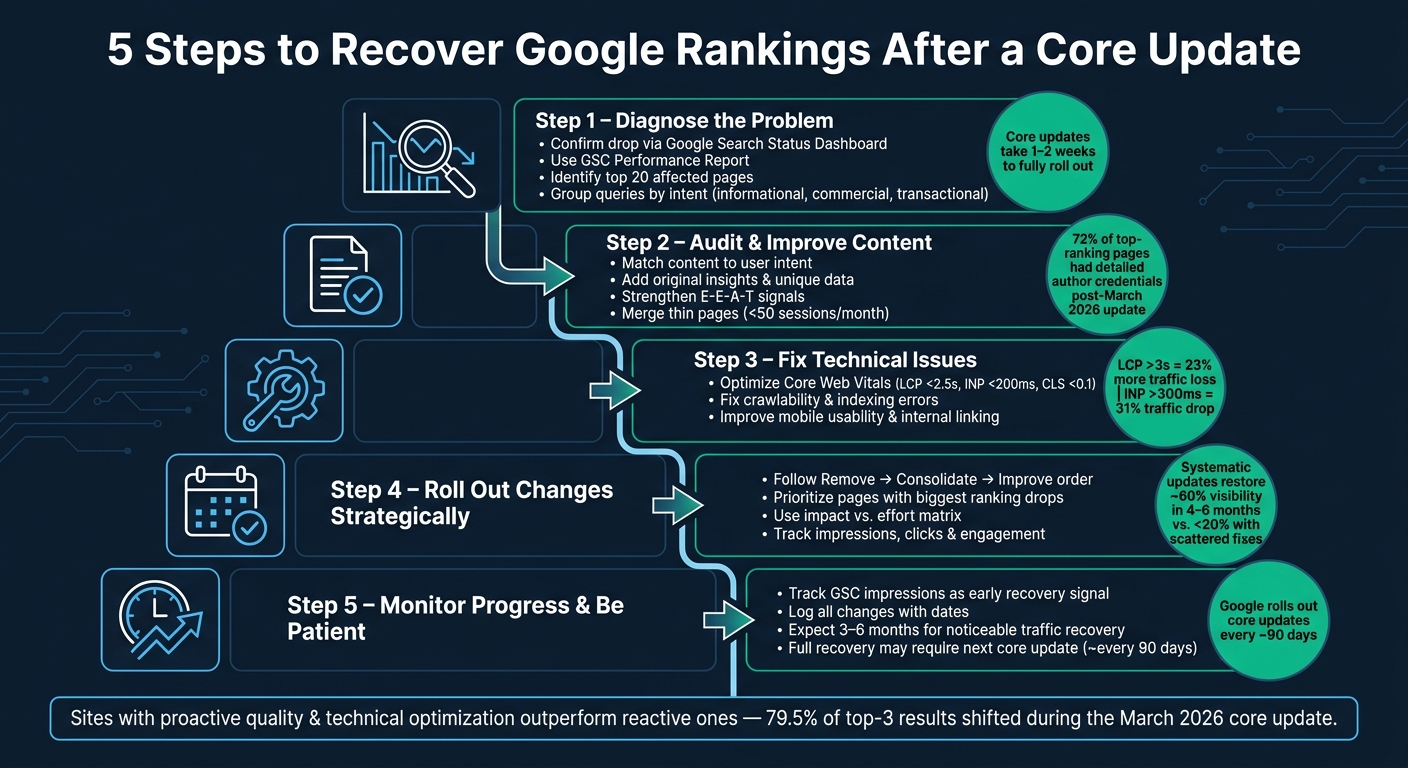
When Google rolls out a core update, your rankings might drop unexpectedly. These updates don’t penalize your site – they change how Google evaluates content, prioritizing depth, trust, and user experience. Recovery isn’t about quick fixes; it’s about improving your entire site to meet Google’s updated standards. Here’s a simple breakdown:
- Step 1: Diagnose the Problem
Confirm the drop is from a core update using Google Search Console and analyze which pages and queries are most affected. - Step 2: Audit and Improve Content
Align content with user intent, add original insights, and strengthen E-E-A-T (Experience, Expertise, Authoritativeness, Trustworthiness). - Step 3: Fix Technical Issues
Optimize Core Web Vitals, improve page speed, and resolve crawlability or indexing errors. - Step 4: Roll Out Changes Strategically
Prioritize impactful updates and track performance metrics like impressions, clicks, and engagement. - Step 5: Monitor Progress and Be Patient
Recovery can take months, often requiring the next core update for full results.
Key Insight: Focus on quality content and technical optimization to build a site that thrives through future updates.
5 Steps to Recover Google Rankings After a Core Update
Recovering From Google Updates 100% Recovery from a Core Update to Another
Step 1: Diagnose the Ranking Drop
Before making any changes to your content or site, it’s crucial to figure out what caused the ranking drop in the first place.
Confirm the Core Update Caused the Drop
Start by checking the Google Search Status Dashboard to verify if a core update occurred. Then, head to Google Search Console (GSC) to look for indexing errors. If you notice a sharp decline in rankings within a few days of a confirmed update, it’s likely tied to that update. On the other hand, a slow and steady drop over months usually signals aging content or technical issues.
"If your rankings cratered two days after a confirmed core update began rolling out, that’s probably not a coincidence." – Brett Helling, Founder, Trendline SEO
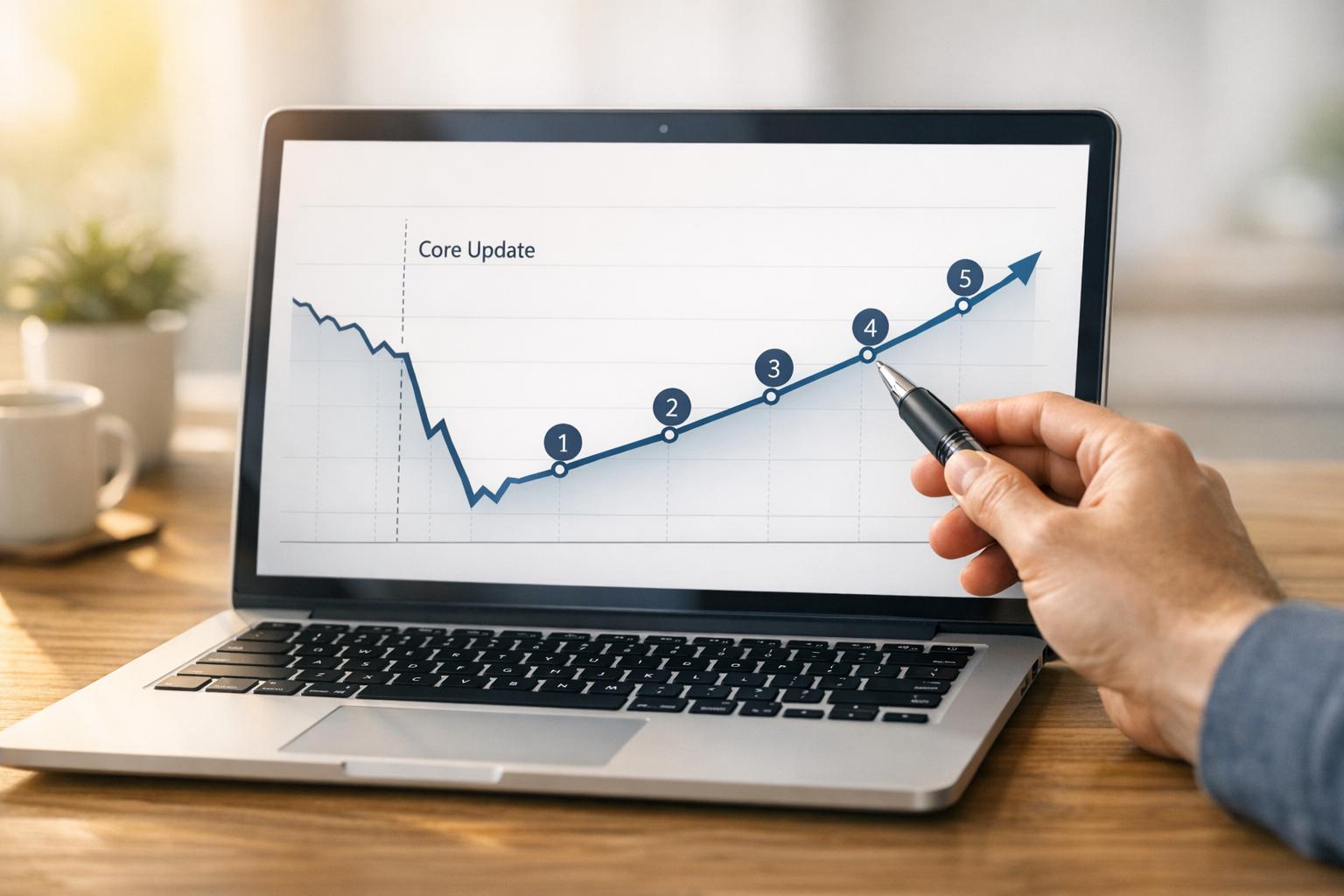
Patience is key here. Core updates often take 1–2 weeks to fully roll out, during which rankings can fluctuate wildly – a phenomenon known as the "Google Dance." Acting too soon could lead to fixing the wrong problems. Waiting until the update settles ensures you’re addressing the right issues.
Once you’ve confirmed the update is the cause, the next step is pinpointing which pages and queries were most affected.
Find the Affected Pages and Queries
After the update stabilizes, use GSC’s Performance Report’s Compare feature to analyze a stable 14-day period before the update against the same timeframe after it concludes. Sort results by "Clicks" and "Impressions" to identify the pages and queries with the biggest traffic drops.
Create a list of the top 20 pages with the steepest declines. Then, group the affected queries by intent – whether they’re informational, commercial, or transactional. For instance, if blog posts suffered but service pages remained steady, the issue might be tied to content quality rather than technical problems. Also, check if the drop is isolated to mobile users or specific regions by filtering for device and country. This could point to usability or localization challenges, requiring a mobile SEO audit to identify technical performance issues.
Don’t forget to use the Search Appearance filter in GSC. Sometimes, what looks like a ranking drop is actually due to changes in how search results are displayed, such as losing a Featured Snippet or being pushed down by new SERP features.
Review Competitor Performance
Now that you know which areas are affected, compare them to competitors to understand how ranking standards have shifted. For each underperforming page, identify who replaced you in the rankings.
Pay attention to three factors on the new top-ranking pages: content depth, author credentials, and format. For example, after the March 2026 update, 72% of high-ranking pages included detailed author credentials – up from 58% prior to the update. Additionally, sites featuring original research or proprietary data saw a 22% boost in visibility. If competitors are using comparison tables, exclusive data, or step-by-step guides where you had a standard blog post, Google’s interpretation of user intent may have shifted. This pattern was evident when sites with weaker topical authority and relevance lost significant traffic following the update.
"A single original data point is worth more than ten rewritten blog posts in Google’s current ranking system." – Kawsar Ahmed, SEO Specialist
Step 2: Audit and Improve Your Content
Once you’ve identified the pages that saw the biggest ranking drops, it’s time to dig into the content itself. This is where the bulk of recovery efforts take place – and where meaningful improvements can make a real difference.
Check That Content Matches User Intent
Run a search for your target keywords in an incognito browser. Take a close look at the top 5 results: Are they blog posts, product pages, comparison guides, or something entirely different? If your page format doesn’t match what currently dominates the search results, your content might be misaligned with user intent.
Make sure your content directly addresses common follow-up questions. Pay attention to any AI Overviews that appear in the search results. The March 2026 Core Update impacted about 55% of monitored websites, with affected pages dropping an average of 8 positions in rankings. A significant portion of these drops came down to intent mismatches rather than poor-quality writing. Interestingly, pages using FAQ schema experienced an average ranking boost of 12% after the update. This suggests that structured, question-focused content is being rewarded.
To confirm your content aligns with user intent, review user engagement metrics in your analytics tools. From there, you can refine and expand your content to better meet evolving user expectations.
Add Depth and Original Value to Content
Generic, surface-level content no longer makes the cut. Google’s algorithms now prioritize what’s often called "information gain" – the unique value your content offers that isn’t already covered by other top-ranking pages.
To stand out, enhance your pages with original insights, such as specific data, unique case studies, or detailed examples. Use your performance data to identify which pages need this type of improvement most. For instance, if you’re writing about conversion rate optimization, include test results or firsthand observations. As one analysis noted:
"The era of publishing volume as a strategy is ending. Fewer pages with deeper insight, original perspective, and real expertise beats a content calendar full of AI-generated filler every time." – Vantacron
If you have several thin pages covering the same topic, consider merging them into one comprehensive resource. Pages drawing fewer than 50 sessions per month and lacking backlinks are prime candidates for consolidation or removal.
Beyond adding depth, your site’s credibility plays a major role in rankings.
Strengthen E-E-A-T Signals
E-E-A-T – Experience, Expertise, Authoritativeness, and Trustworthiness – isn’t just a buzzword. It’s how Google assesses whether your content deserves to rank. Strengthening these signals complements your technical fixes by building trust and authority. After the March 2026 update, 72% of top-ranking pages included detailed author credentials, up from 58% before the update. That’s a significant shift.
Start by focusing on your author bylines. Every article should link to a dedicated bio page that highlights the writer’s credentials, professional background, and other published work. For product reviews or how-to guides, include original screenshots, before-and-after results, or real performance data – these details show that your content is based on firsthand experience. Trustworthiness is especially crucial: ensure your site uses HTTPS, has a clear contact page, and includes properly cited sources throughout.
Here’s a quick summary of E-E-A-T components and their impact on rankings:
| E-E-A-T Component | Key Signal to Implement | Impact on Visibility |
|---|---|---|
| Experience | Screenshots, case studies, original videos | High – hard to replicate with AI |
| Expertise | Author bios with relevant certifications | High (Critical for YMYL topics) |
| Authoritativeness | Backlinks from respected sources, guest contributions | Medium-High (Builds brand authority) |
| Trustworthiness | HTTPS, clear contact info, cited sources, privacy policy | Highest (Foundational for E-E-A-T) |
Don’t overlook your "About" page. Including details like team credentials, company history, and industry affiliations helps Google – and your audience – understand who’s behind your content. Sites that publish original research and unique data have seen an average visibility increase of 22% after recent algorithm changes. Clearly, demonstrating real expertise and authority pays off.
Step 3: Fix Technical and Usability Issues
Even the best content can fall short if technical problems prevent Google from properly assessing your site. After refining your content and bolstering your E-E-A-T signals, the next step is tackling the technical issues that might be holding your site back. Here’s how to address key technical factors to complement your content improvements.
Improve Core Web Vitals and Page Speed
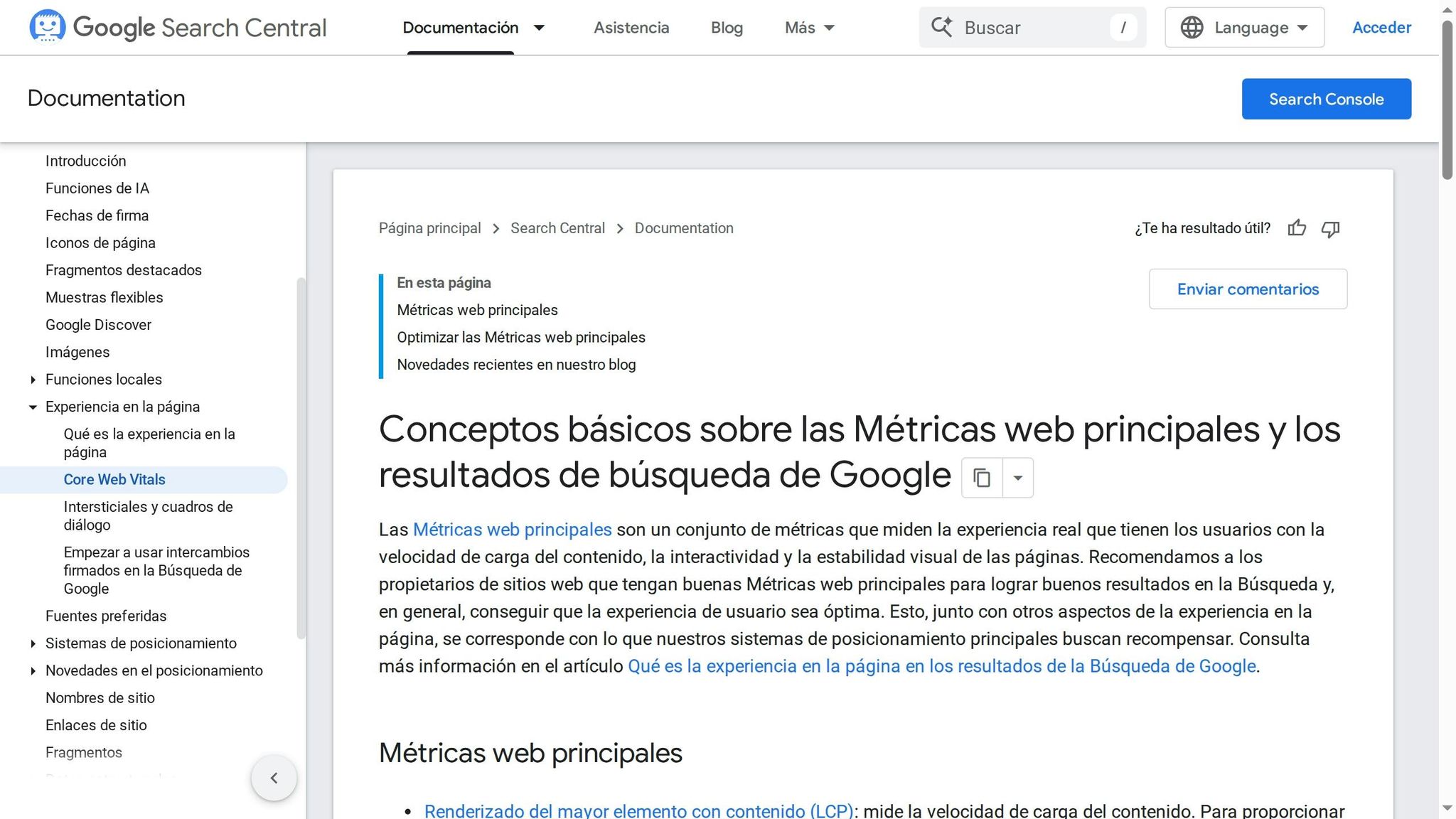
Technical SEO basics are critical for a full recovery. Core Web Vitals, for instance, often act as tiebreakers when competing content is equally strong. If your site’s scores lag behind, you’re giving competitors an edge. Consider this: sites with a Largest Contentful Paint (LCP) above 3 seconds saw 23% more traffic loss during the December 2025 update, while Interaction to Next Paint (INP) scores above 300ms resulted in a 31% traffic drop – especially on mobile.
Here are the targets to aim for:
| Metric | Target | Falling Short Means |
|---|---|---|
| LCP (Largest Contentful Paint) | < 2.5 seconds | > 3s linked to 23% more traffic loss |
| INP (Interaction to Next Paint) | < 200 milliseconds | > 300ms linked to 31% traffic loss |
| CLS (Cumulative Layout Shift) | < 0.1 | High scores lead to jarring layout shifts |
| TTFB (Time to First Byte) | < 800 milliseconds | Slower response delays content and crawling |
To improve these metrics, use tools like PageSpeed Insights to pinpoint problem areas. Quick fixes include preloading hero images with <link rel="preload" as="image"> and removing render-blocking JavaScript above the fold. These adjustments can significantly improve your LCP score. Keep in mind that Google evaluates Core Web Vitals across your entire site, and improvements are often reflected within 4–8 weeks.
Fix Indexing and Crawlability Errors
Even if your pages are perfectly optimized, they won’t rank if Google can’t access or render them. Use Search Console’s URL Inspection tool to ensure that JavaScript-rendered content is properly indexed. Double-check your robots.txt file to avoid misplaced Disallow directives. As highlighted in Insight Engine’s SEO Debugging Guide:
"A single robots.txt error can block entire site sections, a misconfigured canonical can trigger large-scale duplication, and rendering failures can prevent search engines from seeing your content at all."
Watch for hidden issues like JavaScript-injected noindex tags, which can block pages from ranking if overlooked during server-side audits. Additionally, manage your crawl budget wisely. Faceted navigation, URL parameters, and empty category pages can generate low-value URLs that distract Googlebot from reaching your high-priority pages. Removing or noindexing thin content can boost your site’s quality ratio and free up crawl budget for important content.
For a step-by-step guide, check out SearchX’s technical SEO services or their detailed guide on optimizing robots.txt for SEO.
Once Google’s crawlers can effectively access your site, focus on improving the user experience to reinforce your rankings.
Improve On-Page Usability
After resolving technical issues, refining on-page usability can further strengthen your site’s performance. This not only enhances user engagement but also helps Google assess your content more favorably. Make sure your mobile and desktop versions are consistent in terms of content, headings, and schema markup. Discrepancies can lead Google to rank a simplified or incomplete version of your page.
Formatting also plays a big role. Use bullet points, numbered lists, and tables to make content easier for users and AI to digest. Additionally, audit your site for orphaned pages – important pages that lack internal links. These pages lose topical authority and may remain invisible to crawlers. A strong internal linking structure ensures that your most authoritative pages support the rest of your site while making it easier for Google to access and rank all your valuable content.
Step 4: Roll Out Changes and Track Progress
Once you’ve pinpointed the technical and content issues, the next step is implementing those fixes in a way that maximizes their impact. The order of execution matters, so a strategic approach is key.
Prioritize and Schedule Your Updates
Not all fixes demand equal attention or urgency. A practical way to tackle updates is by following the "Remove-Consolidate-Improve" strategy. Start by removing low-quality or thin pages that harm your site’s overall performance. Next, merge content that overlaps, reducing redundancy. Finally, focus on improving pages that have the potential to perform well.
Give priority to pages that have experienced significant ranking drops – for example, a page falling from position 4 to 29. Smaller shifts, like a drop from position 2 to 4, may stabilize without intervention. To streamline this process, use an impact vs. effort matrix to identify quick wins. Group your updates into topical batches and schedule them accordingly.
Once you have a clear plan, it’s time to adjust your SEO strategy and assess how these changes affect your site’s performance.
Monitor Recovery Metrics
After implementing updates, start tracking performance metrics to measure progress. Early indicators like impressions in Google Search Console often show recovery before rankings or clicks reflect significant changes. Pair these insights with user engagement data – metrics like scroll depth and dwell time can reveal whether your content updates are resonating with visitors.
Here are key metrics to monitor:
| Metric Category | Specific KPI | Tool |
|---|---|---|
| Visibility | Impressions, Avg. Position, CTR | Google Search Console |
| Traffic | Organic Sessions, New Users | Google Analytics 4 |
| Engagement | Dwell Time, Scroll Depth, Bounce Rate | GA4 / Hotjar |
| Technical | LCP (<2.5s), INP (<200ms), CLS (<0.1) | PageSpeed Insights |
| Business | Conversion Rate, Organic Revenue | GA4 |
Keep a change log to document updates. Record the date, the pages affected, and the specific changes made. This log will help you identify which actions are driving results.
Set Realistic Recovery Timelines
Recovery takes time, and setting achievable expectations is essential. On average, traffic improvements become noticeable within 3–6 months. For sites that follow a systematic, content-driven update plan, about 60% of lost visibility can be regained within 4–6 months. In contrast, scattered, reactive updates typically restore less than 20% of visibility.
"Content impacted by one core update might not recover until the next core update rolls out." – Google
Google typically rolls out core updates every 90 days. This means full recovery often depends on the next major update, as Google reassesses your site. While technical fixes might show results within 4–8 weeks, full ranking recovery requires patience and planning. Approach recovery in phases, and set milestones to measure progress rather than expecting immediate results.
Conclusion: Building for Long-Term Ranking Stability
Recovering from a core update isn’t something you tackle once and forget – it’s an ongoing process. The steps outlined in this guide – diagnosing ranking drops, auditing and improving content, addressing technical issues, and tracking changes – create a repeatable system to handle updates effectively.
The numbers tell the story: during the March 2026 core update, 79.5% of top-3 results shifted, and 24.1% of pages that were in the top 10 dropped out of the top 100 entirely. Sites that succeeded had already prioritized content quality and technical optimization well before the update hit, rather than scrambling to react afterward.
Two key practices separate sites that thrive from those that struggle. First, continuously manage E-E-A-T (Expertise, Experience, Authoritativeness, and Trustworthiness): regularly update author credentials, add original research, and keep evergreen content fresh with new insights. Second, maintain a strong technical foundation. For example, during the December 2025 update, sites with a Largest Contentful Paint (LCP) above 3 seconds lost 23% more traffic compared to faster-loading competitors. These stats highlight the importance of consistent effort in improving performance.
"Recoveries from core updates come from quality improvements, not quick fixes. Sites that invest in quality over time tend to stabilize and grow across multiple updates." – Charwin Vanryck deGroot, BKND Development
This underscores the importance of a proactive, quality-first approach. If this feels like too much to handle alone, teaming up with experts like SearchX can provide the structured, long-term support you need. From technical audits to content development, they’ll help you stay ready for whatever Google throws your way.
FAQs
How do I know it was a core update?
When trying to figure out if a core update impacted your site, look at the timing. If your traffic and rankings took a hit right around the dates Google officially announced the update, there’s a good chance the two are connected. Core updates typically lead to noticeable ranking changes across the board, so aligning your performance drop with the update’s rollout can help you pinpoint the cause.
What content changes move the needle fastest?
Improving rankings quickly starts with tackling the core quality signals: originality, expertise, authority, and trustworthiness (E-E-A-T). Simple tweaks – like reworking introductions or stuffing in extra keywords – won’t move the needle much. Instead, put your energy into major upgrades that emphasize unique content, showcase the author’s credentials, incorporate firsthand experiences, and strengthen your authority on the topic. By aligning these meaningful updates with Google’s core update priorities, you’ll have a better shot at faster recovery and improved rankings.
How long does recovery usually take?
Recovery from a Google core update usually takes anywhere from 3 to 6 months, depending on how significantly your site was affected and the steps you take to address the issues. While Google may start re-crawling and re-indexing your site within 1 to 4 weeks, achieving full recovery demands ongoing efforts. This includes improving content quality, refining technical SEO, and enhancing the overall user experience. It’s important to view recovery as a gradual process rather than something that can be resolved overnight.