
SEO for med spas in 2026 is a long-term investment that typically takes 6 to 12 months to deliver stable results. This timeline is influenced by Google’s strict standards for medical-related content, known as YMYL (Your Money or Your Life). Here’s a quick breakdown:
- 0–3 Months: Focus on technical audits, Google Business Profile (GBP) optimization, and local citations. Early wins include improved indexing and slight local visibility gains.
- 3–6 Months: Build content depth, acquire backlinks, and increase review velocity. Expect noticeable traffic growth and better rankings for mid-level keywords.
- 6–12+ Months: Strengthen authority with long-form content, technical SEO, and backlinks. Achieve consistent leads, top 3 Map Pack rankings, and sustainable traffic.
SEO for med spas requires patience but pays off by reducing long-term costs per patient acquisition. Start with GBP optimization, consistent reviews, and service-specific pages to see early progress. By month six, organic traffic and appointment bookings typically show steady growth.
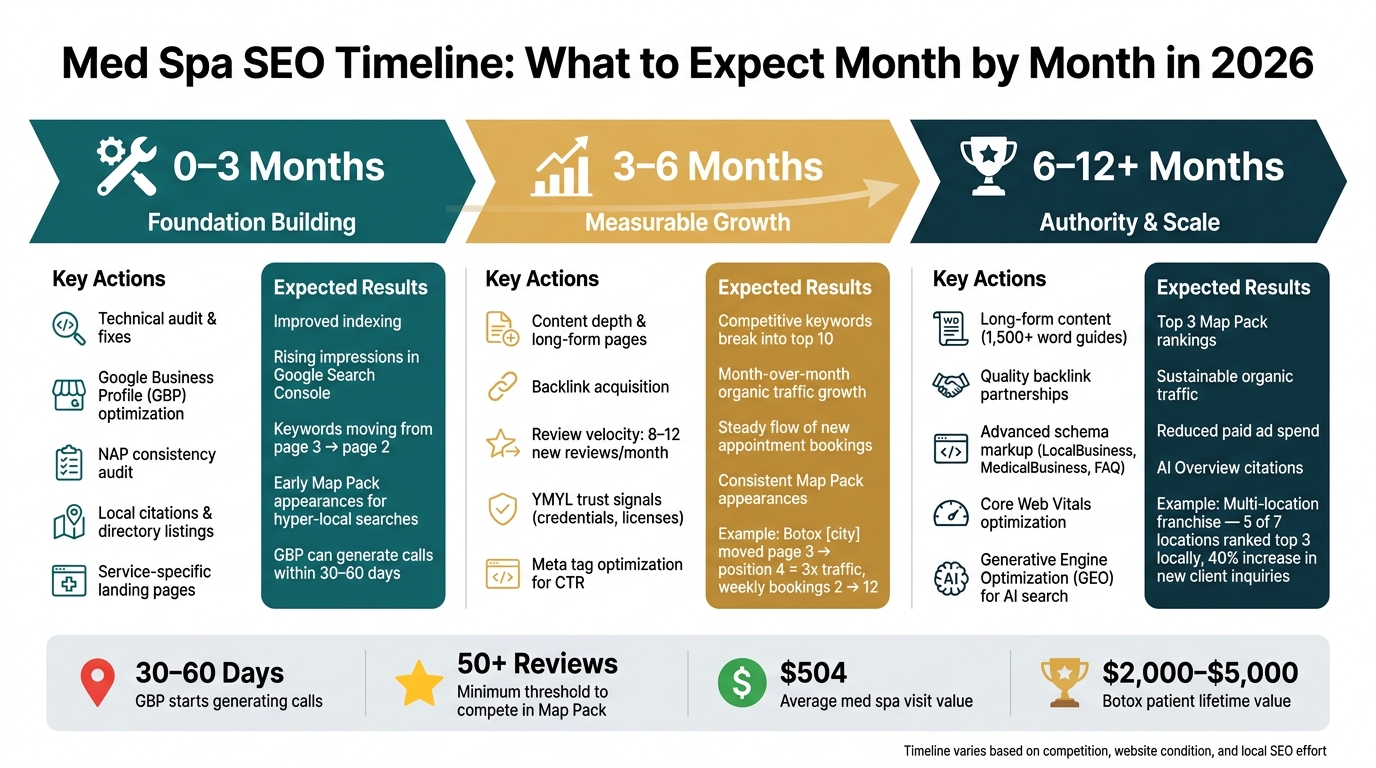
Med Spa SEO Timeline: What to Expect Month by Month in 2026
SEO & AI SEO (GEO, AEO) for Med Spas in 2026: Fast Tips for Better Rankings!
Phase 1: What to Expect in the First 30-90 Days
The first three months are all about laying a strong foundation for medical spa SEO and improving local visibility. While major results take time, early wins often come faster than expected, especially in boosting your presence locally.
Google Business Profile Optimization Results
Your Google Business Profile (GBP) is a powerful tool for local SEO. When fully optimized, it can start generating phone calls and appointment requests in as little as 30–60 days.
Here’s how to get started:
- Set your primary category to "Medical Spa" instead of "Day Spa." This small but crucial detail ensures your profile appears for high-intent searches relevant to your business.
- Add up to nine secondary categories like "Laser Hair Removal Service" or "Skin Care Clinic" to expand your reach.
- Upload 5–10 authentic photos weekly to keep your profile active and appealing.
- Respond to reviews within 24–48 hours to show engagement and build trust.
To encourage reviews, send requests within 48 hours of treatment for the best response rates. Automating this with SMS follow-ups can save time and ensure consistency.
| GBP Action | Recommended Frequency | Ranking Impact |
|---|---|---|
| Photo Uploads | Weekly (5–10 photos) | High |
| Google Posts | Weekly | Medium |
| Review Responses | Within 24–48 hours | High |
| Service List Audit | Quarterly | High |
| Q&A Updates | Monthly or as needed | Medium |
"A steady cadence of genuine feedback boosts trust and location relevance, often accelerating phone calls and appointment requests within 30–60 days." – Rosemont Media
Besides GBP optimization, technical improvements and targeted content also help strengthen local search performance.
Early Local Search Visibility Gains
Two key actions – fixing NAP inconsistencies and building service-specific pages – can speed up local search gains.
NAP consistency (Name, Address, Phone number) is critical. Any mismatch in your NAP details across your website or directories – such as RealSelf or Healthgrades – can confuse Google and hurt your rankings. Conduct a thorough audit to ensure every listing matches exactly.
On the content side, create dedicated pages for each of your core treatments – like Botox, fillers, laser resurfacing, or body contouring. These pages help you target high-intent local keywords more effectively. When paired with GBP optimization and consistent citations, this approach often leads to noticeable improvements in Map Pack rankings within 60 to 90 days.
In the first few weeks, don’t expect an immediate spike in bookings. Instead, look for leading indicators such as rising impressions in Google Search Console, better click-through rates, and keywords moving from page 3 to page 2. By months 2–3, you may start appearing in the Google Maps 3-Pack for low-competition, hyper-local searches like "Botox in [your neighborhood]." This early progress is a promising sign and sets the stage for more significant results in the next phase.
Phase 2: Measurable Progress Between 3-6 Months
By the time you hit the three-month mark, the efforts from Phase 1 start to deliver more visible results. This is the period when organic traffic begins to grow, keyword rankings stabilize, and the connection between your medical SEO strategies and actual bookings becomes increasingly clear. These months are all about turning early local wins into solidified organic traffic and rankings.
Organic Traffic and Ranking Increases
Thanks to the foundation laid in Phase 1, med spas often see noticeable jumps in keyword rankings and website traffic during this phase. Competitive keywords like "laser resurfacing [city]" or "CoolSculpting near me" generally need three to six months to break into the top 10 search results. Why? Because Google takes time to evaluate consistent signals before rewarding pages with higher rankings.
"Organic rankings for competitive keywords take longer, usually three to six months, because Google needs to see consistent signals over time before it promotes a page up the results." – Aditi Goyal, Zoca
For instance, one med spa improved its position for "Botox [city]" from page three to position four, which led to a threefold increase in organic traffic and boosted weekly appointments from 2 to 12.
By the six-month mark, this traffic growth often translates into a steady flow of new appointments. To maximize these gains, use tools like Google Search Console to identify keywords with high impressions but low click-through rates (CTR). Then, refine title tags and meta descriptions to push rankings from positions like 8 to 3.
Review Management and Trust Signal Impacts
If you want to compete in the local map pack, 50 reviews is typically the minimum threshold in most U.S. markets. But it’s not just about hitting a number. Adding 8–12 new Google reviews consistently each month is far more effective than a one-time surge of feedback.
Med spas also fall under Google’s "Your Money or Your Life" (YMYL) category, which means content is held to higher standards of accuracy and authority. Displaying board certifications, medical licenses, and having clinical content reviewed by qualified practitioners can help maintain ranking stability during this phase. By month six, med spas that consistently collect reviews, showcase verified credentials, and update clinical content often see stable appearances in the local Map Pack and a noticeable increase in calls and form submissions.
| KPI | What to Track | 3–6 Month Target |
|---|---|---|
| Keyword Position | Moderate-competition service terms | Movement into top 10 results |
| Organic Sessions | Non-paid traffic in Google Analytics | Measurable month-over-month growth |
| Review Velocity | New Google reviews per month | 8–12 reviews/month |
| Booking Actions | Calls, form fills, online bookings | Steady upward trend |
| Local Pack Presence | Visibility for service + location keywords | Consistent appearances |
As these trust signals and rankings strengthen, the next step focuses on building deeper authority – a key focus of Phase 3.
Phase 3: Building Authority from 6-12+ Months
By the time you hit the six-month mark, your med spa’s online presence should start showing real momentum. This phase is all about consolidating that progress by focusing on advanced content strategies and technical improvements. The goal? To establish your site as a trusted authority, which leads to long-term, sustainable growth in organic traffic.
Content Strategy and Backlink Growth Effects
At this stage, your content strategy evolves. Instead of sticking to basic service descriptions, it’s time to create in-depth, long-form content – think 1,500-word guides that dive deep into treatment protocols, ideal candidates, pricing, and recovery timelines. This level of detail signals to Google that your site is an authoritative resource, which can boost rankings significantly.
Here’s a real-world example: A multi-location med spa franchise in Southern California created tailored landing pages for seven of its clinics in 2025. Within six months, five of those locations ranked in the top three for local map results, which led to a 40% increase in new client inquiries. Even better, they saw a noticeable drop in paid ad spend.
Another key factor? Quality backlinks. Collaborate with local beauty editors, health journalists, and wellness bloggers to earn valuable links. These partnerships not only strengthen your site’s authority but also expand your reach to new audiences.
In 2026, Generative Engine Optimization (GEO) is becoming increasingly important. AI tools like Google AI Overviews and ChatGPT are now summarizing and citing content from trusted medical sources. If your site features physician-authored or physician-reviewed content, you’re far more likely to appear in these AI-generated summaries than competitors using generic text.
As Brandon Schroth, Founder of Reporter Outreach, explains:
"The practices winning in 2026 aren’t doing more SEO. They’re separating their strategy into two streams: Local Pack visibility for ‘near me’ intent, and editorial authority for AI search citations on educational queries."
This dual approach – focusing on both local visibility and AI-driven search authority – can set your med spa apart from the competition.
Technical SEO and Core Web Vitals Influences
Great content alone isn’t enough if your website doesn’t perform well. For med spas, which fall under Google’s YMYL (Your Money or Your Life) guidelines, technical SEO is absolutely essential. Google needs to trust your site before it ranks your medical content.
The most critical technical factors at this stage are your Core Web Vitals. These metrics directly impact user experience and, by extension, your rankings. Here are the benchmarks to aim for:
| Metric | Target Benchmark | Why It Matters |
|---|---|---|
| LCP (Largest Contentful Paint) | Under 2.5 seconds | Ensures pages load quickly |
| INP (Interaction to Next Paint) | Under 200 milliseconds | Improves site responsiveness |
| CLS (Cumulative Layout Shift) | Below 0.1 | Prevents layout shifts during loading |
| Page Load Speed | Under 3 seconds | Reduces bounce rates |
In addition to speed, implementing advanced schema markup – such as LocalBusiness, MedicalBusiness, and FAQ schema – can also make a big difference. This structured data helps search engines and AI tools understand your site better, increasing the chances your content appears in rich snippets or AI-generated answers .
Factors That Affect Med Spa SEO Timelines
The time it takes for med spa SEO efforts to show results can differ greatly, even for clinics in the same city. Why? It all comes down to the starting point – some clinics may already have a strong SEO foundation, while others are building from scratch.
Factors That Speed Up vs. Slow Down SEO Progress
Here’s a quick breakdown of what can either speed up or slow down your SEO progress:
| Factor | Speeds Up Timeline | Slows Down Timeline |
|---|---|---|
| Keyword Competition | Targeting low-competition keywords | Competing for high-competition terms like "Botox near me" |
| Website Condition | Fast, modern website | Outdated design or slow loading speeds |
| Local SEO Efforts | Fully optimized Google Business Profile and directory listings | Inconsistent Name, Address, and Phone (NAP) data across platforms |
These factors play a huge role in determining how quickly your SEO efforts start delivering results.
Take keyword competition, for example. For highly competitive terms like "Botox near me", the cost per lead can easily exceed $100. This is because med spas face stiff competition not only from other local providers but also from dermatologists, plastic surgeons, and national chains. These competitors often invest heavily in SEO, knowing that patient lifetime values can range anywhere from $2,000 to over $5,000.
Another major factor is your website’s condition. A slow-loading or outdated site can frustrate potential clients and hurt your credibility, especially for YMYL (Your Money or Your Life) content. As Mohanraj Reddy from Digital Marketing Insights puts it:
"If your site doesn’t load in under three seconds or the booking form is clunky, you lose the client."
Consistency in review acquisition is another key element. Aim to gather 8–12 new reviews each month to maintain a strong review velocity. This matters because, by 2026, 31% of consumers are expected to consider only businesses with ratings of 4.5 stars or higher, compared to just 17% in 2025. Neglecting reviews can hurt your rankings, as Aditi Goyal from Zoca explains:
"A med spa with 200 reviews, the last of which was posted eight months ago, will often rank lower than a competitor with 80 reviews and a consistent 10 per month."
Ultimately, success in med spa SEO comes down to refining both technical and local strategies to achieve the best possible results.
SearchX Strategies for Faster Med Spa SEO Results
Tackling SEO challenges is just the beginning – having the right tools and strategies can dramatically speed up your progress. SearchX offers a range of solutions to help med spas achieve faster results, from initial audits to building long-term authority.
Using SearchX Free GMB and Website Audit Tools
Before diving into paid SEO efforts, take advantage of SearchX’s free GMB Audit Tool and free Website Audit Tool. These tools provide an instant snapshot of your SEO performance:
- GMB Audit Tool: Identifies gaps in your Google Business Profile that could hurt your local rankings. For example, missing categories or incomplete business information can make it harder for potential clients to find you. (Check out the earlier GBP optimization section for more details.)
- Website Audit Tool: Highlights technical and content-related issues, like slow loading times or missing metadata, without requiring any coding expertise.
These tools are designed to quickly uncover critical weaknesses, so you can address them before committing to a paid SEO strategy. They align perfectly with the phased approach discussed earlier, helping you prioritize areas that need the most attention.
Implementing SearchX Local SEO and Technical Services
Once you’ve identified your SEO gaps, the SearchX Starter plan ($3,000/month) is a great way to tackle the essentials during the first 3–6 months. This plan focuses on:
- GMB management: Ensuring your Google Business Profile is optimized.
- Local listing distribution: Expanding your presence across 50+ directories.
- Keyword tracking: Monitoring your rankings for target keywords.
- Light technical SEO audits: Addressing smaller technical issues that might slow your progress.
For med spas looking to accelerate their results, the Growth plan ($6,000/month) adds more advanced features, including:
- Comprehensive technical SEO audits: Digging deeper into site performance and structure.
- Compare competitor backlinks: Identifying opportunities to strengthen your link profile.
- Conversion tracking: Measuring how SEO efforts translate into client bookings.
This combination of services is designed to deliver noticeable improvements, often within the first 3–6 months.
Scaling with SearchX Growth or Enterprise Plans
For med spas aiming to expand their reach or dominate regional markets, SearchX offers advanced plans to build on earlier successes. The Enterprise plan (starting at $12,000/month) includes:
- Enterprise link building: Strengthening your domain authority with high-quality backlinks.
- Content production: Creating 10–15+ pieces of content per month to boost visibility.
- AI Visibility tracking: Monitoring how your brand appears in AI-driven search results, which are becoming increasingly important.
With a dedicated account team and custom dashboards, these plans make it easier to connect your SEO efforts to measurable results, like increased bookings. For larger, multi-location med spas, custom packages starting at $20,000/month offer programmatic SEO and multi-channel integration, ensuring your strategy scales with your business needs.
Setting Realistic Med Spa SEO Expectations in 2026
Med spa SEO is a slow build, much like compound interest. The first three months focus on laying the groundwork, while months 3–6 bring noticeable ranking improvements. The real momentum, however, kicks in between months 6 and 12. Sticking to this timeline is critical for seeing results.
By 2026, successful med spa SEO will require a two-pronged approach: one targeting local visibility and the other focusing on content authority. As Reporter Outreach explains:
"The practices winning in 2026 aren’t doing more SEO. They’re separating their strategy into two streams: Local Pack visibility for ‘near me’ intent, and editorial authority for AI search citations."
This means tools like your Google Business Profile and local citations will drive appointment bookings, while high-quality, credentialed content will enhance E-E-A-T signals (Experience, Expertise, Authoritativeness, Trustworthiness) that are crucial for organic search performance. These two strategies work in tandem to deliver long-term success.
The benefits of this approach are not just about rankings – they directly impact revenue. With the average med spa visit bringing in $504 and a Botox patient having a lifetime value of $2,000–$5,000, even a modest increase in organic visibility can lead to substantial financial growth.
Chris Fink, Managing Partner at The Med Spa Agency, sums it up well:
"SEO is your long game. It starts slow but delivers powerful, cost-efficient growth."
To get started, focus on identifying key gaps in your current strategy. Commit to a six-month plan and scale your efforts as your visibility improves. Whether you choose the Starter or Growth plan, consistency is the key to success.
FAQs
What should I track to know SEO is working before rankings improve?
To measure SEO progress before seeing ranking improvements, focus on tracking key performance metrics like website traffic, conversion rates, and local visibility. Optimizing your Google Business Profile plays a big role here. Set a goal to gather around 8–12 new reviews each month and keep an eye on how users engage during the booking process. These steps will help you determine if your strategies are on the right track.
How many location pages should a multi-location med spa create?
If you’re running a multi-location med spa, it’s a smart move to create a dedicated service page for each location. Why? Because this strategy can significantly boost your local SEO and help you connect with clients searching for services in their specific area.
Each page should focus on location-specific details, such as the services offered at that branch, the team working there, and any unique features or promotions. By tailoring content to match the needs and search habits of local clients, you make your business more visible and relevant in search results. This approach not only helps potential clients find you but also ensures they feel catered to from the start.
How can my med spa content get cited in AI results like Google AI Overviews?
To make your med spa content more likely to appear in AI-generated results, focus on crafting high-quality, authoritative, and well-organized material. Highlight your clinical expertise, incorporate relevant keywords naturally, and use structured data to signal reliability to AI tools. Ensure your content is thorough, accurate, and frequently updated. Include clear explanations and cite trustworthy sources to align with common user questions and Google’s emphasis on credibility.