

Local search rankings determine whether nearby customers find your business or your competitor’s when they search for services you both offer. The industry term for this practice is local SEO, and it covers everything from your Google Business Profile to the reviews customers leave after a visit. 46% of all Google searches carry local intent, and 28% of those searches result in a same-day purchase. If your business does not rank in the top positions for local queries, you are invisible to buyers who are ready to spend money right now. Understanding why local search rankings matter is the first step toward turning that visibility into real revenue.
Why local search rankings matter more than most owners realize
Local search rankings place your business in front of high-intent customers at the exact moment they are ready to act. This is not passive brand awareness. A person searching “plumber near me” or “best pizza in Austin” has already decided to buy. The only question is who they call first.
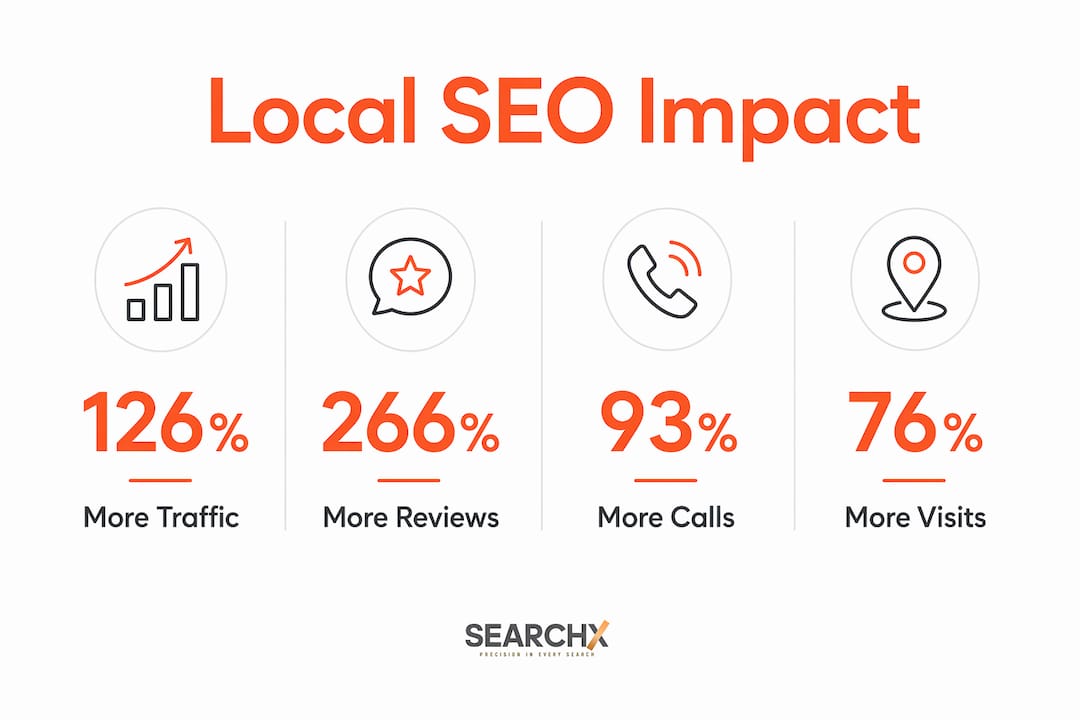
The Google local 3-Pack sits at the top of search results and captures the largest share of clicks for location-based queries. Businesses in the local 3-Pack receive 126% more traffic and 93% more calls and clicks than lower-ranked competitors. That gap is not marginal. It is the difference between a full appointment calendar and a slow week.

Ranking in the Local 3-Pack also acts as an implicit stamp of approval from Google, signaling trust and reliability to consumers. Buyers interpret top rankings as a quality signal, which shortens the sales cycle before you even answer the phone.
What factors influence local search rankings?
Google determines local rankings using three core pillars: relevance, distance, and prominence. Understanding each one tells you exactly where to focus your energy.
- Relevance measures how well your business profile matches what someone is searching for. A complete Google Business Profile with accurate categories, services, and descriptions scores higher on relevance.
- Distance is the physical gap between your location and the searcher. Distance is uncontrollable, but relevance and prominence are fully within your reach.
- Prominence reflects how well-known and trusted your business appears online. Reviews, local citations, backlinks, and engagement signals all build prominence.
Your Google Business Profile is the single most important asset for local search visibility. An optimized Google Business Profile can achieve up to 2.7x more visibility and 70% more direction requests compared to an incomplete profile. That means filling out every field, adding real photos, and keeping your hours accurate.
Reviews carry serious weight in the prominence calculation. Businesses with 50 or more reviews are 266% more likely to appear in the Local Pack, and every 10 new reviews boost conversion by 2.8%. Responding to reviews, both positive and negative, signals active engagement to Google’s algorithm.
Consistent Name, Address, and Phone (NAP) data across directories like Yelp, Apple Maps, and industry-specific sites reinforces your legitimacy. Inconsistent NAP data confuses Google and weakens your prominence score. Avoid shortcuts like using rented addresses or virtual offices. Manipulating distance signals violates Google Business Profile guidelines and risks penalties that can erase your rankings overnight.
Pro Tip: Use a tool like BrightLocal or Whitespark to audit your NAP consistency across 50+ directories in one pass. Fixing even a handful of mismatches can produce measurable ranking improvements within weeks.
How do local rankings affect business outcomes and ROI?
Higher local rankings translate directly into foot traffic, phone calls, and revenue. The data on this is clear and consistent across multiple studies.
“Local search leads convert at an 80% higher close rate than outbound cold leads. The intent is already there. You are not convincing anyone to want what you sell.”
Consider what that close rate means in practice. A cold outbound lead requires multiple touchpoints, follow-up emails, and persuasion. A local search lead already wants your service and is comparing you to two or three nearby competitors. Your job is simply to show up and look credible.
The conversion speed is equally striking. 76% of consumers who perform a local mobile search visit a physical location within 24 hours. For a restaurant, a salon, or a hardware store, that is a same-day customer walking through the door.
| Metric | Impact of Top Local Rankings |
|---|---|
| Website traffic | 126% more than lower-ranked competitors |
| Calls and clicks | 93% increase over non-Pack listings |
| Store visits from mobile search | 76% visit within 24 hours |
| Lead close rate vs. cold outbound | 80% higher conversion rate |
| Review volume effect on Local Pack | 266% more likely with 50+ reviews |
The ROI picture gets even stronger when you factor in cost. Organic local traffic costs nothing per click once rankings are established. Paid search campaigns charge you every time someone clicks, regardless of whether they convert. Local SEO compounds over time, meaning the work you do today keeps delivering results months and years from now. You can track the financial impact of this directly using local SEO ROI metrics that connect rankings to revenue.
Local SEO vs. paid ads and social media: which wins?
Local SEO captures demand that already exists. Paid ads and social media create demand, which is a fundamentally different and more expensive task.
When someone searches “emergency electrician near me,” they need a service right now. Local SEO puts you in front of that person at the moment of maximum intent. A Facebook ad shown to the same person three days earlier does not produce the same result. Local SEO captures demand at the precise moment of purchase intent, which is why its customer acquisition cost is lower than almost any other channel.
| Channel | Cost Structure | Longevity | Intent Level |
|---|---|---|---|
| Local SEO | Fixed investment, zero per-click cost | Compounds over time | Very high (active search) |
| Google Ads | Pay per click, ongoing spend required | Stops when budget ends | High |
| Social Media Ads | Pay per impression or click | Stops when budget ends | Low to medium |
| National SEO | High competition, slower results | Long-term | Medium |
Strong local SEO foundations create a defensible market position that competitors cannot easily displace. A business that has accumulated 200 reviews, consistent citations, and a fully optimized profile has built a moat. A competitor cannot simply outspend you to take that position overnight.
The evolving AI-driven search landscape makes local relevance signals even more critical. AI-powered search features like Google’s AI Overviews and Perplexity’s local answers pull from the same signals that drive traditional local rankings. Businesses with strong local SEO are better positioned to appear in these new formats.
Pro Tip: Treat local SEO and paid ads as complements, not substitutes. Run Google Local Services Ads while your organic rankings build. Once you hold a stable top-3 position, you can reduce ad spend and let organic traffic carry the load.
How to improve your local search rankings: 5 practical steps
Improving local search visibility requires consistent effort across several areas. None of these steps are technically complex, but all of them require follow-through.
-
Complete your Google Business Profile fully. Add your business category, service areas, hours, phone number, website, and at least 10 photos. Write a description that includes your primary service and city. An incomplete profile is the most common and most fixable ranking problem. Use SearchX’s guide on Google Business Profile optimization to cover every field.
-
Build a review generation system. Ask every satisfied customer for a review via text or email within 24 hours of service. Respond to every review within 48 hours. Reviews are the primary trust signal for both Google and potential customers. Learn how reviews influence rankings to prioritize this correctly.
-
Audit and fix your NAP citations. Check your business name, address, and phone number on Google, Yelp, Facebook, Apple Maps, and at least 20 industry directories. Fix any inconsistencies. Initial results from local SEO are measurable within 4–12 weeks of consistent citation work.
-
Create localized content on your website. Write service pages that mention your city, neighborhood, and surrounding areas. A roofing company in Denver should have a page titled “Roof Repair in Denver, CO” rather than a generic “Our Services” page. Localized pages rank for geo-specific queries that your competitors may be ignoring. Pair this with solid keyword research techniques to find the exact terms your local customers use.
-
Engage consistently, not just at launch. Post updates to your Google Business Profile weekly. Add new photos monthly. Strong local SEO requires continuous effort including fresh reviews, updated photos, and localized content rather than a one-time setup. Google rewards active profiles with better visibility. Explore local SEO tactics for small businesses to build a repeatable monthly routine.
Behavioral signals also matter more than most business owners realize. Calls, clicks, and direction requests from your listing all feed back into Google’s ranking algorithm. A well-optimized, conversion-friendly profile generates more of these signals, which in turn improves your ranking, creating a positive feedback loop.
Key takeaways
Local search rankings are the most direct path from online visibility to in-store revenue, and businesses that treat local SEO as a long-term asset consistently outperform those that rely on paid ads alone.
| Point | Details |
|---|---|
| Local 3-Pack dominance | Top-ranked businesses get 126% more traffic and 93% more calls than lower-ranked competitors. |
| Reviews drive rankings | Businesses with 50+ reviews are 266% more likely to appear in the Local Pack. |
| High-intent conversion | 76% of local mobile searchers visit a store within 24 hours of searching. |
| Compounding ROI | Organic local rankings cost nothing per click once established, unlike paid ads. |
| Continuous maintenance wins | Rankings require ongoing review generation, photo updates, and localized content to hold. |
The long game most local businesses are losing
Most local business owners I work with treat local SEO as a one-time task. They claim their Google Business Profile, add a few photos, and consider it done. Then they wonder why a competitor with half their experience is showing up above them in search results.
Local business owners tend to undervalue the long-term profit benefits of ranking highly in local searches, mistaking it for a short-term tactic rather than a sustained business asset. That mindset is expensive. Every month you are not actively building your local presence, a competitor is.
The businesses I have seen grow fastest from local SEO are the ones that treat their Google Business Profile like a second storefront. They update it regularly, respond to every review, and add localized content consistently. They also understand that organic SEO for lasting growth compounds in ways that paid campaigns simply cannot replicate.
My honest advice: stop thinking about local SEO as marketing spend and start thinking about it as infrastructure. Your rankings are a business asset that appreciates over time if you maintain them. Neglect them, and a competitor will take your position and your customers.
— SEO
How SearchX helps local businesses rank higher and earn more
Local search visibility requires the right strategy, not just effort. SearchX builds custom local SEO programs that cover Google Business Profile optimization, citation management, review strategy, and local link building to move your business into the positions that generate real revenue.
Every SearchX engagement starts with deep keyword research to identify the exact local queries your customers use. From there, the strategy is built around measurable outcomes, not vanity metrics. If you are ready to turn local search visibility into a consistent source of leads and sales, SearchX has the methodology to get you there.
FAQ
What is local SEO and why does it matter?
Local SEO is the practice of optimizing your online presence to rank higher in location-based search results. It matters because 46% of Google searches have local intent, and top-ranked businesses capture the majority of clicks, calls, and store visits.
How long does local SEO take to show results?
Most businesses see measurable improvements within 4–12 weeks of consistent optimization work. Results compound over time, meaning rankings and traffic continue to grow with ongoing effort.
How do reviews affect local search rankings?
Reviews are a primary trust and ranking signal for Google’s local algorithm. Businesses with 50 or more reviews are 266% more likely to appear in the Local Pack than those with fewer reviews.
Is local SEO better than google ads for small businesses?
Local SEO produces compounding returns at zero cost per click once rankings are established, while Google Ads stop delivering leads the moment your budget runs out. For long-term customer acquisition, local SEO delivers a lower cost per lead.
What is the google local 3-pack?
The Google local 3-Pack is the block of three business listings that appears at the top of local search results, above organic listings. Securing a position in the 3-Pack is the primary goal of local SEO because it captures the highest share of clicks and calls.