
Entity SEO is the practice of optimizing website content and structure so search engines recognize distinct entities, including people, brands, products, and concepts, and understand how those entities relate to each other. Where traditional SEO targets keyword strings, entity-based search optimization targets meaning. Google’s Knowledge Graph, Schema.org structured data, and tools like the Google NLP API are the infrastructure that makes this possible. Semrush defines entity SEO as optimizing for atomic concepts rather than text matches, and that distinction changes everything about how you build and structure content. Mastering this approach is no longer optional for SEO professionals who want to compete in AI-driven search environments.
What is entity SEO and how does it differ from keyword SEO?
Keywords are text strings. Entities are concepts. That single distinction separates traditional SEO from entity SEO, and understanding it is the fastest way to see why search has changed so fundamentally over the past decade.
When you optimize for the keyword “Tesla,” a search engine matches your page to that string. It cannot tell whether you mean the electric vehicle company, the 19th-century inventor Nikola Tesla, or the rock band. Entities solve this problem. Entities are unique, they carry attributes, and they exist independently of language. Google’s Knowledge Graph assigns each entity a stable identifier, so “Tesla the company” and “Tesla the inventor” are two distinct nodes, not two uses of the same word.

This has a direct consequence for your content strategy. Keyword SEO rewards pages that repeat a target phrase at the right density. Entity SEO rewards pages that clearly declare which concept they are about, cover that concept’s attributes thoroughly, and connect it to related entities through internal links and structured data. The two approaches are not mutually exclusive. Keywords remain essential for matching user intent, but entity SEO adds the semantic depth that AI-powered search systems use to rank and cite content.
Pro Tip: Run your top-performing page through the Google NLP API and check the entity salience scores. If the highest-salience entity is not the concept your page is supposed to be about, your content is sending mixed signals to Google.
| Point | Keyword SEO |
|---|---|
| Focus | Exact text match |
| Unit of optimization | Keyword phrase |
| Language dependency | High |
| Disambiguation | None |
| Knowledge Graph integration | Indirect |
| Point | Entity SEO |
|---|---|
| Focus | Semantic concept |
| Unit of optimization | Named entity with attributes |
| Language dependency | Low |
| Disambiguation | Built in via unique IDs |
| Knowledge Graph integration | Direct |
How to implement entity SEO: core techniques
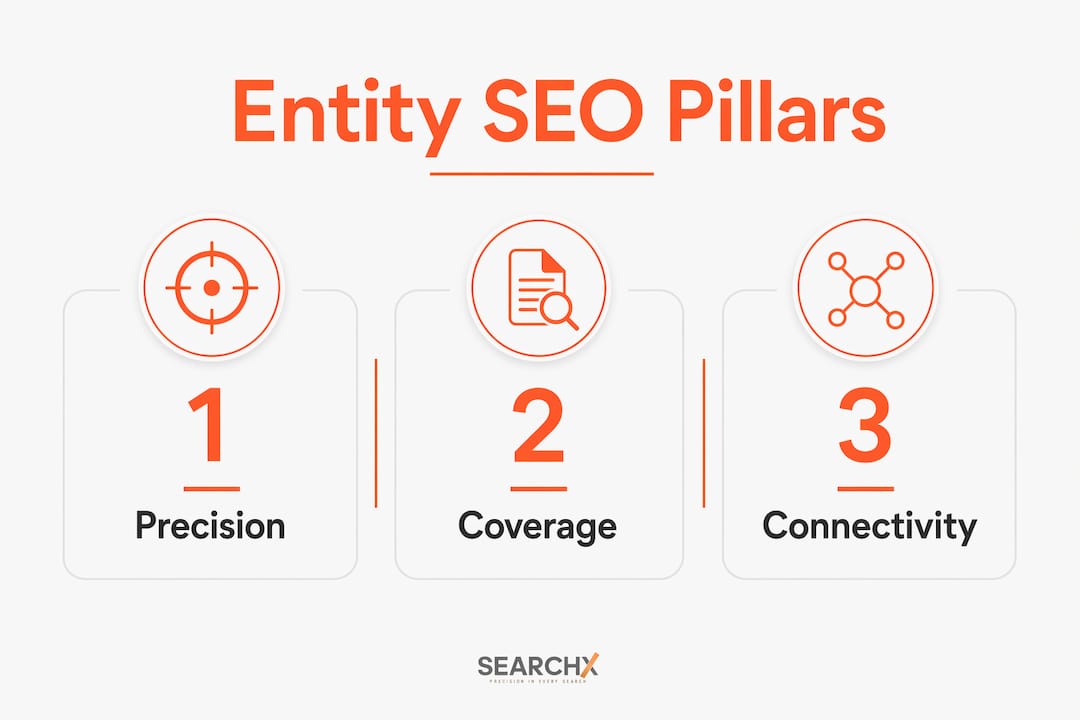
Effective entity SEO rests on three pillars identified by Search Engine Land: precision, coverage, and connectivity. Each pillar requires specific technical and editorial actions.
Precision: declaring your primary entity
Every page should have one canonical primary entity. That entity should appear in the page title, the H1, and the Schema.org "mainEntityOfPage` property. The mainEntityOfPage field tells AI systems and search engines exactly which concept the page represents, reducing ambiguity that could dilute your rankings. A product page for a specific software tool, for example, should declare that tool as its primary entity, not the broader category it belongs to.
Coverage: mapping related entities
A single entity does not exist in isolation. Google’s Knowledge Panel for any major topic includes dozens of related entities, and your content needs to reference those sub-entities to signal topical authority. Entity coverage depth is a direct signal of how comprehensively you understand a topic. If you are building a page about content marketing, covering related entities like HubSpot, editorial calendars, buyer personas, and content distribution channels tells Google your page belongs in the same semantic neighborhood as authoritative sources.
Here is a practical workflow for building entity coverage:
- Identify your primary entity and look up its Knowledge Panel on Google.
- List every entity that appears in the “People also search for” and “Related topics” sections.
- Cross-reference those entities against your existing content to find gaps.
- Create or update pages to cover missing sub-entities, linking them back to your primary entity page.
- Validate your entity map using the Google NLP API or OpenAI embeddings to confirm salience scores align with your intent.
Connectivity: linking entities together
Internal linking is not just a navigation tool in entity SEO. It is a semantic signal. Internal links and sameAs schema references create connections between related pages that mirror the structure of Google’s Knowledge Graph. When your “content marketing” page links to your “editorial calendar” page and both carry aligned schema markup, you are building a mini knowledge graph within your own site.
Key connectivity practices include:
- Adding
sameAsproperties in your schema to reference authoritative external sources like Wikipedia or Wikidata entries for your primary entity. - Using descriptive anchor text in internal links that names the target entity explicitly.
- Auditing orphaned pages that cover relevant entities but receive no internal links.
- Aligning schema types across related pages so Google sees a coherent entity ecosystem, not isolated documents.
Pro Tip: Use a spreadsheet to map every page on your site to its primary entity and two to three related entities. This entity map becomes your editorial calendar, your internal linking guide, and your schema audit checklist all at once.
How to measure entity SEO success
Measuring entity SEO requires different metrics than measuring keyword SEO. Ranking positions and click-through rates still matter, but they do not tell you whether Google actually understands what your content is about.
The most direct signal is Knowledge Panel presence. If Google displays a Knowledge Panel for your brand or a topic you cover, that confirms entity recognition. Monitor this manually or use tools that track Knowledge Panel appearances over time. AI citation frequency in tools like ChatGPT, Perplexity, and Google’s AI Overviews is an emerging proxy metric. Pages that are cited by AI systems are almost always pages where entity signals are strong and unambiguous.
For technical validation, the Google NLP API and OpenAI embeddings let you assess entity salience scores and semantic alignment at the page level. Run your most important pages through these tools quarterly and track whether your primary entity consistently scores as the highest-salience entity on the page.
Workflow alignment matters as much as tooling. Writers need to know which primary entity each piece of content is assigned to before they start drafting. Developers need to implement schema consistently across content types. Analysts need to audit entity maps and flag pages where salience scores drift from the intended entity. Without this cross-team coordination, entity signals become inconsistent and Google’s understanding of your site degrades over time.
Practitioners validate entities by analyzing Knowledge Panels, People Also Ask results, and NLP API outputs before briefing content teams. This pre-production step prevents the most common entity SEO failure: publishing content that is topically adjacent to your target entity but never clearly declares it.
Strategic recommendations for leveraging entity SEO
The most effective way to apply entity SEO at scale is to build topic clusters around core entities rather than around keyword lists. A keyword list tells you what people search for. An entity map tells you what Google understands. Those two things overlap significantly, but the entity map gives you a structural blueprint that a keyword list cannot.
Follow these steps to shift your content strategy toward entity-first thinking:
- Identify the three to five core entities your brand or website should own in Google’s Knowledge Graph.
- Audit your existing content against those entities using the Google NLP API to find pages with weak or misaligned salience scores.
- Integrate Schema.org markup across all content types, including brand pages, product pages, blog posts, and author profiles. The structured data tips for multilingual SEO apply equally well to monolingual entity SEO because the underlying schema logic is identical.
- Earn authoritative external mentions that reference your brand entity consistently. Consistent NAP data and authoritative external references improve entity trust signals and increase the likelihood of Knowledge Graph inclusion.
- Secure stable external identifiers for your brand entity, including a Wikipedia page, a Wikidata entry, or a Crunchbase profile. Stable external IDs are how Google confirms that your brand is a canonical Knowledge Graph node rather than an ambiguous text string.
Pro Tip: Do not treat entity SEO as a one-time setup task. Entity maps need quarterly audits because your content grows, your competitors publish new pages, and Google’s Knowledge Graph updates continuously. Schedule entity map reviews the same way you schedule technical SEO audits.
Keyword SEO remains the foundation. You still need to match user intent, and keywords are how users express that intent. Entity SEO layers semantic precision on top of that foundation. The combination of keyword and entity optimization produces rankings that are more stable and more resistant to algorithm updates because they are grounded in meaning, not just text frequency. For specialized industries, this combination is especially powerful. Law firms, for example, can use entity SEO to own the semantic space around specific practice areas, as SearchX has documented in law firm SEO strategies that go beyond generic keyword targeting.
Key takeaways
Entity SEO succeeds when every page declares a single canonical entity, covers related sub-entities thoroughly, and connects to the broader entity ecosystem through internal links and schema markup.
| Point | Details |
|---|---|
| Entity vs. keyword | Entities carry unique IDs and attributes; keywords are text strings with no built-in disambiguation. |
| Three implementation pillars | Precision, coverage, and connectivity determine how clearly Google understands your entity signals. |
| Schema markup is non-negotiable | The mainEntityOfPage property and sameAs references are the clearest technical signals you can send. |
| Measurement requires NLP tools | Google NLP API salience scores and Knowledge Panel presence confirm whether entity recognition is working. |
| Keywords and entities work together | Entity SEO adds semantic depth to keyword strategy; neither approach replaces the other. |
Why entity SEO is the shift most SEO teams are still underestimating
I have reviewed content strategies for dozens of websites, and the pattern is almost always the same. Teams invest heavily in keyword research, produce well-written content, and then wonder why their topical authority never quite crystallizes. The answer, almost every time, is that their content is entity-ambiguous. Google cannot confidently assign their pages to a specific concept because the entity signals are inconsistent or absent entirely.
The mistake I see most often is treating entity SEO as a more sophisticated form of keyword expansion. It is not. Adding synonyms and related terms to a page does not make it entity-optimized. What makes a page entity-optimized is a declared primary entity in the schema, a salience score that confirms Google reads the page the way you intended, and internal links that connect it to a coherent entity ecosystem. Those are structural decisions, not editorial ones.
The teams that get this right are the ones that build entity maps before they write a single word of content. They know which entity owns each URL, which sub-entities that page should reference, and which external sources should be cited to reinforce entity trust. That level of pre-production rigor feels like overhead until you see how much faster those pages rank and how much more stable those rankings are when Google updates its algorithms. For SEO professionals who want to future-proof their visibility, entity SEO is not a trend. It is the architecture that AI-driven search is built on, and the sooner you build for it, the harder your rankings become to displace. You can see this same principle applied across niche contexts, from entertainment website SEO to local service businesses, and the entity-first logic holds in every case.
— SEO
Ready to build an entity SEO strategy that actually moves rankings?
SearchX specializes in SEO strategies that go beyond keyword rankings to build genuine topical authority and search visibility. Whether you need a full entity map audit, schema implementation, or a content strategy aligned with Google’s Knowledge Graph, SearchX delivers results grounded in real semantic precision.
Start by running your site through the SEO score calculator to identify where your entity signals are weakest. Then explore SearchX’s technical SEO checklist to see exactly where schema and structured data fit into your 2026 optimization plan. When you are ready for a custom strategy, SearchX is the team that builds it around your specific entities, your audience, and your revenue goals.
FAQ
What is entity SEO in simple terms?
Entity SEO is the practice of optimizing content so search engines recognize the specific people, brands, products, or concepts a page is about, rather than just matching keyword strings. It relies on structured data, internal linking, and external references to build that recognition.
How does entity SEO work with Google’s Knowledge Graph?
Google’s Knowledge Graph assigns unique identifiers to entities and maps their relationships. Entity SEO works by sending clear signals, through Schema.org markup, sameAs references, and consistent external mentions, that connect your content to the correct Knowledge Graph node.
Is entity SEO replacing keyword SEO?
Entity SEO does not replace keyword SEO. Keywords remain the primary way users express search intent, but entity SEO adds semantic depth that makes rankings more stable and more aligned with how AI-driven search systems interpret content.
What tools are used for entity recognition in SEO?
The Google NLP API and OpenAI embeddings are the most widely used tools for entity salience analysis. Knowledge Panel monitoring, People Also Ask analysis, and Schema.org validation tools also play a role in confirming entity recognition.
How do I know if my entity SEO is working?
The clearest signals are Knowledge Panel presence for your brand or target topics, high entity salience scores from the Google NLP API on your primary pages, and citation frequency in AI-generated search results. Consistent improvement across all three confirms your entity signals are landing correctly.