

A search engine algorithm is the automated system of mathematical rules and machine learning models that determines which web pages appear in response to a query and in what order they rank. Google, Bing, and other major search engines run every query through this system in milliseconds, pulling from a pre-built index rather than scanning the live web in real time. Understanding how this system works is the single most practical advantage a marketer or business owner can have in building organic visibility.
What is a search engine algorithm and how does it work?
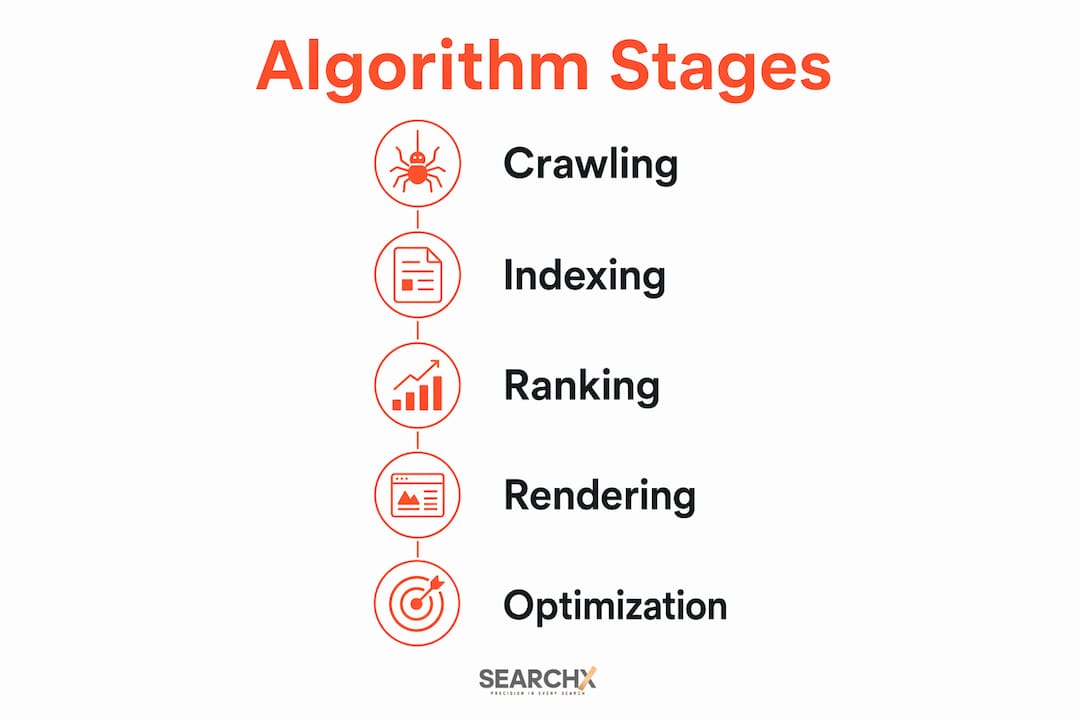
A search engine algorithm operates through three sequential stages: crawling, indexing, and ranking. Each stage is distinct, and a failure at any one of them means your page never reaches a searcher. Most marketers focus on ranking while ignoring the two stages that make ranking possible.
Crawling is the discovery phase. Googlebot, Google’s web crawler, visits URLs and fetches their content to pass along for processing. One detail that surprises most site owners: Googlebot fetches only 2MB per URL (excluding PDFs), which means anything buried deep in a long page may never be read. That 2MB ceiling is a hard technical constraint, not a guideline. If your most important content sits at the bottom of a bloated page, the algorithm may never see it.

Indexing follows crawling. Search engines query an indexed database, not the live web, when a user types a query. The index is a structured catalog of analyzed content, where the engine has already determined what each page is about, what entities it mentions, and how it relates to known topics. Think of it as the library card catalog that makes retrieval possible at all.
Ranking is where the algorithm applies its full weight. Ranking signals include query meaning, page relevance, content quality, usability factors like page speed and mobile compatibility, and sometimes user location and search history. All of these signals are processed simultaneously to produce an ordered list of results within milliseconds.
Google also runs a Web Rendering Service (WRS) after crawling to process JavaScript and client-side code. The WRS has its own 2MB limit per resource, which means JavaScript-heavy pages face compounding constraints. A page that looks complete in a browser may be partially invisible to the algorithm.
What types of search engine algorithms exist?
Modern search does not run on a single algorithm. It runs on a layered system of specialized algorithms, each handling a different part of the process. Here is how the main types break down:
| Algorithm type | Primary purpose | Real-world impact |
|---|---|---|
| Crawling algorithms | Prioritize which URLs to fetch and how often | Determines crawl frequency and budget allocation |
| Indexing algorithms | Analyze and organize fetched content | Controls what gets stored and how it is categorized |
| Keyword matching | Match query terms to page content | Foundational relevance signal for all results |
| Intent interpretation (BERT, RankBrain) | Understand the meaning behind a query | Surfaces contextually relevant pages over keyword-stuffed ones |
| Quality ranking models | Score pages on authority, trust, and usefulness | Separates high-value content from thin or manipulative pages |
| AI-powered ranking | Integrate multimodal signals and learned patterns | Powers AI Overviews and generative search features |
BERT (Bidirectional Encoder Representations from Transformers) and RankBrain represent a fundamental shift in how search engines interpret language. Before these models, algorithms matched keywords. After them, algorithms interpret intent. A query like “can a landlord enter without notice” now returns pages about tenant rights, not pages that simply contain every word in that phrase.
Modern ranking is not a static formula but a system of learned models and signals estimated from vast user and query data. This matters because it means no single optimization tactic produces permanent results. The algorithm continuously updates its understanding of what satisfies a given query based on how users actually behave.
Search algorithms now integrate AI to understand longer, more complex queries and deliver multimodal results that incorporate images and text together. Google’s AI Overviews are a direct product of this evolution, and they draw from pages that already rank well for traditional signals.
What are the key search engine ranking factors?
Ranking signals are the inputs the algorithm uses to score and order pages. They are not equally weighted, and their relative importance shifts depending on the query type. Here are the primary factors every marketer needs to understand:
-
Query intent alignment. The algorithm first determines what the searcher actually wants: information, a product, a local business, or a specific page. Pages that match the dominant intent for a query rank above pages that merely contain the right keywords. Understanding how search intent shapes SEO is foundational to any ranking strategy.
-
Content relevance and quality. The algorithm evaluates whether a page thoroughly addresses the query topic, covers related subtopics, and demonstrates genuine expertise. Thin content that answers only the surface question consistently underperforms against pages that go deeper.
-
Technical crawlability and indexability. If a page cannot be crawled or indexed, it cannot rank. Pages must return HTTP 200 status codes, avoid blocking directives that prevent indexing, and contain content the crawler can actually read. A technical SEO audit catches the crawlability and indexability issues that silently kill rankings.
-
Page speed and mobile usability. Google’s Core Web Vitals measure loading performance, interactivity, and visual stability. Pages that fail these benchmarks face ranking penalties, particularly in mobile search where the majority of queries now originate.
-
Authority and trust signals. Backlinks from credible, relevant sources signal that other publishers trust your content. The algorithm uses this as a proxy for real-world authority, though link quality matters far more than link quantity.
-
User experience signals. Engagement patterns, including how quickly users return to search results after visiting a page, inform the algorithm’s assessment of whether a page actually satisfied the query.
Pro Tip: Place your most important content, including primary headings and key answers, near the top of your HTML source. Because Googlebot stops fetching at 2MB, content buried deep in long pages may never be crawled or indexed at all.
Robots meta tags and robots.txt directives control crawling and indexing at different levels, and choosing the right controls aligned with your goals prevents accidental de-indexing of pages you want ranked.
How can marketers optimize for search engine algorithms?
Optimization for search algorithms starts with the same foundation it always has, and SEO for AI-powered search features is not a separate checklist. It is an evolution of core principles: crawlability, indexability, and user-focused content quality. Here is what that looks like in practice:
- Audit technical health first. Before any content work, confirm your pages are crawlable, return correct status codes, and are not accidentally blocked by robots.txt or noindex tags. Technical barriers override every other optimization.
- Match content to search intent. Use Google Search Console to identify which queries drive impressions for your pages, then compare your content format and depth to the pages currently ranking. A guide on aligning content with user intent provides a structured method for this analysis.
- Prioritize page speed and Core Web Vitals. Use Google PageSpeed Insights or Lighthouse to identify specific performance bottlenecks. Slow pages lose rankings and lose visitors before they convert.
- Build topical depth, not just keyword coverage. Pages that cover a topic thoroughly, including related questions, subtopics, and practical examples, consistently outperform pages optimized for a single keyword phrase.
- Prepare for AI search features. Google’s AI Overviews pull from pages that already satisfy traditional ranking signals. Unique, well-structured, factually accurate content is the entry requirement. Learn how AI predicts search intent to understand what the algorithm looks for when generating these features.
Pro Tip: Keep individual page HTML lean and well-structured. Heavy JavaScript frameworks, excessive inline scripts, and bloated templates eat into the 2MB crawl limit and the WRS rendering budget. Server-side rendering or static HTML for critical content removes this risk entirely.
The 5-step process for aligning content with search intent is one of the most direct paths to improving algorithmic rankings without chasing individual signals.
Key takeaways
Search engine algorithms rank pages through crawling, indexing, and ranking, and technical accessibility is the non-negotiable foundation before any content or authority signals matter.
| Point | Details |
|---|---|
| Three-stage pipeline | Every page must pass crawling, indexing, and ranking to appear in search results. |
| 2MB crawl limit | Googlebot stops fetching at 2MB per URL, so critical content must appear early in HTML. |
| Intent over keywords | Algorithms like BERT and RankBrain interpret query meaning, not just keyword matches. |
| Technical SEO is foundational | Pages that cannot be crawled or indexed cannot rank, regardless of content quality. |
| AI search same core rules | Performing well in AI-powered search features requires the same crawlability and quality signals as classic SEO. |
Why most marketers are still thinking about algorithms the wrong way
After working across hundreds of SEO campaigns, the pattern I see most often is marketers treating the algorithm as a puzzle to solve rather than a system to align with. They chase ranking factors as if there is a fixed formula, when the reality is that ranking is a dynamic estimation built from learned models that update continuously.
The most common and costly mistake is investing heavily in content while ignoring technical foundations. I have seen well-written, thoroughly researched pages that never ranked because a misconfigured robots.txt blocked Googlebot, or because the page’s critical content sat below a JavaScript-rendered fold that the WRS never processed. Content quality cannot compensate for technical invisibility.
The second misconception is treating AI search as a separate discipline. It is not. The same page that ranks well in traditional search, because it is technically sound, intent-matched, and genuinely useful, is the page that gets cited in AI Overviews. There is no shortcut that bypasses the fundamentals.
My honest recommendation: spend the first 30% of your SEO effort on a technical audit before writing a single word of new content. Fix what the algorithm cannot see before trying to impress it with what you have written.
— SEO
How SearchX can help you rank with confidence

SearchX builds SEO strategies around the exact principles this article covers: technical health, intent-matched content, and keyword research that reflects how your customers actually search. The agency’s approach starts with understanding your business goals and maps every tactic directly to qualified traffic and revenue, not vanity metrics.
If you want to put these algorithm insights to work, the keyword research techniques and tools resource from SearchX is the right starting point. It covers how to identify the queries your audience uses, how to interpret intent signals, and how to build a content strategy that the algorithm rewards. SearchX clients, including local small business owners, consistently see measurable growth in organic traffic and leads as a result of this structured approach.
FAQ
What is a search engine algorithm in simple terms?
A search engine algorithm is the set of rules and models a search engine uses to decide which pages to show for a query and in what order. It evaluates signals like relevance, quality, and user experience to rank results within milliseconds.
How often do search engine algorithms change?
Google makes thousands of updates to its ranking systems each year, ranging from minor adjustments to major core updates that can significantly shift rankings. Staying current with Google Search Central announcements is the most reliable way to track meaningful changes.
What is the difference between crawling, indexing, and ranking?
Crawling is the process of discovering and fetching page content, indexing is organizing that content into a searchable database, and ranking is applying signals to order results for a specific query. A page must pass all three stages to appear in search results.
How do BERT and RankBrain affect rankings?
BERT and RankBrain are machine learning models that help Google interpret the meaning and intent behind queries rather than matching keywords literally. They allow the algorithm to surface contextually relevant pages even when the exact query words do not appear in the content.
Does technical SEO still matter with AI-powered search?
Technical SEO is more important than ever. Pages that cannot be crawled or indexed are ineligible for both traditional rankings and AI-generated search features like Google’s AI Overviews. Crawlability and indexability remain the non-negotiable entry requirements for any search visibility.