
When someone searches for HVAC services, speed and mobile performance can make or break your chance to win their business. Here’s why:
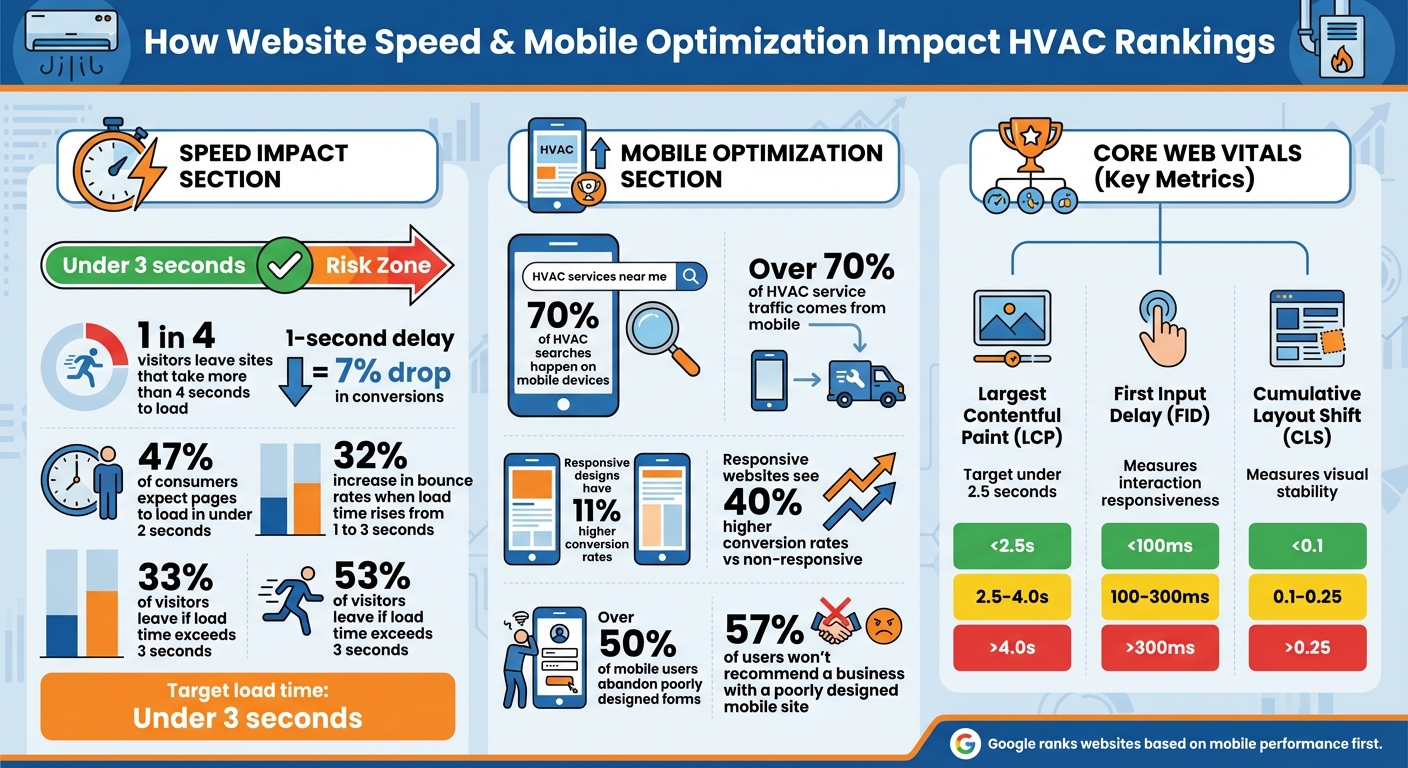
- Speed Matters: 1 in 4 visitors will leave a site that takes more than 4 seconds to load. A 1-second delay can drop conversions by 7%.
- Mobile is Key: Nearly 70% of HVAC searches happen on mobile. Google ranks websites based on their mobile performance, not desktop.
- User Behavior Affects Rankings: Slow sites lead to higher bounce rates, which signal Google to lower your visibility.
- Local SEO Impact: Fast, mobile-friendly sites rank higher for local searches like “AC repair near me” and drive more leads.
To stay competitive, focus on optimizing speed, improving mobile usability, and regularly auditing performance. Simple fixes like compressing images, cleaning up code, and upgrading hosting can directly boost rankings and customer engagement. Don’t let a slow, clunky website cost you leads and revenue.
How Website Speed and Mobile Performance Impact HVAC Business Rankings
Page Speed and SEO: Do Core Web Vitals impact Google rankings?
How Website Speed and Mobile Optimization Affect HVAC Search Rankings
If you want better search rankings for your HVAC website, you need to understand how Google evaluates your site. It’s not just about the content you create – your site’s performance plays a huge role. And here’s the kicker: Google primarily evaluates your mobile site, thanks to mobile-first indexing. So, even if your desktop version looks flawless, a slow or clunky mobile experience can tank your rankings. This makes it essential to audit and improve your site’s performance with mobile users in mind.
Search Engine Ranking Signals
Google uses specific metrics called Core Web Vitals (CWV) to assess user experience, and these carry a lot of weight in search rankings. Here’s what they measure:
- Largest Contentful Paint (LCP): How quickly the main content on your page loads. Aim for under 2.5 seconds.
- First Input Delay (FID): How fast your site responds when a user interacts with it, like clicking a button or link.
- Cumulative Layout Shift (CLS): Whether your page stays stable while loading or if elements jump around.
By 2025, these metrics will remain key factors in determining search visibility. And while having high-quality content is still crucial, even the best content won’t help if your site fails these performance tests. A slow or unstable site will struggle to rank, no matter how excellent your HVAC services are.
User Behavior and Engagement
Site performance isn’t just a technical issue – it directly affects your bottom line. Slow load times can cause a 32% increase in bounce rates when load time rises from one to three seconds. And if it takes more than three seconds, 53% of visitors will leave. Google tracks these behaviors, and high bounce rates or low time-on-page signal that your site isn’t meeting user needs. This creates a downward spiral: poor performance leads to bad engagement metrics, which hurt your rankings, making it harder for potential customers to find you. For HVAC businesses, where fast service is critical, this could mean losing out on emergency calls and, ultimately, revenue.
Local SEO and Mobile Search
Mobile optimization is especially crucial for reaching local customers. With the majority of web traffic now coming from mobile devices, most people discover HVAC services on their phones. A fast, mobile-friendly site not only boosts your local search rankings but also improves engagement with customers who find you through your Google Business Profile. When someone searches for "furnace repair near me", they want quick access to your phone number, service area, and availability. If your mobile site delivers this information clearly and quickly, you’re more likely to win that lead. In fact, responsive designs have an 11% higher conversion rate than non-responsive ones. This means mobile optimization doesn’t just improve your rankings – it directly impacts your ability to turn visitors into paying customers.
How to Audit Your HVAC Website’s Speed and Mobile Performance
Conducting a thorough audit of your HVAC website can help uncover issues like oversized images, inefficient coding, or poor mobile layouts. By identifying these problems, you can turn performance metrics into actionable improvements that enhance user experience and search rankings.
Tools for Performance Audits
Start with Google PageSpeed Insights, a free and easy-to-use tool that evaluates both desktop and mobile performance. It provides scores for Core Web Vitals – Largest Contentful Paint (LCP), First Input Delay (FID), and Cumulative Layout Shift (CLS) – along with a prioritized list of fixes. You don’t need to be a coding expert, as the tool delivers clear, actionable feedback.
For deeper insights, use GTmetrix, which breaks down load times and pinpoints elements slowing your site down, such as large images, render-blocking scripts, or slow server responses. To ensure accuracy, test your site from multiple U.S. locations to identify server-related delays that could impact users in different areas.
Testing Mobile Usability
Speed isn’t the only factor – your site also needs to function flawlessly on mobile devices. Google’s Mobile-Friendly Test is a great starting point to identify mobile-specific issues like small text sizes or buttons that are too close together.
However, automated tools can miss some real-world usability challenges. That’s why manual testing is essential. Test your site on popular devices like an iPhone and an Android smartphone. Check that phone numbers are tappable, forms scroll smoothly, and menus work without glitches. These hands-on checks can reveal problems that frustrate users, especially those seeking urgent HVAC services during extreme weather.
Creating an Action Plan from Audit Results
Once you’ve completed your audit, organize the results into categories such as image optimization, script issues, hosting and caching, and mobile navigation. Focus on the most impactful fixes first, especially those related to Core Web Vitals and mobile usability, as they significantly influence SEO.
For example, if large images are slowing your site, optimize them before tackling smaller issues like minor script delays. Aim for a load time under three seconds to improve customer retention and search rankings. Group similar tasks together to create a straightforward improvement plan. This structured approach not only enhances your website’s performance but also strengthens your local SEO, keeping your HVAC business competitive in a crowded market.
How to Improve HVAC Website Speed
If you want your HVAC website to load faster, focus on optimizing images, cleaning up your code, and upgrading your hosting. These steps not only reduce load times but also help improve your search engine rankings.
Optimize Images and Media
Images often account for the largest file sizes on a website, making them a prime target for speeding things up. Stick to JPG for photos, PNG for transparent graphics, and newer formats like WebP or AVIF for better compression. Use tools to convert images to modern formats while keeping the originals intact.
To shrink file sizes without impacting quality, compress images using tools like TinyPNG or ImageMin. For JPEGs, lowering the quality to around 85 usually keeps them looking good while reducing size. Add the loading="lazy" attribute for images below the fold to delay their loading until needed, which improves your Largest Contentful Paint (LCP) score. For hero images, use fetchpriority="high" to make sure they load quickly.
Responsive images are another must. Use the <picture> and <source> elements with srcset attributes to serve images tailored to a user’s screen size. This prevents mobile users from downloading unnecessarily large files. Always include height and width attributes to avoid layout shifts while images load. For small icons and logos, consider using Base64 strings or inline SVGs to eliminate extra network requests.
These tweaks to your images can make a noticeable difference in your site’s speed.
Streamline Code and Scripts
Bulky CSS and JavaScript files can bog down your site because browsers can only handle so many simultaneous requests. You can lighten the load by minifying and combining files – removing unnecessary characters and bundling multiple JS and CSS files into single ones using tools like webpack.
Use the async attribute on <script> tags to let the browser keep rendering while scripts load. Alternatively, move scripts to the bottom of your HTML, just before the closing </body> tag, so critical content loads first. Take the time to audit your site and remove any unnecessary scripts, stylesheets, or plugins that aren’t adding value.
By simplifying your code, you’ll speed up rendering and deliver a smoother browsing experience.
Use Better Hosting and Caching
Shared hosting often means slower speeds due to resource competition. Upgrading to managed hosting can give you faster servers, better uptime, and built-in caching tools. If your audience is U.S.-based, choose a host with servers located nearby to cut down on data travel time.
Browser caching is another game-changer. It stores static files like HTML, images, CSS, and JavaScript on a visitor’s device, making their return visits much faster. Install caching plugins and configure your server to set expiry headers, which tell browsers how long to keep cached files.
For even better performance, use a Content Delivery Network (CDN) such as Cloudflare, BunnyCDN, or StackPath. CDNs distribute your static files across multiple servers, ensuring your content is delivered quickly from the closest location to your visitors. Plus, CDNs that support HTTP/2 or HTTP/3 protocols allow multiple files to load simultaneously, speeding up the process compared to older protocols.
How to Improve Mobile Usability for HVAC Customers
Once you’ve optimized your site’s speed, the next step is to make sure mobile users can navigate it effortlessly. A fast site won’t do much good if visitors on their phones or tablets struggle to find what they need or complete a form. Considering that over 70% of HVAC service traffic comes from mobile devices, ensuring a smooth mobile experience is non-negotiable. Poor usability can drive potential customers away before they even make contact.
Responsive Design and Layout
Your website needs to automatically adjust to fit screens of all sizes – whether it’s a desktop, tablet, or smartphone. Since Google now uses the mobile version of a site as the basis for its rankings, a clunky mobile experience could hurt your visibility in search results. Just like fast load times help retain users, a responsive layout ensures they can interact with your site easily, no matter the device.
To achieve this, use a flexible grid layout and CSS media queries so your content adapts seamlessly. For logos and icons, opt for Scalable Vector Graphics (SVGs) to keep them sharp and clear on any screen size. Businesses with responsive websites report 40% higher conversion rates compared to those without.
In 2025, Kelly’s Heating & Air partnered with RS Gonzales to revamp their outdated mobile site. The result? A sleek, responsive design that not only loaded quickly but also improved mobile usability, generating daily leads within just three weeks.
Simplify Mobile Navigation
Mobile users are often looking for quick answers, so your navigation should be simple and intuitive. Keep your menu focused on essentials like Home, Services, About, Blog, and Contact. Avoid cluttered dropdowns or hidden contact details – users should be able to find key information in seconds. Buttons should also be large enough and spaced out properly for easy tapping.
Place critical actions like "Call Now" or "Request Service" prominently, ideally above the fold. Sticky navigation bars are a great addition, keeping these options visible as users scroll.
For example, Breeze Heating, Air & Electrical redesigned their site in 2025 with a mobile-first approach, including a standout call-to-action button. Within just two months, they saw a surge in traffic, ranking for over 150 keywords and generating daily leads – all without spending on ads.
Optimize Mobile Forms
Nothing frustrates users more than long, clunky forms on a small screen. In fact, over 50% of mobile users abandon poorly designed forms. Keep your forms short and to the point – stick to essentials like name, phone number, and service type for initial contact.
To make the process even smoother, use the right keyboard for each field (e.g., numeric for phone numbers, email for email addresses), enable autofill, and add real-time validation to catch errors instantly.
One HVAC company in Dallas saw a 20% increase in service inquiries simply by adding click-to-call buttons to their mobile site. Making it easy for users to contact you with just one tap can lead to similar success for your business.
How to Monitor and Maintain Website Performance
Keeping your HVAC website running smoothly is an ongoing task. Search engines like Google frequently update their algorithms, which means your site’s performance can fluctuate over time. Regular monitoring ensures you catch problems early, helping to maintain your rankings and prevent minor issues from snowballing into major setbacks. Staying proactive is key to staying competitive in HVAC search rankings.
Track Key Performance Metrics
Analytics tools are your best friend when it comes to assessing how well your site performs for visitors. Pay close attention to metrics like bounce rates – if users leave your site quickly, it could point to slow loading times or poor mobile usability. Other important metrics include engagement time and mobile interaction data. Here’s why it matters: Google has found that 53% of users will abandon a site if it takes more than 3 seconds to load. Even a slight dip in performance can translate into lost leads. Make it a habit to review these metrics monthly, and always re-test after implementing major changes to ensure your site stays on track.
Re-Test After Major Changes
Every time you make a significant update to your site, it’s essential to re-test its speed and mobile usability. Changes that seem beneficial can sometimes introduce unexpected problems. By re-running your original audits, you can confirm that your site still meets performance standards. This step is crucial for avoiding ranking drops and ensuring your customers have a seamless experience.
Use SearchX SEO Solutions

For long-term success, having expert support can make all the difference. SearchX offers technical SEO audits to uncover crawl errors, security issues, and mobile usability problems before they impact your rankings. Their local SEO services are designed to keep HVAC businesses visible in search results. With custom dashboards and dedicated account teams, SearchX equips you with the tools and insights needed to monitor performance metrics and adjust your strategy based on real-time data.
Conclusion: Speed and Mobile Optimization for HVAC SEO
Your website’s speed and mobile optimization are critical for ranking well in search results. Google prioritizes fast, mobile-friendly websites, which means your site needs to perform seamlessly on mobile devices. In fact, nearly half of consumers – 47% – expect pages to load in under two seconds.
So, what’s the game plan? Start by evaluating your site’s current performance. From there, tackle specific fixes like compressing images, cleaning up unnecessary code, upgrading your hosting, and ensuring your design is responsive. These changes don’t just help with search rankings – they also create a smoother, more enjoyable experience for people searching for HVAC services in your area.
Keep in mind, optimization isn’t a one-and-done deal. Regular monitoring is essential to catch and resolve issues before they affect your rankings or drive customers away. For example, tracking bounce rates and user engagement on a monthly basis can help you stay ahead of potential problems. After all, 57% of users won’t recommend a business if its mobile site is poorly designed.
To maintain these improvements, HVAC businesses need to pair technical updates with ongoing support. As highlighted earlier, SearchX offers technical SEO audits and local SEO services to help ensure your site stays in top form while attracting local customers.
FAQs
How can I check if my HVAC website is optimized for mobile users?
To check how well your HVAC website performs on mobile devices, tools like Google’s Mobile-Friendly Test and PageSpeed Insights are a great place to start. These tools provide insights into critical aspects like load speed, mobile responsiveness, and overall user experience.
Focus on how fast your site loads on mobile, whether the layout adapts smoothly to various screen sizes, and if it’s easy for users to navigate. Enhancing these elements not only boosts your local SEO but also ensures a smoother experience for potential customers browsing on their smartphones.
What are Core Web Vitals, and why do they matter for HVAC SEO?
Core Web Vitals are a set of metrics developed by Google to assess how users interact with a website. They focus on three critical aspects: loading speed (measured by Largest Contentful Paint or LCP), interactivity (tracked through First Input Delay or FID), and visual stability (evaluated by Cumulative Layout Shift or CLS). Together, these metrics ensure websites are quick, user-friendly, and visually consistent.
Google considers Core Web Vitals as ranking factors because they directly influence the user experience. For HVAC businesses, improving these metrics is crucial – not just for climbing search rankings, but also for attracting local customers and keeping them engaged. A fast, mobile-optimized website doesn’t just enhance visibility; it turns visitors into loyal clients.
Why does website speed matter for local HVAC search rankings?
Website speed is a big deal when it comes to local HVAC search rankings. Why? Because it directly impacts how users interact with your site and how search engines, like Google, view its quality. A quick-loading site keeps visitors interested, lowers bounce rates, and sends a clear message to search engines that your site is worth showing in local search results.
Boosting your site’s speed doesn’t just improve your rankings – it can also turn more visitors into paying customers. A faster site means a smoother experience, which is especially critical for mobile users looking for HVAC services nearby.