
Local SEO ensures your dental practice appears in front of nearby patients actively searching for services like yours. Here’s how to optimize your online presence and attract local patients:
- Google Business Profile (GBP): Keep your profile complete and accurate with your hours, location, services, and photos.
- Local Keywords: Use phrases like "dentist near me" or "teeth whitening in [city]" across your website and GBP.
- Patient Reviews: Encourage reviews and respond promptly to build trust and boost rankings.
- Website Structure: Create location-specific pages with consistent Name, Address, and Phone (NAP) details.
- Technical Setup: Ensure fast load times, mobile compatibility, and proper schema markup.
- Tracking Results: Monitor conversions, rankings, and reviews to measure success.
Start by optimizing your GBP, gathering reviews, and targeting local keywords. These steps can connect your practice to patients searching for care in your area today.
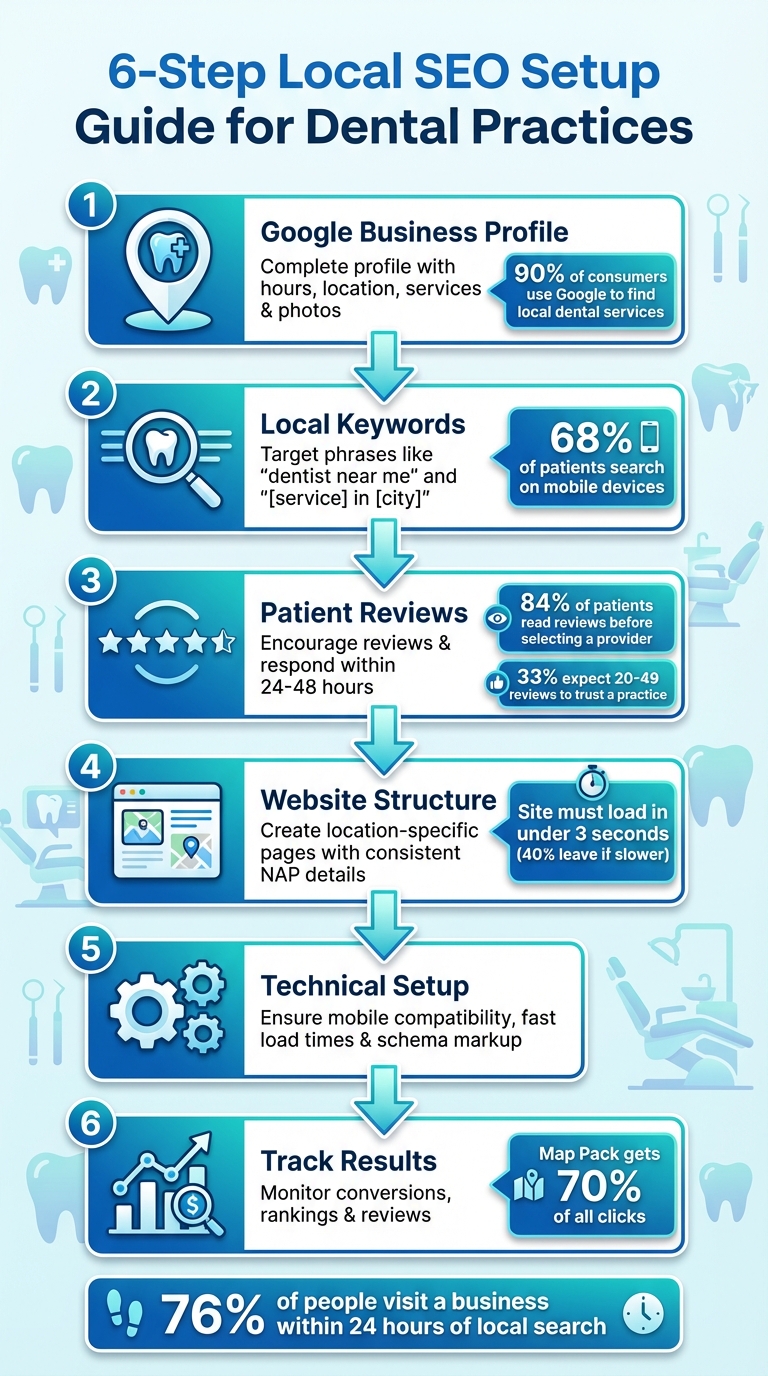
6-Step Local SEO Setup Guide for Dental Practices
Local SEO Guide for Dentists To Outrank 99% Of Dental Practices (Free Checklist)
Setting Up Your Local SEO Foundation
Before diving into page optimization or review collection, it’s crucial to establish a solid local presence that clearly signals your practice’s location and service area to Google. This groundwork is essential for ensuring your practice appears in search results when potential patients in your area look for dental care. Laying this foundation also sets the stage for better performance on Google Business Profiles and the local keywords we’ll discuss later.
Identifying Your Practice’s Service Area
The first step is defining the geographic area your practice serves. Most dental practices typically attract patients from a 20–50 mile radius or within a 20–30 minute drive. To pinpoint your service area, list the cities, neighborhoods, and ZIP codes your patients come from.
For example, a single-location practice might focus on a few nearby neighborhoods, while multi-location practices should assign each office its own specific territory. Ian de Jongh, an SEO expert from Pain-Free Dental Marketing who has worked with over 100 dental practices, highlights the importance of this approach:
"Local SEO is all about, you guessed it, local. You need to prove to Google that your business is an option for that community and the best option available".
Google’s algorithm prioritizes physical proximity. A practice located directly in the town being searched will generally rank higher than a competitor located 30 minutes away, even if that competitor has optimized content for the area.
Organizing Your Dental Website for Local Search
Aligning your website with your service area is a key step in improving local search visibility. Your site should clearly communicate your practice’s location and services to both search engines and potential patients. Create dedicated pages for each service you offer – such as teeth whitening, dental implants, or emergency care. If you serve multiple areas, build separate location pages for each one. Each location page should include complete and consistent NAP (Name, Address, Phone number) details in the standard U.S. format. For example:
"Bright Smile Dental, 1234 Main Street, Suite 200, Dallas, TX 75201, (214) 555-0123."
Ensure this information is displayed consistently across your site, ideally in the header or footer. Embedding a Google Map on these pages can further emphasize your geographic relevance.
Google tends to rank location-specific pages higher. Ian de Jongh notes that only URLs dedicated to a specific town typically rank well for searches in that town. Pages that simply mention multiple locations without dedicated content often fail to appear in local searches. For multi-location practices, each office should have its own unique page with content tailored to that location’s services, staff, and hours. Avoid duplicating content across pages, as this can lead to penalties from Google.
Using SearchX Tools for Technical Setup
After defining your service area and organizing your website, it’s time to tackle the technical aspects that support local SEO. Technical issues, such as slow load times or poor mobile compatibility, can undermine your efforts before potential patients even see your content. SearchX’s technical SEO services can help identify and resolve issues like crawlability errors, mobile-friendliness problems, and slow page speeds.
Begin with a comprehensive site audit to evaluate your website’s structure. Implement LocalBusiness schema markup to help search engines better understand your practice’s details. If you’re unsure how to add schema markup, SearchX provides a helpful guide on adding local business schema markup.
Finally, ensure your site is mobile-friendly, loads quickly, and uses secure HTTPS. These technical factors not only improve your search rankings but also enhance the user experience for your patients. SearchX tools can assist in monitoring and maintaining these elements, ensuring your local SEO strategy stays on track.
Setting Up Your Google Business Profile
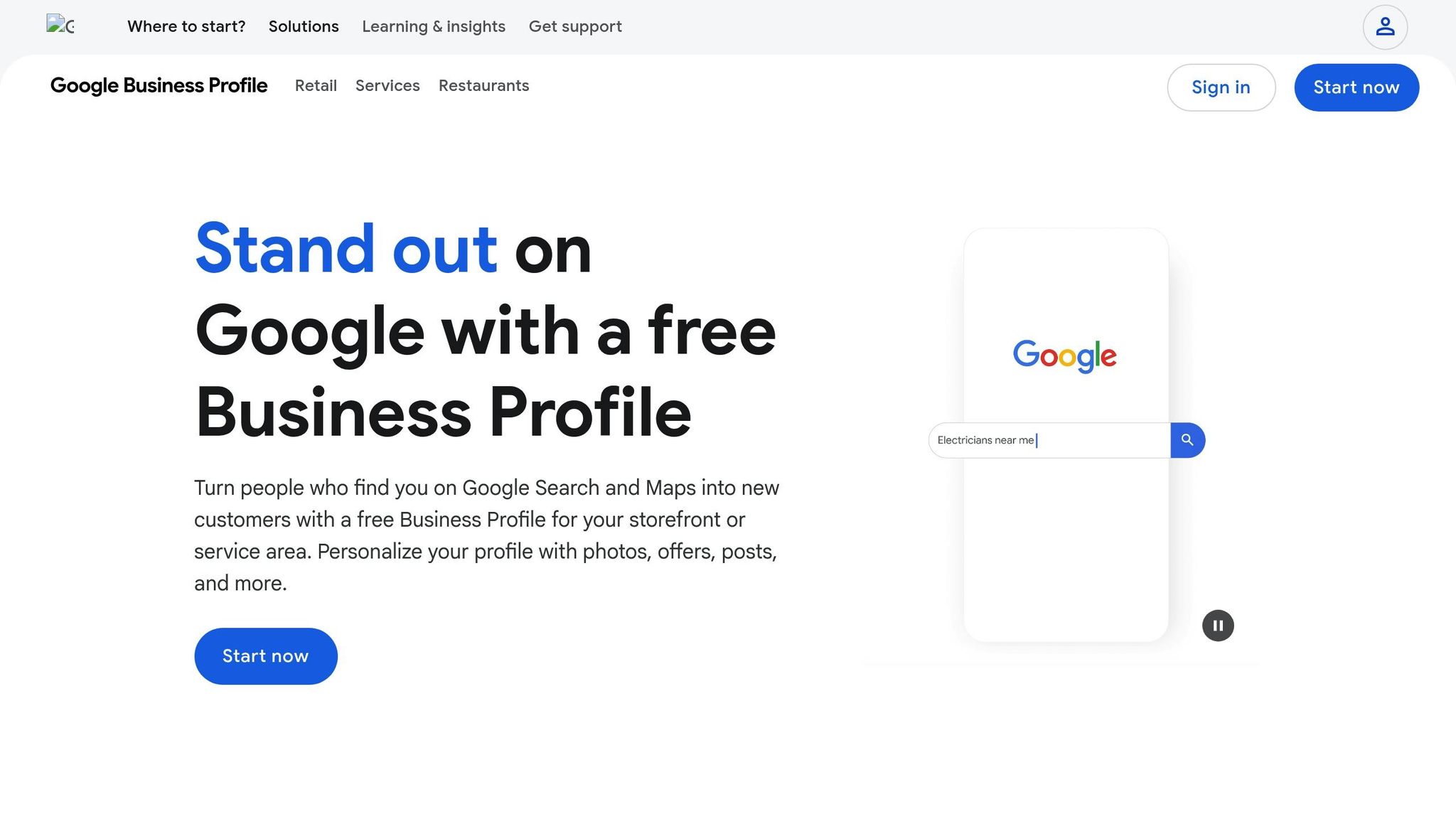
Your Google Business Profile (GBP) is a key element in local dental SEO. With over 90% of consumers turning to Google to find local dental services, your GBP often serves as the first impression potential patients have of your practice. A well-maintained and accurate profile can boost your visibility in local search results and on Google Maps, driving more calls and appointments.
Filling Out Required GBP Fields
If you haven’t already, start by claiming or creating your GBP. Make sure to complete every field – Google tends to favor profiles that are fully filled out. Enter your practice name exactly as it appears on your signage and website, and choose a primary category that best matches your specialty. For instance, you might select "Dentist" for general practices or more specific options like "Cosmetic Dentist", "Pediatric Dentist", "Orthodontist", or "Emergency Dental Clinic" depending on your services. You can also add secondary categories to cover additional offerings.
Write a clear and concise business description that highlights your services, expertise, and what sets you apart. Use local keywords naturally, such as "family dental care in San Diego." Be sure to list your services in detail – examples include teeth whitening, dental implants, root canals, or orthodontics. If your practice has multiple locations, ensure each profile reflects the specific services available at that office.
Add attributes that help patients know what to expect. Examples include wheelchair accessibility, online appointment booking, and accepted payment methods. If you offer emergency services, make that clear by adding features like "accepts emergencies" or "open late." Use the Q&A section to address common questions patients may have, such as insurance coverage or treatment availability.
Finally, verify your business hours and define your service areas accurately.
Configuring Hours and Service Areas
Accurate hours are essential. Enter your operating hours in the 12-hour format (e.g., 9:00 AM–5:00 PM) and update holiday hours in advance so patients know if you’re open during times like Thanksgiving or Christmas. Highlight any emergency services you offer outside of regular hours.
For your service area, define the geographic region your practice covers. If patients visit your office, include your full address in the U.S. format: practice name, street address (including suite number if applicable), city, state abbreviation, and ZIP code. For practices with multiple locations, each office should have its own GBP with unique details. Consistency is critical – ensure your Name, Address, and Phone number (NAP) are identical across your website, GBP, and other directories. Even small discrepancies can affect your search rankings.
Once these details are set, turn your attention to managing reviews and adding high-quality photos.
Handling Reviews and Photos
Reviews are a powerful factor in local SEO. According to a 2025 BrightLocal study, 84% of dental patients read online reviews before selecting a provider. Many patients rely on reviews as much as they do on a dentist’s credentials. Encourage satisfied patients to leave reviews through follow-up emails, text messages with direct links, or in-office QR codes.
Responding to reviews is just as important. It shows you value feedback and can improve your search rankings. Businesses that consistently reply to reviews often see a 12% increase in review submissions, and 89% of searchers are more likely to choose a business that engages with all reviews. Aim to respond within 24 to 48 hours. For positive reviews, thank the reviewer and reference something specific they mentioned. For negative reviews, acknowledge their concerns, apologize, and invite them to discuss the issue privately.
Be sure to follow HIPAA guidelines when responding. Never identify reviewers as patients or disclose personal health information. Keep responses general and focus on your dedication to quality care. For instance, you could say, "We aim to provide excellent care for all our patients. Please call our office to discuss further", instead of mentioning specific treatments.
High-quality photos and videos can further enhance your profile. Showcase inviting waiting areas, modern equipment, and friendly staff. Pediatric practices might highlight bright, kid-friendly spaces with engaging features. With patient consent, share before-and-after photos of cosmetic or orthodontic treatments. You could even add a virtual office tour to help potential patients get a feel for your practice. Regular updates through Google Posts – such as promotions, new services, dental tips, or patient success stories – can also signal to Google that your profile is active and up-to-date.
An optimized GBP can make all the difference in connecting your dental practice with local patients who need your services.
Finding and Using Local Keywords
Local keywords are a powerful way to connect with nearby patients by combining your services with your location. Think phrases like "teeth whitening in Austin" or "emergency dentist near me." Knowing how to discover and use these keywords effectively can make a big difference in how visible your practice is in local search results.
Researching Local Dental Keywords
Once you’ve established the basics of local SEO, it’s time to zero in on keywords that match your services and the areas you serve. Start by listing the treatments you offer and the locations you target. For example, use combinations like "dental implants Chicago", "affordable braces Brooklyn", or proximity-based phrases like "pediatric dentist near me."
Check out your competitors’ page titles and meta descriptions to uncover local keywords they’re using. This can help you spot opportunities they may have missed and give you a clearer picture of what’s working in your market.
Organize your keywords by service type and location to create a structured plan. For instance, separate terms related to emergency dental care from those focused on cosmetic procedures. Also, group keywords by neighborhoods or ZIP codes you serve. Pay close attention to search intent – someone searching "how much do veneers cost" is likely at a research stage, while "cosmetic dentist open Saturday" signals they’re ready to book. Focus on keywords that align with your services and have strong potential to attract patients, considering factors like relevance and search volume.
Adding Local Keywords to Your Pages
After identifying your target keywords, strategically integrate them into your website. Start with your page titles, ensuring they include both the service and location. For example, "Root Canal Therapy in Denver | [Practice Name]." Keep titles under 60 characters so they appear fully in search results.
Write meta descriptions that naturally incorporate local keywords while encouraging clicks. For example: "Looking for a family dentist in Portland? We offer gentle care for all ages and accept most insurance plans." Aim for meta descriptions between 150 and 160 characters.
Use local keywords in headers, such as "Comprehensive Dental Care in San Diego" for your homepage or "Invisalign Treatment in Downtown San Diego" for a service page. In your body content, keep keyword usage balanced – aim for a density of 1–2% so it feels natural and not overdone.
Don’t overlook image alt text and URLs. For instance, use descriptive alt text like "dental office waiting room in Miami" to boost accessibility and SEO. Clean, keyword-rich URLs like "yourpractice.com/invisalign-miami" also help search engines and users understand your content. If your practice has multiple locations, create separate pages for each office, complete with unique content that highlights local landmarks, neighborhood names, and relevant keywords throughout the page.
For additional insights, consider using professional tools to refine your keyword strategy.
SearchX Keyword Research Tools
Advanced tools can help you uncover high-intent keywords tailored to your practice. SearchX offers professional keyword research services that analyze search volume, competition, and patient intent to craft a focused keyword plan.
If you’re targeting mobile users – many of whom search for dental services while on the go – SearchX’s mobile keyword research guide can help you find location-based terms that perform well on smartphones. Since "near me" searches often happen on mobile devices, this strategy ensures you connect with patients at the exact moment they’re looking for care.
You can also use SearchX’s competitor SERP ranking comparison tool to see which local keywords your competitors are ranking for. This tool identifies areas where you can outperform them, providing actionable insights to strengthen your local SEO efforts. Combining these tools with your technical setup and Google Business Profile optimization creates a unified, data-driven strategy that focuses on the keywords most likely to bring patients through your doors.
Measuring Your Local SEO Results
Tracking your local SEO performance is essential to understand what’s working and to make informed decisions about your marketing efforts. Without measurement, you’re essentially guessing whether your strategies are bringing in new patients.
Key Local SEO Metrics to Monitor
Start by keeping an eye on your local search rankings, particularly your position in the Google Map Pack. This is important because the Map Pack accounts for over 70% of all clicks, making it a critical area for dental practices to target. Focus on securing first-page visibility with your top local keywords, as most users rarely venture beyond the first page.
Beyond rankings and traffic, conversions are what really count. Track important actions like phone calls, online appointment bookings, and contact form submissions. Also, be aware that a slow website can hurt your efforts – if your site takes longer than 3 seconds to load, up to 40% of visitors might leave before even seeing your services.
Don’t forget to leverage Google Business Profile Insights. This free tool provides valuable data on how patients find your practice and where they’re coming from. Reviews are another critical metric – 42% of people read online reviews when searching for local businesses, and 33% expect to see between 20 and 49 reviews before considering a practice trustworthy. Regularly monitor your total review count, average star rating, and how quickly you respond to feedback.
By tracking these metrics, you’ll have a solid foundation to evaluate and refine your SEO efforts.
Tools to Help Track Performance
Google Business Profile Insights is a great starting point. It shows how patients discover your practice – whether through direct searches (using your name), discovery searches (looking for dental services), or Google Maps. It also highlights the actions patients take most often, such as calling your office, visiting your website, or requesting directions.
Google Analytics 4 is another must-have tool. It provides detailed insights into how users interact with your website, including which pages they visit, how long they stay, and where they drop off. Setting up conversion tracking can help you measure key actions, and comparing mobile and desktop performance is crucial since mobile searches dominate local queries.
For a more comprehensive approach, consider tools like SearchX. Their 12 SEO Metrics Tracking Guide outlines essential indicators, and their SERP Feature Tracking Tools Comparison can help you find the best solution for your practice.
These tools provide a clear view of how your SEO efforts are contributing to your practice’s success.
Connecting Metrics to Practice Growth
To evaluate your return on investment (ROI), use this formula:
ROI = [(Total Revenue – SEO Costs) / SEO Costs] x 100.
For dental practices, these metrics often translate directly into more patient appointments and overall growth. Estimate the value of each conversion based on your historical data, and track how many new patients mention finding you through Google or your online presence. Then, compare your SEO expenses to the revenue these patients generate over their lifetime. For more detailed guidance, check out SearchX’s SEO ROI Measurement Guide.
Conclusion and Next Steps
Local SEO isn’t a one-and-done effort – it demands ongoing attention. Google regularly updates its algorithms, new competitors enter the scene, and patient behaviors shift over time. The key to staying ahead? Consistency. Practices that keep their Google Business Profile updated, gather fresh reviews, and fine-tune their websites are the ones capturing 70% of those coveted Map Pack clicks. These foundational tasks ensure your local SEO efforts translate into sustained patient engagement and appointment bookings.
Recap of Local SEO Strategies
To succeed, focus on three essential elements: an optimized Google Business Profile, consistent NAP (Name, Address, Phone number) details, and locally relevant content. Make sure your website loads in under 3 seconds on mobile devices – where 68% of patients are searching – and target specific local keywords like "emergency dentist near me" or "[Your City] pediatric dentist". Tailor content to address the unique needs of your community, and track your performance using tools like Google Business Profile Insights, Google Analytics 4, and conversion metrics tied to new patient appointments.
Where to Begin
Start with the most impactful step: claim and optimize your Google Business Profile. Once that’s done, move on to other strategies – ask happy patients for reviews, ensure your website is mobile-friendly, research local keywords, and build citations on relevant directories. In competitive markets, practices investing at least $3,000 per month in local SEO often see measurable results. But even smaller budgets can deliver returns if you focus on the right priorities.
For dental practices looking for expert help, SearchX offers tailored tools and services to simplify local SEO. Explore their DIY Local SEO resources for step-by-step guidance, or check out their Technical SEO Services to ensure your website meets Google’s latest standards. For a more comprehensive approach, their SEO Solutions include everything from keyword research to ongoing optimization, starting at $3,000/month.
Take action now. 76% of people searching for local services visit a business within 24 hours. Your next patient could be searching at this very moment – make sure they find you before anyone else. Focused, immediate steps can make all the difference in dominating your local market.
FAQs
What are the best ways to encourage patients to leave reviews for my dental practice?
Encouraging patients to share their feedback can be straightforward and impactful when approached the right way. One effective method is to ask for reviews shortly after their visit. This can be done in person, or through a follow-up email or text message. To make the process seamless, provide a direct link or a QR code that takes them straight to your review page.
It’s equally important to acknowledge every review with a professional response, whether the feedback is glowing or offers room for improvement. Positive reviews can be highlighted on your website or social media platforms, showcasing your commitment to patient satisfaction. This not only helps build trust with potential patients but also shows current ones that their opinions truly matter. By staying consistent and adding a personal touch, you can strengthen your online reputation over time.
What key technical steps should I take to improve local SEO for my dental practice?
To boost your dental practice’s local SEO, start by fine-tuning your Google Business Profile. Make sure your business details – Name, Address, and Phone number (NAP) – are accurate and consistent. Add high-quality photos that showcase your practice and post updates regularly to keep your profile active.
Your website also plays a big role. It should be mobile-friendly, load quickly, and include local keywords in a natural way to attract nearby patients. Beyond that, work on securing local backlinks and citations from reputable sources. These not only improve your site’s authority but also help search engines connect your business to your community.
Encouraging online reviews is another key step. Ask satisfied patients to leave feedback and take time to respond to reviews – both positive and negative. This builds trust and shows you’re engaged with your audience. Lastly, consider using schema markup on your website. This helps search engines better understand your business, making it easier for potential patients to find you in local search results.
How can I find the best local keywords for my dental practice’s SEO?
To find the most effective local keywords, start by pairing your services with location-based terms, such as city names or specific neighborhoods. For instance, phrases like “family dentist in Seattle” or “emergency dentist near Uptown” can work wonders. The goal is to focus on keywords that show clear local intent while also having a reasonable search volume.
Leverage keyword research tools to uncover relevant terms, and don’t forget to analyze your competitors for ideas. Pay attention to variations that include descriptive modifiers like “affordable,” “best,” or “top-rated.” Once you’ve nailed down your keyword list, weave them seamlessly into your website content, Google Business Profile, and online directories. This approach can boost your visibility and bring in more local patients.