

Local SEO helps attorneys connect with nearby clients searching for legal services. It focuses on improving your online visibility in local search results, ensuring your firm appears when people search for terms like "divorce lawyer near me" or "personal injury attorney in Chicago." Here’s what you need to know:
- Google Business Profile (GBP): Claim, verify, and optimize your GBP with accurate details like name, address, phone number (NAP), and business hours. Add high-quality photos and encourage clients to leave reviews.
- Citations and Backlinks: Ensure your firm is listed consistently across legal directories (e.g., Avvo, Justia) and general ones (e.g., Yelp). Build backlinks from local organizations, bar associations, and community events.
- Location-Specific Content: Create city-specific landing pages and localized legal guides to target searches in your area. Include geo-specific keywords and address local legal concerns.
- Technical SEO: Use LocalBusiness and LegalService schema markup to help Google understand your firm’s services and locations. Optimize title tags and meta descriptions for local keywords.
- Track Performance: Monitor metrics like GBP views, local traffic, and conversions using tools like Google Analytics, Google Search Console, and CallRail.
Local SEO isn’t just about ranking higher; it’s about reaching the right clients in your area. By focusing on GBP optimization, consistent citations, local content, and technical SEO, you can drive more inquiries and grow your practice.
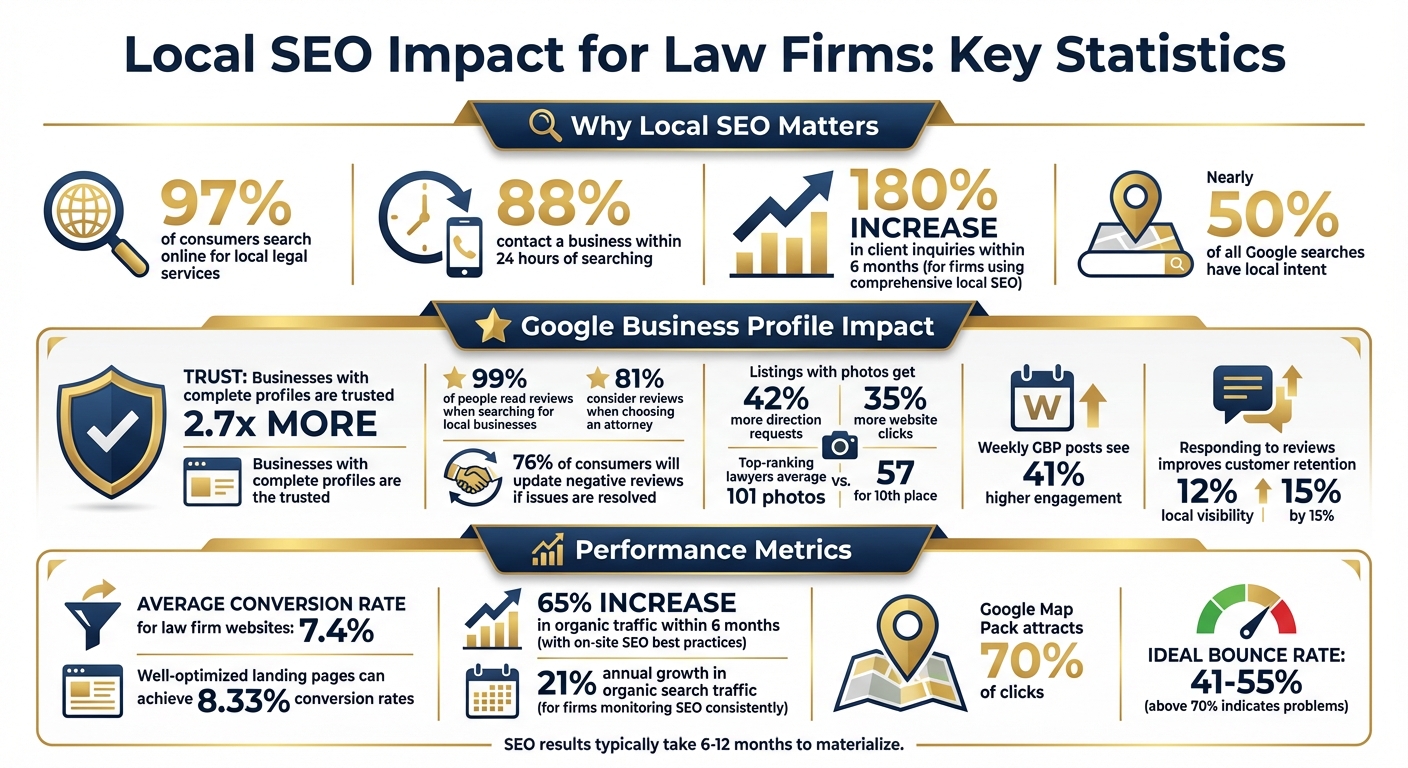
Local SEO Statistics and Performance Metrics for Law Firms
Local SEO for Lawyers: Rank Top 3 in Your City
How to Optimize Your Google Business Profile
Your Google Business Profile (GBP) acts as the online face of your law firm. It’s where potential clients first interact with your services. Businesses with complete profiles are trusted 2.7 times more by online users – a clear advantage in a competitive market.
Claiming and Verifying Your Profile
To get started, search for your law firm’s name on Google or Google Maps to see if a profile already exists. If it does, click on "Own this business?" and follow the instructions to claim it. If no profile is found, head to the Google Business Profile website, sign in with your Google account, and create a new listing.
When setting up your profile, stick to your law firm’s official name as it appears in your legal documents. Avoid keyword stuffing – like adding phrases such as "Best Personal Injury Lawyers in Chicago" – as this violates Google’s rules and could result in your profile being suspended. Instead, select a specific primary category that accurately reflects your practice, such as "Personal Injury Attorney", "Family Law Attorney", or "Criminal Justice Attorney."
Before your profile goes live, Google requires verification. Most firms will receive a postcard with a code to enter within 30 days. In some cases, verification can also be done via phone, SMS, or email. Completing this step is essential – it activates your profile, allows you to make updates, and establishes credibility with potential clients.
Once verified, your next step is to update your business information to ensure accuracy.
Updating Your Business Information
After verification, make sure every detail on your profile is accurate and up-to-date. If you have a physical office where clients can visit, include your exact address. Keep in mind, Google may suspend profiles that rely on virtual offices or P.O. boxes. If you work remotely or visit clients at their locations, define your service area instead.
Use a local phone number rather than toll-free or call-tracking numbers, and link to your homepage or a specific landing page. Keep your business hours updated, including holiday schedules, so clients know when you’re available. Consistency is key – ensure your Name, Address, and Phone number (NAP) are identical across your website, legal directories, and social media profiles. Even minor discrepancies can confuse search engines and harm your rankings.
Write a concise yet compelling business description (up to 750 characters) that naturally includes your practice areas and location. Highlight what sets your firm apart. List all the legal services you offer and enable attributes like "wheelchair accessible" or "women-owned" to reflect your firm’s unique identity.
Managing Reviews and Photos
Once your profile is complete, focus on reviews and visuals to build trust with potential clients. Reviews are a major factor in decision-making – 99% of people read reviews when searching for local businesses, and 81% consider them when choosing an attorney. Encourage satisfied clients to leave Google reviews by sharing a link via email or SMS as part of your case-closing process. Avoid offering incentives, as this violates Google’s policies. Respond to reviews within 24–48 hours. For positive feedback, express gratitude. For negative reviews, address concerns with empathy and offer to resolve issues privately. Studies show that 76% of consumers are open to updating a negative review if their issue is resolved.
"I always asked customers, ‘What made you call me?’ and oftentimes they tell me, ‘We reached out because of your Business Profile on Google.’"
– Detroit Voltage
Visuals are equally important. Listings with photos see 42% more requests for driving directions and 35% more website clicks. Upload high-quality images, such as attorney headshots (at least 720×720 pixels), office interiors and exteriors, team photos, and short videos (up to 30 seconds). A study found that top-ranking lawyers in local search results averaged 101 photos on their GBP, compared to 57 photos for those ranked tenth. Regularly adding fresh, professional images keeps your profile active and engaging.
For example, Moore Ganske Murr PLLC saw impressive results after optimizing their profile – 60% of their total calls now come directly from their GBP.
Building Local Authority Through Citations and Backlinks
When it comes to local SEO, optimizing your Google Business Profile is just the beginning. The next crucial step is establishing local authority, which hinges on two key elements: citations and backlinks. Citations are online mentions of your law firm’s Name, Address, and Phone number (NAP), while backlinks are links from other websites that point to yours. Together, these factors signal to Google that your firm is credible, reliable, and relevant to local users.
Consistency is everything when it comes to citations. Google’s local ranking algorithm relies heavily on accurate and uniform NAP details. Even small inconsistencies – like variations in abbreviations – can confuse search engines and hurt your rankings. Instead of chasing as many citations as possible, focus on high-quality sources. Authoritative legal websites and prominent local business directories are your best bets, especially if they already rank for important keywords.
Listing in Business and Legal Directories
Start by claiming profiles on trusted legal directories. Platforms like Justia (with over 12 million monthly visits), Avvo (a top destination for legal information), Nolo, and Martindale-Hubbell‘s network (boasting over 23 million monthly visitors) are excellent choices. These directories not only enhance your visibility but also strengthen your firm’s online authority.
General business directories shouldn’t be overlooked either. Websites like Yelp and Yellow Pages are highly regarded by search engines. Additionally, listings with your local Chamber of Commerce and Better Business Bureau add credibility within your community. Google often prioritizes platforms like Avvo, Yelp, and FindLaw, showcasing their importance in search rankings.
Make sure to verify any existing listings to avoid duplicates, as duplicate entries can negatively impact your rankings. Some directories allow you to create profiles for both your law firm and individual attorneys – take advantage of this opportunity. Many also offer features like publishing articles or adding detailed descriptions, which can further boost your authority online.
Getting Local Backlinks
Local backlinks are another powerful tool for building credibility and improving rankings. Links from community organizations, bar associations, or regional news sites act as endorsements in the eyes of search engines, validating your firm’s trustworthiness. Here, quality trumps quantity – a single backlink from your state bar association can carry more weight than dozens of links from low-tier directories.
Building local backlinks is less about traditional SEO tactics and more about cultivating relationships within your community. Consider sponsoring local events, charities, or youth sports teams – these often include a link to your website on sponsor pages. Writing guest articles for local business journals, chamber of commerce newsletters, or community blogs is another effective way to earn backlinks. Don’t forget to join your local bar association and ensure your firm is listed in their member directory, complete with a link to your site. Additionally, participating in community events can lead to coverage from local news outlets, which often results in high-quality backlinks.
Creating Location-Specific Content
Once you’ve optimized your Google Business Profile and established local credibility, the next step is crafting content that connects with your local audience. Legal services are inherently local – clients need attorneys familiar with their specific courts and jurisdictions. Generic content simply won’t cut it. Instead, you need pages tailored to each service area. Consider this: nearly half of all Google searches have local intent, and 97% of consumers prefer to shop locally. When someone searches for "personal injury lawyer near me" or "divorce attorney in Phoenix", they’re looking for immediate, local expertise.
Creating location-specific content not only makes you more visible in search results but also strengthens your authority. These tailored pages show potential clients that you understand the nuances of their local legal landscape. They also help boost your search rankings, making it easier for your firm to appear in the local pack, Google Maps, and organic search results where clients are actively looking. Google’s local algorithm prioritizes relevance, distance, and prominence, so by focusing your content on specific geographic areas, you’re signaling that your firm is the right choice.
Building City-Specific Landing Pages
If your firm operates in multiple cities, it’s crucial to create a dedicated landing page for each location. These pages clearly communicate to Google where your services are available, making it easier for local clients to find you. A generic website won’t attract high-value cases – your landing pages need to be laser-focused on each market. In fact, firms that implement on-site SEO best practices often see a 65% increase in organic traffic within just six months.
To build these pages, create a "locations" directory on your site (e.g., yourlawfirm.com/locations/phoenix) and incorporate geo-specific keywords into title tags, meta descriptions, headers, and body copy. Include your physical address and relevant local details to reinforce your presence in the area. For example, a personal injury lawyer in Charleston could use a title tag like: "Top Personal Injury Lawyer in Charleston | [Your Law Firm’s Name]". A well-optimized landing page with a clear call-to-action can achieve conversion rates as high as 8.33%. These pages serve as the foundation for engaging local audiences and driving meaningful interactions.
Writing Local Legal Guides and FAQs
Another effective strategy is to create localized blog posts, legal guides, and FAQs that address specific laws and legal concerns in your area. For instance, a blog titled "What to Do After a Car Accident in Los Angeles" offers practical advice for local users. Similarly, content like "Florida’s No-Fault Approach to Car Accident Cases" or "Understanding Attorney-Client Privilege in New Jersey" can engage potential clients while improving your local SEO.
To meet Google’s E-E-A-T guidelines (Expertise, Experience, Authoritativeness, and Trustworthiness), cite official sources and state statutes, and attribute the content to a licensed attorney on your team. Combine professional knowledge with a tone of empathy, and use LegalService Schema markup with the areaServed property to enhance your search visibility through rich snippets. These efforts help position your firm as a trusted local resource while building stronger connections with your community.
Technical SEO for Local Search
Technical SEO serves as the backbone of local search by helping search engines understand your firm’s services and the areas you serve. The way your website is structured plays a huge role in whether search engines can accurately read and rank your pages. Tools like schema markup and optimized meta elements act as a direct line of communication with Google, providing clarity about your firm’s location, practice areas, and credentials. These technical elements not only enhance your local business profile but also amplify your content efforts, making your firm more visible in local search results.
Adding Local Business Schema Markup
Schema markup is a form of structured data that helps search engines grasp the details of your content. For law firms, using the LegalService schema provides Google with specifics such as your location, practice areas, operating hours, attorney credentials, bar numbers, and even accepted payment methods. This can lead to rich snippets in search results, like star ratings, office hours, or contact details, which can significantly improve visibility and click-through rates.
To get started, add LocalBusiness schema to each location page. Include all essential details like your full address, phone number, operating hours, and geographic coordinates. Use LegalService schema to outline your practice areas and the jurisdictions you serve. Enhance navigation with BreadcrumbList schema and address common questions with FAQPage schema. If your firm has multiple offices, structure them correctly using Organization schema with subOrganization properties. For best results, implement this data in JSON-LD format within your website’s <head> section.
Once you’ve added schema markup, validate it using Google’s Rich Results Test. Keep an eye on your implementation through Google Search Console and run re-tests regularly, especially after making changes to your website.
"If you’re familiar with JSON-LD format (which is highly recommended), you can manually code your schema markup to ensure full accuracy." – Chris Dreyer, CEO & Founder of Rankings.io
"Incorrect or misconfigured schema can be detrimental rather than beneficial. Conducting regular Technical SEO audits for your law firm is a reliable way to ensure your schema markup is precise and implemented correctly." – Colton Dirks, Legal Marketing Expert
After your schema is in place, focus on optimizing your title tags and meta descriptions to further strengthen your local SEO.
Writing Title Tags and Meta Descriptions for Local Search
Title tags and meta descriptions are essential tools that work hand-in-hand with schema markup to boost your local search visibility. A well-crafted title tag makes your firm stand out instantly in search results. For maximum impact, include your practice area, specific location (city and state), and firm name within 55 to 65 characters. For example: "Personal Injury Lawyer in Miami, FL | Johnson Law Group."
Meta descriptions, on the other hand, should be concise – typically under 155 to 160 characters – and highlight your location, key services, and a compelling call to action. Together, these elements reinforce your local SEO strategy while encouraging users to click through to your site.
Tracking Your Local SEO Performance
Once you’ve implemented technical optimizations, it’s time to measure how your local SEO efforts are paying off. Focus on tracking both leading indicators, like Google Business Profile (GBP) views and keyword rankings, and lagging results, such as booked consultations and revenue generated. Keep in mind that SEO results often take six to twelve months to materialize.
"Investing in local SEO without measuring it is a shot in the dark. The beauty of digital marketing is its measurability." – ENX2 Legal Marketing
Regularly analyzing your performance across platforms will help you identify successful strategies and areas that need improvement. Law firms that consistently monitor and refine their SEO strategies report an average 21% annual growth in organic search traffic.
Metrics to Monitor
Breaking down your performance into measurable categories makes tracking progress more manageable.
Start with local visibility metrics through Google Business Profile Insights. Keep an eye on GBP views, direction requests, and phone calls directly linked to your profile. Businesses that post weekly on their GBP see 41% higher engagement compared to those posting less frequently. Responding to reviews is another powerful tactic – it can improve customer retention by 12% and boost local search visibility by 15%.
For website performance, monitor organic traffic from local searches, time spent on pages, bounce rates, and the number of pages visited per session. Track key conversions, such as consultation bookings, newsletter sign-ups, or calls lasting over 90 seconds. Law firm websites with effective SEO tracking report an average conversion rate of 7.4%. Aim for bounce rates between 41–55%, as rates above 70% may indicate a mismatch between your content and user intent.
Keyword rankings are another essential metric. Track your positions for local keywords (e.g., "personal injury lawyer Miami") and "near me" searches using tools like Ahrefs, Semrush, or Pro Rank Tracker. Also, monitor your Share of Local Voice (SoLV), which measures how often your listing appears in Google’s Map Pack. Considering that the Map Pack attracts 70% of clicks, maintaining strong visibility here is critical.
| Metric Category | What to Track | Tools to Use |
|---|---|---|
| Local Visibility | GBP views, keyword rankings, Share of Local Voice | Google Business Profile Insights, Local Falcon, Pro Rank Tracker, Ahrefs |
| Website Traffic | Organic local traffic, bounce rate, time on page | Google Analytics (GA4) |
| Conversions | Consultation requests, form submissions, calls | Google Analytics (GA4), CallRail |
Analytics and Reporting Tools
To track and analyze your local SEO performance, start with free tools like Google Search Console and Google Analytics (GA4). Google Search Console provides insights into how technical elements like LegalService schema markup affect your visibility and shows which search queries drive traffic to your site. GA4, on the other hand, offers detailed data on user behavior, conversion rates, and page engagement, helping you understand how local visitors interact with your site.
For more precise local ranking data, tools like Local Falcon can create geo-grid heat maps to show how visible your business is across specific areas. This is particularly useful for spotting gaps, such as strong rankings in downtown areas but weaker visibility in nearby suburbs.
Call tracking tools like CallRail are invaluable when it comes to measuring the ROI of your SEO efforts. They connect customer searches directly to paying clients. For keyword tracking, platforms like Ahrefs and Semrush help you monitor your performance for targeted local keywords and uncover areas for improvement.
Make it a habit to review your performance data monthly. Look for trends and refine your strategy as needed. Experiment with A/B testing for different GBP post styles, service descriptions, and call-to-action phrasing to see what resonates most with your audience. Seasonal analysis can also reveal shifts in local search behavior, allowing you to adjust your approach ahead of time. Use these insights to keep your local SEO strategy sharp and effective.
Conclusion
Local SEO is a game-changer for attorneys, connecting you with potential clients when they need legal help the most. With 97% of consumers turning to online searches for local legal services and 88% reaching out to a business within 24 hours, your presence in local search results can directly influence your firm’s success. In fact, law firms that embrace a well-rounded local SEO approach often see a 180% jump in client inquiries within just six months.
At the heart of any effective local SEO strategy lies your Google Business Profile and consistent NAP (Name, Address, Phone number) data across more than 60 directories. These steps alone can significantly improve your local rankings. Add to that the power of client reviews, and you’ll also see a boost in click-through rates.
"Local SEO for lawyers isn’t just about ranking. It’s about ranking for the right searches that bring in paying clients." – Grow Law
Beyond the basics, advanced technical efforts take your strategy to the next level. Features like location-specific landing pages, LegalService schema markup, and mobile-friendly design ensure search engines know exactly where you operate and who you serve. These aren’t tasks you complete once and forget – they require ongoing attention to deliver lasting results.
To create a strong local SEO plan, start with the essentials: claim your Google Business Profile, encourage happy clients to leave reviews, and make sure your NAP information is accurate and consistent everywhere. From there, build on these foundations with location-focused content, local backlinks, and regular tracking of your performance. This guide has laid out every step to help your firm stand out in local search. Attorneys who dominate their local market don’t rely on luck – they follow these strategies consistently to secure long-term success.
FAQs
What’s the best way for attorneys to encourage clients to leave Google reviews?
Attorneys looking to gather Google reviews from clients should start by delivering an outstanding client experience and then politely asking for feedback. The best time to make this request is shortly after a successful outcome or service – when the experience is still fresh and top of mind for the client.
To make it easy, provide clear instructions or share a direct link to your Google Business Profile review page. A friendly reminder about how their review can guide others in finding reliable legal help can also go a long way. And don’t forget – always thank clients for taking the time to share their thoughts. A little gratitude can leave a lasting positive impression.
What are the best practices for creating effective city-specific landing pages for law firms?
To craft effective city-specific landing pages for your law firm, it’s important to tailor your content to match the unique needs and characteristics of each location. Start by weaving the city name into key areas like the page title, meta description, headers, and naturally throughout the body content. This not only improves search engine visibility but also helps potential clients quickly recognize the page’s relevance.
Showcase details that resonate with the local audience, such as specific laws, court systems, or your involvement in the community. Highlighting these points demonstrates your understanding of the area and builds credibility. Pair legal industry keywords with the city name to improve local search rankings. Including high-quality images of your office, team, or recognizable landmarks from the city adds a personal and trustworthy touch.
Lastly, make sure your contact information matches what’s listed on your Google Business Profile and other directories. Don’t forget to include a clear call-to-action, like encouraging visitors to schedule a consultation, to make it easy for potential clients to take the next step.
How can local backlinks boost a law firm’s credibility online?
Local backlinks are essential for boosting a law firm’s online reputation and visibility. When respected local websites – like community organizations, local directories, or trusted businesses – link to your law firm’s site, it sends a strong message to search engines about your site’s reliability and relevance within your area.
These links do more than just improve search rankings; they also foster trust with potential clients by connecting your firm to well-known local entities. To enhance your online presence, aim to secure links from sources such as local news outlets, legal associations, or sponsorships tied to community events.