

TL;DR:
- Social signals influence SEO indirectly by accelerating content discovery, increasing referral traffic, and boosting backlink opportunities. They also grow brand search demand and reinforce authority signals over time. Measuring their impact requires tracking referral, ranking, and backlink data within 7 to 14 days of social campaigns.
Social signals are defined as user interactions on social media platforms, including likes, shares, comments, and reposts, that indirectly influence how search engines discover, evaluate, and rank content. The role of social signals in SEO is not about direct ranking boosts. Google has confirmed that social signals are not a direct ranking factor. Their power lies in what they trigger: faster indexing, referral traffic, backlink acquisition, and brand authority growth. Tools like Google Search Console and Google Analytics give SEO professionals the data to track these downstream effects with precision.
How do social signals indirectly impact SEO performance?
Social media accelerates content discovery and indexing by search engines, increasing content visibility before traditional link building even begins. When a piece of content spreads across LinkedIn, X (formerly Twitter), or Reddit, Googlebot encounters it through crawl paths created by social sharing. That faster discovery window matters most for time-sensitive content competing in crowded SERPs.

Referral traffic from social platforms sends behavioral signals to search engines. When users click through from a Facebook post or a LinkedIn share and spend time on a page, those engagement signals affect rankings by indicating content quality. Low bounce rates and longer session durations from social referrals reinforce the page’s relevance.
High-performing social posts expose content to journalists and bloggers who may create backlinks. This is the most direct SEO payoff from social activity. A single viral LinkedIn post reaching the right audience can generate five to ten editorial links that no outreach campaign would have secured.
Strong branded search demand sends trust and authority signals to search engines, contributing to improved non-branded term rankings over time. When social campaigns drive users to search for your brand by name, Google interprets that demand as a quality signal. The result is a lift in domain authority that benefits every page on the site.
Key indirect mechanisms social signals activate:
- Content discovery: Social sharing creates new crawl paths for Googlebot, reducing time to indexing.
- Referral traffic: Clicks from social posts signal user interest and content relevance to search engines.
- Backlink amplification: Viral content reaches link-building audiences, journalists, and bloggers organically.
- Branded search growth: Social campaigns increase brand name searches, which strengthen domain trust signals.
- E-E-A-T reinforcement: Consistent social presence builds the author and brand credibility Google’s quality guidelines reward.
Pro Tip: Set up a Google Analytics segment for social referral traffic and monitor it alongside your organic ranking data. A spike in social referrals followed by a ranking lift within 7–14 days is strong evidence of the indirect SEO effect in action.
What measurement strategies evaluate social signals’ SEO effects?
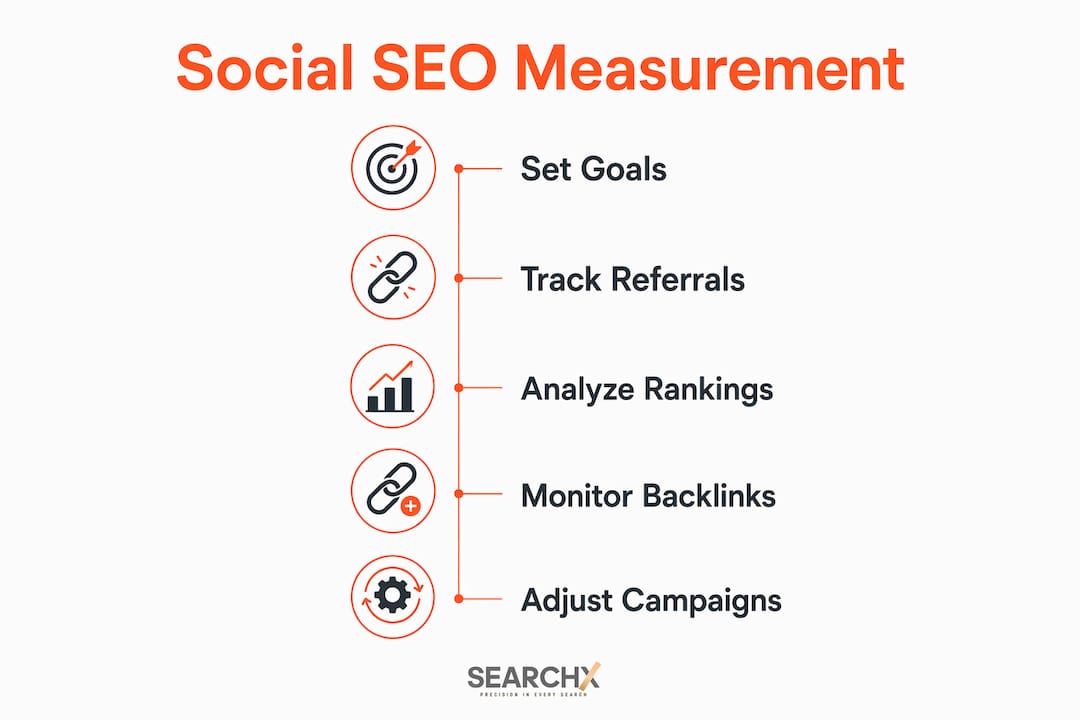
Measuring the impact of social media on SEO requires a structured approach. The challenge is attribution. Social effects on rankings are lagged and indirect, so you need a system that isolates variables and tracks outcomes over defined windows.
Follow these steps to build a reliable measurement framework:
-
Segment social referral traffic in Google Analytics. Create a custom segment for each major platform (LinkedIn, Facebook, X, Instagram). Track session duration, pages per session, and conversion rate separately from other referral sources.
-
Record every major social publishing event. Log the date, URL, platform, and post format for each campaign. This creates the baseline you need to correlate social activity with SEO changes.
-
Monitor organic ranking changes within 7–14 days post social spikes. Attribute performance changes to specific URLs and posting waves, then observe lagged SEO effects in those windows. Ranking tools like Semrush or Ahrefs make this straightforward.
-
Review new backlink acquisition on highly shared URLs. Use Ahrefs or Moz to check referring domain growth on URLs that received heavy social promotion. A correlation between share volume and new backlinks confirms the amplification effect.
-
Cross-reference data in Google Search Console. Social channel insights in Google Search Console illuminate the effect of audience engagement and brand awareness on search visibility. Filter by URL and compare impressions and click-through rates before and after social campaigns.
-
Track branded search query volume. A rise in branded queries after a social campaign is a measurable proxy for the trust signal effect. Google Search Console’s Performance report shows this data directly.
Pro Tip: Run social SEO campaigns like controlled experiments. Promote one URL heavily on social while keeping a comparable URL unpromoted. Compare their ranking trajectories over 14 days. The difference gives you a clean signal of social’s SEO contribution.
How do social signals compare to other SEO factors?
Social signals operate in a different tier from direct ranking factors. Understanding where they fit prevents both overinvestment and underinvestment in social as part of an SEO strategy.
Pages ranking #1 on Google have 3.8x more backlinks than those in lower positions. Backlinks remain the strongest off-page ranking signal. Social signals matter because they accelerate the process of earning those backlinks, not because they substitute for them.
Social engagement patterns should complement, not replace, technical SEO and traditional authority signals. A technically broken site with strong social engagement will not rank well. Core Web Vitals, site architecture, and crawlability remain non-negotiable foundations.
“At SearchX, we treat social signals as a distribution multiplier, not a ranking shortcut. When a client’s content earns shares and drives branded searches, we see measurable lifts in domain authority within weeks. But that only happens when the technical SEO foundation is already solid.” — Lorenz Esposito, CEO of SearchX
Social media influences SEO through digital authority, AI discoverability, and entity recognition in 2026, not by direct ranking boost. This is a meaningful shift. As AI-powered search tools like Google’s AI Overviews and Perplexity pull from entity-rich sources, a strong social presence that builds brand entity recognition becomes a competitive advantage.
| Factor | Type | SEO impact | Social signal role |
|---|---|---|---|
| Backlinks | Direct | Very high | Social amplifies backlink acquisition |
| Technical SEO | Direct | Very high | Social does not affect technical factors |
| Branded search volume | Indirect | High | Social campaigns drive branded queries |
| Referral traffic | Indirect | Medium | Social is a primary referral source |
| Content discovery speed | Indirect | Medium | Social sharing accelerates indexing |
| E-E-A-T signals | Indirect | High | Social presence reinforces author authority |
What practical strategies optimize social signals for SEO benefit?
The most effective approach treats social media as a content distribution engine aligned with your SEO keyword strategy. Publishing content on social without SEO alignment wastes the amplification potential.
Proven strategies for maximizing the SEO benefit of social signals:
- Align social content with target keywords. Publish social posts that mirror the search intent of your target pages. When users search for a term after seeing it on social, branded and non-branded query volume both rise.
- Use high-engagement posts to accelerate link acquisition. Identify your top-performing social content and build outreach campaigns around those URLs. Journalists who saw the post are already warm contacts.
- Combine influencer marketing with SEO content. Influencer marketing paired with SEO extends content reach to audiences that include bloggers and editors with linking authority. A single influencer share in a niche community can trigger multiple editorial backlinks.
- Publish consistently across platforms. Sporadic social activity produces sporadic SEO effects. A consistent publishing cadence builds cumulative branded search demand and keeps content in active crawl paths.
- Integrate Google Search Console with your social calendar. Review which URLs receive social-driven impressions and prioritize those for further optimization. This closes the loop between social performance and search visibility.
- Track social impact on local SEO separately. For local businesses, social signals from geographically relevant audiences carry additional weight in local pack rankings.
Pro Tip: After a major social campaign, pull the referring URLs report in Google Analytics and identify which social posts drove the most engaged sessions. Repurpose those posts as the basis for link outreach emails. The social proof of high engagement makes the pitch more credible.
Key Takeaways
Social signals improve SEO indirectly by accelerating content discovery, driving referral traffic, and increasing backlink acquisition, making them a distribution multiplier rather than a direct ranking factor.
| Point | Details |
|---|---|
| Social signals are indirect | Likes, shares, and comments do not directly change rankings but trigger measurable SEO effects. |
| Backlinks remain primary | Pages ranking #1 have 3.8x more backlinks; social amplifies the path to earning them. |
| Measurement requires structure | Track referral traffic, ranking changes, and new backlinks within 7–14 days of social campaigns. |
| Technical SEO comes first | Social engagement cannot compensate for poor site architecture or slow page speed. |
| Brand authority compounds | Consistent social presence grows branded search demand, which strengthens domain trust over time. |
The real value of social signals is patience
The SEO community has argued about social signals for years, and the debate usually misses the point. Marketers who dismiss social because it is not a direct ranking factor leave real SEO value on the table. Marketers who treat social shares as a ranking hack get frustrated when nothing moves.
The truth is more interesting. Social signals work on a delay and through proxies. A LinkedIn post that earns 200 shares in a niche B2B community might generate three editorial backlinks over the following month. Those backlinks move rankings. The social post started the chain, but the attribution is invisible unless you are measuring it correctly.
The shift toward AI-powered search in 2026 adds another layer. Social signals now influence AI discoverability and entity recognition, which means a brand with consistent social presence gets recognized as an authoritative entity by AI search tools. That recognition translates into citations in AI Overviews and Perplexity answers, which is a new form of search visibility that traditional SEO metrics do not yet capture fully.
Lorenz Esposito, CEO of SearchX, puts it directly: “The clients who see the biggest SEO gains from social are the ones who treat it as a long game. They publish consistently, they track the downstream effects, and they use social data to inform their content strategy, not replace their technical work.”
The practical advice is simple. Build the technical foundation first. Then use social as a distribution engine. Measure the downstream effects with discipline. And give it time.
— SEO
SearchX can connect your social activity to real SEO results
Social signals create SEO opportunities. Capturing those opportunities requires the right keyword strategy and measurement framework working together.
SearchX builds integrated SEO campaigns that align content strategy, keyword research, and social distribution to drive qualified organic traffic. The keyword research techniques SearchX applies ensure your social content targets the exact queries your audience is already searching. Every campaign is tracked with full transparency so you can see exactly which social activities are moving rankings and generating revenue. Contact SearchX to build a social-informed SEO strategy that delivers measurable growth.
FAQ
Do social signals directly affect Google rankings?
Social signals are not a direct Google ranking factor. They influence rankings indirectly through referral traffic, backlink acquisition, and branded search demand growth.
How long does it take for social signals to impact SEO?
SEO effects from social activity typically appear within 7–14 days of a major campaign. Backlink-driven effects may take longer, depending on how quickly linked content is indexed.
What tools measure the SEO impact of social signals?
Google Analytics tracks social referral traffic and session behavior. Google Search Console monitors organic impressions and branded query volume. Ahrefs and Semrush track new backlink acquisition on promoted URLs.
Are social signals more important for local SEO?
Social signals from geographically relevant audiences carry additional weight in local search. Consistent social engagement from a local audience reinforces the geographic relevance signals that influence local pack rankings.
Can social signals replace link building?
Social signals cannot replace link building. Pages ranking #1 have 3.8x more backlinks than lower-ranked pages. Social amplifies the process of earning backlinks but does not substitute for a dedicated link building strategy.