Social media and SEO both deliver results, but their effectiveness depends on your goals. In 2025, SEO outperformed social media for Charleston businesses when it came to attracting high-intent customers ready to buy. Here’s why:
- SEO connects businesses with people actively searching for solutions (e.g., "optimizing for multiple service areas"). Leads from SEO convert faster and offer a predictable ROI – averaging 32% over 12 months.
- Social media excels at building awareness and engaging broad audiences. However, it requires consistent posting, paid ads, and months of effort to generate leads. Organic reach is declining, with Facebook posts reaching just 0.05% of followers without paid promotion.
Quick Comparison
| Metric | Social Media | SEO / Local Search |
|---|---|---|
| Primary Reach | High (64% of SMB traffic) | Moderate (52% of SMB traffic) |
| Conversion Intent | Low (Passive/Push) | Very High (Active/Pull) |
| Cost Per Acquisition | Higher (due to content churn) | Lower (high-intent keywords) |
| Content Lifespan | Short (hours to days) | Long (months to years) |
| Time to First Lead | 6–9 months | ~90 days for initial rankings |
If your business needs quick visibility or brand awareness, social media is a solid choice. But for sustainable growth and high-converting leads, SEO is the better investment. For those starting out, learning SEO basics can help build this foundation. Pairing both strategies can amplify results – use social media to drive traffic and backlinks, while SEO ensures long-term visibility.
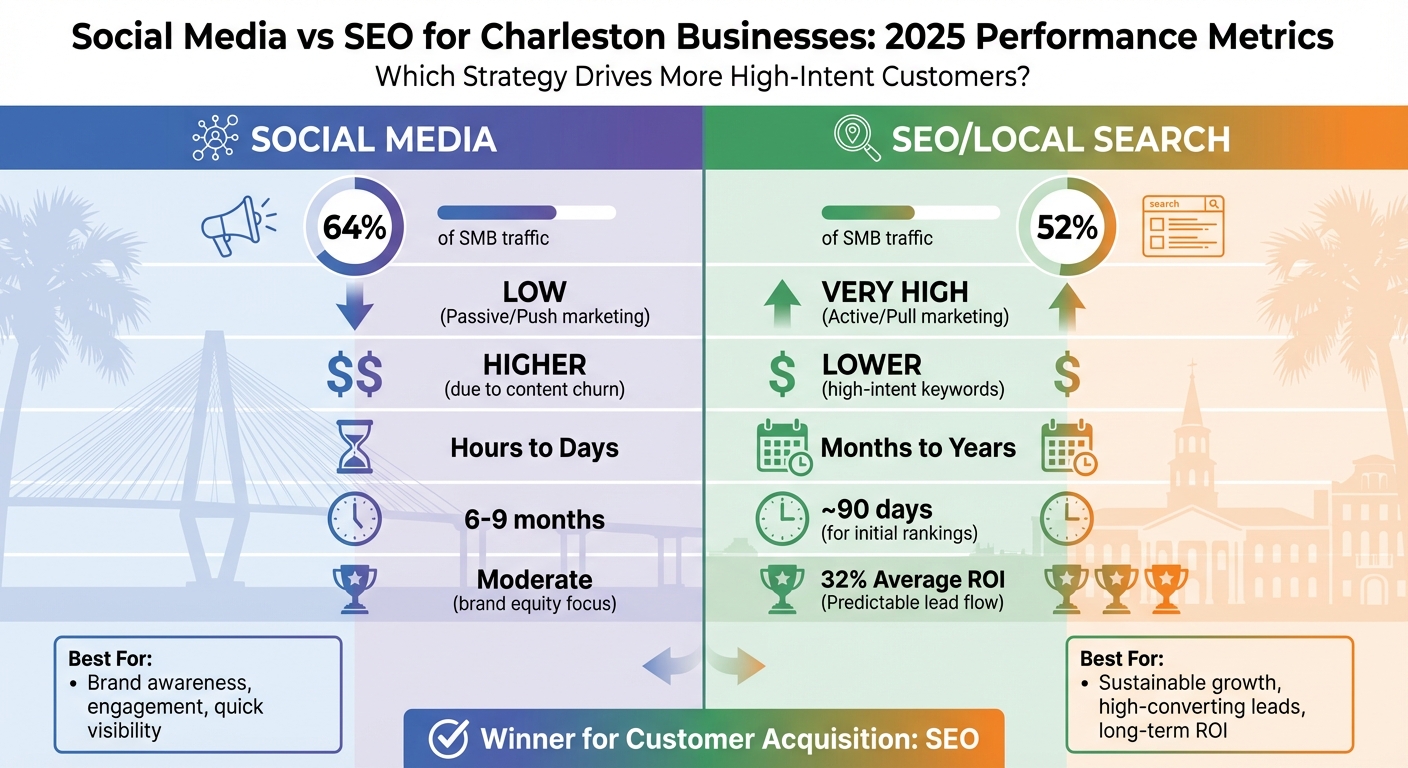
Social Media vs SEO Comparison for Charleston Businesses 2025
SEO vs Social Media: Which One Generates Real Leads in 2025?
Social Media Marketing for Charleston Businesses in 2025
Social media has become a cornerstone for small and medium-sized businesses (SMBs), with 64% listing it as their primary traffic source, compared to 52% relying on organic search. In the U.S., social platforms drive 15.23% of all website visits, far outpacing the global average of 10.12%. For Charleston businesses, this shift offers exciting growth opportunities while introducing new hurdles. Platforms like Facebook, Instagram, and TikTok provide massive reach, but the social media landscape has evolved dramatically in just the past two years. Let’s dive into how Charleston businesses can navigate platform-specific reach, conversion challenges, and long-term ROI.
Reach and Engagement on Popular Platforms
Facebook continues to dominate in the U.S., driving 73% of all social-driven traffic. However, organic reach for business pages has plummeted to a mere 0.05%. For context, if your Charleston restaurant’s Facebook page has 1,000 followers, only about five people will see your posts unless you invest in paid promotion.
TikTok is shaking things up, with its traffic skyrocketing eight times between January and August 2025. The platform is especially powerful for local businesses – 36% of TikTok users visit or order from a restaurant after seeing a viral video. Meanwhile, Instagram Reels have become a must-use tool, offering four times the reach of static image posts. Short-form video is no longer optional; it’s essential for staying visible.
Another major trend is the rise of private communities. Over 64% of users now prefer engaging in private groups, such as Facebook Groups or WhatsApp Communities, rather than public feeds. For Charleston service providers, these local groups often outperform business pages in generating leads.
Conversion Rates and Customer Acquisition
Turning social media engagement into paying customers remains a tough nut to crack. 35% of small businesses cite "driving and converting traffic" as their biggest hurdle. Platform-specific quirks add to the challenge – Instagram’s limited linking options make it hard to direct users to your site, and TikTok’s algorithm often prioritizes global audiences over local ones.
That said, some Charleston businesses have found success with creative, targeted approaches. Take Miles Laughlin, "The Pool Guy", who gained most of his leads by sharing pool cleaning videos in local Facebook homeowner groups. Similarly, Roger Wakefield, a Texas plumber, used YouTube tutorials to showcase his expertise, earning over 100 million views and a higher client conversion rate. On Instagram, Dr. Munib Shaw built a following of 6 million by posting daily skincare tips via Reels.
The secret? Consistency and value-driven content. As Jenny Bernarde from BrightLocal explains:
"In reality, people respond better to authentic social channels. You don’t need clever marketing campaigns, or professionally designed images".
While these strategies help build trust and engagement, budget constraints and algorithm changes remain hurdles for long-term customer acquisition efforts.
Long-Term ROI Challenges for Charleston Businesses
Social media has transitioned into a "pay-to-play" model. Makena Finger Zannini, CEO of The Boutique COO, puts it plainly:
"Organic reach on social media is dying, and small businesses that want real visibility now need to treat social as a paid channel".
Meta ads are relatively affordable, costing less than $1.00 per click. Still, experts recommend dedicating 30-50% of monthly marketing budgets to social media, divided between paid ads and content creation. For example, a Charleston HVAC company with a $2,000 monthly marketing budget would need to allocate $600-$1,000 to social media alone.
Keeping up with content demands is another challenge. Platforms like Instagram require frequent updates, with posts losing relevance within a day or two. Tracking ROI is equally tricky – 20% of businesses struggle to attribute sales to specific social posts. On top of that, 40% of small businesses report losing traffic due to recent algorithm changes. These unpredictable shifts make it tough for Charleston businesses to plan for sustainable, long-term growth.
SEO Strategies for Charleston’s Local Market
Social media might demand constant updates and paid promotions, but SEO offers a more steady and sustainable approach to acquiring customers. With AI-powered search engines now prioritizing semantic relevance and authority over outdated keyword stuffing, Charleston businesses can thrive by focusing on building genuine expertise in their niche. For a competitive local market like Charleston, these local SEO tactics are key to establishing visibility and credibility.
Local Search Visibility with Google Business Profile
Your Google Business Profile (GBP) is the cornerstone of local SEO success. When someone in Charleston searches for terms like "emergency AC repair Mount Pleasant" or "best seafood in Charleston", an optimized GBP ensures your business shows up where it matters – directly in front of potential customers with high purchase intent. Unlike the fleeting nature of social media posts, your GBP works 24/7, appearing in both Google Search and Google Maps.
To make the most of your GBP, focus on these essentials:
- Keep your business hours up to date.
- Upload fresh, high-quality photos.
- Respond to reviews promptly.
- Add specific details about your services.
For instance, HVAC companies in Charleston that mention neighborhoods like West Ashley, James Island, or Daniel Island often attract more qualified leads than those relying on generic descriptions. Here’s the kicker: 76% of people who search for local businesses visit within 24 hours, a conversion rate that far outpaces social media’s often unpredictable results.
Targeted Keywords and Conversion Rates
Using location-specific keywords is a direct way to connect with Charleston customers who are ready to take action. For example, a downtown law firm targeting "Charleston personal injury lawyer" is likely to reach individuals actively seeking legal assistance – not casual Instagram scrollers. Similarly, a King Street restaurant optimizing for "seafood restaurant near King Street" can attract both locals and tourists looking for a place to dine.
Here’s how targeted keywords can work across different industries in Charleston:
| Target Industry | Example Charleston-Specific Keywords |
|---|---|
| Real Estate | "homes for sale in Charleston SC", "top neighborhoods in West Ashley" |
| Legal | "Charleston personal injury lawyer", "family law Charleston SC" |
| Food/Dining | "best seafood in Charleston", "seafood restaurant near King Street" |
| Home Services | "Charleston roofer", "emergency AC repair Mount Pleasant" |
| Tourism | "historic Charleston lodging", "walking tours near French Quarter" |
By focusing on these high-intent searches, businesses can attract customers who are actively searching for solutions – not just browsing for fun.
Long-Term ROI with Content and Backlinks
Investing in quality content and backlinks pays off in the long run. For example, a blog post about "preparing your Charleston home for hurricane season" can continue driving traffic for years. This type of content reinforces your relevance as an expert in your field. Additionally, backlinks from local sources – like news outlets, chamber of commerce pages, or industry directories – further strengthen your authority.
These efforts create a ripple effect. Search engines see your business as both trustworthy and prominent within the Charleston community. Unlike social media, which requires ongoing spending to stay visible, SEO builds momentum over time. By combining these strategies with social media, you can amplify your digital presence and maintain a competitive edge.
Head-to-Head Comparison: Social Media vs. SEO
Let’s break down how social media and SEO compare when it comes to delivering ready-to-buy customers for Charleston businesses. While both channels have their strengths, the real question is: what kind of results are you looking for – and how soon?
Currently, social media drives 64% of traffic for small businesses, while organic search accounts for 52%. But here’s the catch: traffic volume doesn’t necessarily equal conversions. The real difference lies in the quality of the leads each channel generates.
SEO is laser-focused on customers with immediate buying intent. Unlike social media, which often targets a broader audience, SEO connects businesses with people actively searching for solutions. This intent-driven approach is why Charleston service providers – like HVAC companies or plumbers – often see faster conversions through SEO in Charleston, even if the initial traffic numbers are lower.
Social media, on the other hand, shines in building brand awareness and creating quick visibility. A single Instagram post or Facebook ad can rack up hundreds of impressions in just a few hours. But for businesses that rely on urgent service calls, like plumbers, those impressions rarely translate into immediate action. In fact, social media branding efforts often take 6–9 months of consistent posting before they start generating leads. While social media is great for staying top-of-mind, its slower conversion timeline stands in stark contrast to SEO’s ability to deliver ready-to-buy customers.
SEO takes a bit longer to gain traction – typically 3 to 6 months – but the leads it generates are already at the decision-making stage. For instance, someone searching “emergency AC repair Mount Pleasant” isn’t just browsing; they’re ready to book a service. This explains why SEO delivers an average 32% ROI, which is 10% higher than the next best digital marketing strategy. For Charleston businesses focused on measurable returns, SEO’s impact only grows over time.
Performance Metrics Comparison Table
| Metric | Social Media | SEO / Local Search |
|---|---|---|
| Primary Reach | High (64% of SMB traffic) | Moderate to High (52% of SMB traffic) |
| Engagement Rate | High (Visual/Interactive) | Moderate (Information-seeking) |
| Conversion Intent | Low (Passive/Push) | Very High (Active/Pull) |
| Cost Per Acquisition | Higher due to content churn | Lower for high-intent keywords |
| 12-Month ROI | Moderate (Brand Equity) | High (Avg. 32%, Predictable Lead Flow) |
| Content Lifespan | Short (hours to days) | Long (months to years) |
| Time to First Lead | 6–9 months for service businesses | 90 days for initial rankings |
This side-by-side comparison highlights how each channel serves different goals. Next, we’ll dive into examples from Charleston businesses to see how these strategies play out in real-world scenarios.
Charleston Business Examples
Looking at the strategies discussed earlier, here’s how businesses in Charleston put them into action.
Charleston boutiques use Instagram to tell visual stories, often featuring iconic local spots like Rainbow Row and the Ravenel Bridge. This approach helps them connect instantly with both residents and tourists. Retailers on King Street collaborate with local micro-influencers (those with 1,000–10,000 followers) to build trust and promote products through partnerships. They also invest in Facebook and Instagram ads, running campaigns with daily budgets ranging from $5 to $20. Some even use weather-triggered campaigns to adjust their ad spending when bad weather hits.
"Charleston’s strong ‘buy local’ ethos and support for small businesses provides a receptive audience for authentic, community-focused social media content."
- MyShyft
Meanwhile, Charleston restaurants focus on boosting their local SEO by creating content clusters around topics like Lowcountry cuisine and waterfront dining. By prioritizing semantic relevance, they not only rank well in traditional search results but also gain visibility on AI-powered search assistants, which are becoming a go-to tool for tourists planning meals.
"Ranking in Charleston’s local search isn’t just about keywords – it’s about semantic relevance and entity strength."
- Shanzaib, Charleston SEO Company
Tourism businesses take a blended approach, producing region-based content like "Explore Charleston" digital guides to attract visitors searching for activities in the area. These guides are paired with targeted social media remarketing campaigns, ensuring they stay top of mind for potential customers. These examples highlight how tailored strategies effectively engage Charleston’s unique and varied audience.
Combining Social Media and SEO for Charleston Businesses
Charleston businesses can see stronger results by blending social media efforts with SEO strategies. Social platforms serve as a key driver, bringing referral traffic to websites and sparking natural backlinks when content gains traction through shares or goes viral. This combination takes advantage of the unique strengths of both approaches.
"Social media isn’t just for brand awareness or community building – it’s also a powerful catalyst for Search Engine Optimization (SEO)."
- Adrian Garcia, The Adrian Carlo
A great way to merge these strategies is by repurposing SEO-optimized content for social media. For instance, a well-performing blog post about Charleston dining could be transformed into an Instagram carousel, a TikTok video, or even a LinkedIn infographic. This method is especially effective given that over 40% of Gen Z users now turn to social media as their primary source for information, bypassing traditional search engines. To stay relevant, businesses need to place their content where their audience is already looking.
Optimizing social media profiles for local SEO is another smart move. Treat profiles like mini landing pages by incorporating Charleston-focused keywords, such as "Charleston Real Estate" or "Mount Pleasant HVAC", into business names and bios. These keywords should also appear in captions and geotags (e.g., King Street, Rainbow Row, Mount Pleasant) to improve visibility in both social platform searches and Google results. This ties directly into broader local SEO strategies.
Social media engagement also provides valuable SEO insights. Comments and questions on platforms like Instagram or LinkedIn can uncover what Charleston customers are curious about, offering fresh inspiration for SEO blog topics and keyword ideas. Additionally, creating shareable content – like infographics or data-driven guides about Charleston’s market – can encourage backlinks from local blogs and news sites, which boosts domain authority and earns favor with search engines.
"Social media is a powerful amplifier, and those social signals (shares, mentions, links) ultimately build domain authority and trust."
- Ioana Postolache, Senior SEO Specialist
Conclusion: SEO Delivers Better Results for 2025
By 2025, SEO continues to outshine social media as the go-to strategy for Charleston businesses looking for sustainable customer acquisition and long-term ROI. Why? SEO attracts high-intent leads – people actively searching for solutions, like "emergency plumber near King Street" or "Mount Pleasant HVAC repair." These users are ready to take action, turning searches into phone calls, bookings, and sales. The best part? The content you optimize today keeps working for you, driving qualified leads for months or even years.
This focus on high-intent traffic is the backbone of effective SEO strategies. SearchX helps Charleston businesses achieve lasting visibility with a tailored approach. They combine hyper-local keyword research – centered around well-known Charleston spots like King Street and Waterfront Park – with technical optimization to ensure your site is mobile-friendly and fast-loading. Their Starter Plan ($3,000/month) includes essentials like Google Business Profile optimization and ensuring NAP (Name, Address, Phone number) consistency across 50+ directories. For businesses ready to dominate their local market, the Growth Plan ($6,000/month) adds in-depth technical audits and competitor analysis.
Not sure where to start? Try SearchX’s free GMB and Website Audit Tools to uncover gaps in your current setup. These tools pinpoint issues like mobile performance problems, local business schema markup, and inconsistent listings – potentially costing you customers right now. From there, SearchX crafts a custom plan tailored to Charleston’s market, optimizing for local events like the Spoleto Festival and building topical authority. It’s a strategy designed to drive measurable, long-term growth.
FAQs
How much should a Charleston business budget for SEO vs social media in 2025?
In 2025, Charleston businesses can expect to spend anywhere from $100 to $3,000 per month on local SEO. Interestingly, nearly half of local businesses allocate their budgets within this range. While social media marketing costs can differ significantly, it’s often considered less critical than SEO when it comes to generating leads. The key is to align your budget with your business objectives and choose strategies that resonate most with your target audience.
What’s the fastest way to get more calls from Google Maps in Charleston?
If you’re looking to increase calls from Google Maps in Charleston, focusing on your Google Business Profile (GBP) is key. Start by making sure all your details – like your business name, address, phone number (NAP), hours of operation, and categories – are accurate and fully filled out.
Add high-quality photos and videos that showcase your business and include recognizable local landmarks to create a stronger connection with the Charleston community. Responding quickly and thoughtfully to reviews not only builds trust but also boosts your profile’s visibility.
Incorporate local keywords throughout your profile to align with what people in Charleston are searching for. Additionally, using schema markup can help search engines better understand your business, enhancing your visibility in local search results. These small but impactful steps can lead to more calls and higher engagement on Google Maps.
How do I combine SEO and social media without doubling my workload?
One smart way to bring SEO and social media together is by repurposing content to work for both strategies. For instance, you can craft social media posts that incorporate local keywords or promote community events. This not only boosts engagement but also strengthens your local SEO efforts.
Another approach is sharing your SEO-optimized content – like blog posts or guides – on social platforms. This can help attract backlinks, increase visibility, and drive traffic to your site.
To make things easier, consider using centralized tools to manage and schedule posts across platforms. By aligning themes and messaging across both SEO and social media, you can save time, avoid duplicating work, and achieve better results.