
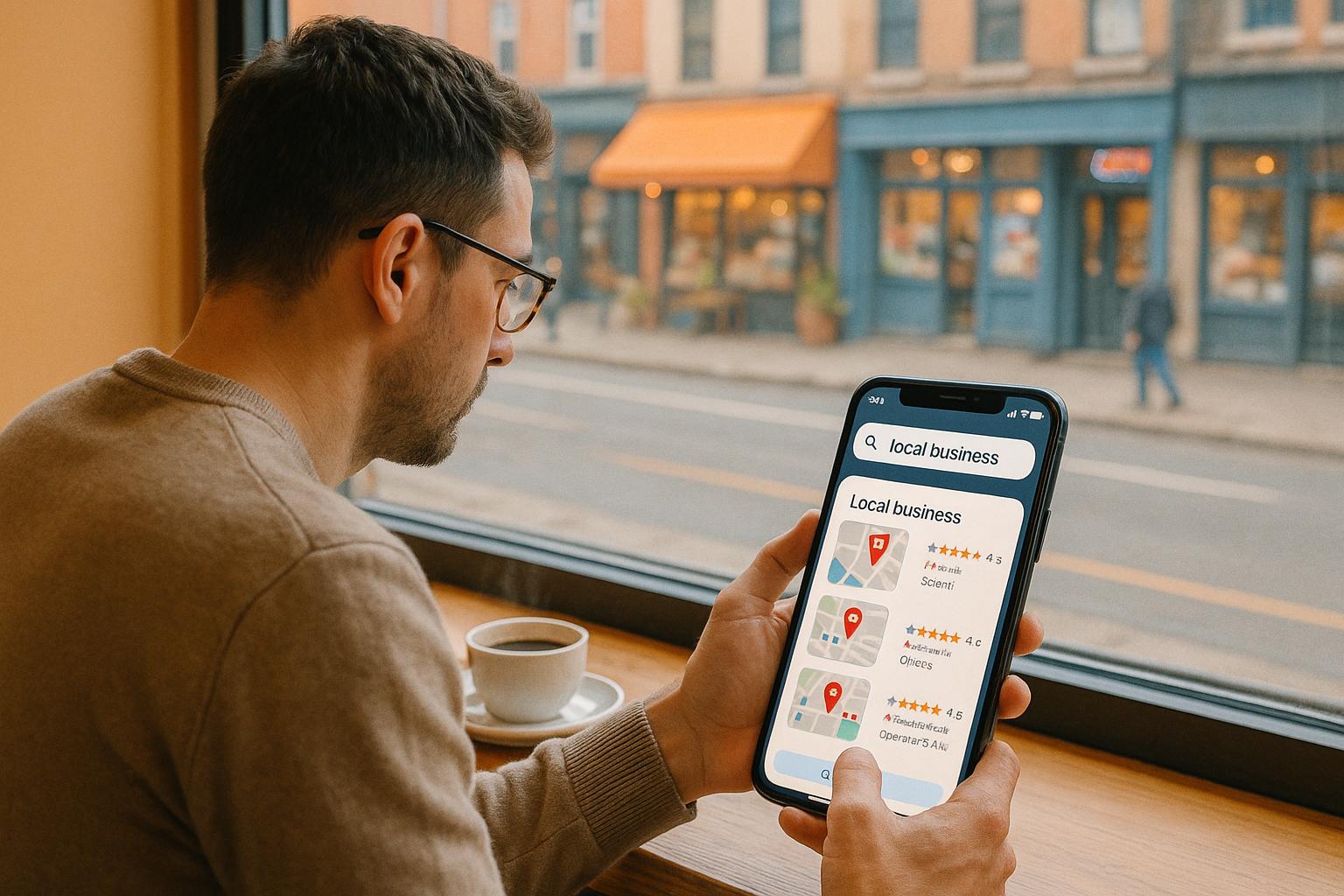
Search intent has transformed local SEO. It’s no longer just about keywords – it’s about understanding why someone is searching and tailoring results to meet their immediate needs. Modern search engines consider location, time, device, and user behavior to deliver highly personalized results. For businesses, this means optimizing for three types of local search intent:
- Transactional Intent: Users ready to act (e.g., "plumber near me").
- Logistical Intent: Users seeking practical details like hours or proximity (e.g., "pharmacy open now").
- Informational Intent: Users researching options (e.g., "best coffee shops in NYC").
Nearly 46% of Google searches include local intent, and 76% of "near me" mobile searches lead to in-store visits within 24 hours. To stay visible, businesses need to focus on:
- Keeping Google Business Profiles accurate.
- Using structured data for AI to understand services.
- Creating content tailored to different intent types.
✨ How Small Business Owners Can Use Search Intent for Local SEO Domination
How Search Intent Has Changed in Local SEO
In the early days of local SEO, the strategy was pretty straightforward. Businesses focused on stuffing their websites with keywords like "plumber near me" and ensuring their NAP (Name, Address, Phone number) information was consistent across directories. The idea was simple: if your keywords matched what users typed into the search bar, your site would likely appear in the results.
But that playbook doesn’t work anymore. Modern search algorithms don’t just look for keyword matches – they aim to understand why a user is searching. They evaluate context like location, device type, browsing history, and even urgency to deliver tailored results. For example, a search for "pizza delivery" suggests the user wants food immediately, while "best pizza restaurants" indicates they’re exploring options. AI-driven systems are now sophisticated enough to differentiate between these intents, which is why old-school SEO tactics often fall flat today.
Why Traditional Local SEO Methods Fall Short
Relying solely on static keyword targeting and maintaining NAP consistency just doesn’t cut it anymore. Let’s say you have a perfectly optimized page targeting "emergency plumber." If your site lacks real-time availability data or structured booking options, it might not show up when a user urgently needs help. Traditional strategies fail to account for the nuances between someone researching services and someone ready to make a decision. This gap leaves businesses struggling to connect with potential customers at the right moment.
How AI Reads Search Intent
Modern AI systems, powered by Natural Language Processing (NLP), take search queries to a whole new level. Instead of just matching keywords, they break down queries into actionable details. For example, if someone searches for "I need a mechanic near me who can take me tomorrow morning", AI identifies key elements like location, time, and service needs – details older methods would completely miss.
Techniques like "Get Context" allow AI to analyze a user’s browsing history, past purchases, and previous interactions. It can even assess urgency and sentiment. Queries with phrases like "open now", "available today", or "emergency" trigger responses designed for immediate needs. Factors such as the user’s device type and the time of day further refine the results, helping AI understand not just what the user is looking for, but also why and how quickly they need it.
These advancements go beyond improving query interpretation – they make local search results more personalized than ever. This shift is reshaping local SEO, pushing businesses to adopt strategies that align with how modern systems interpret user intent.
3 Types of Local Search Intent
Understanding the different types of local search intent is key to meeting users’ needs effectively. Each intent reflects a specific goal, and businesses must tailor their strategies to address these varying expectations. Here’s a breakdown of the three main types of local search intent and how to align your approach with each.
Transactional Intent: Engaging Users Ready to Take Action
Transactional intent revolves around users who are prepared to make a purchase, book a service, or take immediate action locally. These searches often include keywords like "near me", "available today", or "book now." For example, someone searching for "pizza delivery" or "plumber near me" is ready to act. Similarly, a query like "custom bathroom cabinets in Raleigh" indicates a user who has a specific need and is ready to contact a provider.
To capture this intent, your online presence should make it easy for users to act quickly. Optimize your site with local, action-driven keywords. For instance, if you’re in the automotive repair business, phrases like "Schedule Automotive Appointment" can help attract users searching for "mechanic near me who can take me tomorrow morning". Use clear calls-to-action such as "Book Today" or "Available Now in [City Name]" to emphasize urgency. Structured data that highlights real-time availability and booking options can also boost your visibility in search results.
Additionally, focus on addressing logistical concerns, such as location and timing, to further enhance your appeal.
Logistical Intent: Focusing on Location and Timing
Logistical intent is all about practicality – users are looking for services that meet their specific location and timing needs. Common search phrases include "near me", "open now", or "emergency service". These users prioritize proximity and availability, and search engines rely on factors like user location, device type, and time of day to deliver the most relevant results. For example, a search like "I need a pharmacy open now" reflects both a geographic and time-sensitive need.
To meet logistical intent effectively, ensure your foundational data is accurate and up-to-date. This includes maintaining consistent NAP (Name, Address, Phone) information and keeping your Google Business Profile current with accurate hours, especially during holidays. Real-time availability schemas and mobile optimization are also crucial, as many of these searches happen on smartphones.
Adding specific qualifiers to your content, such as "24-hour", "pet-friendly", or "same-day service", can further refine your targeting. For instance, a veterinary clinic could highlight "pet-friendly emergency vet near me" to address both proximity and service-specific needs.
Finally, informational intent caters to users in the research phase of their journey.
Informational Intent: Assisting Users in the Research Phase
Informational intent involves users who are gathering knowledge, comparing options, or exploring solutions before making a decision. These searches often lack urgency and focus on learning rather than immediate action. Examples include queries like "best pizza in Daytona" or "how to find a good plumber", which indicate that the user is still researching their options. The primary objective here is to build trust and establish your brand as a reliable source.
To serve this intent, develop content that answers common questions and provides valuable insights. Blog posts, guides, FAQs, and comparison articles are excellent formats to address queries such as "Top Electricians in [City]" or "How to Choose the Right HVAC Service." Use an "Answer-First" approach by presenting clear, concise information under well-organized headings. This not only improves the user experience but also makes your content easier for AI systems to summarize and display.
Grouping related content into clusters – such as beginner, intermediate, and advanced guides – can showcase the depth of your expertise. Additionally, schema markup can help clarify your content’s structure, making it more accessible to search engines.
How to Align SEO with Local Search Personalization
Once you’ve grasped the different types of local search intent, the next step is to implement strategies that help search engines and AI systems connect your business to the right users at the right time. This requires going beyond standard SEO practices and adopting a more personalized, intent-driven approach.
Optimize Google Business Profiles for Intent Matching
Your Google Business Profile is the cornerstone of local search visibility. AI systems depend heavily on accurate and up-to-date Name, Address, and Phone (NAP) data to determine whether your business meets specific user needs. If your NAP details are incomplete or outdated, AI might favor your competitors instead.
But it’s not just about the basics. Your profile should also highlight attributes that align with various search intents. For instance, if you run an emergency service like a veterinary clinic, adding a "24-hour service" attribute can make sure you show up when someone searches for "emergency vet near me." Regularly updating your hours is equally important to capture time-sensitive queries.
User engagement signals are another key factor. Responding to reviews, updating the Q&A section with location-specific keywords, and uploading fresh photos can all indicate activity and relevance. Providing real-time availability information can also make a big difference, especially for users with urgent needs.
Use Structured Data for AI Visibility
Once your profile is optimized, structured data can further enhance your local relevance in the eyes of AI systems. Schema markup translates your website’s content into machine-readable data, helping AI prioritize your business in search results. Adding local business schema ensures that your location, services, hours, and contact information are clear and accessible to search engines. For service-based businesses, appointment and availability schema can allow AI to match users searching for immediate services with your real-time booking options.
FAQ schema is particularly useful for informational searches, as it enables AI to display concise answers directly in search results. Similarly, product schema with qualifiers like "Best for running" helps AI understand which products or services align with specific user needs. Including review and rating schemas can also build trust and influence your ranking in transactional searches. Additionally, attributes like "Provides Delivery" or "Has Outdoor Seating" are increasingly being highlighted by search engines, so aligning your structured data with these details can further boost visibility.
Create Content That Serves Multiple Intents
After refining your profile and implementing structured data, the next step is to develop content that addresses every stage of the local customer journey. Great local content connects with users at all points in their decision-making process – from initial research to final purchase. Start by creating area-specific service pages that showcase your local expertise through neighborhood references, relevant statistics, and examples specific to your region. For example, a Denver plumbing service might create a page titled "Emergency Plumbing Services in Denver", detailing common issues, pricing, booking options, and 24-hour availability.
An "answer-first" content structure makes it easier for AI to extract and feature your content in search results. Use natural, location-specific language throughout your site, including in service descriptions, meta descriptions, and headers, to resonate with your local audience. If your business operates in multiple locations, create dedicated pages for each one. Include unique addresses, contact details, and embedded maps to ensure each page feels tailored to its specific community.
Lastly, make sure your site is mobile-friendly and update your content regularly to stay aligned with evolving local search trends.
How to Measure and Adapt to Search Intent Trends
To deliver truly personalized local search results, it’s not enough to focus solely on intent-based SEO – you’ve got to measure your results and adjust as user behavior changes. Search intent isn’t static; it shifts with seasons, economic trends, and even how people use technology. Keeping an eye on the right metrics and staying flexible is key to staying ahead.
Look Beyond Rankings When Measuring Performance
Sure, keyword rankings tell you where you stand in search results, but they don’t paint the full picture. They don’t show whether you’re actually connecting with users who are ready to act. To gauge how well your local SEO aligns with search intent, focus on metrics that reflect real-world business outcomes.
- AI visibility metrics: Featured snippets and knowledge panels are great indicators of your authority for specific search intents. Test this by searching common questions related to your services – does your content pop up in answer boxes? If so, you’re on the right track.
- Conversion rates by intent type: Not all conversions are created equal. A transactional user who makes a purchase is different from an informational user who downloads a guide. Track these separately to see which intent types your business serves best.
- Google Business Profile actions: These actions reveal how users engage with your listing. Are they requesting directions? That’s logistical intent. Making phone calls? That’s transactional readiness. Website clicks? Likely informational intent.
- User engagement metrics: Metrics like time on page, scroll depth, and interactions with location-specific content show whether visitors are finding what they need. For instance, if your "Emergency Services" page has a high bounce rate, it might mean users aren’t quickly finding critical details like contact info or availability.
- Mobile conversion rates: Mobile users often signal strong local intent with phrases like "open now" or "near me." Track mobile behavior separately to identify opportunities for improvement.
"We focus on tangible, revenue-boosting outcomes rather than vanity metrics." – SearchX
These metrics aren’t just numbers – they’re tools to help you refine your SEO strategy, which we’ll dive into next.
Adapt Your Strategies Using User Data
Once you’ve gathered performance data, the next step is to tweak your strategy to match evolving user intent. What worked six months ago might not cut it today. Regularly analyzing and adjusting your approach ensures your local SEO stays in sync with current search behavior.
- Analyze Analytics and Search Console data: Look at which local queries are driving traffic and conversions. Spot trends in query variations – if "dentist near me" is gaining traction while "best dentist in [city]" is dropping, it could signal a shift toward immediate-action intent.
- Review Google Business Profile insights: Check which search terms lead users to your listing and what actions they take afterward. For example, if direction requests spike during certain hours, consider emphasizing accessibility or parking options on your profile.
- Account for seasonal trends: Search intent often changes with the seasons. Queries like "snow removal near me" surge in winter, while "outdoor wedding venues near me" peak in spring. Review your search query data quarterly to spot these patterns and update your content accordingly.
- Set up Google Search Console alerts: Automated alerts can help you spot emerging high-intent local queries. By creating timely content, you can position yourself as the go-to solution for these new needs.
- Optimize for voice search: Voice search is becoming more conversational and location-specific. If you notice an increase in voice-driven traffic, adjust your content to include question-based headers and conversational phrasing.
- Audit top pages by intent type: Review your top-performing pages quarterly and categorize them by intent – transactional, logistical, or informational. If most of your traffic comes from informational content but your business relies on conversions, you might need to create more transactional pages or strengthen your calls-to-action.
- Tailor content by location: For businesses with multiple locations, track engagement for location-specific content clusters. This helps you identify which areas are performing well and which could use more tailored messaging.
Conclusion
Local search has evolved dramatically. Search engines now factor in context, urgency, and user behavior to deliver results tailored to individual needs. If your SEO strategy doesn’t address search intent, you risk missing out on customers who are ready to buy or visit.
For example, someone searching for "pizza delivery" is looking for fast, convenient options, while "best pizza restaurants" signals a desire to explore dining experiences. Search engines instantly understand these differences, and your SEO strategy should too. To succeed, you need to create content that meets the needs of transactional users ready to purchase, logistical users seeking availability or directions, and informational users researching their options. Winning strategies also include structured data to help AI understand your services, maintaining accurate Google Business Profile details, and focusing on metrics like conversions rather than just rankings.
Why does this matter? Because search behavior has changed. When someone has an immediate need, they’re not browsing through endless results – they’re clicking on the business that clearly addresses their intent. This shift requires a proactive SEO approach that positions your business as the obvious choice.
Take a hard look at your local SEO efforts. Are you addressing transactional searches with clear calls-to-action and availability? Do your location pages provide accurate NAP (Name, Address, Phone) information and booking options for logistical users? Does your content answer the questions informational users are asking? If not, you’re leaving potential revenue on the table.
The good news? You don’t need a massive budget to succeed. What you need is consistent effort and smart prioritization. Keep your Google Business Profile accurate, create content that speaks directly to customer needs, implement structured data basics, and track which intent signals generate your best leads. Regularly review your data and adjust your approach as search trends shift to stay competitive.
As AI continues to refine search personalization, businesses that adapt to user intent will capture customers their competitors overlook. Review your strategy, make the necessary adjustments, and stay ahead in the race for local search visibility. By optimizing for intent now, you’ll be ready to attract customers before your competition even has a chance.
If you’re looking for expert guidance in developing a local SEO strategy tailored to your business goals, SearchX offers services and resources to help businesses thrive in today’s search landscape.
FAQs
How can businesses optimize their SEO strategies to meet different local search intents?
To fine-tune SEO strategies for local search intent, businesses need to start by grasping what their audience is looking for and why. Pinpointing local keywords that match user intent – whether it’s to gather information, find a location, or make a purchase – is key to attracting the right kind of traffic.
It’s also important to create content that feels locally relevant. This might involve weaving in city-specific phrases or referencing nearby landmarks. Combine this with clear, well-organized metadata and precise business listings to help search engines provide users with the most relevant local results.
How does AI help businesses understand local search intent, and how can they use it to improve their SEO strategies?
AI is instrumental in breaking down and understanding local search intent by spotting patterns in how users behave, the types of queries they make, and their location-based preferences. This enables businesses to grasp what their customers are seeking and customize search results to meet those expectations, creating a more tailored and relevant experience.
Businesses looking to boost their local SEO can tap into AI-powered tools to analyze search trends, fine-tune content with locally focused keywords, and gain a deeper understanding of customer behavior. These insights help craft targeted strategies that enhance local search visibility and attract more relevant traffic to their websites.
Why should businesses regularly update their Google Business Profile, and how does it affect local search rankings?
Keeping your Google Business Profile updated is crucial for getting noticed in local searches and drawing in potential customers. When your profile includes accurate details like business hours, address, and contact information, it not only helps search engines provide relevant results but also builds trust with your audience.
An up-to-date profile can also increase engagement by featuring photos, responding to reviews, and promoting special offers or events. These updates show search engines that your business is active and relevant, which can lead to better local search rankings and more traffic – whether to your website or your storefront.