
When customers search for HVAC services online, reviews play a major role in determining which businesses they trust and choose. Reviews and reputation management directly impact local search rankings, customer behavior, and overall business growth. Here’s why:
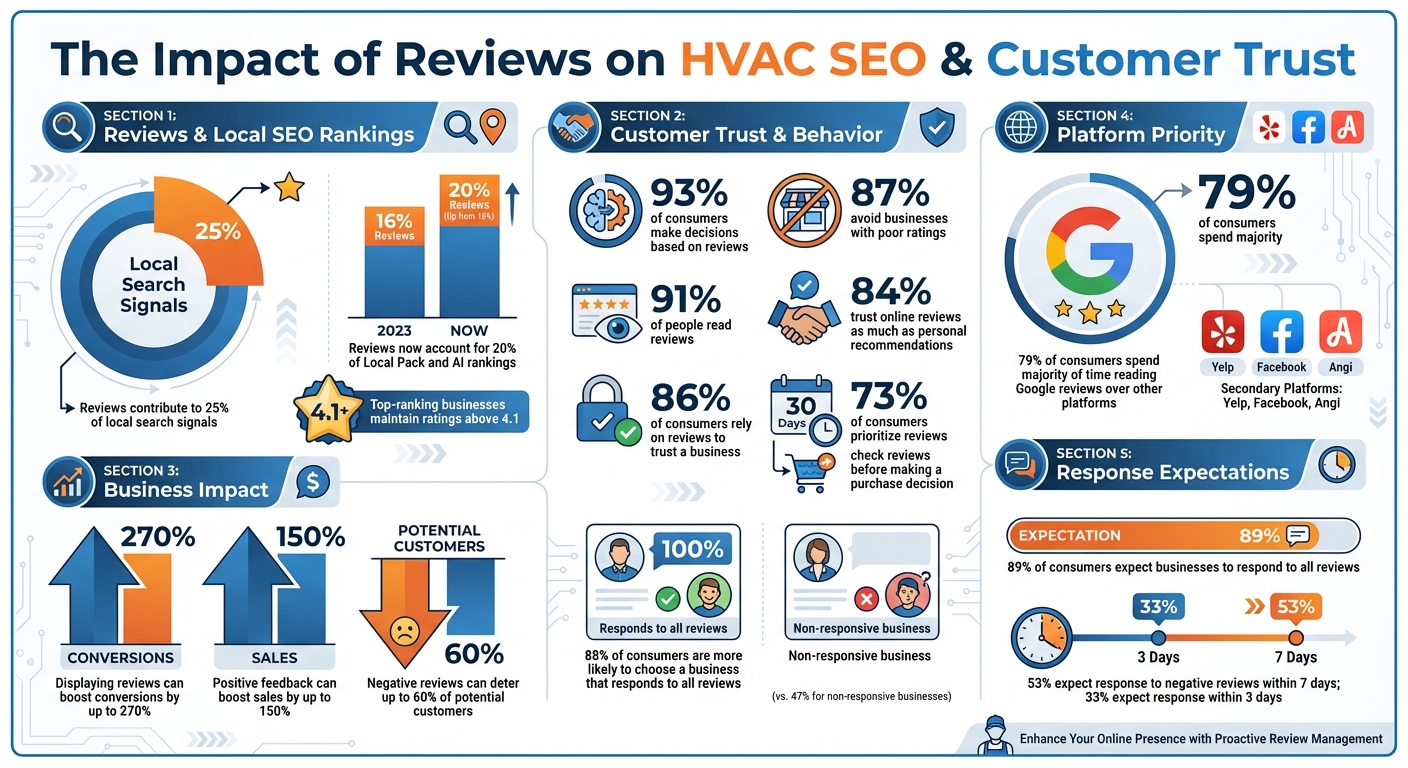
- Reviews influence visibility: Google uses reviews as a ranking factor, with customer feedback contributing to 25% of local search signals.
- Customer trust matters: 93% of consumers make decisions based on reviews, and 87% avoid businesses with poor ratings.
- Improved engagement: High ratings increase click-through rates, which further boosts rankings and customer interactions.
- Platforms to prioritize: Google Business Profile is the most critical, followed by Yelp, Facebook, and Angi.
- Managing feedback: Quick responses to reviews – especially negative ones – build trust and show customers you care.
- Compliance is key: Adhering to FTC rules ensures ethical practices and avoids hefty penalties.
To thrive in local markets, HVAC businesses should actively gather reviews, respond promptly, and use customer feedback to strengthen SEO strategies. A strong review profile doesn’t just improve rankings – it builds trust and drives conversions.
HVAC Reviews Impact on Local SEO and Customer Trust Statistics
How Reviews Affect HVAC Local SEO
How Google Ranks Businesses Based on Reviews
Google takes several factors into account when ranking businesses based on reviews, including the number of reviews, how recent they are, the star ratings, and the keywords used in the reviews themselves. These elements directly influence two key local ranking factors: prominence and relevance.
"User interaction – like getting ratings and generating reviews from your active customers – are a key component of any solid Local SEO strategy."
- Ben Fisher, Author, Semrush
When it comes to Google Maps and the Local Pack, research shows that having a larger number of reviews often outweighs having a slightly higher average rating. Most top-ranking businesses maintain ratings above 4.1.
The specific language used in customer reviews also matters. For example, if someone mentions "emergency furnace repair" or "AC installation in Phoenix", these keywords help reinforce your business’s relevance for those specific search queries. Additionally, responding to reviews demonstrates engagement, which can further improve your online visibility.
Reviews have become increasingly important over time. They now account for 20% of the factors influencing Local Pack and AI rankings, up from 16% in 2023. With 91% of people reading reviews and 84% trusting them as much as personal recommendations, having a strong review profile not only boosts your visibility but also builds trust with potential customers.
Now, let’s take a closer look at which review platforms HVAC companies should prioritize to maximize these benefits.
Top Review Platforms for HVAC Companies
For HVAC businesses in the U.S., focusing on the right review platforms is key. The Google Business Profile is the most critical, as 79% of consumers spend the majority of their time reading Google reviews over other platforms. Google also uses its own review data as a ranking factor for both Maps and the Local Pack, making it essential to maintain an active and positive presence here.
Other platforms also play a role. Yelp remains influential, particularly in urban areas where local recommendations are highly valued. Facebook reviews add another layer of credibility by allowing customers to share feedback within their social networks. Additionally, Angi (formerly Angie’s List) is a go-to platform for homeowners specifically searching for heating and cooling services.
Google evaluates three types of reviews when assessing your business: reviews on Google itself, reviews from third-party sites, and reviews posted directly on your website. While Google reviews carry the most weight, maintaining profiles across multiple platforms helps build a well-rounded online reputation and strengthens trust with potential customers.
These platforms not only impact rankings but also influence how customers interact with your business.
How Reviews Influence Customer Actions
Beyond rankings, reviews play a pivotal role in shaping customer behavior. They can drive actions like clicks, calls, and visit requests. When potential customers come across your HVAC listing, the combination of star ratings and review counts often determines whether they click through to your website, call your business, or request directions. In fact, displaying reviews has been shown to boost conversions by up to 270%, underscoring the power of social proof.
About 86% of consumers say they rely on reviews to trust a business. For HVAC services – where reliability and professionalism are crucial – having recent reviews is especially important. Fresh reviews show that your business is active and that customers are satisfied with your services, building trust and influencing Google’s ranking algorithm.
Timing also matters. A significant 73% of consumers prioritize reviews written within the past month. Consistently gathering new reviews signals that your business is engaged and meeting customer expectations, which increases both search visibility and consumer confidence.
Finally, the review snippets displayed in Google’s Local Pack play a role in shaping perceptions. Data shows that 60% of these snippets are neutral, 38% are positive, and only 2% are negative. This balance helps potential customers make informed decisions about contacting your business.
How to Get More Reviews and Manage Them
Creating a System to Request Reviews
The best time to ask for reviews is right after completing a service call – when the customer is most satisfied. Train your technicians to request reviews face-to-face once the job is done. Make it easy for customers by sending them direct links to your Google Business Profile or other review platforms via text or email shortly after the service is completed. Personalize these messages by including details like the technician’s name, the type of service performed, and the job location. This way, the request feels thoughtful rather than automated. For a seamless process, consider using HVAC business software to automatically send review requests as soon as a job is marked complete. This ensures consistent follow-up without requiring extra effort.
Using multiple communication methods can also help increase review counts. Combine quick text message requests with email campaigns that include direct links. You can even use post-service surveys that lead into a review request. For more complex jobs or high-value customers, a personal phone call can be especially effective. Studies show that 67% of consumers have been asked to leave a review at some point. However, don’t overdo it – one request followed by a single reminder is usually enough.
Once you’ve set up a system to collect reviews, the next step is managing any negative feedback effectively.
How to Respond to Negative Reviews
When a negative review comes in, aim to respond within 24 to 48 hours. A quick response shows customers you care and can help prevent the situation from escalating. Start by acknowledging the issue and showing genuine concern. A simple statement like, "We’re sorry to hear about your experience", can go a long way in demonstrating that you’re listening.
Take responsibility without making excuses. Pair your apology with a clear solution – whether it’s offering a discount, providing a refund, or scheduling a follow-up service. These actions show you’re committed to making things right. After addressing the issue publicly, move the conversation offline by sharing your contact information for further discussion. Importantly, never ask customers to delete their reviews. Doing so could violate platform policies and harm your credibility. Keep in mind that 89% of consumers expect businesses to respond to all reviews, making your approach to criticism a direct reflection of your commitment to customer service.
Finally, it’s crucial to stay compliant with review platform rules.
Following Review Platform Rules
As of October 21, 2024, the Federal Trade Commission (FTC) enforces regulations on consumer reviews under 16 CFR Part 465. Violating these rules can lead to civil penalties of up to $51,744 per infraction. Avoid offering incentives or rewards in exchange for positive reviews. If you provide incentives for honest feedback, the review must clearly disclose that it was written as part of an incentive program.
Steer clear of review gating – don’t filter out negative reviews while showcasing only positive ones. While you can flag reviews you suspect are fake, you’ll need to verify their inauthenticity before requesting removal. Additionally, if reviews come from business owners, employees, or their family members, they must include a clear disclosure of their relationship to your company. Company officers and managers should avoid soliciting reviews from immediate family or employees altogether. Never use legal threats to push customers into deleting or altering reviews, and don’t repurpose reviews from one service to falsely promote another – a tactic known as review hijacking.
Using Reviews to Improve Local SEO and Business Results
Optimizing Website Content Based on Review Language
Customer reviews are a treasure trove of keywords that reflect how people actually search for HVAC services. Phrases like "AC repair", "heating installation", or "air duct cleaning" often appear in reviews and match the terms potential customers type into Google. By weaving these real-world keywords into your website’s page titles, meta descriptions, headings, and body text, you can align your content with what your audience is actively searching for. For instance, if "emergency furnace repair" is a recurring term in your reviews, consider creating a dedicated service page that highlights this offering.
You can amplify these efforts by incorporating service and location details into your review responses. For example, replying with, "We’re glad you trusted us for your AC repair in Phoenix!" not only personalizes your responses but also reinforces local SEO signals. Plus, the continuous stream of fresh, user-generated content from reviews signals to Google that your site is active and relevant, which can give your search rankings a boost.
These optimizations lay the groundwork for showcasing reviews in ways that build trust and credibility.
Displaying Reviews to Build Trust and Increase Conversions
About 75% of consumers check reviews before making a purchase decision. Highlighting excerpts and testimonials prominently on your website – especially on your homepage and service pages – can establish trust with new visitors. Embedding review widgets alongside before-and-after photos adds another layer of authenticity and visual proof.
Taking it a step further, using schema markup to tag your reviews allows Google to display star ratings and review counts directly in search results. These visual cues make your listings stand out, increasing click-through rates. In fact, displaying reviews can boost conversions by as much as 270%. Trust badges showing your aggregated star ratings from platforms like Google or Yelp also provide instant credibility to potential customers. Together, these elements not only enhance trust but also improve your local SEO visibility – an essential factor for HVAC companies looking to attract nearby clients.
Business Benefits of a Strong Review Profile
A strong review profile does more than improve your SEO; it directly impacts your bottom line. For HVAC companies, a robust presence of positive reviews can drive local engagement, increase revenue, and even justify premium pricing. Customers are more likely to choose businesses that have a solid reputation, and reviews play a key role in shaping that perception.
Additionally, businesses that actively engage with their reviews tend to see better results. Research shows that 88% of consumers are more likely to choose a business that responds to all its reviews, compared to just 47% who would consider one that doesn’t. This kind of engagement fosters loyalty and retention, as customers feel valued and are more inclined to return for future services. A strong review strategy not only builds trust but also positions your business as professional and reliable, helping you stand out in a competitive market.
Tools and Strategies for Managing Your HVAC Reputation
Reputation Management Tools for HVAC Businesses
Managing your HVAC business’s reputation can feel overwhelming, but specialized tools make it much easier. These platforms automate review requests, track feedback across multiple sites, and even use AI to help craft responses. For instance, many of these tools send review invitations right after a service is completed, which encourages about 70% of customers to leave reviews. This automation forms the backbone of an effective reputation strategy.
Take Housecall Pro, for example. It helped On Time Electric gather hundreds of reviews in just one year. Similarly, Kinty Jones Heating & Cooling used Podium’s AI features to rack up 52 reviews in a single month, with a 25% response rate.
But these tools go beyond just collecting reviews. They offer sentiment analysis to understand public perception, monitor social media for mentions of your business, and even analyze competitors to uncover market opportunities. Many platforms also provide free trials, so you can test them out: Housecall Pro offers a 14-day trial without needing a credit card, while ReviewArm uses a pay-as-you-go model with a similar trial period. On average, these tools save HVAC companies over 8 hours a week and can drive a 35% increase in revenue.
Using Review Data to Improve Your SEO Strategy
Customer reviews aren’t just good for your reputation – they’re a goldmine for improving your local SEO. Reviews often include the exact language customers use when searching for services, giving you valuable keyword insights. For example, if customers frequently mention terms like "emergency furnace repair" or "AC installation", Google picks up on this as a ranking signal that boosts your relevance in local searches.
By analyzing customer feedback, you can uncover these high-impact keywords and align your SEO strategy with real-world search behavior. This approach isn’t just guesswork – it’s rooted in how your customers actually talk about and search for your services. Beyond SEO gains, this also strengthens the trust signals your business sends to potential customers.
Showing Trust Signals to US Homeowners
When it comes to choosing an HVAC contractor, American homeowners lean heavily on trust. A whopping 84% of customers trust online reviews as much as recommendations from friends or family. And 73% say they’re more likely to trust local businesses with positive reviews. To tap into this trust, display star ratings prominently on your homepage and service pages. It’s a simple but effective way to build credibility with new visitors.
You can also take it a step further by showing the total number of reviews next to your phone number or call-to-action buttons. Positive feedback doesn’t just build trust – it can boost your sales by up to 150%. On the flip side, negative reviews can deter up to 60% of potential customers.
To make the most of these trust signals, use schema markup to display your ratings directly in search results. Add review widgets with customer testimonials to your site, and showcase trust badges from platforms like Google or the Better Business Bureau. These visual indicators reassure homeowners that your business is reliable and the right choice for their HVAC needs.
Reviews & Reputation for your Plumbing & HVAC Business
Conclusion
Managing reviews and your online reputation plays a key role in local SEO and attracting customers. Google prioritizes businesses with a steady flow of recent, positive reviews, which directly impacts how visible you are in local search results. By consistently gathering reviews and managing your reputation wisely, you not only strengthen your search engine authority but also build trust with potential customers. Here’s how you can put these insights into action.
Start by setting up an automated system to request reviews right after completing a service. Respond to every review – especially negative ones – within three days to show you value customer feedback. In fact, 53% of customers expect businesses to address negative reviews within seven days, and one in three expects a response in three days or less. Additionally, analyze the language customers use in their reviews to fine-tune your SEO strategy. These steps help enhance trust and improve the ranking signals we’ve covered.
Keep your NAP (Name, Address, Phone number) consistent across all platforms, display your star ratings on your website, and leverage reputation management tools to optimize your results. Consistency in these areas strengthens your local SEO efforts. Interestingly, the top-ranking businesses in local search aren’t always those with flawless 5.0-star ratings. Instead, they tend to have an abundance of genuine 4.9-star reviews that reflect real customer satisfaction.
Don’t wait – start implementing these strategies today. Even small changes can lead to noticeable improvements in your search rankings, website traffic, and customer inquiries. Make sure your online reputation mirrors the quality of service you provide, ensuring both search engines and local homeowners can see the value your business offers.
FAQs
How do customer reviews affect local SEO rankings for HVAC businesses?
Customer reviews are a game-changer when it comes to boosting local SEO rankings for HVAC businesses. Positive feedback doesn’t just make your business look good – it directly impacts relevance, prominence, and trustworthiness, the key factors Google evaluates for local search rankings. Plus, glowing reviews make your business more appealing and credible to potential customers.
But it’s not just about collecting reviews; how you handle them matters, too. Responding thoughtfully to both positive and negative feedback can elevate your online reputation. This proactive approach not only improves your chances of showing up in local search results and the Google Map 3-Pack but also builds trust with your audience. The result? More organic traffic and leads coming your way.
What review platforms should HVAC companies focus on to improve local visibility?
HVAC companies should prioritize platforms like Google, Yelp, Facebook, Nextdoor, and the Better Business Bureau (BBB) to strengthen their presence in local markets.
Google plays a crucial role in local search rankings and gathering customer reviews, making it an essential focus. Yelp and Facebook are great tools for building trust and engaging directly with the community. Nextdoor is particularly effective for connecting with nearby neighborhoods, which is invaluable for HVAC services. Meanwhile, the BBB helps establish credibility, especially among older or more traditional audiences.
By maintaining an active presence on these platforms, HVAC companies can enhance their reputation, draw in more local customers, and solidify their online visibility.
How should I handle negative reviews for my HVAC business?
Responding to negative reviews with care and professionalism can do wonders for your business’s reputation – and might even win back dissatisfied customers. Timeliness matters, so aim to reply within 48 hours to show you’re attentive and value their feedback.
When crafting your response, maintain a polite and professional tone, even if the review feels unwarranted. Avoid letting emotions take over or getting defensive. Start by thanking the reviewer for their input, acknowledge their concerns, and, if appropriate, offer a sincere apology. Then, propose a solution or next steps to address the issue. This not only highlights your commitment to resolving problems but also signals to others that you care about providing excellent service.
Lastly, use the feedback as an opportunity to improve. Take meaningful steps to prevent similar problems in the future. A thoughtful and constructive response doesn’t just help resolve the current issue – it also builds trust and shows potential customers that you’re dedicated to their satisfaction.