

Practice area pages are essential for law firm websites. These pages focus on specific legal services (like personal injury or family law) and help your firm rank higher in search results. When optimized well, they attract potential clients actively searching for legal help and convert them into leads.
Why Practice Area Pages Matter:
- Better Search Rankings: Target specific keywords like "divorce attorney near me."
- Local SEO Benefits: Use city-specific terms (e.g., "Seattle personal injury lawyer") to attract local clients.
- Client Conversion: Include detailed service descriptions, FAQs, case results, and testimonials to build trust.
- Long-Term ROI: Unlike ads, these pages generate consistent traffic and leads over time.
Key Features of Effective Pages:
- Clear Structure: Use headings (H1, H2) to organize content.
- Targeted Sub-Pages: Break down broad areas (e.g., personal injury) into niche topics like car accidents or slip-and-fall cases.
- Trust Elements: Add attorney bios, client reviews, and specific case results.
- Technical SEO: Ensure fast loading, mobile-friendliness, and schema markup (e.g.,
LegalService).
Tracking Performance:
Monitor keyword rankings, traffic, and conversions using tools like SEMrush or Google Analytics. Update content regularly to stay relevant and improve results.
Bottom Line: Practice area pages are a powerful tool for law firms to rank higher, attract clients, and grow their business. Focus on detailed, localized content and strong SEO practices to maximize their impact.
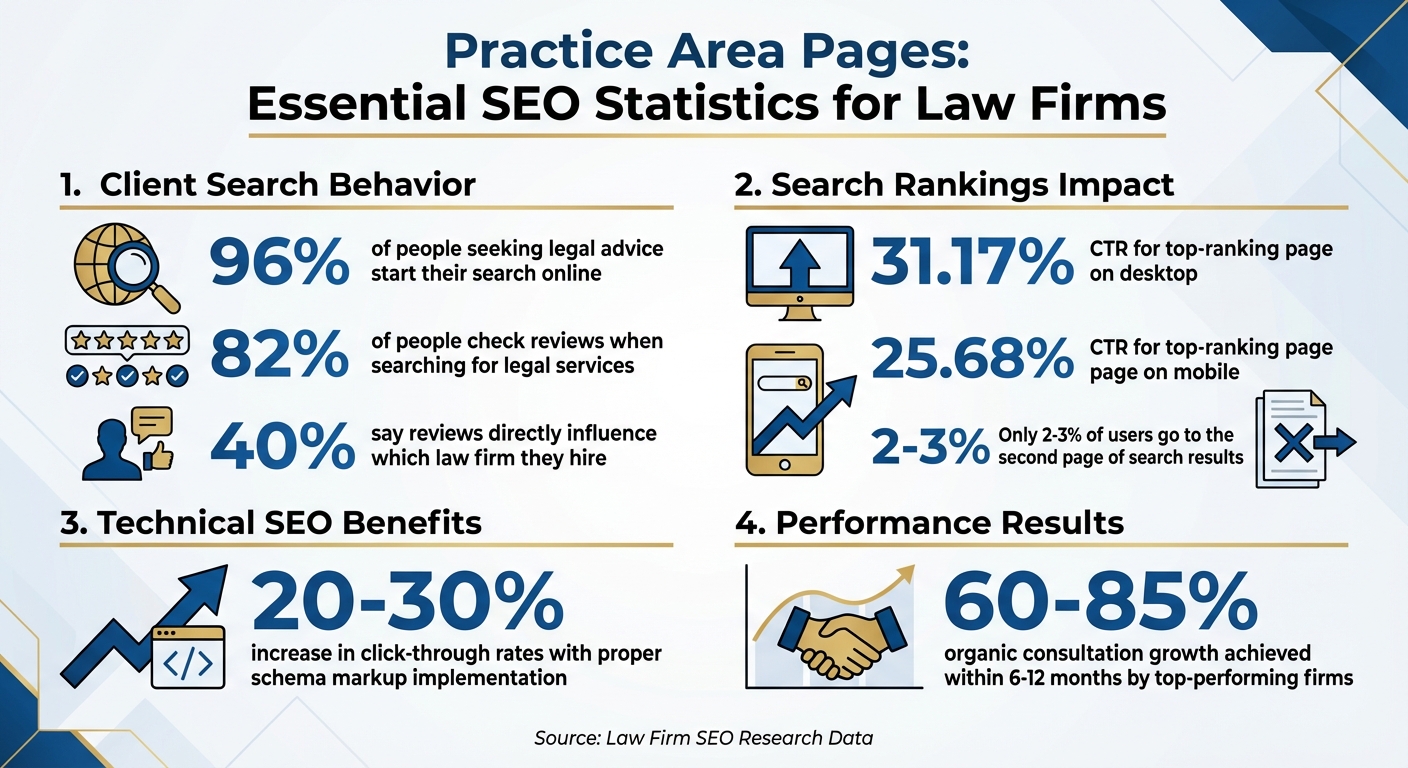
Law Firm Practice Area Pages: Key SEO Statistics and Performance Metrics
290. Law Firm SEO Strategy Guide 2025 with Jason Hennessey
How Practice Area Pages Improve Law Firm Search Rankings
Practice area pages are a powerful tool for aligning your website with the terms people actively search for. When someone enters phrases like "personal injury lawyer in New York" or "divorce attorney near me" into Google, the search engine seeks out pages that directly address those needs. A dedicated page focused on personal injury law, complete with relevant keywords, signals to Google that your firm is exactly what the searcher is looking for. This focused approach lays the groundwork for strategies that align with user intent, strengthen your site’s authority, and tap into local SEO opportunities.
Matching What Clients Search For
Each practice area page is designed to target specific legal queries, whether it’s family law, criminal defense, or estate planning. These pages incorporate the keywords potential clients are already using.
Understanding what your audience is looking for is essential. For example, when someone searches for "car accident lawyer", they’re likely seeking information on case processes, potential compensation, and next steps. Your page should address these needs directly. By aligning with both the keywords and the intent behind the search, you increase the chances of your page ranking higher in search results.
Building Authority Through Site Structure
A well-organized site structure, such as a hub-and-spoke model, can elevate your practice area pages. This setup demonstrates your expertise by creating a clear, logical flow between related pages. It also makes navigation easier for users and helps search engines understand your site’s content. Over time, this structure can enhance your firm’s credibility, improve rankings, and boost conversions.
Connecting with Local SEO
The impact of practice area pages grows even stronger when paired with local SEO strategies. Since most clients search for legal services in their area, incorporating city and region-specific terms – like "personal injury lawyer in Seattle" – can help capture local traffic.
This localized strategy has proven results. Take Hipskind & McAninch, LLC as an example. They created city-specific pages using keywords like "Belleville personal injury lawyer" to highlight their local expertise. Their content addressed details like local courts, regional legal practices, and issues specific to the community. This approach not only improved their search rankings but also increased client conversions by making their services feel tailored to local needs.
What Makes a Practice Area Page Effective
To create practice area pages that truly resonate with potential clients, it’s essential to focus on clear organization, client-centered content, and detailed explanations that address common questions. Start with a strong heading structure – your H1 should clearly define the practice area, while H2 and H3 headings break down subtopics like case processes, FAQs, and next steps. The content itself should be straightforward, using plain language to explain complex legal concepts and preemptively address client concerns. Let’s dive into the key components that turn visitors into clients.
Required On-Page Components
An effective practice area page begins with detailed service descriptions that highlight your legal expertise in a way that’s easy to understand. Strategically use keywords in headings, body text, and even alt tags to ensure your page aligns with search intent. Including an FAQ section is a smart move – it directly addresses common concerns and can help your page appear in featured snippets or quick-answer boxes. The goal is to show that you’re not just targeting a single keyword but understand the broader context of the legal issue.
"Resist the urge to pack multiple services onto a single webpage. Instead, it’s wiser to organize them into logical categories, assigning each specific service area its dedicated page. This approach not only makes it easier for users to locate exactly what they’re looking for, enhancing their overall experience, but it also significantly benefits SEO." – Good2bSocial
In addition to strong content, incorporating trust elements can make all the difference in converting visitors into clients.
Adding Trust Elements
Trust elements elevate a standard service page into a resource that inspires confidence. 82% of people check reviews when searching for legal services, and 40% say reviews directly influence their decision on which law firm to hire. Including attorney bios with credentials and case results helps build credibility. Client testimonials and case studies provide social proof, showing real-world outcomes instead of vague promises. When showcasing case results, opt for specific figures like "$1.2 million settlement" rather than generic phrases like "substantial compensation" to make achievements tangible. These details not only reassure potential clients but also strengthen your E-E-A-T (Experience, Expertise, Authoritativeness, Trustworthiness) signals, which Google uses to assess content quality and authority.
Creating Sub-Pages for Specific Services
Breaking down broad practice areas into targeted sub-pages can significantly boost your ability to rank for niche searches. For instance, instead of grouping all personal injury cases on one page, create separate pages for car accidents, truck accidents, motorcycle accidents, and slip-and-fall cases. Each sub-page can target specific, less competitive keywords with higher conversion potential. For example, someone searching for "truck accident lawyer" likely has a more immediate and specific need than someone searching for "personal injury lawyer." Using descriptive URLs like "yourfirm.com/personal-injury/truck-accidents" not only clarifies your content hierarchy but also improves search engine visibility. This approach helps demonstrate your expertise in specific areas while making it easier for clients to find exactly what they’re looking for.
Local and Technical SEO for Practice Area Pages
Boosting the search visibility of your practice area pages requires a mix of local targeting and technical SEO. While technical optimizations ensure search engines can easily crawl and index your site, local strategies help you connect with potential clients in specific geographic areas. Together, these approaches can elevate your website’s performance.
Building Location-Specific Pages
Creating separate pages for each location and practice area combination is a smart way to target specific searches. For example, instead of a generic "Personal Injury Lawyer" page, you could have pages like "DUI Lawyer in Los Angeles" or "Car Accident Attorney in Brooklyn." These pages should go beyond simply swapping out city names – include unique local details, like nearby landmarks, local courts, or community references, to make the content relevant and engaging. Use descriptive URLs such as "yourfirm.com/los-angeles/dui-lawyer" to make your site’s structure clear to both users and search engines. Don’t forget to maintain consistent NAP (Name, Address, Phone number) information across all pages and platforms to avoid confusion.
Technical SEO Requirements
Technical SEO plays a critical role in improving user experience and search engine rankings. Start by ensuring your pages load quickly and are mobile-friendly – search engines prioritize fast, optimized websites. Tools like Google PageSpeed Insights can help identify areas for improvement, such as resizing images or using modern formats to enhance loading speed.
Another essential step is implementing LegalService schema markup. This structured data clarifies your firm’s services, credentials, and locations for search engines, increasing the chances of earning rich snippets and knowledge panels. In fact, proper schema markup can boost click-through rates by 20-30%, even if your rankings remain unchanged.
"LegalService schema markup is one of the most underrated tools in lawyer local SEO. It can make your firm impossible – yep, impossible – to ignore." – Grow Law
Additionally, strengthen your internal linking strategy. For example, connect your main "Personal Injury" page to sub-pages like "Car Accidents" or "Slip and Fall Cases." This helps search engines understand the relationships between topics on your site, improving your overall SEO.
Connecting with Local SEO Tools
Your Google Business Profile (GBP) is often the first impression potential clients have of your firm, so make sure it’s accurate and appealing. Include up-to-date business hours, service areas, and practice categories, and upload high-quality photos. Use GBP posts to link directly to your practice area pages, driving traffic to your site.
Submitting your firm to local directories like Avvo, Justia, and your state bar association’s lawyer directory is another important step. These local citations not only improve your firm’s authority but also help build a strong local presence. Be sure your NAP information is consistent across all platforms. Finally, test your structured data regularly using Google’s Structured Data Testing Tool to ensure everything is implemented correctly and functioning as intended.
Tracking and Improving Practice Area Page Results
Keeping tabs on how your practice area pages perform is essential to understanding what’s working and what needs adjustment. Without proper tracking, it’s tough to pinpoint which pages are driving client engagement and which ones are falling short.
Metrics to Track
Start by monitoring 20–30 priority keyword rankings using tools like SEMrush, Ahrefs, or Moz. Pair this with monthly reviews in Google Analytics to analyze traffic patterns, user engagement, geographic insights, and conversion paths.
Pay close attention to key metrics like CTR (click-through rate), conversion rates, engagement levels, and organic traffic. For context, the top-ranking page on Google typically sees a CTR of 31.17% on desktop and 25.68% on mobile, while only 2–3% of users venture to the second page. Other crucial metrics include website visits, traffic sources, time spent on pages, page views per session, leads generated, and visitor-to-lead conversion rates . To measure ROI, compare the value of new cases brought in through SEO efforts against your total SEO investment.
These metrics lay the groundwork for making informed updates to your pages.
Using Data to Guide Updates
If a page has high impressions but low clicks, it’s time to revisit its title tags and meta descriptions. Craft them to highlight clear benefits and include strong calls-to-action . For pages attracting traffic but struggling with conversions, tools like Microsoft Clarity can help. Use heatmaps and session recordings to identify design or navigation issues that might be causing friction.
Look closely at which content types, topics, and keywords are driving the most engagement and conversions. Focus on doubling down on what’s already working. If keyword rankings drop after a search algorithm update, don’t panic. Research the changes and make steady, incremental improvements instead of rushing into major overhauls. For your top-performing articles, schedule content refreshes every 6–12 months. Update statistics, case citations, and attorney credentials to keep the information current and relevant. These steps ensure your practice area pages remain effective and competitive.
SearchX Tools for Practice Area Page Optimization

To take optimization further, specialized tools like those from SearchX can be game-changers. Start with their Free Website Audit Tool, which provides an instant snapshot of your site’s technical and content health. For more advanced needs, their Growth plan ($6,000/month) includes features like keyword tracking, technical audits, competitor analysis, and conversion optimization. The Enterprise plan ($12,000+/month) adds AI-powered visibility tracking, custom dashboards, and a dedicated support team.
SearchX focuses on aligning SEO efforts with business growth, not just improving metrics. Their services include keyword research, technical SEO audits, and comprehensive SEO solutions. They also guide you in measuring SEO ROI from organic traffic and tracking the 12 essential SEO metrics that matter most for law firms. With these tools, you can turn your practice area pages into reliable lead generators.
Conclusion
Practice area pages are a cornerstone of your law firm’s SEO efforts, serving as a direct link to potential clients actively searching for legal services. These pages succeed because they address specific client queries head-on, offering targeted information that meets their needs. When properly designed, they not only position your firm as an authority in particular legal fields but also create a site structure that search engines reward with better rankings. Over time, this combination strengthens both your online visibility and your reputation.
The effectiveness of practice area pages hinges on a mix of thoughtful strategy, clear organization, and ongoing updates. As outlined earlier, each service area deserves its own dedicated page, filled with content that reflects genuine expertise and experience. Technical elements, like schema markup, also play a key role in helping search engines understand your offerings. However, crafting these pages is just the beginning. With 96% of people seeking legal advice starting their search online and Google’s emphasis on Experience, Expertise, Authoritativeness, and Trustworthiness (E-E-A-T), staying relevant requires continuous adaptation to client needs and search algorithm changes.
Firms achieving organic consultation growth of 60–85% within 6–12 months don’t rely on one-and-done optimizations. They treat practice area pages as living assets, refining content and structure to keep pace with client questions and competitive markets. These firms create hub pages for broad legal topics, develop location-specific content tailored to local courts, and ensure their pages address the specific concerns of their audience.
FAQs
How can law firms leverage local SEO to enhance their practice area pages?
Law firms looking to improve local SEO for their practice area pages can take a few straightforward steps. Start by weaving location-specific keywords naturally into your content. This helps your site connect with potential clients searching for services in your area. Another effective tactic? Create separate pages for each city or region you serve, making sure the content on each page is tailored to that specific audience.
Don’t overlook your Google Business Profile either. Make sure it’s up-to-date with accurate details like your address, phone number, and the specific practice areas you cover. Finally, earning local backlinks from trusted community websites or organizations can give your visibility a big boost in local search results. These strategies not only bring in more local traffic but also help turn visitors into clients.
What should a practice area page include to attract and convert clients effectively?
To craft a practice area page that grabs attention and turns visitors into clients, make sure to include these essential elements:
- A compelling headline: Clearly state the service you offer in a way that captures interest right away.
- Client-centered content: Speak directly to your audience by addressing their concerns, outlining the benefits of your service, and showcasing your expertise.
- A persuasive call-to-action (CTA): Guide visitors toward their next step, like booking a consultation or reaching out for more information.
- A simple contact form: Make it easy for potential clients to get in touch without unnecessary hurdles.
- Credibility boosters: Add trust-building features such as testimonials, case results, or certifications to show why you’re the right choice.
When you combine these elements with smart SEO techniques, you’ll not only boost your page’s visibility but also its ability to convert visitors into clients.
How often should law firms update their practice area pages to stay effective for SEO?
To keep your law firm’s SEO on point, it’s a good idea to refresh your practice area pages every 3 to 6 months. This regular maintenance helps ensure your content stays up-to-date, includes relevant keywords, and mirrors any shifts in your legal services or case outcomes.
Consistently updating these pages also sends a clear message to search engines: your site is active and reliable. This can boost your rankings and draw in more of the right audience. Make it a priority to add new insights, tackle emerging client concerns, and fine-tune your local SEO strategy to keep these pages delivering results.