

Why Ranking Higher on Google Matters More Than Ever
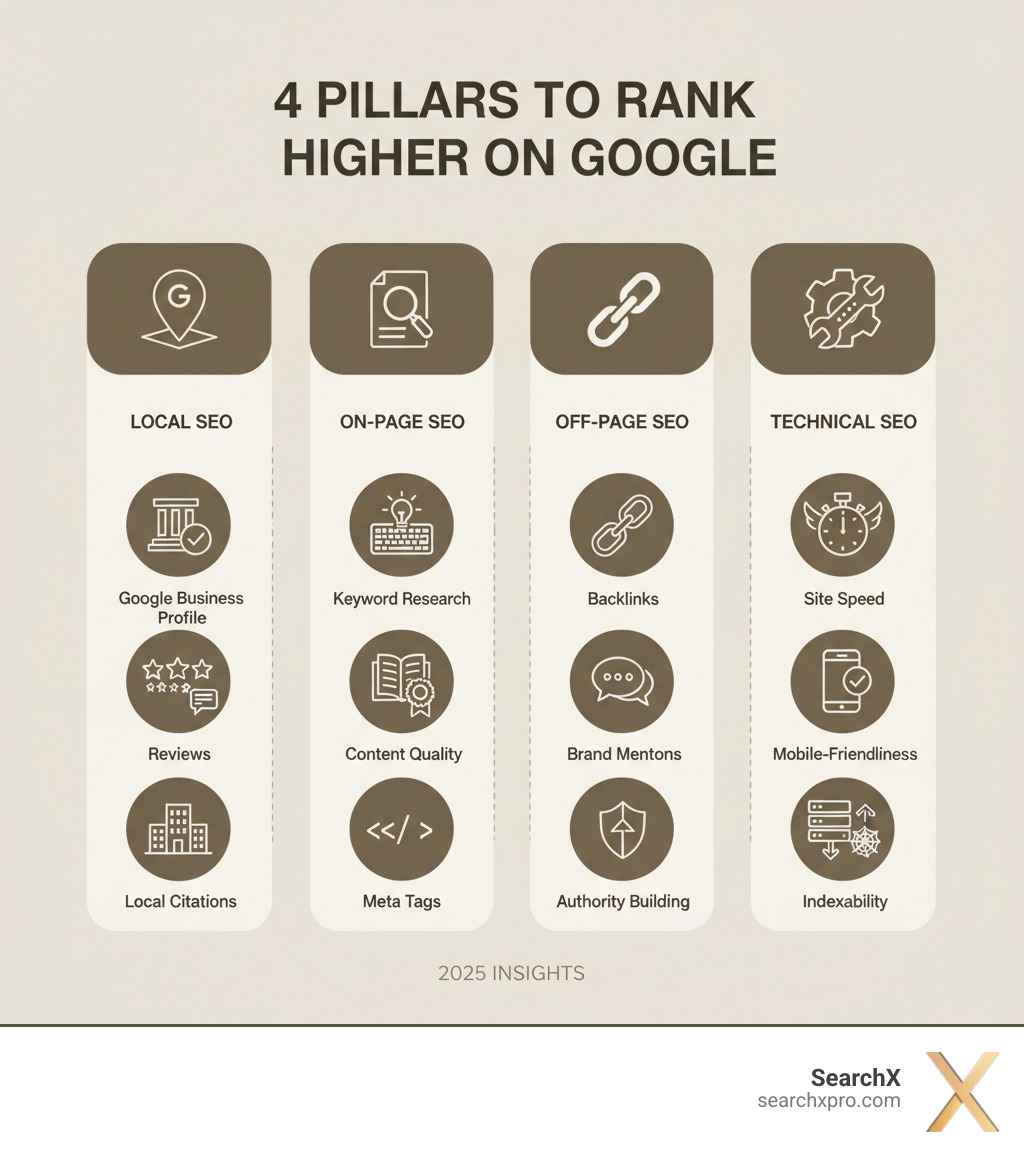
To rank higher on Google, you must focus on four core areas: optimizing your Google Business Profile, creating high-quality content, earning authoritative backlinks, and ensuring a solid technical foundation. These pillars work together to help Google understand, trust, and recommend your business.
Quick Steps to Rank Higher on Google:
- Claim and optimize your Google Business Profile – Complete all information, add photos, respond to reviews
- Target the right keywords – Research what your customers actually search for and match their intent
- Create valuable content – Write comprehensive, well-structured content that answers real questions
- Build quality backlinks – Earn links from reputable websites in your industry
- Fix technical issues – Ensure fast loading, mobile-friendliness, and proper indexing
- Get customer reviews – Actively collect and respond to reviews on Google
Here’s why this matters: 75% of users never scroll past the first page of Google, and the top three organic results get nearly 69% of all clicks. Ranking higher means getting qualified leads, as organic search has a 14.6% conversion rate compared to 10% for paid ads.
Google’s algorithm now uses advanced AI to understand content quality, penalizing old tactics like keyword stuffing. This guide breaks down exactly how to rank higher on Google today. I’m Lorenz Esposito, founder of SearchX, and I help businesses achieve measurable growth through sustainable SEO strategies that deliver real leads and conversions.
Basic rank higher Google glossary:
Mastering Local Search: Your Guide to Google Maps and the Local Pack
When users search for “best coffee shop near me,” they have local search intent. Mastering local SEO is critical for competing in busy markets like Miami, New York, or Austin. Google itself offers guidance on How to improve your local ranking on Google.
The Three Pillars of Local Ranking: Relevance, Distance, and Prominence
Google’s local ranking system uses three core factors to determine which businesses appear in the Google Local Pack and Maps results.
- Relevance: How well your business profile matches the search query. Your information must be detailed and accurate.
- Distance: How far your business is from the searcher. Proximity is a key factor.
- Prominence: How well-known your business is. This includes your review count, overall rating, and web authority.
Google weighs these factors using user data, which you can learn more about here: Your data in Search.
Optimizing Your Google Business Profile for Maximum Visibility
Your Google Business Profile (GBP) is your digital storefront. To rank higher on Google local searches, you must claim, verify, and completely fill out your profile. Start at Manage your business.
Ensure your business name, address, and phone number (NAP) are consistent everywhere online. Keep your hours of operation current. Choose specific business categories (e.g., “Thai restaurant” instead of just “restaurant”) and define your service areas. Use your business description to highlight what makes you unique. For a full walkthrough, see our guide on How to Optimize Google Business Profile for Local SEO.
The Power of Reviews and Photos in Local SEO
Customer reviews and photos are critical ranking factors. Google has stated that more reviews and positive ratings boost local ranking. Reviews also provide user-generated text that reinforces your relevance for specific services.
Ask happy customers for reviews and respond to all of them—positive and negative—to show you’re engaged. Detailed reviews carry more weight. Our Ultimate Guide to Map Pack Review Monitoring Tools can help, and you can learn more about How Reviews Impact Local Search Rankings.
High-quality photos and videos are also crucial. Upload professional images of your storefront, team, and services. Encourage customers to upload their own photos for authenticity. Visuals increase engagement, sending positive signals to Google that help you rank higher on Google.
Content Strategy: How to Create Pages That Rank Higher on Google
Google’s mission is to “present the most relevant, useful results.” Your content must satisfy the searcher’s query so they don’t need to look elsewhere.
Google evaluates content quality using E-E-A-T: Experience, Expertise, Authoritativeness, and Trust. This is especially critical for “Your Money or Your Life” (YMYL) topics like finance and health. Ensure your content meets these standards with our E-E-A-T Content Checklist for 2025.
Understanding Search Intent and Mastering Keyword Research
To rank higher on Google, you must understand why people are searching. This is search intent.
- Informational: “how to fix a leaky faucet”
- Transactional: “emergency plumber Charleston”
- Navigational: “Google Maps”
- Commercial: “best SEO agencies New York”
Your content must match the user’s intent. Learn more in our guide on the 4 Types of Keyword Intent Explained. Also, target long-tail keywords (e.g., “affordable SEO for small businesses in Austin”). They have lower volume but higher intent and are easier to rank for. Use tools like Google Keyword Planner to find opportunities. Our guide on Keyword Research Techniques, Tools, and Strategies can help.
On-Page SEO: Optimizing Your Content for Search Engines
On-page SEO makes your content clear to Google.
- Title Tag: The clickable headline in search results (<60 characters).
- Meta Description: The summary below the title (~155 characters) that boosts clicks.
- Header Tags (H1, H2, H3): Structure your content logically.
- URL Structure: Keep it clean and descriptive. See our 10 Best Practices for SEO-Friendly URL Structure.
- Image Alt Text: Describes images for accessibility and image search.
- Keyword Placement: Write naturally and avoid keyword stuffing.
Our On-Page SEO Checklist for Better Rankings covers all essentials.
Content Formats That Win: Long-Form, Skimmable Content, and Visuals
Comprehensive, long-form content often ranks better. However, it must be skimmable. Use short paragraphs, headings, bullet points, and bold text. Learn more in our guide on How to Structure Content for SEO.
Visuals like high-quality images and videos break up text and increase engagement. Compress images for speed and use descriptive alt text. Our 10 Image Optimization Tips for Faster Page Loads shows you how. Also, answer questions from the “People Also Ask” section to gain visibility.
Navigating the AI Era: Creating Differentiated Content
Google still prioritizes helpful, people-first content. While AI tools can assist, they can’t replicate genuine E-E-A-T. Our research showed human-written content got 5X more traffic than AI-generated content.
To rank higher on Google, focus on what AI can’t do: share your unique experience, demonstrate deep expertise, offer original insights, and let your authentic voice shine. Use AI as a tool, not a replacement for human creativity. For more, read our guide on Building Ethical AI SEO Strategies.
Building Authority: Backlinks, Branding, and Trust Signals

Google doesn’t just look at your website; it also considers what others say about you online. This is off-page SEO, built on trust signals that establish your domain authority. When reputable sites link to you, it’s a powerful endorsement that helps you rank higher on Google.
The Crucial Role of Backlinks in SEO
Backlinks are endorsements from other websites. However, quality matters more than quantity. A single link from a high-authority, relevant site is more valuable than hundreds of low-quality links, which can harm your rankings. Focus on building a natural link profile.
Earn quality backlinks by creating exceptional content. Other white-hat strategies include guest posting on reputable blogs and broken link building. Avoid black-hat tactics like buying links, as they can lead to severe penalties. Our Link Building Services use sustainable strategies, and you can learn to evaluate your profile with our guide on How to Assess Backlink Quality in 2025.
Why Brand Building is the New SEO Frontier
Google increasingly rewards strong, recognizable brands. Branded searches (e.g., “SearchX Charleston”) are powerful ranking signals that show real-world demand.
Even unlinked brand mentions in articles or social media reinforce your credibility. Word-of-mouth marketing is also effective, as noted by Nielsen: one of the most effective and lasting ways is word of mouth.
The average person interacts with a brand 11.1 times before making a purchase, so a consistent presence across your website, social media, and email is crucial. Social media amplifies your content’s reach, driving brand awareness that leads to more searches and links. Learn more about this synergy in our guide: How SEO and Social Media Work Together.
Building authority is about becoming a trusted name in your industry. When you do this, backlinks, mentions, and rankings follow naturally.
Technical SEO Essentials: Ensuring Your Site is Search-Friendly
Technical SEO is your website’s foundation. Without it, even the best content will fail to rank higher on Google. A slow or broken site hurts user experience and rankings. Our Technical SEO Services help businesses in Charleston, Austin, and beyond build this solid foundation.
How Google Finds, Crawls, and Indexes Your Website
Google uses a three-step process:
- Crawling: Googlebot follows links to find pages. You can submit pages via Google Search Console.
- Indexing: Google analyzes content to understand what a page is about and stores it.
- Serving Results: Google finds the most relevant pages from its index for a search query.
Use an XML sitemap as a roadmap for your site and a robots.txt file to guide crawlers. This optimizes your crawl budget. For more details, see How Google Search Works and our Crawlability and Indexability: Technical SEO Guide.
Key Technical Factors to help you rank higher on Google
Google favors sites with a better user experience. Key factors include:
- Core Web Vitals: These measure site speed, responsiveness, and stability, including Largest Contentful Paint (LCP), Interaction to Next Paint (INP), and Cumulative Layout Shift (CLS).
- Mobile-friendliness: Essential, as Google uses mobile-first indexing.
- HTTPS Security: A confirmed ranking signal that builds user trust.
- Safe Browsing: Your site must be free of malware or deceptive content.
Learn more from Google’s documentation on page experience aspects and use our guide on How to Test Core Web Vitals with Free Tools.
Using Schema Markup and Structured Data for Better Visibility
Schema markup is code that helps search engines understand your content’s meaning. It enables rich snippets—improved search results with extra info like star ratings or FAQs. Rich snippets stand out and can improve click-through rates. For example, Local Business Schema can display your hours directly in search results. Test your pages with Google’s Rich Result tester tool and learn the fundamentals in our guide on Schema Markup for Rich Results: Basics.
Website Organization and Duplicate Content Management
A logical site structure with descriptive URLs helps users and search engines. Grouping related content into directories signals topical depth. For more, see our SEO-Friendly URL Structure: 10 Best Practices.
Duplicate content—identical content on multiple URLs—confuses Google and dilutes ranking power. Use canonical tags to specify the preferred version of a page and 301 redirects for permanently moved pages. Our guide on How to Fix Duplicate Content with Canonical Tags provides a step-by-step solution.
Frequently Asked Questions about Ranking on Google
How long does it take to see SEO results?
SEO is a marathon, not a sprint. Meaningful improvements in rankings and traffic typically take 4 to 12 months. Google needs time to crawl, evaluate, and observe user interactions with your site.
Factors like industry competition, your website’s starting point, and your budget all influence the timeline. The good news is that SEO builds momentum over time. Focus on steady improvements and track meaningful metrics, not just rankings. Our guide on How to Measure SEO ROI from Organic Traffic Growth can help you measure what matters.
Can I rank higher on Google for free?
Yes, you can rank higher on Google without a budget, but it requires your time and effort. Many powerful SEO strategies are free:
- Claiming and fully optimizing your Google Business Profile.
- Creating high-quality, helpful content yourself.
- Implementing on-page SEO basics like optimizing titles and headers.
- Earning backlinks naturally by creating exceptional content.
- Using free tools like Google Search Console and Google Analytics.
Our DIY SEO for Small Businesses guide offers practical, budget-free steps.
What is the most important ranking factor?
There is no single “most important” ranking factor. Google uses hundreds of signals, and their importance varies by search query.
However, the core principles are relevance and quality. Google’s goal is to provide the most useful result for the user’s query. All other factors—backlinks, page speed, mobile-friendliness—support this goal. A technically perfect site with poor content won’t rank, and brilliant content on a broken site won’t reach its potential.
Focus on understanding your audience and delivering the best possible answer to their needs. Our guide on How to Align Content with User Intent dives deeper into this critical concept.
Conclusion: Your Path to the Top of Google
The path to rank higher on Google isn’t a secret hack; it’s about consistently executing on fundamentals. Recap: optimize your Google Business Profile, create high-quality content that matches search intent, build authority with backlinks and branding, and maintain a technically sound website.
The search landscape evolves, but Google’s mission to provide helpful, relevant results remains constant. Align your strategy with this mission by focusing on being genuinely useful to your audience. This is a long-term investment that compounds over time.
As a Charleston-based agency, SearchX creates custom SEO strategies that drive real business growth for companies in Charleston, Austin, New York, Miami, Naples, and beyond. We focus on outcomes that matter to your bottom line: qualified leads, calls, and sales. We believe in full transparency and partnership, connecting you with the customers who need what you offer.
Ready to turn clicks into customers? Explore our Local SEO Services to get started.