

Blogging is a powerful tool for dental practices. It improves your website’s visibility on search engines and helps educate patients about treatments, costs, and procedures. By answering common patient questions and targeting local search terms like “emergency dentist near me,” you can attract new patients and build trust before they even step into your office.
Key takeaways:
- Boost SEO: Publish posts with local keywords (e.g., “teeth whitening in Dallas”) to rank higher in search results.
- Educate Patients: Address questions about procedures, costs, and recovery times in simple, clear language.
- Engage Locally: Use location-specific topics and connect blogs to your Google Business Profile for better local visibility.
- Track Performance: Monitor metrics like organic traffic, time on page, and conversions to refine your strategy.
Start small by focusing on patient FAQs, optimizing for local searches, and updating content regularly to stay relevant. Blogging can turn online searches into appointments, helping your practice grow.
Dental Blogging SEO Statistics and Key Performance Metrics
Dentist SEO Hack: AI Built This Blog Strategy While I Did Nothing
How to Build a Dental Blogging Strategy
Crafting a solid blogging strategy for your dental practice can amplify SEO benefits while educating and engaging your patients. Start by setting clear objectives and understanding your audience. Are you looking to attract new patients, boost treatment acceptance, or reduce no-shows? Each of these goals will shape the direction of your content. Dive into your audience’s demographics (age, income, insurance status) and psychographics (dental anxieties, cost concerns). Pay attention to what patients ask during appointments, what your front desk team hears on calls, and the questions popping up in your Google Business Profile Q&A section. These insights can guide you to topics that resonate most. From there, focus on defining goals, identifying your audience, and choosing topics that encourage patient engagement.
Set Blog Goals and Identify Your Target Audience
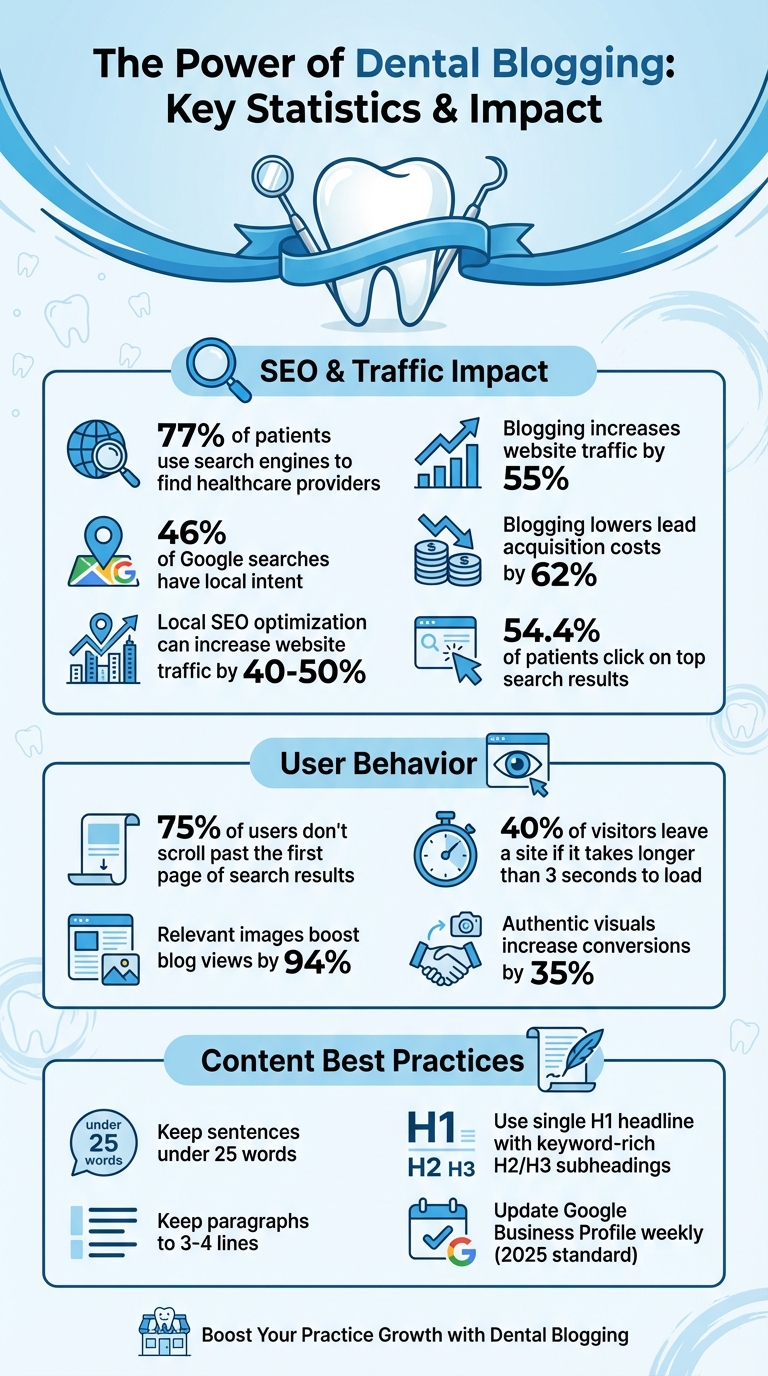
Your blog should address the challenges your patients face. Start by documenting the common questions they ask – these are great indicators of content that could lead to more appointments. For instance, if your practice specializes in pediatric dentistry, you might focus on questions like, "When should I take my baby to the dentist for the first time?" If you offer cosmetic procedures, your audience may be searching for topics like veneer costs or recovery timelines. Blogging can increase website traffic by 55% while lowering lead acquisition costs by 62%. Prioritize queries that help patients move from researching to booking an appointment.
Select Dental Blog Topics That Match Patient Intent
Patients often search for highly specific queries like "cost of dental implants in Boston with insurance" or "emergency dentist near Back Bay open Saturday". Your content should directly address these concerns while maintaining a hopeful tone – acknowledge their worries but focus on positive outcomes. Use tools like Google’s "People Also Ask" and related searches to uncover real questions people are typing in. Local Facebook groups and Reddit can also provide valuable insights into discussions about dental anxiety or treatment recommendations in your area. While AI tools can help brainstorm initial ideas, refine these topics with your team’s expertise and local knowledge. Once you’ve nailed down your topics, weave in local keywords to ensure your content ranks well in location-specific searches.
Add Local Keywords for U.S. Dental Practices
Local keywords are essential for connecting your services to your area in search results. With nearly 46% of Google searches having local intent, optimizing for local SEO can increase website traffic and patient inquiries by 40–50%. Use phrases like "teeth whitening in Carrollton" or "pediatric dentist in [your neighborhood]". Combine service keywords with location-specific modifiers, such as "emergency dentist near me" or "family dentist accepting new patients in Carrollton, Texas, with Saturday appointments". Place these keywords naturally in your blog titles, headers, URLs, and throughout the content. Tools like Google Trends and Ahrefs can help you identify the terms potential patients are searching for and understand how search volumes vary by location.
How to Write Dental Blog Content That Ranks and Educates
To make your dental blog stand out, it’s essential to balance readability, structure, and relevance. Since 77% of patients rely on search engines to find healthcare providers, your content must be easy to find and understand. Google values patient-focused posts that showcase expertise and build trust. That means your writing should answer common patient questions clearly and encourage them to book an appointment. Here’s how to create blog posts that are both engaging and SEO-friendly.
Structure Blog Posts for Easy Reading
A well-organized blog post is key to keeping readers engaged. Start with a single H1 headline and follow it with keyword-rich H2 and H3 subheadings. Keep paragraphs short – about 3-4 lines – and aim for sentences under 25 words. Adding visuals can make a big difference: relevant images boost views by 94%. Use real photos of your practice and team instead of stock images, as authentic visuals can increase conversions by 35%. To maintain fast page load times, compress image files, and ensure your blog is mobile-friendly since search engines prioritize mobile-first indexing.
Write for Patients, Not Dentists
Your blog should feel approachable, not overly technical. Swap out complicated dental jargon (like "endodontic therapy") for simpler terms ("root canal treatment"). Focus on addressing concerns patients actually have, like pain management, recovery time, or what to expect during a procedure. For example, instead of saying, "We utilize advanced periodontal scaling techniques", you could say, "We gently clean below the gum line to remove bacteria and promote healing." Including patient testimonials and insights from your team can further build trust. The goal is to make dental care feel less intimidating and more accessible.
Include U.S.-Specific Information
Cater your content to American patients by addressing their particular concerns. Be upfront about treatment costs in U.S. dollars and explain how common insurance plans, like Delta Dental or MetLife, may cover procedures. Use relatable comparisons to simplify technical details. For example, instead of just listing measurements, provide everyday examples to clarify. Acknowledge dental anxiety openly, and highlight comfort options like sedation dentistry, TV entertainment during procedures, or cozy blankets. If your practice serves a multilingual community, consider professional translations. For areas with large Spanish-speaking populations, offering content in both English and Spanish can make a big impact. Additionally, if you serve retirees, address senior-specific concerns with posts like "Are dental implants safe for people over 65?". Customizing your content to reflect your community’s needs shows patients you understand and care about them.
Up next, we’ll dive into how to optimize your blog for local SEO to further enhance your practice’s visibility.
How to Use Blogs to Improve Local Dental Visibility
Your blog is a powerful tool for connecting with local patients. Considering that 46% of searches have local intent, using clear geographical cues in your blog can significantly increase your visibility among nearby audiences. Here’s how to fine-tune your blog content to attract local searches.
Optimize Blog Content for Local Searches
Incorporate your city, neighborhood, and state names throughout your blog posts, including in titles and headings. Instead of broad topics like "How to Handle a Dental Emergency", go for more location-specific angles, such as "What to Do If You Lose a Filling in Austin, Texas" or "Top Tips for Maintaining Oral Health During Winter in Minnesota." These types of posts target long-tail keywords, which can help bring in more focused traffic.
You can also create content tied to local events. For example, write about "Dental Health Tips for Back-to-School Season in [Your Neighborhood]" or highlight collaborations with nearby schools and community groups. Since 75% of users don’t scroll past the first page of search results, crafting targeted, local content gives you a better shot at being seen. To amplify these efforts, link your blog posts to your Google Business Profile (GBP) to further strengthen your local online presence.
Connect Blogs to Your Google Business Profile
Make it a habit to update your Google Business Profile weekly with posts that link directly to your blog. Regular updates are essential – by 2025, weekly updates have become the standard for maintaining an active GBP presence, as Google prioritizes listings that show consistent engagement.
For instance, Aurora Dental Haven, a suburban clinic, saw a 40% increase in new patient inquiries over six months by frequently updating their profile with promotions and location-focused keywords. Similarly, Pioneer Dental Group boosted their local website traffic by 35% by tailoring blog posts to address local dental concerns and linking them to partnerships within their community. Always ensure your practice’s name, address, and phone number remain consistent across your GBP, website, and other directories to avoid confusion.
Add Local Business Schema Markup to Blog Posts
Schema markup is a type of code that helps search engines understand your content better and display it more prominently in search results. Adding LocalBusiness schema markup to your blog posts, including your practice’s name, address, phone number, and hours, can increase your visibility in rich results. You can also use Dentist schema for specific services, practitioner profiles, patient reviews, and FAQs.
This structured data not only enhances your SEO but also helps your practice show up in voice search results. For example, when someone asks, "Who’s the best dentist near me?" , schema markup ensures your practice is more likely to appear. By clearly showcasing your geographical information through schema, you signal to search engines that your content is highly relevant to local patients.
How to Track Dental Blog Performance
Tracking how well your dental blog is performing is essential if you want to turn readers into patients. Without keeping an eye on key metrics, your content strategy can lose its focus.
Metrics to Monitor
Pay attention to organic traffic and time on page. When readers spend several minutes on a post, it’s a sign that your content resonates and offers value. On the other hand, a high bounce rate might indicate that your content isn’t meeting expectations or that your website is slow to load. Did you know that 40% of visitors will leave a site if it takes longer than 3 seconds to load?
The most critical metric, though, is conversions – these are the actions that turn casual readers into actual patients. Keep track of appointment requests, phone calls, and form submissions. Also, check how your blog ranks in search results for targeted keywords. Tools like Google Analytics and Google Search Console can make tracking these metrics straightforward. The insights you gather will guide you in improving your content strategy.
Using Data to Refine Your Strategy
Once you’ve gathered the data, use it to adjust your approach. Focus on topics that are already performing well. Analyze user behavior to see which posts hold readers’ attention or lead them to explore your services page. If you find posts with high traffic but low conversions, they might lack a clear call-to-action (CTA). Adding something like “Schedule Your Appointment Today” can make a big difference.
If you notice common patient questions that aren’t addressed in your blog, create new posts to fill those gaps. Regular tweaks based on these insights will ensure your content stays relevant and useful for your audience.
The Importance of Content Audits
Schedule quarterly content audits to keep your blog fresh and accurate. Update clinical information, refresh outdated statistics, and ensure pricing reflects current U.S. rates. For example, in April 2025, Curve Dental emphasized the importance of regular SEO audits to track keyword rankings and conversion rates, helping dental practices maintain optimized websites.
Don’t hesitate to retire or revamp outdated content. For instance, blog posts about COVID-19 dental protocols from 2020 may no longer be relevant. Instead, update older posts with new photos, improved techniques, or recent patient testimonials. These updates not only keep your content relevant but also align with Google’s standards for expertise, authoritativeness, and trustworthiness. Regular audits ensure your blog continues to serve both your readers and your practice effectively.
Conclusion
Blogging can be a game-changer for your dental practice. It helps build trust, educate your patients, and improve your visibility in search results. By consistently publishing well-crafted content that addresses real patient concerns, you establish your practice as a trusted authority in your community. Plus, Google’s algorithms, especially its AI-driven search tools, reward websites that offer genuinely helpful and detailed answers to user queries. As Megan Nielsen, SEO strategist at My Social Practice, explains:
"If your content feels genuinely helpful, AI will notice and put you in front of potential patients".
The numbers back this up: 77% of patients research online before choosing a dentist, and 54.4% of them click on the top search results. A well-maintained blog could be the factor that ensures your practice stands out, turning online searches into actual appointments.
Creating a successful dental blog requires a clear strategy. This includes keyword research, local SEO, technical optimization, and regular performance reviews. A partner like SearchX can simplify this process by managing tasks like content creation, technical SEO audits, and local SEO management. With their expertise, you can focus on what you do best – caring for your patients – while they handle the technical side of your blog.
At its core, Google prioritizes content that delivers quality and relevance. Whether you’re launching a new blog or refining an existing one, the key is to stay consistent and keep your patients’ needs front and center. Your blog should answer questions, address concerns, and inspire confidence.
Start small, monitor your progress, and make adjustments along the way. With the right approach, your dental blog can become a powerful tool for growing your practice.
FAQs
How does blogging help boost my dental practice’s SEO?
Blogging is a powerful tool to boost your dental practice’s SEO, particularly when it comes to ranking higher in local search results. By publishing useful, locally-focused content that incorporates relevant keywords and addresses common questions or concerns from your patients, you make it easier for potential patients in your area to find you.
On top of that, optimizing each blog post with the right meta tags, headers, and well-chosen images improves your site’s visibility to search engines. Beyond just rankings, blogging helps establish trust and credibility by sharing helpful information, which not only attracts new patients but also keeps your existing audience engaged.
What kind of content works best for a dental blog?
To create an engaging and effective dental blog, focus on content that educates and captivates your audience. Some excellent topics include tips for maintaining dental hygiene, simple explanations of procedures like teeth whitening or cavity fillings, and preventive care advice to promote long-term oral health. Addressing common questions from patients, debunking dental care myths, and sharing patient success stories can also help establish credibility and build trust with your readers.
To keep your content dynamic, incorporate multimedia elements like videos or infographics. These can simplify complex topics and make your blog more visually appealing. Additionally, writing about local dental concerns or using region-specific keywords can help you connect with nearby patients and boost your blog’s search engine rankings.
How can I use local keywords to improve my dental blog’s SEO?
To boost your local SEO, weave local keywords naturally into your blog posts. For example, include the name of your city, neighborhood, or nearby landmarks alongside terms like “dentist,” “dental care,” or the specific services you offer. These keywords should appear in areas like your blog titles, meta descriptions, headers, and throughout the content.
Think about creating dedicated content for each location you serve. This could mean crafting pages or blog posts that spotlight your services in particular areas. Additionally, make sure your Google Business Profile is up-to-date with accurate Name, Address, and Phone (NAP) details, along with photos and patient reviews. For even more targeted traffic, focus on long-tail keywords that combine your location with specific services, such as “teeth whitening in Dallas” or “emergency dentist near me.”
Lastly, keep your NAP details consistent across all online directories. This small step can make a big difference in strengthening your local SEO.