
Want more patients to find your dental practice online? Your website needs to rank high in local searches like "dentist near me." On-page SEO ensures your site is optimized to attract local traffic and convert visitors into patients.
Here’s what you need to focus on:
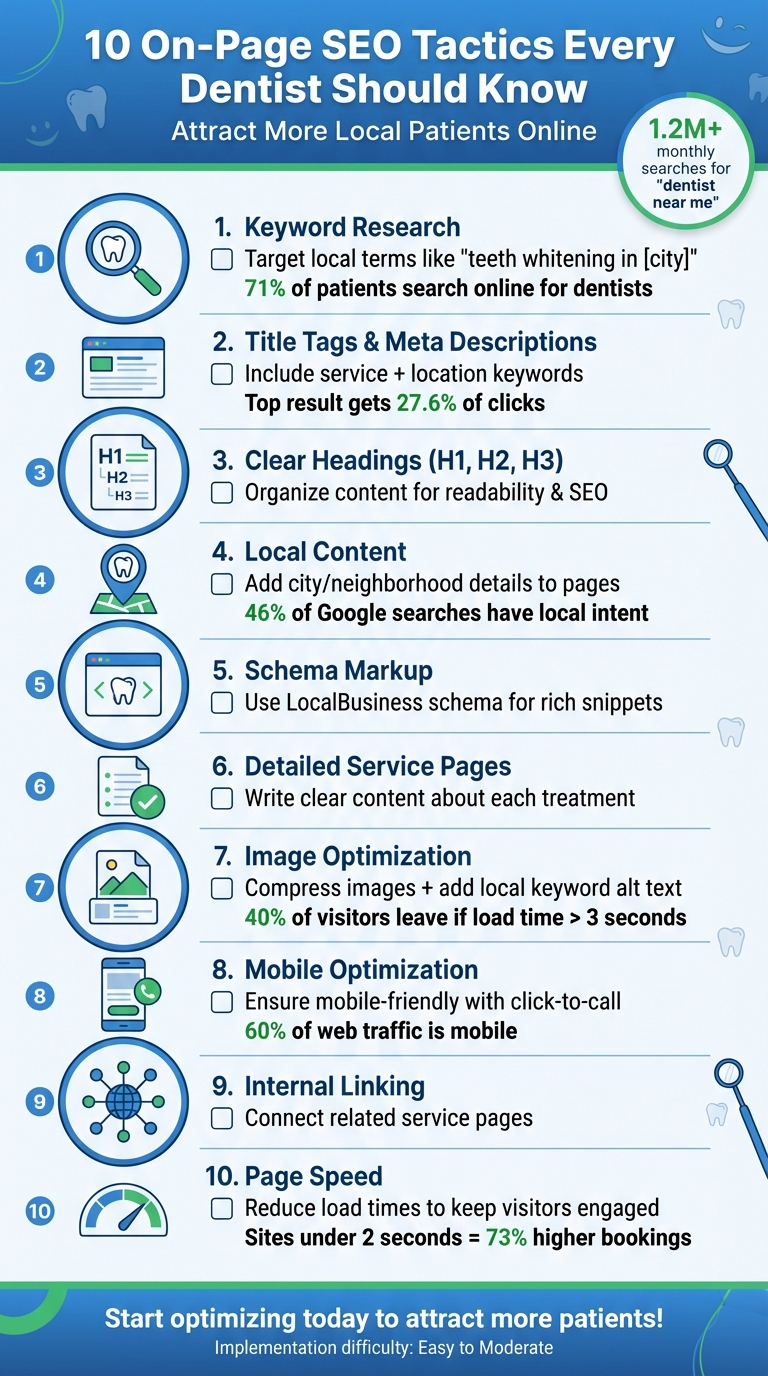
- Keyword Research: Use tools like Google Keyword Planner to target local search terms such as "teeth whitening in [city]."
- Title Tags & Meta Descriptions: Include service and location keywords (e.g., "Dental Implants in Miami | Free Consultations").
- Clear Headings: Organize content with H1, H2, and H3 tags to improve readability and SEO.
- Local Content: Add location-specific details to service pages (e.g., "Emergency Dental Care in Brooklyn").
- Schema Markup: Use LocalBusiness schema to enhance visibility in search results.
- Detailed Service Pages: Write simple, informative content about treatments like dental implants or root canals.
- Image Optimization: Compress images and use alt text with local keywords.
- Mobile Optimization: Ensure your site is mobile-friendly with click-to-call buttons.
- Internal Linking: Connect related service pages to guide users and boost SEO.
- Page Speed: Reduce load times to keep visitors engaged and improve rankings.
These strategies are simple to implement and can significantly improve your practice’s online visibility. Start optimizing today to attract more patients!
10 Essential On-Page SEO Tactics for Dental Practices
1. Conduct Keyword Research for Dental Services
Relevance to U.S. Dental Practices
Keyword research is the cornerstone of how local patients discover your dental practice online. In the U.S., over 1.2 million people search for "dentist near me" on Google every month, and a whopping 71% of patients start their search for a new dentist online. Here’s why ranking matters: the top search result grabs 27.6% of clicks, while the tenth result barely gets 2.4%.
For dental practices, the goal is to pinpoint the exact phrases potential patients are using. Long-tail keywords like "pediatric dentist in Austin" or "dental implants for seniors" may have fewer searches, but they often attract people who are ready to book an appointment. Since these searches reflect specific needs, they tend to result in higher conversion rates. By targeting these terms, you can create content that directly connects with high-intent local patients.
Impact on Local SEO and Patient Acquisition
Local keyword research is a game-changer for dentists, as most new patients live just a few miles from the practice. To find these high-value search terms, use tools like Google Keyword Planner, SEMrush, and Google Search Console. For instance, phrases like "Miami dentist" or "emergency dentist downtown Miami" can help you attract patients searching for services in your area.
Start by identifying your core services – such as teeth whitening or dental implants – and use tools like Google Autocomplete and "People Also Ask" to uncover related local search phrases. Google Search Console can also show you the actual queries bringing traffic to your site. Additionally, browsing dental forums or social media can help you understand how patients describe their concerns. For example, patients might say "shrinking gums" instead of the clinical term "gum recession." Using these insights, you can optimize your site to align with the language and needs of potential patients.
Ease of Implementation for Dental Websites
You don’t need a massive budget to get started. Free tools like Google Keyword Planner and Google Search Console provide plenty of data to build a solid foundation. These tools allow you to compare keywords across various locations and services, helping you prioritize terms based on search volume and competition.
When optimizing your site, focus each page on one or two primary keywords. For example, instead of combining multiple services on one page, create separate pages for "dental implants in [city]" and "teeth whitening [city]." This makes it easier for Google to understand your content and match it with relevant local searches. By keeping your approach focused, you can improve your visibility and attract the right patients.
2. Optimize Title Tags and Meta Descriptions with Local Keywords
Relevance to U.S. Dental Practices
Think of title tags and meta descriptions as your practice’s digital welcome sign – they’re often the first impression potential patients get when they see your listing in search results. In the U.S., where the top search results grab the majority of clicks, these snippets can be the deciding factor in whether someone chooses your practice.
This is especially important for dentists because nearly 46% of Google searches have local intent, and 30% of mobile searches are tied to location. For example, if someone searches for "emergency dentist downtown Miami" or "pediatric dentist in Austin", Google prioritizes results with relevant local keywords. By aligning your metadata with these local terms, you can significantly increase your chances of attracting new patients.
Impact on Local SEO and Patient Acquisition
To make the most of this opportunity, craft your metadata using a straightforward formula that includes your service, location, and a compelling modifier. For example: "Dental Implants in Carrollton, TX | Accepting New Patients." Aim to keep title tags under 60 characters and meta descriptions between 155-160 characters, and use action-oriented language to grab attention.
Here’s a real-world success story: Aurora Dental Haven, a suburban clinic, saw a 40% boost in patient inquiries over six months simply by integrating location-specific keywords into their website and Google My Business profile. By consistently using phrases like "dentist in Carrollton, TX" in their metadata, they ranked highly for searches such as "dentist near me" and "dental clinic in [City]". Adding modifiers like "affordable", "best," or "top-rated" alongside your location can further help you connect with specific patient groups.
Ease of Implementation for Dental Websites
Updating your title tags and meta descriptions is straightforward if you use a content management system (CMS). Customize unique snippets for each service page to maximize their impact. For instance, your teeth whitening page could use: "Professional Teeth Whitening in [City] | Results in One Visit | [Practice Name]." Meanwhile, a dental implants page might feature: "Dental Implants [City] | Experienced Implant Dentist | Free Consultation."
3. Use Clear Headings and Subheadings on Service Pages
Relevance to U.S. Dental Practices
When patients visit your service pages – whether it’s for "Dental Implants" or "Teeth Whitening" – they should immediately grasp the services you provide. A clear heading structure (H1, H2, H3) not only organizes complex dental information but also makes it easy for patients to skim through the content on any device. This approach benefits both your audience and search engines, ensuring your pages are accessible and informative .
Impact on Local SEO and Patient Acquisition
Headings do more than just improve readability – they play a key role in local SEO. Search engines analyze your headings to understand the focus of each page and match it with relevant patient searches. By including keywords in your headings – such as "What to Expect During Your Dental Implant Procedure in Dallas" – you enhance your page’s relevance for both Google and potential patients . This strategy becomes even more critical with AI-driven search results, where structured content is more likely to appear in Google’s AI Overviews.
"Google has stated that using an H1 tag ‘helps Google understand the structure of the page.’" – Backlinko
Take, for instance, a clinic featured by AIOSEO in August 2025. They published a post titled "What to Expect During Your First Root Canal", using clear, well-organized headings. This single post not only ranked on the first page of search results but also brought in dozens of new visitors every month – proving that structured content can directly impact patient acquisition.
Ease of Implementation for Dental Websites
Creating a logical heading structure is simpler than you might think. Start with a single H1 tag that incorporates your main keyword, like "Professional Teeth Whitening Services." Follow it with H2 tags for key sections, such as "Treatment Process", "Benefits", and "Pricing", and use H3 tags for detailed subpoints under each section. Most dental website platforms make this process easy – just choose the appropriate heading level in your editor. Ensure your headings follow a clear hierarchy, with each one accurately describing its section’s content .
4. Add Location-Specific Content to Key Pages
Relevance to U.S. Dental Practices
When people search for dental care, they’re often looking for a provider nearby. For instance, a person in Brooklyn searching for "teeth whitening" is likely interested in options within their own neighborhood, not across the city. To meet this expectation, it’s important to include geographic details – like the city, neighborhood, or nearby landmarks – on key pages of your website.
Impact on Local SEO and Patient Acquisition
Incorporating location-specific content does more than just make your website relevant – it can significantly improve your local SEO and help attract new patients. By creating pages such as "Emergency Dental Care in Queens" or "Dental Implants in Brooklyn", you can target keywords that indicate a strong intent to book an appointment. These pages can help your practice appear prominently in local search results and on Google Maps, making it easier for potential patients to find you. To maximize this strategy, weave local keywords into your titles, headings, meta descriptions, and body content. If your practice serves multiple neighborhoods or has multiple locations, consider building separate pages for each service and area you cover.
Ease of Implementation for Dental Websites
Implementing this approach is straightforward. Start by ensuring your clinic’s full address, phone number, and business hours are visible on every page – usually in the footer. Then, create dedicated pages for each service you offer, incorporating local details naturally. For example, instead of a generic "Teeth Whitening" page, name it "Teeth Whitening in [Your Neighborhood]" and include references like "conveniently located near [local landmark]" or "proudly serving families in [neighborhood name] since [year]". The goal is to make your location details feel natural and genuinely useful to potential patients.
5. Implement LocalBusiness Schema Markup
Relevance to U.S. Dental Practices
Schema markup is a type of structured data that helps search engines understand key details about your practice, like your address, phone number, operating hours, and services [11, 28]. By presenting this information in a standardized format, search engines can easily process it, which enhances your local visibility and improves how your practice appears in search results.
Impact on Local SEO and Patient Acquisition
Adding LocalBusiness schema markup to your site can make your dental practice stand out in search results with rich snippets. These snippets might include star ratings, business hours, or even FAQ dropdowns – elements that draw attention and encourage clicks [11, 28]. Schema markup also boosts your visibility in local searches and Google’s Map Pack, helping you rank higher and attract more patients. Plus, it enhances voice search functionality, ensuring that assistants like Siri and Alexa provide accurate details about your practice [4, 11]. The result? Better visibility, increased trust, and more appointments from qualified leads.
Ease of Implementation for Dental Websites
Setting up schema markup is simpler than it sounds. Tools like Google’s Structured Data Markup Helper and WordPress plugins such as AIOSEO and Rank Math make the process straightforward [11, 28]. For dental practices, focus on schema types like LocalBusiness, Dentist, Review, and FAQ to highlight your services, location, and patient feedback. Whether you work with an SEO agency or tackle DIY local SEO, schema is a one-time setup that delivers long-term benefits. It integrates seamlessly with other on-page strategies, strengthening your website’s authority while improving its search performance.
Alignment with On-Page SEO Best Practices
Schema markup works hand in hand with your optimized content, adding structured data that reinforces your site’s credibility under Google’s E-E-A-T guidelines (Experience, Expertise, Authoritativeness, Trustworthiness). It complements elements like targeted keywords, mobile-friendly design, and high-quality content by providing search engines with an additional layer of context [2, 4, 11]. By clearly showcasing your credentials, patient reviews, and essential details, schema markup helps establish your authority and trustworthiness, making it a vital part of your technical SEO strategy.
6. Write Detailed Content About Dental Treatments
Relevance to U.S. Dental Practices
When it comes to dental treatment pages, accuracy and trustworthiness are non-negotiable. Patients researching procedures like root canals, dental implants, or teeth whitening want clear, dependable information before deciding to schedule an appointment. By offering detailed, easy-to-understand content that explains essential aspects of each procedure, you can build trust and establish your practice as a go-to resource in your community. This strategy not only enhances credibility but also creates a natural pathway to turn interest into booked appointments.
Impact on Local SEO and Patient Acquisition
Comprehensive treatment pages do more than just inform – they attract patients who are ready to take action. These pages tie directly into your local SEO strategy by addressing patient concerns in a way that resonates. Using service-focused keywords like "teeth whitening in [City]" or "emergency root canal near me" helps boost your visibility in local search results . Adding elements like comparison articles, relevant data, or expert commentary strengthens your authority and makes it easier to rank for competitive terms.
Ease of Implementation for Dental Websites
Start by creating dedicated pages for each service . Write in a clear, conversational tone that avoids overwhelming readers with technical jargon. Use heading tags (H1, H2, H3) to structure your content for better readability, and include descriptive alt text for all images. To keep your content fresh, consider publishing blog posts every other month . Original content is key – duplicate material can hurt your search rankings. These well-organized, focused pages will not only enhance your SEO but also improve the user experience.
Alignment with On-Page SEO Best Practices
Detailed content works hand-in-hand with your SEO strategy, reinforcing your website’s authority. Naturally integrate primary keywords into titles, headings, and body text, but steer clear of overloading your content with keywords . Keep your pages fresh and engaging by regularly adding updates like case studies, patient testimonials, or procedure videos . Educational, straightforward content not only builds trust but also improves engagement and search rankings .
"Google favors clear explanations, common questions, and an educational tone rather than medical jargon." – Straumann
7. Optimize Images with Alt Text and Compression
Relevance to U.S. Dental Practices
Images play a key role in building trust by giving potential patients a glimpse of your practice. But here’s the catch: large, non-optimized image files can slow down your website, causing up to 40% of visitors to leave before the page even loads. For dental practices operating in competitive local markets, this could mean losing patients before they even see what you offer. By optimizing images, you ensure fast load times while maintaining the professional visual quality that attracts and reassures patients. Plus, this step can improve your local search rankings.
Impact on Local SEO and Patient Acquisition
Optimized images can do more than just make your site look good – they can improve your local SEO and help you attract more patients. When search engines find images with descriptive alt text that includes local keywords – like "Dr. Smith performing teeth whitening in Austin" – they can better understand your content and connect it to relevant local searches. This not only boosts your visibility but also improves accessibility for users with vision impairments, making your website more inclusive and engaging.
Ease of Implementation for Dental Websites
Optimizing images for your dental website doesn’t have to be complicated. Start by converting images to modern formats like WebP or AVIF and compressing them using tools such as ShortPixel or WP Rocket. Rename image files with descriptive keywords, such as "dental-office-chicago.jpg", and add alt text that clearly describes the image. Just be sure to avoid including any personal health information to stay HIPAA-compliant.
Alignment with On-Page SEO Best Practices
Page speed is a major ranking factor, especially for mobile users. Compressing images not only keeps your site running smoothly but also helps keep visitors engaged, improving your search rankings. Use tools like Google PageSpeed Insights to monitor performance, and ensure both file names and alt text are descriptive. Search engines rely on these details to understand your images, making optimization a crucial part of your broader on-page SEO strategy.
"If even one of your Core Web Vitals metrics falls below Google’s recommended thresholds, your competitors – whose sites are fully in the green – will likely outrank you." – Promodo
8. Make Your Site Mobile-Friendly with Click-to-Call Buttons
Why Mobile Optimization Matters for U.S. Dental Practices
These days, mobile optimization isn’t just nice to have – it’s essential for dental practices aiming to attract local patients. Over 60% of web traffic comes from mobile devices, and 30% of all Google mobile searches are tied to location. Think about it: most potential patients are searching for terms like "emergency dentist near me" or "teeth cleaning in [city]" right from their phones. If your website isn’t mobile-friendly, you’re likely losing these patients before they even get a chance to explore your services. Since July 5, 2024, Google has been using its mobile crawler to assess all websites, meaning mobile optimization is no longer optional if you want to maintain visibility in search results. Along with strategies like metadata optimization and schema markup, a mobile-ready site builds trust with local patients and directly impacts how they engage with your practice.
How Click-to-Call Buttons Help with Local SEO and Patient Conversions
A mobile-friendly site with click-to-call buttons simplifies the process for patients to reach out. When someone finds your practice on their phone, they should be able to call you with just one tap. This small feature can have a big impact: 77% of patients research online before choosing a dentist. By making it easy to call, you increase the likelihood they’ll choose your practice over a competitor. Additionally, optimizing your Google Business Profile with a one-tap dialing feature can improve your visibility – businesses with complete profiles are 70% more likely to attract visits.
Simple Steps to Add Click-to-Call Features to Your Site
Start by using responsive design to ensure your website adapts to any screen size. Make your phone number easy to find by placing it above the fold, at the bottom of pages, and in sidebars. On mobile, format the number as a clickable link using HTML, like <a href="tel:555-123-4567">. This way, patients can call you instantly with a tap. Don’t forget to test your site on different devices to ensure smooth navigation and that buttons are easy to tap.
Mobile Optimization and On-Page SEO
Google prioritizes mobile-friendly sites in its rankings, so optimizing for smartphones is critical. A 1-second delay in mobile load time can reduce conversions by up to 20%, so focus on speed alongside mobile usability. Use tools like Google’s Page Experience Report and Lighthouse to monitor your site’s performance. Ensure fonts are readable, buttons are easy to click, and your site loads quickly to meet Google’s mobile-first indexing standards.
"Google has fully transitioned to mobile-first indexing – meaning your mobile version is your primary version in Google’s eyes. If your mobile site is missing content, loads slowly, or has clunky navigation, it can hurt your rankings. Make sure your mobile experience includes: Fast loading times (check your Core Web Vitals scores), Readable font sizes, Clickable buttons, No hidden or missing content." – My Social Practice
9. Link Between Related Dental Service Pages
Relevance to U.S. Dental Practices
After optimizing metadata and structuring content effectively, internal linking becomes a key strategy to improve both user experience and SEO. Linking between related dental service pages allows patients and search engines to navigate your website more intuitively. For instance, someone visiting your "teeth whitening" page might also be curious about "dental veneers" or "cosmetic dentistry." Connecting these pages not only guides patients through relevant services but also encourages them to explore more options before making a decision. This approach supports a smoother user journey and strengthens your local SEO by creating logical pathways through your site.
Impact on Local SEO and Patient Acquisition
Strategic internal linking helps search engines better understand your website’s structure. By linking related service pages, you’re signaling to Google which pages are important and how they relate to one another. This can improve rankings across multiple keywords. As Marina Turea explains:
"Although links are a dying ranking factor, they still matter. They improve metrics such as time spent on the site, CTR, and conversion."
This means internal links not only benefit SEO but also contribute to keeping visitors engaged, which can lead to more bookings.
Ease of Implementation for Dental Websites
A practical way to implement internal linking is by creating a pillar page for your dental services, which then links to more specific cluster pages. For example, a pillar page titled "A Comprehensive Guide to Dental Health" could link to clusters like:
- Preventive Dentistry: Covering regular checkups, home oral hygiene, and diet’s role in dental health.
- Cosmetic Dentistry: Including teeth whitening, veneers, and orthodontics.
- Restorative Dentistry: Discussing implants, crowns and bridges, and root canals.
Each cluster page should also link back to the pillar page, forming a hub-and-spoke structure. This model not only organizes your content but also integrates seamlessly with your broader on-page SEO strategy.
Alignment with On-Page SEO Best Practices
When linking pages, use clear, descriptive, and keyword-rich anchor text. For example, instead of generic phrases like "click here", opt for "learn more about dental implants" or "explore our teeth whitening services". This approach provides context to search engines and improves user navigation. Additionally, link from high-authority pages to those with less visibility to distribute authority effectively. Regularly audit your links to fix any broken ones, ensuring your site remains credible and user-friendly.
10. Speed Up Page Load Times
Why It Matters for U.S. Dental Practices
Page speed plays a crucial role in whether potential patients stick around on your website or leave before scheduling an appointment. Studies show that websites taking more than 3 seconds to load lose 40% of their visitors. For dental practices competing in local markets, this can translate to a significant loss of potential patients. On top of that, Google penalizes slow-loading pages, which can negatively impact your search rankings. With 68% of dental searches happening on mobile devices, having a fast-loading mobile site is no longer optional – it’s essential for reaching patients actively searching for dental care. A faster site not only keeps visitors engaged but also increases the likelihood of converting them into patients.
The Link Between Speed, SEO, and Patient Conversions
The relationship between page speed and conversions is undeniable. Websites that load in under 2 seconds experience 73% higher appointment bookings. Faster-loading pages not only rank higher in search results but also lead to more visitors becoming patients. Practices that deliver a seamless mobile experience, including quick load times, report 45% higher conversion rates from organic traffic. Since Google considers page speed a ranking factor, particularly for mobile users, improving your site’s speed can boost both your online visibility and patient acquisition.
Simple Steps to Improve Dental Website Speed
Start by testing your website speed with Google PageSpeed Insights. This free tool highlights areas that may be slowing your site down. One easy fix is converting images to modern formats like WebP or AVIF, which significantly reduce file sizes without compromising quality. Tools like ShortPixel or WP Rocket can automate image compression for you. Another effective tactic is enabling lazy loading, so offscreen images only load when needed. These straightforward adjustments can lead to measurable improvements in load times.
How Speed Aligns with On-Page SEO Efforts
Site speed isn’t just a technical detail – it’s a key part of your overall SEO strategy. Alongside optimizing keywords and content, focus on compressing CSS and JavaScript files, enabling caching, and removing unnecessary code to enhance load times. Regularly monitor your Core Web Vitals to ensure your site meets Google’s performance standards. By building a strong technical foundation, your other SEO efforts – like content creation and internal linking – can work more effectively to boost your rankings and drive more patient appointments.
SEO for Dentists: The New Way to Rank Your Practice #1 on Google 🤯
Comparison: Well-Optimized vs. Poorly Optimized Dental Service Pages
Let’s dive into how well-optimized and poorly optimized dental service pages stack up. By examining elements like heading structure, keyword usage, and technical performance, it becomes clear which strategies can improve search rankings and attract more patients.
A well-optimized page features a single H1 tag with the primary keyword, supported by a logical structure of H2–H6 tags. This makes it easier for search engines to understand the content. On the other hand, poorly optimized pages might skip the H1 tag altogether or include multiple H1s, confusing search engines and hurting rankings.
Keyword integration is another major differentiator. High-quality pages skillfully weave local and long-tail keywords into titles, meta descriptions, headings, early content, image alt text, and URLs. This natural placement improves both readability and rankings. In contrast, pages that neglect keyword research – or worse, resort to keyword stuffing – risk alienating readers and being penalized by Google, which prioritizes terms placed early in the content.
Technical performance also plays a critical role. Strong pages load quickly, are mobile-friendly, include schema markup, and feature clear calls-to-action. Weak pages, however, often suffer from slow load times, poor mobile responsiveness, missing schema markup, and cluttered, unstructured text. These issues make navigation difficult and can drive potential patients away. Considering that over 60% of web traffic now comes from mobile devices and Google has been using mobile-first indexing since July 5, 2024, these technical flaws can significantly hurt both patient acquisition and search rankings.
Ultimately, these differences highlight the importance of thorough on-page optimization. By addressing these key areas, dental service pages are more likely to convert local searches into actual patient appointments.
Conclusion
On-page SEO plays a crucial role in helping dental practices get noticed online. With nearly half (46%) of Google searches focused on local intent, your website needs to be optimized to attract local patients actively searching for dental services.
Key strategies like refining title tags and meta descriptions, using schema markup, and improving page speed can make a big difference in how easily potential patients find your practice. Considering that 54.4% of users click on one of the top three search results, even small improvements in your rankings can lead to a noticeable increase in appointment bookings.
To get started, focus on keyword research, enhance your service pages, and ensure your site loads quickly on mobile devices. While professional dental SEO services typically range from $1,500 to $5,000 per month, they can offer a strong long-term return on investment by driving more patients to your practice.
Competition among dentists is growing, but most patients turn to online searches before selecting a provider. This means your on-page SEO efforts can directly impact your practice’s growth. By carefully applying these strategies, you can build trust, improve your search rankings, and consistently draw in qualified patients.
FAQs
How does keyword research help my dental practice attract more local patients?
Keyword research plays a crucial role in helping dental practices connect with the right audience. By focusing on local keywords – such as "dentist near me" or "teeth whitening in [city]" – and service-specific phrases, you can boost your website’s visibility in search results. This ensures you’re reaching local patients who are actively looking for dental services.
Using targeted keywords also enhances your website’s relevance in the eyes of search engines, which can strengthen your online presence. Over time, this can translate into increased website traffic, improved search rankings, and, most importantly, more appointments for your practice.
What is schema markup, and how can it help my dental practice rank higher in search results?
Schema markup is a piece of code you can add to your website to help search engines grasp the details of your content more effectively. For dental practices, it can showcase essential information like your services, patient reviews, office location, and business hours. This data can then appear as rich snippets in search results, making your listing more eye-catching and informative to potential patients.
Using schema markup can set your practice apart in search results, boost your local visibility, and draw in more patients searching for dental care nearby. It’s a straightforward yet impactful way to strengthen your online presence.
Why is having a mobile-friendly website important for local dental practices?
Having a website that works well on mobile devices is crucial for local dental practices. Why? Because most people turn to their smartphones when searching for nearby services. Plus, Google now uses mobile-first indexing, which means the mobile version of your site heavily influences your search rankings.
A site that’s responsive, quick to load, and easy to navigate not only improves the experience for visitors but also makes it simpler for potential patients to find your practice, learn about your services, and schedule appointments. On top of that, a mobile-friendly website boosts your chances of ranking higher in local search results, putting your practice in front of more nearby patients.