
AI search has transformed how med spas attract clients in 2026. To stay visible, you need to shift from traditional SEO to strategies that align with AI-driven algorithms. Here’s what matters most:
- AI prioritizes intent, not just keywords: Search engines now analyze user intent, favoring websites with detailed, well-organized content over those with basic pages.
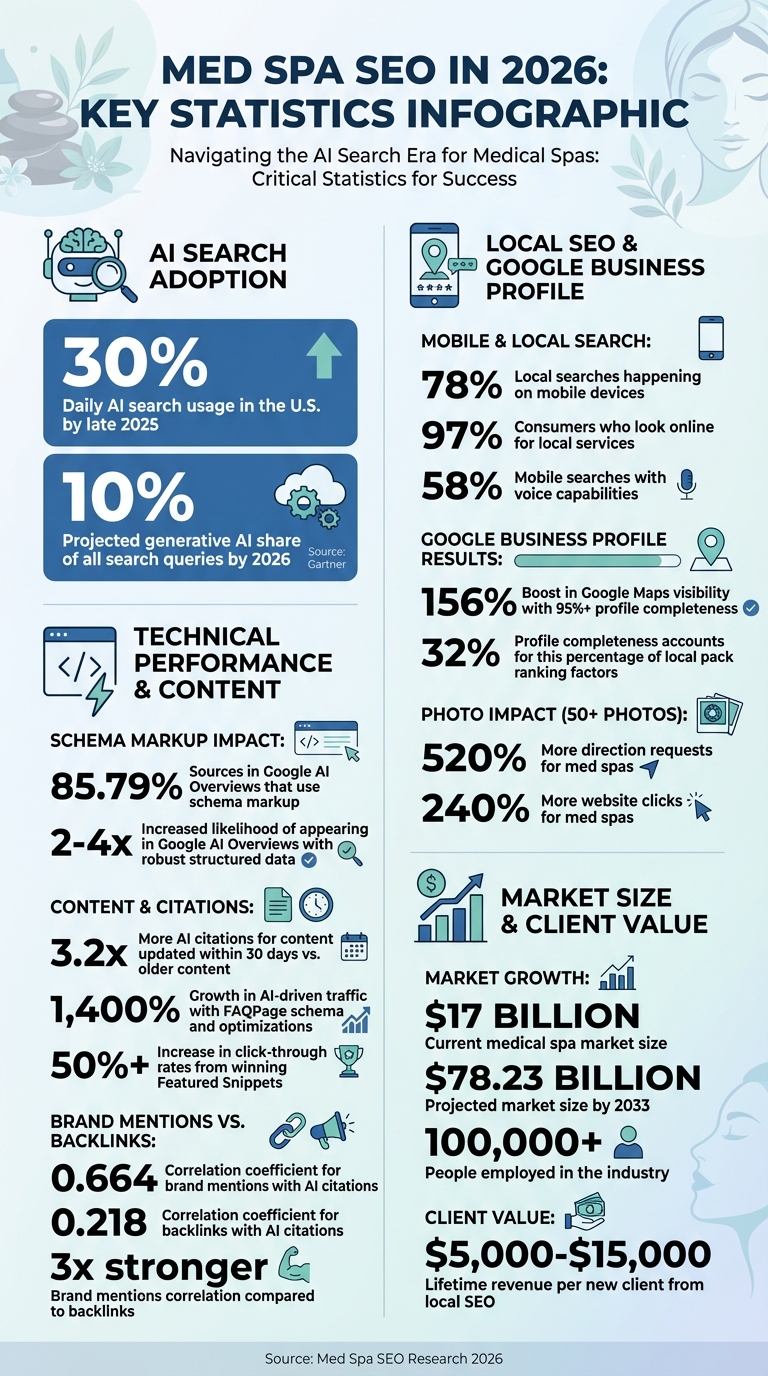
- Structured data is critical: 85.79% of sources in Google AI Overviews use schema markup. Adding structured data improves your chances of being cited in AI-generated answers.
- Google Business Profile (GBP) is a key tool: A fully completed GBP boosts visibility by 156% in local searches. AI uses GBP data for recommendations, so keep it accurate and updated.
- Content depth matters: Med spas with content clusters around treatments (e.g., Botox, laser hair removal) are seen as experts and rank higher in AI results.
- Technical SEO is non-negotiable: Fast-loading, mobile-friendly sites with strong Core Web Vitals metrics are favored by AI systems.
Take action: Optimize your GBP, use schema markup, create in-depth treatment pages, and track AI-driven SERP features to stay ahead in this competitive market. Success depends on positioning your med spa as a trusted, high-quality source in AI search results.
Med Spa SEO Statistics 2026: AI Search Impact on Local Visibility
Med Spa SEO – What Goes into Successful SEO for Med Spas (Pt 1)
Optimizing Google Business Profile for Local Search
Your Google Business Profile (GBP) is a key tool for improving local SEO. By 2026, having a fully completed profile accounts for 32% of local pack ranking factors. Med spas that increase their profile completeness to over 95% often see a 156% boost in Google Maps visibility. Since Google validates GBP ownership and enforces quality standards, search engines rely on it as a trustworthy data source – especially for conversational queries like, "best med spa for lip filler near me". Let’s dive into how you can make the most of AI-powered features within your GBP.
Using AI-Powered GBP Features
Google’s AI tools are designed to enhance your profile’s effectiveness. For example, the system uses AI to analyze reviews and business data, automatically generating answers to common questions like operating hours, parking, and service details. To keep these responses accurate, review and approve AI-generated answers weekly – especially for details like pricing and policies.
AI also identifies recurring themes in customer reviews, such as "painless injections" or "friendly staff", and highlights them in your profile summaries. These summaries appear prominently at the top of your listing, giving potential customers a quick snapshot of your strengths.
Engage customers by enabling GBP messaging and aim to respond within five minutes. Quick response times are increasingly factored into local recommendations by AI systems. Regularly update the Q&A section with essential topics such as financing options, parking availability, and treatment recovery details. Another handy feature: Google’s AI can scan uploaded PDFs or images of service menus and convert them into a structured format for your profile. Beyond using these dynamic tools, ensure all business details are accurate to strengthen AI’s trust in your profile.
Adding Complete and Accurate Business Information
Set "Medical Spa" as your primary category to align with high-intent searches. You can also add up to nine secondary categories, such as "Laser Hair Removal Service" or "Skin Care Clinic", to capture a broader range of treatment-related queries. Create a detailed service list, including every treatment you offer. Use all 300 characters per entry to describe services and include transparent pricing (e.g., "Botox per unit") to help AI generate accurate search summaries.
Ensure consistency in your Name, Address, and Phone (NAP) details across all platforms. Even minor differences like "Suite 200" vs. "Ste 200" can affect your rankings, as AI uses these details for verification. Use the full 750 characters in your business description to highlight treatments, provider qualifications, and the neighborhoods you serve. AI analyzes this information for relevance, so specificity matters. Don’t skip attributes like "wheelchair accessible", "LGBTQ+ friendly", or "appointment required", as these filters are commonly used in AI-driven searches. Accurate and detailed business information lays the groundwork for a strong med spa SEO strategy.
Finally, don’t underestimate the power of visuals. Med spas with 50+ photos see 520% more direction requests and 240% more website clicks compared to those with fewer than 10. Keep a collection of 100+ high-quality photos showcasing treatment rooms, staff, and before-and-after results (with consent). Update your photo library weekly to improve AI analysis. Engagement also gets a boost when you respond to reviews quickly – ideally within 24–48 hours. Active management signals professionalism and keeps your profile competitive.
Local Keyword Research and Geo-Targeted Content
Now that your local business profile is in place, it’s time to focus on advanced keyword research to attract local searches. Modern local keyword strategies prioritize understanding the semantic context of searches instead of relying on outdated keyword stuffing techniques. For med spas, this involves targeting search patterns like Service+Location, Near-me, Service+Intent, and Specific Concern+Treatment. Considering that over 97% of consumers look online for local services and more than 58% of these searches happen on mobile devices with voice capabilities, your strategy should also account for conversational queries. Think of phrases like, “Where is the nearest Botox clinic?” or “What med spa is open now?”. This approach aligns with how AI interprets user intent, making it a crucial part of your SEO plan.
Tools for Finding Local Keywords
Start with Google Autocomplete to gather real-time, high-intent searches for services like Botox. Then, check your Google Search Console for impressions to spot underperforming pages that need optimization. For more in-depth research, tools like SearchX‘s keyword research service can uncover geographic terms beyond city names – such as neighborhoods, ZIP codes, regional nicknames, and even local landmarks that people frequently use in their searches. To maximize ROI, map these keywords to every stage of the customer journey, from initial awareness to the final decision. Considering that a single new client brought in through local SEO can generate $5,000 to $15,000 in lifetime revenue, investing in detailed keyword research is well worth the effort. These targeted keywords will then serve as the backbone for creating location-specific landing pages.
Creating Location-Specific Landing Pages
Each core treatment should have its own dedicated landing page to help Google match it with specific search intent. Aim for 600–800 words of content that directly addresses common client questions, such as pricing, recovery time, and expected results. Make sure to include your service name and a local identifier in the page title, H1, meta description, and opening paragraph.
"In my tests, ChatGPT disproportionately recommends sites that explicitly use keywords like ‘Top Rated Med Spa in Nashville’ in their page titles and headers." – Ricky Shockley, Owner, Med Spa Magic Marketing
Avoid duplicating content templates for different cities. Each location page should feature unique details, including specific directions and neighborhood-relevant information. Use local anchor text (e.g., "med spa in Scottsdale") to link between related services and connect your homepage to location-specific pages. Embedding a Google Map on your contact or location page further enhances your geographic relevance. Additionally, implement LocalBusiness and Service schema markup in JSON-LD format. This structured data makes it easier for AI-driven search engines to extract and highlight your information. By combining these strategies, you not only improve keyword relevance but also build trust in AI-powered search results.
Using Schema Markup for AI Search Results
After optimizing local listings and keywords, adding schema markup is a powerful way to make your med spa stand out in AI-driven search results. Schema markup essentially translates your website’s content into a structured format that AI systems – like Google’s AI Overviews, ChatGPT, and Perplexity – can easily read and reference. According to research, 85.79% of sources cited by Google AI Overviews include structured data. These AI models depend on schema to verify details, ensuring they provide accurate information. For med spas in competitive local markets, using the right schema types can be the deciding factor between being overlooked and becoming the go-to recommendation in AI-generated answers.
Schema Types Med Spas Should Use
To get started, focus on these key schema types:
- LocalBusiness or MedicalBusiness schema: Use this on your homepage and contact pages to clearly define your business’s location and identity for "near me" searches.
- Service schema: Apply this to each treatment page, but avoid general terms. Create specific markups for services like "Botox injections", "dermal fillers", or "laser hair removal" to align with precise user queries.
- Review and AggregateRating schema: Add this to testimonial and service pages to showcase star ratings directly in search results, which can lead to a 20–30% increase in click-through rates.
- FAQPage schema: Include this on your service pages to provide structured Q&A content. This format feeds AI systems with ready-to-use answers and has been linked to a 1,400% growth in AI-driven traffic when paired with other optimizations.
Looking ahead to 2026, consider adding Author Credentials Schema to connect practitioner profiles with platforms like LinkedIn or medical boards, and VideoObject Schema for treatment demonstration videos. These additions enhance your credibility and improve visibility across multi-format AI search results. Use JSON‑LD format for schema implementation, as it’s the most widely recognized by AI search engines. If you’re unsure about proper setup, SearchX’s technical SEO services can ensure your schema is configured correctly.
Once these schema types are in place, the next step is understanding how they directly enhance your visibility in AI search results.
How Schema Improves AI Search Visibility
When implemented effectively, schema markup builds trust with AI systems. It doesn’t just improve rankings – it positions your med spa as a trusted authority. By nesting schemas (e.g., linking a Service schema to a MedicalBusiness schema and verified Person entities), you create a "trust loop" that AI engines recognize. This increases the likelihood of appearing in rich snippets and AI-generated summaries. In fact, pages with robust structured data are 2–4 times more likely to feature in Google AI Overviews.
"Technical excellence isn’t optional for AI visibility. This isn’t correlation, it’s causation." – CheckThat.ai
For example, if someone asks an AI chatbot, "What’s the best med spa near me for lip filler?" the system pulls from structured local content to generate its response. Your schema provides AI with all the details it needs – services offered, location, hours, and customer reviews – in a format that’s both verifiable and trustworthy. Even in zero-click scenarios, where users get answers without visiting a site, proper schema ensures your med spa is cited as the primary source, preserving your brand authority. To maintain consistency, ensure your Name, Address, and Phone (NAP) details match across your Google Business Profile and website footer.
Tracking SERP Features and AI Search Trends
Once you’ve implemented AI-focused schema, keeping an eye on SERP features becomes essential to stay ahead of shifting search trends. Schema markup helps improve visibility, but monitoring AI-driven search trends ensures your med spa remains relevant. By late 2025, daily AI search usage in the U.S. reached nearly 30%, and Gartner projects that generative AI will account for 10% of all search queries by 2026. This evolution means traditional ranking metrics alone no longer provide the full picture. For instance, your med spa might rank on the first page for "Botox near me", but if an AI Overview appears above your listing and doesn’t reference your business, you’re essentially invisible to that audience. By tracking features like AI Overviews, Local Map Packs, and Knowledge Graph Panels, you can identify where visibility is shifting and adjust your strategy to maintain relevance. These efforts connect your schema work to broader SERP tracking.
SERP Tracking Tools for AI Search
To remain competitive, you need tools capable of tracking AI-driven changes in real time. SearchX’s SERP feature tracking solutions are specifically designed for this, monitoring the appearance of Google AI Overviews for your keywords and confirming whether your med spa is cited. Tools like SEMrush and BrightEdge offer AI-powered SERP tracking, while platforms like Riff Analytics specialize in tracking AI mentions across systems like ChatGPT, Gemini, and Perplexity. For local businesses, keeping tabs on the Local Map Pack is critical, as it continues to drive "near me" traffic.
Start by identifying 20–30 high-intent queries, such as "best lip filler in [City]", to establish a baseline for visibility. Test these queries in ChatGPT and Perplexity to see how your business appears. Then, automate ongoing monitoring with SearchX’s SERP feature tracking tools. Keep a close eye on Featured Snippets and People Also Ask (PAA) boxes, as content featured in these sections is more likely to be cited by AI search systems. If your target keywords trigger Featured Snippets but you’re not winning them, this highlights an immediate area for improvement. Securing a Featured Snippet can boost click-through rates by over 50% for certain queries.
Measuring Performance with SEO Metrics
Once you’ve started tracking SERP changes, it’s time to measure the impact using targeted AI metrics. While traditional metrics still matter, you should also monitor these five AI-specific metrics:
- Mention Rate: The percentage of industry queries where your brand appears in AI-generated responses.
- Citation Rate: How often AI explicitly cites your content as a source.
- Position in Response: Whether your business is the primary recommendation or just mentioned.
- Answer Share: Your brand’s share of voice within AI-generated answers.
- Sentiment: How AI portrays your med spa – whether as a budget-friendly option or a top-tier provider.
Recent studies show that brand mentions have a correlation three times stronger with AI citations than backlinks (0.664 vs. 0.218 correlation coefficient). This makes reputation management on platforms like Yelp, RealSelf, and Healthgrades even more important.
Use Google Search Console to filter performance reports by "Search appearance" and isolate traffic from rich results. Review frequency and recency are also crucial – aim for 8–12 new reviews per month, as AI prioritizes fresh, consistent feedback. Regularly refreshing your content is equally important; content updated within 30 days earns 3.2x more AI citations than older material. Tools like SearchX’s SEO metrics tracking can help you monitor these indicators and evaluate the return on investment from your AI-focused efforts.
"Success in 2026 search isn’t about ranking #1 anymore. It’s about being the source AI trusts." – Lillian Pierson
Finally, don’t overlook technical details. Make sure the Google-Extended crawler isn’t blocked in your robots.txt file. This crawler is essential for Gemini grounding. If it’s blocked, Gemini won’t be able to cite your content in AI Mode, no matter how well-optimized your pages are. For help configuring your robots.txt file, check out SearchX’s robots.txt guide. This small but critical adjustment supports your broader AI visibility strategy.
Building Content Clusters Around Popular Treatments
After setting up your SERP tracking and AI metrics, the next step in your AI SEO strategy is to focus on creating content clusters for high-value treatments. These clusters help AI systems see your med spa as an expert in specific areas, rather than just a collection of unrelated pages. In 2026, search engines prioritize topical authority over individual page optimization. This means they assess whether your site provides a deep, interconnected view of a subject – like Botox or laser hair removal – instead of evaluating pages based on isolated keywords. By combining your local and AI strategies, content clusters solidify your authority across various treatments.
Selecting Top Treatments for Content Strategy
Begin by targeting treatments that bring in the most revenue and attract significant search interest. For many med spas, this includes services like Botox, dermal fillers, laser hair removal, CoolSculpting, and microneedling – procedures with high-intent audiences actively looking to book appointments. Use tools like Google Search Console to identify high-traffic queries with low click-through rates. You can also explore autocomplete suggestions (e.g., searching "Botox in Dallas" might reveal queries like "Botox for forehead lines Dallas" or "how long does Botox last") to better understand local search trends.
Additionally, analyze your top three to five competitors to spot gaps in your content. Look for features like FAQs, treatment explanations, and provider videos that they offer but you don’t. Ensure each treatment has its own dedicated page rather than being lumped under broad categories like "Neurotoxins." This approach not only improves user experience but also signals to AI that your site thoroughly covers each treatment.
Structuring Content Clusters for AI
Once you’ve identified your key treatments, organize them using a hub-and-spoke model. Start with a central pillar page (2,500–4,000 words) that provides an in-depth overview of the treatment. Then, create smaller spoke pages (1,200–2,000 words) that dive into specific subtopics. For example, a Botox pillar page could link to spoke pages addressing questions like "How long does Botox last?" or "Botox for migraines."
Design spoke pages in 150–200-word sections, each tackling a single idea. This format makes it easier for AI to extract and understand key points. Use headings framed as questions – like "What are the benefits of microneedling?" – and provide concise answers within the first 40–60 words to improve your chances of being featured in AI Overviews.
Internal linking is crucial for showcasing your topical authority. Aim for 3–5 contextual links per 1,000 words, ensuring at least 80% of related pages are interconnected. For instance, a microneedling page should link to a PRP treatment page, while the pillar page ties all related spoke pages together.
"To rank in 2026, your website must be more than a digital brochure; it needs to be an authoritative folder of information." – Ricky Shockley, Owner, Med Spa Magic Marketing
Since AI prioritizes content that is regularly updated – sources in AI Overviews tend to be 25.7% newer than traditional results – review and refresh your content clusters every 90 days to maintain their relevance and appeal.
Technical SEO Audits for Core Web Vitals and Mobile
Even the best content won’t succeed if your site’s technical foundation is weak. By 2026, AI search engines like ChatGPT and Perplexity prioritize fast-loading, accurate local content. Med spas with a technically sound website are more likely to appear in AI-generated answers. Google also evaluates real-time user behavior, such as click-through rates and interactions with mobile-friendly features. Ricky Shockley, Owner of Med Spa Magic Marketing, explains:
"Technical SEO… are ‘housekeeping tasks.’ They are the equivalent of doing the dishes. Doing the dishes doesn’t make your house more valuable; it just ensures it isn’t a disaster".
A thorough technical audit is essential to reinforce the content and local SEO strategies outlined earlier.
Improving Core Web Vitals
Google measures page experience using three Core Web Vitals metrics: Largest Contentful Paint (LCP), Cumulative Layout Shift (CLS), and Interaction to Next Paint (INP) – the latter replacing First Input Delay (FID) in 2026 as the main responsiveness benchmark. These metrics influence both traditional rankings and local Map Pack visibility. To meet Google’s standards, aim for these thresholds:
- LCP: Under 2.5 seconds
- INP: Under 200 milliseconds
- CLS: Under 0.1
Start by using tools like Google PageSpeed Insights and the Core Web Vitals report in Google Search Console to pinpoint issues. For faster LCP, preload critical hero images and reduce render-blocking CSS and JavaScript. To improve CLS, always define width and height attributes for images and videos, ensuring layout stability during loading. With over half of mobile users abandoning slow sites, optimizing these metrics is critical to retaining potential bookings.
Additionally, optimize images – often the heaviest part of a page – by using modern formats like WebP or AVIF and enabling native lazy loading. Check your site’s security with SSL Labs to remove mixed content on HTTPS pages, and consider adding HTTP Strict Transport Security (HSTS) headers to minimize redirect delays for returning visitors.
By addressing these technical elements, you not only enhance user experience but also improve your site’s standing with AI-based search engines.
Optimizing for Mobile Devices
With 78% of local searches happening on mobile devices, mobile performance plays a major role in med spa visibility. Since Google primarily indexes and ranks the mobile version of your site, ensure that your content, structured data, and internal links are consistent across both mobile and desktop versions. A poor mobile experience can hurt the engagement signals that AI tools use to assess site quality.
To improve usability, make sure interactive elements have a minimum tap target size of 48×48 CSS pixels with at least 8 pixels of spacing. Add sticky call-to-action (CTA) buttons for actions like booking, keeping them visible as users scroll. Streamline the booking process so it takes no more than two or three clicks from the homepage to confirmation. As Aditi Goyal from Zoca points out:
"A slow site means lost bookings before they even begin".
For better AI visibility, update your robots.txt file to whitelist AI crawlers by including these lines:
User-agent: GPTBot Allow: / User-agent: Google-Extended Allow: / User-agent: PerplexityBot Allow: / Finally, aim for a Lighthouse accessibility score of 90 or higher to ensure your site is easy to navigate for both users and AI systems. If you need extra help, consider using tools like SearchX technical SEO services. By refining your mobile experience and Core Web Vitals, you’ll not only boost user satisfaction but also secure a stronger presence in AI-driven search results.
Conclusion
The medical spa industry has grown into a $17-billion market, employing over 100,000 people, and it’s expected to skyrocket to $78.23 billion by 2033. With this rapid growth comes fierce competition for online visibility. Med spas thriving in 2026 will prioritize AI-driven search optimization as a core strategy.
To stay ahead, focus on these five essential areas: keep your Google Business Profile updated with fresh posts and reviews, create dedicated service pages tailored with local content for each treatment, use schema markup to improve AI citations, meet Google’s Core Web Vitals for technical performance, and establish credibility with original photos and verified practitioner credentials [1–3].
These steps are the foundation of success for top-performing med spas, often built on comprehensive medical SEO strategies. As Ricky Shockley from Med Spa Magic Marketing explains:
"The defining word for 2026 is Authenticity. Whether it’s Google or an AI engine, these tools are getting better at finding the most reputable, trustworthy businesses."
Adapting from traditional SEO to Answer Engine Optimization means crafting content for AI understanding. This includes placing direct answers within the first 40–60 words and using headings that reflect conversational queries. With 85.79% of sources cited by Google AI Overviews relying on structured data, schema markup is no longer optional – it’s a must.
Take Diamond Aesthetics in New York City as an example. By shifting from high-cost Google and Instagram ads to an organic-focused SEO approach in early 2026, they replaced ad fatigue with a steady stream of clients actively searching for their services. The owner, who once struggled with technology, now focuses on growing profits instead of managing ad budgets.
The med spas that win in this AI-driven landscape will be those that consistently adapt and evolve. Regularly review your content every 90 days, whitelist AI crawlers in your robots.txt file, and focus on building authority that rivals can’t easily duplicate. By embracing these strategies, your med spa can lead the way in the AI search era while securing long-term growth in a constantly changing digital world.
FAQs
What should I optimize first for AI search – GBP, schema, or content?
In 2026, the key to success starts with refining your content strategy. AI systems like BERT and MUM are designed to prioritize content that’s high-quality, user-focused, and aligned with search intent. This means your content needs to be detailed, semantically rich, and offer real value to readers.
Once your content hits the mark, shift your attention to optimizing your Google Business Profile (GBP) and using schema markup. These tools are essential for improving local search visibility and earning rich results, like featured snippets or enhanced listings.
At the core of AI-driven search rankings is strong, well-optimized content. Without it, even the best technical tweaks won’t deliver the results you’re aiming for.
Which schema types are most important for med spa treatment pages?
To stay ahead in search engine visibility, med spa treatment pages should focus on a few critical schema types. One essential schema is FAQPage, which is particularly useful for optimizing content for AI-driven and voice search queries. This structure ensures that search engines can easily pull answers to common questions, enhancing your chances of appearing in featured snippets.
Another important set of schemas includes local business types like MedicalBusiness or MedicalClinic. These are designed to improve local SEO by signaling to search engines that your business is relevant to users searching for med spa services in your area. Using these schemas helps search engines better interpret your content, making it more likely to show up in local and relevant search results.
How can I tell if AI Overviews are sending my med spa traffic?
To see if AI Overviews are bringing traffic to your med spa, dive into your website analytics and look for referral traffic from AI-driven search platforms. Make sure your content is ready for AI citation by crafting clear, easily extractable statements and incorporating structured data – key elements of advanced SEO strategies for 2026.