

Local SEO is the key to dominating your real estate market.
With 46% of Google searches focused on local information, real estate agents who optimize for local SEO can connect directly with high-intent buyers and sellers in their area. Here’s why it matters and how to get started:
- Focus on Local Keywords: Use phrases like "homes for sale in [city]" or "real estate agents near me" to attract serious leads.
- Optimize Your Google Business Profile: Keep your name, address, and phone number consistent across all platforms, add high-quality photos, and respond to reviews.
- Build Neighborhood Pages: Highlight schools, parks, and amenities to showcase your expertise in specific areas.
- Encourage Reviews: Positive, location-specific reviews build trust and improve rankings.
- Mobile Optimization: Ensure your site is fast, responsive, and easy to navigate on smartphones.
Game-Changing Local SEO Strategies for Real Estate Agents in 2024 🚀
Local Keyword Research for Real Estate
Keyword research forms the backbone of any local SEO strategy. It’s about pinpointing the exact phrases potential buyers and sellers use when searching for properties or agents in your area. This approach ensures you’re targeting people who are ready to act, not just casual browsers.
Here’s the key difference: generic keywords like "luxury real estate" put you in direct competition with massive national platforms. On the other hand, more specific terms like "homes for sale in [your neighborhood]" focus on individuals actively looking in your market, giving you a much better shot at connecting with them.
Finding High-Intent Local Keywords
High-intent keywords reveal a searcher’s readiness to buy, sell, or hire an agent. These aren’t just window shoppers – they’re people actively seeking help in your area. To make the most of your keyword strategy, it helps to break it down into categories that address different buyer needs.
- Foundational local keywords establish your presence in a specific area. Think phrases like "real estate agents in [city]", "realtors near me", or "local real estate agents." These capture leads searching within your service area.
- Service-specific keywords highlight your offerings. Examples include "buying homes in [city]", "selling properties in [neighborhood]", or "property management services near me".
- Niche keywords cater to unique buyer interests, such as "oceanfront residences in [area]" or "homes near top-rated schools." These resonate with buyers who prioritize lifestyle factors like school districts or proximity to amenities.
Interestingly, about 70% of Google searches involve long-tail keywords – phrases with three or more words like "3-bedroom homes for sale in [neighborhood]" or "real estate agents specializing in waterfront properties in [city]". While these keywords may have lower search volumes individually, they tend to convert better because they reflect a more specific intent. For example, someone searching for "3-bedroom homes for sale in [specific neighborhood]" is likely much closer to making a decision than someone using a broader term like "homes for sale".
To stand out, combine location-specific terms with clear buyer intent. Instead of competing for "homes for sale", focus on more targeted phrases like "new homes for sale in [neighborhood]" or "luxury real estate agents in [city]." This hyper-local approach allows you to dominate searches in specific neighborhoods rather than getting lost in national results.
Voice search is another growing trend you can’t ignore. Many buyers now use their phones to ask questions like, "What’s the best school district in [your city]?" or "How’s the downtown market right now?" By creating content that answers these types of questions, you can tap into this expanding segment of search traffic.
Tools for Local Keyword Research
Once you’ve brainstormed potential keywords, the right tools can help you refine and validate your choices. Here are three standout platforms for real estate keyword research:
- Google Keyword Planner: This free tool gives you insights like search volume, competition levels, and bid estimates – essential for understanding what people in your area are searching for.
- Ahrefs: A comprehensive platform that provides detailed metrics like keyword difficulty, search volume, and competitor analysis. It’s particularly useful for identifying ranking opportunities and spotting gaps in your competitors’ strategies.
- Google Search Console: This tool shows the actual keywords people use to find your website and provides insights into your current rankings. It’s an invaluable resource for fine-tuning your strategy based on real-world performance.
When using these tools, focus on four key metrics:
- Search volume: Look for keywords with at least 50–100 monthly searches in your local market to ensure there’s genuine interest.
- Keyword difficulty: Prioritize medium-difficulty terms where you can realistically compete.
- Local search volume: Pay attention to searches that include your location, like "homes for sale in [your city]" versus just "homes for sale."
- Buyer intent: Keywords that include terms like "buy", "sell", "agent", or "near me" often indicate a readiness to act.
For real estate professionals seeking tailored support, SearchX’s keyword research services are a great option. As they put it:
"We don’t just promise clicks; we deliver qualified buyers to your site, turning traffic into revenue."
To stay ahead, update your keyword strategy every quarter to reflect shifting search trends.
Don’t forget about the untapped potential in property listings themselves. When writing descriptions, naturally include details about nearby parks, schools, attractions, or major employers that buyers might search for. Instead of just saying "3-bedroom house", try phrases like "walking distance to [popular park]" or "minutes from [major employer]" to increase visibility in relevant searches.
Finally, take a close look at your competitors. Research the top 3–5 local agents or agencies to see which keywords they rank for. This can help you uncover gaps in their strategies and identify overlooked opportunities.
Optimizing Your Google Business Profile
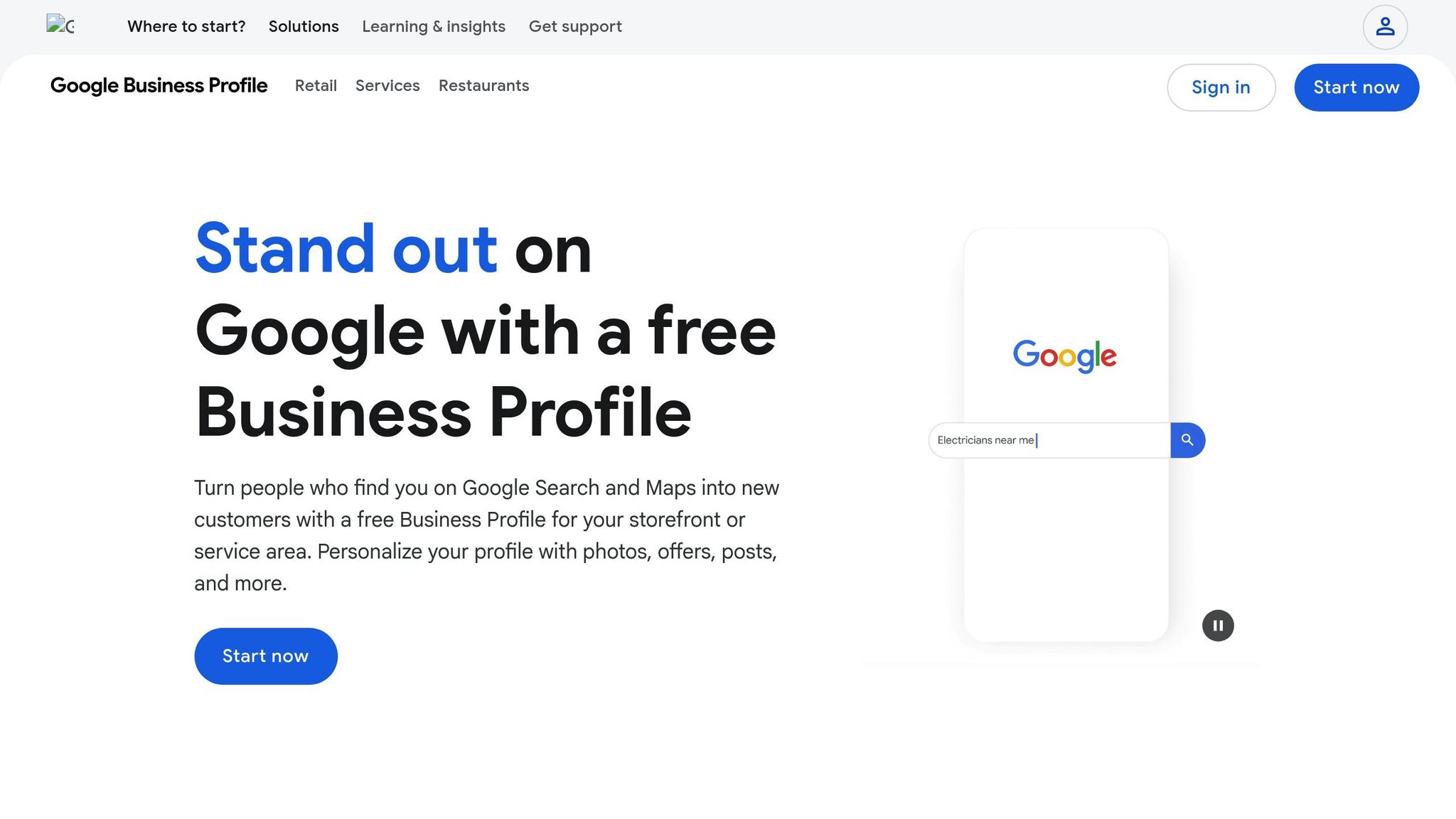
Your Google Business Profile (GBP) is like your digital storefront, especially when it comes to local search results. It determines how you appear on Google Maps and in the Local Pack – the three business listings that show up at the top of local search results. Without a properly set up and maintained GBP, your local visibility takes a hit. A well-tuned profile is a key part of the local SEO strategy laid out in this guide.
Setting Up and Verifying Your Profile
To get started, head to the Google Business Profile Manager and fill in your business details: name, address, phone number, website, and category. If you’re in real estate, your primary category will typically be "Real Estate Agent" or "Real Estate Agency."
Once you’ve entered your information, you’ll need to verify your profile through mail, phone, or email. This step is essential – Google uses it to confirm that your business is legitimate and active, which directly impacts how often you show up in local searches.
If your business doesn’t have a physical office, be sure to define your service areas. This tells Google where you operate and helps your profile appear in searches for those locations.
Start by getting your GBP up and running, then dive into optimizing every detail to attract more local leads.
Adding Photos and Descriptions
Adding high-quality, regularly updated photos can make a big difference in how your profile performs. Google rewards businesses that keep their profiles fresh, and frequent updates show that your business is active and engaged.
Begin with a professional headshot or logo for your profile photo. Then, upload 10-15 high-quality images showcasing your office, team, recent property listings, and even local landmarks in your service areas. Avoid stock images – people want to see the real faces they’ll be working with.
When adding captions to photos, include local keywords and neighborhood names. For instance, instead of a generic caption like "Beautiful home", try "Luxury homes in Cherry Creek" or "Downtown Denver real estate office." These small details help Google understand your local relevance.
Videos are another great addition. Virtual tours or market updates can boost engagement and keep people on your profile longer. The more time users spend interacting with your content, the more Google sees your profile as valuable. If possible, aim for weekly updates to keep things fresh.
Your business description is another important piece. It should clearly outline your services while naturally incorporating local keywords. For instance, instead of saying, "Experienced real estate agent serving the Denver area", try something more specific like, "Luxury real estate agent specializing in Cherry Creek, LoDo Denver, and Highland neighborhoods." Highlight what you offer, whether it’s residential sales, luxury listings, property management, or commercial real estate.
Keep your descriptions concise and informative. This text not only influences how Google interprets your profile but also sets the tone for potential clients. Avoid cramming in too many keywords – it looks unprofessional and could trigger Google’s spam filters. The goal is to make your profile both relevant and trustworthy.
Don’t forget about the Q&A section. Add questions that people commonly ask about your market, like "What’s the best school district in [your city]?" or "How’s the downtown market right now?" This can help capture voice search traffic and position you as a knowledgeable local expert.
Enable messaging and set up automated responses for frequently asked questions, but keep them personal. Fast response times not only improve client satisfaction but can also boost your local rankings.
Once your profile is verified, focus on enhancing it visually and textually to better engage your audience.
Maintaining NAP Consistency
NAP consistency – ensuring your Name, Address, and Phone number are the same across all platforms – is a cornerstone of local SEO. Google uses this information to confirm your business’s legitimacy.
When your NAP details match across your GBP, website, and directories like Zillow, Realtor.com, and Yelp, it signals to Google that your business is reliable. On the flip side, inconsistencies – like different phone numbers, varying abbreviations (e.g., "St." versus "Street"), or slight name changes (e.g., "John Smith Real Estate" vs. "John Smith Realty") – can confuse Google’s algorithms and hurt your rankings.
Here’s how to stay consistent:
- Audit your online listings, including your website, social media profiles, GBP, and major directories like Zillow and Realtor.com.
- Ensure every platform displays the same information, formatted identically.
Start with high-impact platforms like your website and GBP, as these carry the most weight. From there, check and update your details on other directories. This unified approach strengthens your local authority and increases your chances of appearing in the Local Pack, making it easier for local buyers and sellers to find you.
Don’t overlook your business hours – they should always be up to date. If your hours change for holidays or special events, update them immediately across all platforms. Inaccurate hours can frustrate potential clients and hurt your credibility with Google.
To measure your progress, regularly review your GBP Insights. Look at search queries (what people searched to find you), calls and direction requests (offline actions), and photo views (how you stack up against competitors). These metrics can help you identify what’s working and where you need to adjust.
The GBP dashboard is a goldmine of performance data that many agents miss. Use it to guide your decisions and fine-tune your strategy over time.
Building Trust Through Reviews and Citations
Creating a solid online reputation hinges on two key elements: client reviews and accurate citations. Reviews provide social proof of your expertise, while citations verify your local presence. Together, they complement your optimized profile and keyword strategy, strengthening your credibility.
Getting Client Reviews
Client reviews can significantly boost your online visibility. To make the process easier, include a direct link to your Google Business Profile review page in your communications. This small step minimizes effort for your clients and encourages more authentic feedback. Keep your review requests personal and respectful, steering clear of offering incentives, as these often violate platform rules.
Responding to Reviews
When you receive positive reviews, take the time to craft a personalized response that highlights specific comments. This shows clients you value their feedback and reinforces your professionalism. For less favorable reviews, address concerns calmly and professionally. Inviting clients to discuss issues offline demonstrates your commitment to resolving problems and maintaining satisfaction. These thoughtful responses, combined with accurate citations, can significantly strengthen your local SEO efforts.
Managing Business Citations
Citations are online references to your business’s NAP (Name, Address, and Phone Number) details, acting as digital proof of your presence in a specific area. To maximize their impact:
- List your business on real estate-specific directories, such as Zillow, Realtor.com, Trulia, Homes.com, and Redfin, as these platforms are highly relevant to your industry.
- Include your business on general directories, like Yellow Pages, Yelp, Bing Places, Apple Maps, and local Chamber of Commerce websites, which enhance your overall online authority.
- Ensure consistency across all platforms. Even minor variations in your NAP details can confuse search engines and reduce your visibility.
- Regularly audit and update your citations to reflect changes like a new address, phone number, or rebranding. Keeping this information accurate is essential for maintaining your local SEO strength.
As Martín Sedarri of SearchX shared:
"Our team fixed our listings and helped the business show up for local keywords, ultimately driving real client engagement" (Source: SearchXPro.com, Client Testimonial by Martín Sedarri).
Quality matters more than quantity when it comes to citations. A single listing on a trusted directory can carry more weight than multiple entries on less reliable platforms. By maintaining accurate and consistent citations, you lay a solid foundation for boosting your local search visibility.
Creating Local Real Estate Content
Creating content that directly connects with your local audience transforms your website into a go-to resource for the community. Buyers aren’t just hunting for square footage – they’re exploring neighborhoods, schools, and lifestyles. Your content should address these deeper needs while naturally weaving in local keywords to boost search visibility. By crafting content that reflects the unique traits of your market, you strengthen your local SEO and build trust with both potential clients and search engines.
Building Neighborhood Pages
Neighborhood pages are the backbone of a strong local real estate SEO strategy. They allow you to showcase your in-depth knowledge of each community and go beyond just listing properties.
Start by organizing your site with a clear hierarchy: create main pages for cities, break these into neighborhood pages, and then add pages for specific property types. This structure makes it easier for both visitors and search engines to navigate your expertise and service areas.
Each neighborhood page should offer something distinct. Highlight the types of homes available, the community’s vibe, and who might find it appealing. Dive into specifics – talk about schools, parks, local dining spots, shops, and employers that make the area attractive. Mention nearby landmarks and attractions that buyers might search for, and incorporate local terms naturally, like “Modern Condos in SoMa” or “Family Homes Near Central Park.”
Don’t forget the technical aspects that can elevate your SEO. Write unique meta titles and descriptions with local keywords, add schema markup for addresses to provide structured data, and use internal links to connect neighborhood pages to related listings and blog posts. Integrating your IDX (Internet Data Exchange) feed is another smart move – it keeps visitors engaged by showing current listings while reinforcing your authority in the area.
Writing Local Blog Posts
Regular blog posts packed with local insights can position you as the authority on the areas you serve. They also help educate potential buyers while boosting your visibility with location-specific keywords.
Write about topics that genuinely reflect your expertise. For example, a post like “Top Schools in [City]” could dive into academic programs, extracurriculars, and parent reviews. Guides like “Best Places to Live in [Region]” can showcase neighborhood charm, from popular coffee shops to family-friendly parks.
Stay current by covering local events, market trends, and developments that impact property values. If a new restaurant opens or a major improvement project is announced, a timely post can capture search traffic from buyers curious about the area.
Using long-tail keywords is essential. Instead of broad terms like “luxury real estate,” aim for specific phrases such as “Beachfront Homes in Malibu” or “Modern Townhouses in Austin.” Tools like Google Keyword Planner, Ahrefs, or Google Search Console can help you find these niche keywords.
Enhance your posts with real, high-quality photos from the neighborhoods you cover. Avoid relying solely on stock images – authentic visuals help establish a genuine connection. Incorporating local language and highlighting well-known landmarks also reinforces your expertise. Finally, share these posts on social media to reach a broader audience and drive traffic back to your site.
Optimizing Property Listings
Your property listings are another great opportunity to showcase your local expertise while improving SEO.
Use neighborhood-specific keywords to make your listings more relevant. For instance, instead of a generic title like “3-Bedroom Home for Sale,” try “3-Bedroom Craftsman Near Lincoln Park in Capitol Hill.” Including details about nearby amenities – like schools, parks, coffee shops, or bike paths – helps buyers imagine their future lifestyle and enhances the local appeal of your listings.
Consistency is key. Use the same neighborhood names and keywords across all platforms, from your website to your Google Business Profile and directory listings. This consistency helps search engines associate your business with specific areas.
Optimize technical details by including location-specific metadata, such as titles, meta descriptions, and image alt text. You can also target niche searches to attract buyers with specific needs, like “Homes with Mountain Views in Boulder” or “Waterfront Properties Near Naples.”
Tracking performance is essential. Tools like Google Search Console can reveal which neighborhood-specific keywords drive traffic to your listings. Use this data to refine your strategy and focus on areas where your content resonates most.
With 46% of all Google searches focused on local information, creating detailed neighborhood pages, writing engaging local blog posts, and optimizing property listings with area-specific details can significantly increase your visibility. This approach bridges the gap between buyers researching neighborhoods and the homes you represent, positioning you as the go-to local expert.
Technical SEO and Mobile Optimization
The technical setup of your website plays a big role in how easily people can find and interact with it. For real estate, where most local searches happen on smartphones, this is especially important. Picture this: someone scrolling through listings during lunch, checking out neighborhoods while driving around, or researching agents from the comfort of their couch. If your website is slow to load or clunky on mobile devices, you’re likely losing potential clients to competitors who’ve prioritized their technical SEO.
Content and citations may attract local traffic, but technical SEO ensures that traffic turns into results. A well-optimized site not only creates a smooth user experience but also sends clear signals to Google about your location and services. When your site is fast, mobile-friendly, and communicates effectively with search engines through structured data, you’ll rank higher in local searches and convert more visitors into leads. This technical groundwork amplifies your local SEO strategies, ensuring your efforts translate into real-world success.
Making Your Site Mobile-Friendly
Mobile optimization is no longer optional. Google uses mobile-first indexing, meaning it evaluates the mobile version of your site to determine rankings. If your mobile experience is poor, your rankings will take a hit.
The cornerstone of mobile optimization is responsive design. Your website should automatically adjust to fit any screen size. This means property images resize correctly, text remains legible without zooming, and menus adapt for easy touchscreen navigation.
Real estate websites, in particular, require extra attention to mobile usability. Property search tools should be thumb-friendly, avoiding tiny buttons or complicated interfaces. Contact forms need large, easy-to-fill fields, and call-to-action buttons like “Schedule a Showing” or “Get Pre-Approved” should be prominent and easy to tap. If potential buyers struggle to navigate your site or contact you on their phone, they’ll quickly move on.
To ensure your site is mobile-friendly, use Google’s Mobile-Friendly Test tool. It’s a free resource that highlights specific issues, such as text that’s too small, clickable elements that are too close together, or content that doesn’t fit the screen properly.
Keep in mind that mobile users often browse while on the go, looking for quick details like your phone number, office hours, or directions. Make these key details easy to find and functional – your phone number should be clickable to call, and your address should link to a map for instant navigation.
Improving Site Speed
Fast load times are crucial for keeping local leads engaged. Page speed directly affects your search rankings and your ability to convert visitors. Think about it: if someone searches for “homes for sale near me” and clicks your site, they expect it to load in just a few seconds. If it takes longer than three seconds, most users will hit the back button and choose a competitor.
Real estate websites often face challenges with speed because they rely heavily on high-quality images. While these images are essential for showcasing properties, they can significantly slow down your site. Start by compressing images with tools like TinyPNG or ImageOptim. You can also use responsive images (with the srcset attribute) to ensure faster load times on mobile devices.
Other steps to speed up your site include reducing unnecessary CSS and JavaScript, enabling browser caching so returning visitors don’t have to reload everything, and using a content delivery network (CDN) to decrease latency.
To identify speed issues, run your site through Google PageSpeed Insights. This tool offers a performance score and actionable tips for improvement. Pay close attention to the mobile score, as it’s the most relevant for local SEO. Common problems include unoptimized images, third-party scripts (like IDX feeds or virtual tours), and render-blocking resources.
Make it a habit to test your site’s speed every few months, especially as you add new listings or content. Regular monitoring ensures your site stays fast and responsive, even as it grows.
Adding Local Business Schema Markup
Schema markup is a type of structured data that helps Google understand your business and display key details in search results. For real estate agents, local business schema is especially important. It allows you to highlight your name, address, phone number (NAP), business hours, and service areas, making it easier for Google to match you with local searches like “real estate agent in Capitol Hill” or “homes for sale in 78704.” Schema markup can also enhance your search listing with rich snippets, showing reviews, ratings, and contact info directly in the results.
To implement schema markup, you’ll need to add JSON-LD code to your site. Google’s Structured Data Markup Helper can generate this code for you, even if you’re not a tech expert. For real estate agents, the RealEstateAgent or LocalBusiness schema types are ideal. Be sure to include:
- Verified NAP details that match your Google Business Profile and directory listings
- Service areas (specific neighborhoods, cities, or ZIP codes)
- Business hours and contact methods
- Links to your social profiles and Google Business Profile
If you don’t have a physical office, defining your service area becomes even more critical. Schema markup allows you to specify the neighborhoods or ZIP codes you serve, ensuring you appear in location-specific searches.
After adding schema markup, validate it using Google’s Rich Results Test. This tool checks for errors in your code, such as mismatched NAP info, missing fields, or syntax issues. For real estate websites, you can also apply the RealEstateListing schema to structure property details like address, price, dimensions, and bedroom/bathroom count. This makes your listings more likely to appear in property-specific searches.
For agents managing multiple neighborhood pages, add schema markup to each page to emphasize your relevance to those areas. Consistency is key – your schema details must align with the information on your website, Google Business Profile, and all online directories.
If you’re working with a web developer, make sure they understand the importance of local business schema. Many developers overlook this element, but it’s a key part of local SEO success. A technically sound, mobile-friendly site with proper schema markup ensures that when potential buyers search for homes in your area, your website ranks well, loads quickly, and provides a user-friendly experience that turns visitors into clients.
Building Local Backlinks and Partnerships
Once your on-site SEO is in good shape, it’s time to focus on building your off-site credibility. One of the best ways to do this is by creating quality backlinks. Backlinks – links from other websites that point to yours – are a major factor in SEO rankings. For real estate agents, links from neighborhood-specific sources are far more impactful than generic ones. These not only improve your domain authority but also boost your local search rankings and increase your chances of showing up in Google’s Local Pack. Think of backlink building as a two-way street: it’s not just about what you gain but also about what you can offer in return. This approach complements your technical SEO efforts and reinforces your local presence.
Partnering with Local Organizations
Teaming up with local businesses, schools, charities, and community groups can do wonders for your SEO while also positioning you as someone deeply connected to the community. Start by identifying potential partners that cater to the same audience you’re targeting. For example, mortgage lenders, home inspectors, and contractors are natural collaborators since their client base overlaps with yours. Reach out with specific ideas, like writing a guest article on home inspections or co-creating a neighborhood guide, to ensure the partnership benefits both sides.
Neighborhood associations and community organizations are especially valuable sources for local backlinks. These groups often maintain websites with resources like event calendars and business directories. By sponsoring events, contributing to newsletters, or offering real estate market insights, you can secure backlinks that send strong local signals to search engines. Similarly, working with charities, nonprofits, or schools not only earns you backlinks but also shows your dedication to the community. When reaching out, make your communication personal and focus on how the partnership can create value for everyone involved.
Building these relationships takes effort, so nurture them over time. Stay connected through newsletters, social media engagement, and occasional follow-ups. These partnerships not only enhance your backlink profile but also solidify your reputation as a community-focused professional.
Listing in Local Directories
Beyond partnerships, local directories and citations play a key role in establishing your online presence. Citations – mentions of your business name, address, and phone number – help Google confirm your business details and reinforce your local relevance. Focus on high-impact platforms like Google Business Profile, Zillow, and Realtor.com. Don’t overlook smaller, locally focused directories, such as chamber of commerce listings or neighborhood business directories, which can further strengthen your connection to the area.
Consistency is key. Make sure your business information is identical across all platforms. Conduct monthly audits to ensure your details – like address and phone number – are accurate everywhere. Local media outlets are another goldmine for backlinks. Being featured in local newspapers, blogs, or radio shows not only boosts your credibility but also signals your expertise to search engines.
To keep track of your progress, use tools like Google Search Console or Google Analytics. Monitor metrics such as the number and quality of backlinks and referral traffic to fine-tune your strategy over time.
Building a strong local backlink profile takes consistent effort, but the payoff is well worth it. When paired with accurate citations across reputable directories, these actions can significantly improve your local search rankings and establish you as the go-to real estate agent in your community. For extra support, check out SearchX’s link building services to identify high-value partnerships and boost your online visibility.
Creating an Action Plan and Measuring Results
To make your local SEO strategies count, you need a clear plan and a way to measure progress. Once you’ve optimized your profiles, content, and local links, this plan ensures your efforts lead to measurable outcomes. Without tracking your results, it’s impossible to know what’s working and what needs tweaking.
Implementing Local SEO Strategies
Focus on 10–15 neighborhoods, striking a balance between well-established areas and up-and-coming ones. This approach offers a mix of immediate opportunities and long-term growth potential.
Start by auditing and optimizing your Google Business Profile. Make sure your NAP (name, address, phone number) details are consistent across all platforms. This consistency not only builds trust with Google but also ensures potential clients can reach you without confusion.
Next, research local keywords using tools like Google Keyword Planner, Ahrefs, or Google Search Console. Look for location-specific, long-tail keywords that reflect real searches. For instance, instead of targeting "luxury real estate", aim for terms like "3-bedroom homes in downtown Phoenix" or "family-friendly neighborhoods near Scottsdale schools".
Then, create neighborhood-specific pages with unique, valuable content for each area you serve. Avoid generic information from sources like Wikipedia. Instead, include authentic details about local schools, parks, amenities, and the community vibe to answer buyers’ questions.
Incorporate neighborhood keywords into property listings, mentioning nearby attractions, schools, and local hotspots.
Expand your reach by building your local citation presence on platforms like Google Business Profile, Zillow, and Realtor.com. Don’t overlook smaller directories like local chambers of commerce or neighborhood business associations.
Lastly, develop a review strategy. Encourage happy clients to mention specific neighborhoods in their reviews. These location-based testimonials send strong signals to Google about your expertise.
To stay on track, use this checklist:
- Optimize your Google Business Profile.
- Research hyper-local keywords.
- Build neighborhood-specific pages.
- Publish weekly blog posts.
- Track rankings using SEO tools.
- Request 1–2 new reviews monthly.
- Repurpose local blog content for social media.
Once these steps are in motion, the next step is to measure your progress and refine your approach.
Tracking Your Local SEO Performance
Tracking key metrics is essential to understand how your strategies are performing. Focus on metrics that impact your business directly, rather than just vanity numbers. As SearchX explains:
"When it comes to SEO, numbers don’t lie. We focus on tangible, revenue-boosting outcomes rather than vanity metrics. No fluff – just proven strategies that move the needle on your bottom line."
Here are three key areas to monitor:
- Local search visibility: Keep an eye on your rankings for target keywords in Google Maps, the local pack (the three-business carousel in search results), and organic search results. Tools like BrightLocal or manual incognito searches in Google Maps can show how you’re performing for hyperlocal keywords.
- Website traffic and engagement: Use Google Analytics to track how many visitors come from local search, which pages they visit, and how long they stay. Your Google Business Profile dashboard also offers valuable data, like search queries, calls, direction requests, and photo views. These insights can guide ongoing content optimization.
- Lead generation and conversion: Track phone calls, form submissions, and appointment requests from local search traffic. Evaluate lead quality by considering client retention and overall conversion rates.
Don’t forget to monitor your review volume and ratings. A steady flow of new, genuine reviews signals to Google that your business is active and trustworthy. Also, ensure NAP consistency across directories to avoid confusion that could harm your rankings.
With nearly half of all Google searches seeking local information, these metrics directly reflect how visible you are to potential clients in your target areas. Agents with fully optimized Google Business Profiles often see more calls, direction requests, and website visits compared to those with incomplete profiles.
Using Tools for Ongoing Improvement
The right tools can simplify monitoring and help you refine your strategies. For keyword research and tracking, tools like Google Keyword Planner, Ahrefs, and Google Search Console provide insights into search volume, location-based opportunities, and buyer intent.
For local search tracking, BrightLocal offers grid-based monitoring of your rankings across multiple neighborhoods and keywords. This helps you see exactly where you stand in each targeted area.
Managing reviews and citations is easier with platforms like Yelp, Realtor.com, and your Google Business Profile dashboard. Responding promptly to reviews – whether positive or negative – not only builds engagement but can also improve your search rankings.
Google Analytics is invaluable for understanding local search-driven website traffic, user behavior, and which neighborhood pages generate the most qualified leads. For technical SEO, use these tools to check mobile responsiveness, site speed, and image optimization, ensuring a strong performance in mobile-first searches. Keeping your local imagery updated is also crucial, as Google compares your photos to competitors’.
Set up a monthly review schedule to assess your progress. During these reviews, check rankings, evaluate new reviews, verify NAP consistency, and analyze local search traffic. Every quarter, dive deeper – review the effectiveness of neighborhood pages, analyze competitor strategies, and monitor trends in reviews and ratings.
If you need professional help, SearchX’s DIY local SEO resources offer cost-effective solutions. For a more comprehensive approach, consider SearchX’s technical SEO services, which identify issues that might be holding back your rankings.
Remember, local SEO is a long-term investment. Many agents see results within 3–6 months of consistent effort, though timelines can vary based on market competition, your current online presence, and how aggressively you implement your strategies. In competitive markets, results might take 6–12 months, while less competitive areas or niche markets could yield quicker wins.
Consistency is key. Adjust your strategy based on the data. If rankings drop, NAP details become inconsistent, a competitor launches a strong campaign, or you expand into new neighborhoods, make immediate changes. If lead generation remains low after three to six months, it might indicate issues with your keyword targeting, content relevance, or technical SEO.
Conclusion: Key Takeaways for Real Estate Agents
Local SEO isn’t just a marketing option – it’s the game-changer that can establish you as the go-to real estate expert in your target neighborhoods. While massive platforms like Zillow dominate nationally, you have the opportunity to shine in hyperlocal searches by showcasing your deep knowledge of the area and applying the strategies outlined here.
Start by getting the basics right. Your NAP (Name, Address, Phone number) details must be 100% consistent across every platform – your website, Google Business Profile, Zillow, Realtor.com, social media, and business directories. Even tiny inconsistencies, like using "Suite 100" on one site and "Ste. 100" on another, can confuse Google’s algorithms and hurt your search rankings.
Your Google Business Profile is essentially your storefront for local online searches. Optimize it with clear, accurate information, high-quality photos, and a well-written description packed with local keywords. Regular updates – such as new listings, market trends, or buyer tips – posted 2–3 times a week will keep you visible and relevant in 2025 [10,16]. Don’t forget to set up automated, yet friendly, messaging responses to enhance client satisfaction and boost your rankings.
Creating hyperlocal content is a smart way to stand out. Focus on 10–15 key neighborhoods and build dedicated pages for the most important ones. These pages should provide valuable insights into schools, parks, amenities, and other local highlights – not generic details anyone can find elsewhere. With about 70% of Google searches being long-tail queries, this neighborhood-specific approach can generate high returns for independent agents.
Don’t underestimate the power of reviews. Aim to collect 1–2 new reviews each month and respond thoughtfully to every one of them. Mention specific neighborhoods and sprinkle in relevant keywords to enhance your local credibility [6,16]. These reviews not only improve your Google rankings but also reassure potential clients that you’re actively engaged in the community.
Mobile optimization is a must. With most local searches happening on smartphones, your website needs to load quickly and look great on any device. If a potential buyer searching for "homes for sale near me" lands on a slow or clunky site, they’ll quickly move on to another agent.
Building local authority also means getting involved in your community. Seek backlinks from trusted sources like your local Chamber of Commerce, city websites, and event pages. Whether you’re sponsoring local events or creating engaging content like “Top 10 Family-Friendly Restaurants in [Your City],” these efforts bolster your reputation as a neighborhood expert.
Track your progress by focusing on metrics that matter. Keep an eye on your Google Business Profile rankings, clicks from Maps, review counts, and – most importantly – the number of qualified leads and closed deals coming from local searches. Tools like BrightLocal or Ahrefs can help you monitor your rankings, traffic, and NAP consistency on a monthly basis.
It’s important to remember that local SEO is a long-term strategy. Agents who consistently update their profiles, generate reviews, create fresh content, and build local connections will steadily outperform those who don’t. While some results may appear within 3–6 months, more competitive markets might take 6–12 months of effort.
So, where should you start? Begin by auditing your NAP details, optimizing your Google Business Profile, researching local keywords, building 3–5 neighborhood pages, and setting up a system for requesting and responding to reviews. These steps, achievable in 30–60 days, will set the stage for ongoing success.
Agents who take action now and stick with these strategies will position themselves far ahead of competitors who delay. Your local expertise is your strongest asset – use it to ensure buyers and sellers in your target neighborhoods can easily find you when they’re ready to make a move.
FAQs
How can I use local keywords to boost my real estate SEO strategy?
To get the most out of local keywords for your real estate SEO, start by figuring out what terms people in your area are searching for. Focus on location-specific phrases like "homes for sale in [city]" or "real estate agents near [neighborhood]." Tools such as Google Keyword Planner can help you discover popular search terms that drive traffic.
Once you have your keywords, weave them naturally into your website content. This includes property listings, blog posts, meta descriptions, and headings. Also, make sure your Google Business Profile is fully optimized with accurate location details and relevant keywords. This step is crucial for improving your visibility in local searches. Remember, consistency across all platforms not only helps search engines but also builds trust with potential clients.
How can I optimize my Google Business Profile to improve local search rankings?
To boost your visibility in local search results, start by making sure your Google Business Profile is fully filled out and accurate. Double-check that your contact information, business hours, and service descriptions are current. Sprinkle in relevant keywords naturally in your profile to match local search terms.
Upload high-quality photos showcasing your properties, office, or team to give your profile a personal and professional touch. Positive reviews from happy clients can make a big difference, so encourage them to share their experiences. Stay active by updating posts, responding to reviews (both good and bad), and answering customer questions. This not only improves your rankings but also shows potential clients that you’re attentive and trustworthy.
How can reviews and citations help boost trust and improve local SEO for real estate agents?
Reviews and citations are key to earning trust from potential clients and boosting your local SEO performance. Positive reviews on platforms such as Google, Yelp, and Zillow do more than just enhance your reputation – they also send a strong message to search engines that your business is reliable and relevant for local searches.
Citations, which refer to mentions of your business’s name, address, and phone number (NAP) on directories and websites, play a vital role in reinforcing your business’s authority. To make the most of them, ensure your NAP details are accurate and consistent across all platforms. Even small inconsistencies can negatively impact your SEO. It’s a good idea to routinely check and update this information to keep your business trustworthy and visible.