
In 2026, local dental SEO is no longer just about ranking for "dentist near me." Success depends on building a credible digital presence that extends beyond your website to include Google Business Profiles, patient reviews, and AI-driven search tools. Here’s what matters most:
- Target Specific Keywords: Use long-tail, service-specific phrases like "Invisalign cost in [City]" or "emergency dentist in [Neighborhood]."
- Optimize for AI and Voice Search: Structure content to answer conversational, question-based queries like "What’s the best treatment for sensitive teeth?"
- Use Schema Markup: Implement structured data (e.g.,
Dentist,Service,FAQ) to improve visibility in search results and AI recommendations. - Focus on Technical SEO: Ensure fast-loading, mobile-friendly websites that meet Google’s Core Web Vitals standards.
- Leverage Reviews and Backlinks: Encourage detailed patient reviews and build local partnerships for authoritative backlinks.
With AI tools influencing 60% of U.S. adults and 76% of local searches leading to visits within 24 hours, staying ahead means prioritizing precision, trust, and functionality. Local SEO in 2026 isn’t just about visibility – it’s about becoming the go-to dental provider in your area.
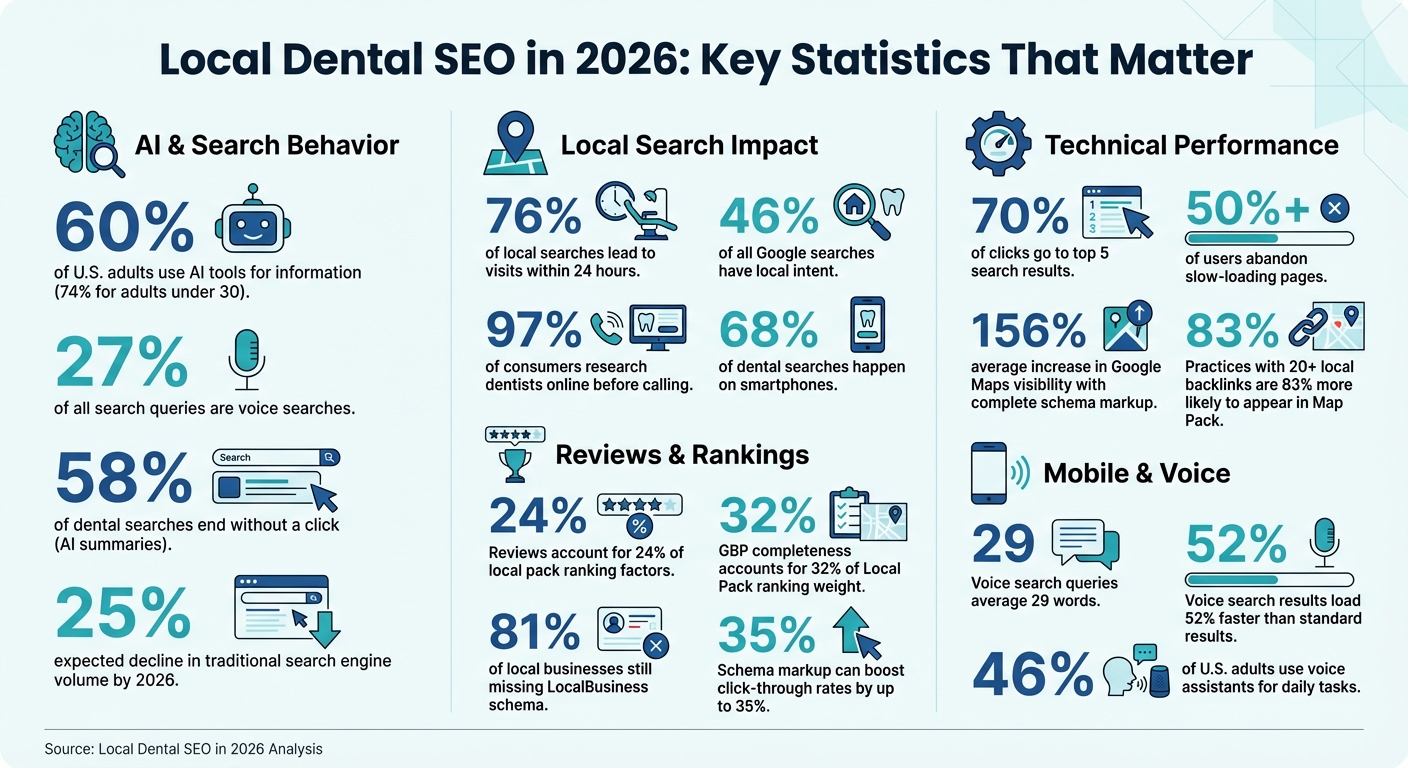
Local Dental SEO Statistics and Key Metrics for 2026
Local SEO for Dentists: The Strategy Everyone Gets Wrong
Keyword Strategies for Dental Practices
If you’re still relying solely on broad terms like "Dentist Near Me", it’s time to rethink your approach. The future of dental SEO lies in hyper-targeted, service-specific keyword strategies that highlight what makes your practice stand out. Instead of competing for generic phrases like "dentist in [City]", focus on intent-driven keywords such as "Invisalign cost in [City]" or "emergency tooth extraction [Neighborhood]". These long-tail keywords attract patients who already know what they need and are ready to take action [1, 13].
Hyper-local targeting is another must-have strategy. Patients often search for dentists close to their neighborhoods, schools, or even landmarks. For example, phrases like "pediatric dentist near [Specific School]" or "dentist near Midtown with parking" align with how people naturally search [1, 3]. Considering that 46% of all Google searches have local intent and 97% of consumers research dentists online before making a call, being precise with your keywords can make all the difference.
Addressing patient pain points and symptoms directly is another way to connect with potential clients. Keywords like "how to fix a chipped front tooth" or "teeth whitening for sensitive teeth" target those in the research phase who are likely to book later [1, 10]. Adding transactional modifiers such as "open now", "accepting new patients", or "dentist accepting [Insurance Name] in [City]" can further attract patients ready to schedule an appointment [1, 5].
Long-Tail Keywords and Service-Specific Searches
To make the most of long-tail keywords, create dedicated landing pages for each high-value service. A page titled "Same-Day Dental Crowns in [Neighborhood]" will outperform a generic "Restorative Dentistry" page because it matches specific search queries. Services like dental implants, root canals, and clear aligners each deserve their own page with localized content.
Organize your keywords into five intent clusters to cover every stage of the patient journey:
- Core Services: Keywords like "Invisalign [City]" focus on your primary offerings.
- Urgency: Phrases like "emergency dentist open now" target immediate needs.
- Cost: Keywords such as "veneers price" address financial concerns.
- Insurance: Searches like "dentist that accepts [Insurance]" appeal to insured patients.
- Symptoms: Queries like "broken tooth fix" attract those seeking solutions.
With nearly 70% of all clicks going to the top five search results, targeting the right intent is critical.
| Keyword Category | Example Long-Tail Phrases | Intent Level |
|---|---|---|
| Emergency | "emergency dentist open now [Neighborhood]", "tooth extraction cost without insurance" | High (Urgent) |
| Cosmetic | "Invisalign vs braces cost [City]", "teeth whitening for sensitive teeth reviews" | Medium (Research) |
| Pediatric | "pediatric dentist accepting [Insurance] near me", "first dental visit for toddlers [City]" | High (Transactional) |
| Restorative | "same day dental implants [City]", "how long does a root canal take" | Medium (Informational) |
Voice Search and Mobile Query Optimization
With voice search making up 27% of all mobile queries and a 200% rise in mobile searches for "dentist near me" since 2020, optimizing for conversational queries is more important than ever. People using voice assistants often ask full questions like, "Hey Google, where’s the nearest pediatric dentist open now?" rather than typing fragmented phrases.
To capture these searches, structure your content around question-based headers that reflect natural speech patterns. Examples include:
- "How much do dental implants cost in [City]?"
- "What’s the best treatment for sensitive teeth?"
Follow each question with concise, 40–60 word answers to increase your chances of being featured in voice search results or AI-generated snippets [13, 15].
Implement FAQ schema markup on your service pages so voice assistants can easily pull structured answers from your site [10, 11]. With 58% of internet searches now happening on mobile devices and traditional search engine volume expected to decline by 25% by 2026 due to AI and voice assistants, staying ahead of these trends is crucial. Also, ensure your mobile site is fast (loading in under three seconds) and user-friendly, with buttons large enough to tap easily [5, 13].
"The dentists who win in 2026 won’t just rank – they’ll be recommended by AI, cited as experts, and chosen automatically by local search assistants."
- Tana, Founder, Dental Marketing BFF
Local Business Schema Markup for Dental Practices
Schema markup acts as a structured framework that helps search engines and AI systems understand your business – who you are, what you offer, and where patients can find you. By 2026, search engines treat businesses as "entities", and schema plays a key role in linking your website, Google Business Profile, and social media accounts into a unified digital identity. This structured data directly impacts your online visibility.
Adding schema markup can significantly improve local search performance. Dental practices using complete schema setups have reported an average 156% increase in Google Maps visibility within 90 days. For example, one clinic climbed 4 positions in Google Maps rankings within 8 weeks after implementing a comprehensive LocalBusiness schema. Beyond rankings, schema can also generate rich search snippets – like star ratings, appointment links, and FAQs – which can boost click-through rates by up to 35%.
"Local business schema markup is no longer optional in 2026. It is a structural trust layer that helps Google, Maps, and AI systems understand exactly who you are."
AI-driven tools like ChatGPT and Gemini rely heavily on structured data to recommend local providers with confidence. With 81% of local businesses still missing LocalBusiness schema on their websites, adopting it gives dental practices a clear edge.
Dental-Specific Structured Data
Using precise schema classifications strengthens your authority as a trusted dental care provider. Instead of the generic "LocalBusiness" type, opt for @type: "Dentist" or "MedicalClinic" to signal your medical specialty to search engines. Key properties to include are your Name, Address, Phone (NAP), geo (latitude and longitude), openingHoursSpecification, url, and image.
To highlight specific treatments, embed Service schema within your LocalBusiness block. This allows you to showcase offerings like "Invisalign", "Dental Implants", or "Emergency Care". Add precise geo-coordinates and use areaServed to define your service boundaries, especially in cities with multiple competing practices. If you provide mobile or emergency services, use serviceArea or areaServed to outline your geographic reach.
| Schema Type | Purpose for Dental Practices | Essential Properties |
|---|---|---|
| Dentist | Defines primary business identity | name, address, telephone, geo, openingHours |
| Service | Highlights specific treatments | name, description, offers (e.g., pricing) |
| AggregateRating | Displays star ratings in search results | ratingValue, reviewCount, bestRating |
| FAQPage | Enables expandable Q&A in search results | mainEntity (Question and Answer pairs) |
Always implement schema using JSON-LD format, as it’s Google’s preferred method for structured data. After setting it up, validate your schema with tools like Google’s Rich Results Test and Schema Markup Validator to catch errors or missing fields.
Schema for Reviews and Multiple Locations
In addition to service schemas, incorporating review and location-specific markup can further enhance your local SEO. Use AggregateRating and Review schema to display star ratings in search results, but only if the reviews are genuine and hosted on your website. Avoid pulling reviews from third-party platforms like Yelp or Google, as this violates search engine policies and can lead to penalties. Including reviews in your schema can boost click-through rates by up to 35%.
Reviews play a major role in local rankings, accounting for about 24% of local pack ranking factors. Google also uses AI to summarize reviews on Business Profile listings. Use the sameAs property to link your schema to authoritative external profiles, like Facebook, LinkedIn, or directories like Healthgrades, to reinforce your online presence.
For practices with multiple locations, each office should have its own unique landing page featuring LocalBusiness schema specific to that location. Include the NAP, geo-coordinates, and a hasMap link to its Google Business Profile. You can connect these branches to your main entity using the parentOrganization property. Typically, the homepage will use Organization schema, while individual location pages use Dentist schema for that specific branch.
To establish your practice as a distinct entity in Google’s Knowledge Graph, use the @id property – a permanent URL like your homepage URL followed by #organization. For temporary changes, such as holiday hours, use OpeningHoursSpecification with validFrom and validThrough dates to keep search engines updated.
"Schema markup isn’t a direct ranking factor, but it enhances all the local ranking signals that matter: Relevance, Proximity, and Prominence."
- Tana, Founder, Dental Marketing BFF
Content Strategies for Local Dental SEO
To bring in more patients, focus on creating content that aligns with their specific dental needs at different stages. Instead of just listing services, aim to address the intent behind their searches. For example, when someone types "why do my gums bleed at night", they’re likely in the early stages of seeking information. Later, searches like "Invisalign vs braces cost" show they’re comparing options. Finally, high-intent searches such as "emergency dentist in [Neighborhood]" indicate they’re ready to take action and book an appointment.
The digital landscape is changing, too. Google’s search market share dropped below 90% in Q4 2024, while 60% of U.S. adults – and an even higher 74% of those under 30 – now rely on AI tools for information. This means your content needs to be structured in a way that AI systems can easily interpret and reference your practice as a reliable source.
Building Pillar Pages for Key Services
Creating pillar pages for your core treatments is a smart way to organize your content. Instead of lumping all your services onto one generic page, develop dedicated pillar pages for high-demand services like dental implants, Invisalign, or emergency dentistry. Each of these pages (roughly 350–600 words) should act as a central hub, linking to 8–12 detailed sub-pages. For instance, a "Dental Implants in [City]" page might link to topics like healing timelines, cost breakdowns, sedation options, and bone grafting requirements.
Start these pages with straightforward answers to common questions. If someone searches, "how long do dental implants take to heal", your opening line should provide a direct answer before diving into the details. This approach appeals to both human readers and AI systems that prioritize clear and concise information. Avoid using overly technical terms – stick to language your patients are likely to use, such as "teeth cleaning" instead of "periodontal evaluation".
Here’s an example of success: Between August and November 2025, a California pediatric dental practice revamped its website with focused, single-topic pages for core services. This strategy boosted the practice’s visibility in AI-generated summaries for high-intent searches like "emergency pediatric sedation" and "sedation options", thanks to the clarity and precision of their content.
For practices in competitive areas, consider creating neighborhood-specific pages. These can include details like local transit options and parking availability, which often perform better than generic city-wide pages.
AI-Driven Content for Patient Intent
AI tools are transforming how practices can align their content with patient intent. These tools now analyze the deeper meaning behind searches, helping you create content that addresses what patients are truly looking for. For instance, in 2026, AI systems can differentiate whether a search for "tooth pain relief" signals an emergency or simply a need for at-home care.
"Generative Engine Optimization improves how AI systems interpret and reuse the SEO signals your practice already provides. It focuses on clarity, consistency, and credibility."
- Tyson Downs, Founder, Titan Web Agency
To make your content AI-friendly, structure your pages with clear headings and FAQ-style sections. This layout helps AI systems easily extract and summarize your information. Use schema markup like MedicalCondition and MedicalProcedure to ensure your treatments are accurately categorized. When describing procedures, break the content into manageable sections that cover triggers for the treatment, urgency, financing options, insurance details, and sedation availability.
Building topical authority is another key factor. AI systems favor websites that demonstrate expertise through interconnected content clusters. For example, a "Cosmetic Dentistry" pillar page linked to detailed sub-pages on veneers, teeth whitening, and before-and-after galleries signals a deep understanding of the topic.
Keep in mind that as AI systems evolve, your practice may be featured in summaries rather than generating direct clicks. This shift underscores the importance of presenting clear and credible information, which is now more critical than simply stuffing your content with keywords.
Technical SEO for Dental Websites
The technical backbone of your dental website plays a huge role in your online visibility. In 2026, Google places heavy emphasis on sites that load quickly, work seamlessly on mobile devices, and offer a clear, logical structure for both users and search engines. A slow or disorganized website not only frustrates visitors but also drags down your search rankings.
"A beautiful website without solid technical SEO is like a gorgeous dental office with a locked front door. Patients can’t get in."
- Megan Nielsen, SEO Strategist, My Social Practice
Take this example: A dental practice in Manchester revamped its technical SEO and keyword strategy in the months leading up to January 2026. By targeting high-value searches like "Invisalign Manchester" and improving site speed, they boosted monthly Invisalign consultations from 8 to 34. This change added $156,000 in annual revenue from Invisalign treatments alone. These results came from fixing technical issues that were invisible to the practice but glaringly obvious to search engines.
Core Web Vitals and Mobile Performance
Google uses Core Web Vitals metrics to gauge your site’s performance, and these metrics directly affect your rankings. Here’s what you need to know:
- Largest Contentful Paint (LCP): This measures how quickly your main content (like a hero image or key call-to-action) loads. Aim for under 2.5 seconds.
- First Input Delay (FID): This tracks how fast interactive elements, like booking forms, respond. Keep it under 100 milliseconds.
- Cumulative Layout Shift (CLS): This ensures visual stability by preventing unexpected page shifts. A score below 0.1 is the target .
With 68% of dental searches now happening on smartphones, mobile optimization is no longer optional – it’s essential. Google evaluates your mobile site, not your desktop version, for rankings. Start by compressing images into formats like WebP to reduce file sizes by 25–35% without losing quality. Use lazy loading for images below the fold and specify image dimensions in your HTML or CSS to avoid layout shifts.
Other ways to boost performance include connecting your site to a CDN, enabling server-side caching, and using GZIP compression to shrink load times. Eliminate render-blocking JavaScript to speed up your site further. Regularly audit your site with tools like Google PageSpeed Insights or Lighthouse, especially after major updates, to keep everything running smoothly.
| Core Web Vital | What It Measures | 2026 Target |
|---|---|---|
| LCP | Loading performance (hero image/main content) | Under 2.5 seconds |
| FID | Interactivity (booking form response) | Under 100 milliseconds |
| CLS | Visual stability (prevents layout shifts) | Under 0.1 |
Don’t forget to make buttons and tap targets at least 44 pixels wide. Also, ensure your entire site runs on HTTPS – Google prioritizes secure websites, especially in healthcare. With over 50% of users abandoning slow-loading pages and a one-second delay potentially cutting leads by up to 7%, technical performance isn’t just important – it’s critical. For practices seeking expert help, SearchX provides technical SEO services.
Once your site is technically sound, the next step is to structure it effectively for better crawlability and authority.
Internal Linking and Site Structure
A well-thought-out internal structure not only strengthens your site’s authority but also improves local SEO for dental practices. Group related services into clusters and link them together. For instance, your cosmetic dentistry page should connect to specific treatments like veneers, teeth whitening, and smile makeovers. Ensure that every key treatment page can be accessed within two clicks from your homepage.
Use descriptive URLs that include both the service and location, such as /invisalign-manchester instead of generic ones like /page-123. Neighborhood-specific landing pages should link back to core treatment pages and booking forms. If your site includes FAQs or educational resources, link them to the relevant service pages to boost topical relevance.
Be sure to address technical issues like duplicate location URLs or thin service pages, as these can confuse search engines and hurt your rankings. Maintain a clear header hierarchy by using one H1 tag per page for the main topic, followed by H2s and H3s for subtopics . This logical structure helps both search engines and AI systems interpret your content more effectively. By refining your internal linking strategy, you set the stage for further SEO gains.
Backlink Building for Local Dental Authority
Boost your local authority by building a solid backlink profile that reflects trust within your community. Earning local endorsements signals to Google that your practice is a credible entity, verified through local citations, social mentions, and backlinks. As of 2026, Google evaluates your dental practice as an "entity", cross-checking these elements to confirm legitimacy and geographic relevance. Practices with 20 or more high-quality local backlinks are 83% more likely to appear in the Google Map Pack compared to those without.
"One genuine local backlink from a respected organization is more powerful than 50 random ones."
- Dental Marketing BFF
Google’s E-E-A-T (Experience, Expertise, Authoritativeness, Trustworthiness) framework applies to backlinks as well. Links from respected local health blogs or community organizations hold more weight than generic directory listings. In fact, local backlinks are three times more effective for improving local SEO than links from unrelated or distant websites. For professional help, SearchX offers specialized link-building services.
Local Directories and Citations
Citations – mentions of your Name, Address, and Phone number (NAP) – play a crucial role in verifying your business’s location and legitimacy, which directly affects Local Pack rankings. Start with a tiered approach to directory listings:
- Tier 1: Claim essential directories like Google Business Profile, Yelp, Healthgrades, Apple Maps, and Facebook. These platforms drive local rankings and provide social proof.
- Tier 2: Secure listings on healthcare-specific platforms such as WebMD, Vitals, ZocDoc, and 1-800-Dentist to build authority in your field.
- Tier 3: Add your practice to local directories like your Chamber of Commerce, state dental associations, and the Better Business Bureau to reinforce geographic relevance.
Consistency is key. Use the same NAP format across all platforms (e.g., "123 Main Street, Suite 100") to strengthen credibility. Don’t overlook insurance provider directories like Aetna and Cigna, as many patients start their search there. Perform a citation audit every three months to remove duplicate listings or outdated information. Cleaning up inconsistencies can improve Local Pack rankings by 2–4 positions within 4–6 weeks.
| Directory Tier | Priority Platforms | Why It Matters |
|---|---|---|
| Tier 1: Essential | Google Business Profile, Yelp, Healthgrades, Apple Maps, Facebook | Drives Local Pack rankings and builds social proof |
| Tier 2: Healthcare | WebMD, Vitals, ZocDoc, 1-800-Dentist | Establishes trust and authority in the healthcare industry |
| Tier 3: Local | Chamber of Commerce, State Dental Associations, BBB | Strengthens community ties and geographic relevance |
| Insurance | Aetna, Cigna, and other in-network directories | Attracts high-intent patients from trusted sources |
Guest Posts and Local Partnerships
Once your citations are in order, expand your reach with guest posts and local collaborations. Editorial backlinks from guest posts carry more ranking power than standard directory listings. Use HARO (Help a Reporter Out) to provide expert commentary and secure high-authority links from reputable news or health sites. When pitching guest posts, focus on educational topics like "How gum disease affects heart health", as editors favor informative content over promotional material.
Forge partnerships with non-competing local health professionals, such as gyms, nutritionists, or pediatricians, to be featured as a recommended provider. These niche-relevant backlinks not only boost local trust but also drive referral traffic. Sponsoring local events, sports teams, or school health programs can also earn backlinks through "Sponsors" pages, further strengthening your local signals.
Additionally, create shareable resources like "Oral Care Checklists for Kids" or "Dental Implant Cost Comparison Charts." These assets are likely to be referenced by local parenting blogs or lifestyle sites.
Finally, keep an eye out for unlinked mentions of your practice online. Politely ask the author to link back to your site, improving both user experience and your backlink profile. These targeted strategies, combined with strong on-site optimizations, can help your practice stand out in local search results and attract more patients.
Voice Search and AI Personalization
Voice search has transformed how patients find dental care, now making up 27% of all search queries. Instead of typing short phrases like "dentist near me", people ask detailed, conversational questions such as, "Who has emergency dental appointments open today?" or "What dental clinics are open now near me?". These queries average 29 words, reflecting the shift toward more specific and natural language searches.
Voice assistants, like Siri or Alexa, often display just one featured snippet as the answer. This "winner-takes-all" approach means your content must provide precise, direct answers to capture attention. It’s a high-stakes game, especially since 76% of local voice searches lead to a business visit within 24 hours. Google’s AI also plays a significant role by treating your practice as an entity, cross-referencing details from your Google Business Profile, website, social media, and directory listings to verify your credibility and showcase your services.
"Rankings in 2026 will favor clinics that understand what patients are saying aloud, and what they are typing into AI – not just what they used to type."
- Case Dentistry
AI personalization is reshaping how patients are matched with providers. Recommendation systems now prioritize a few options based on trust, clarity, and intent. With 60% of U.S. adults using AI tools to search for information – and that number climbing to 74% among adults under 30 – adapting to these changes is crucial. To stay competitive, dental practices need to optimize not just for Google but also for platforms like ChatGPT, Siri, Alexa, and Gemini, all of which rely on unique data sources and signals.
Conversational Query Optimization
To capture voice search traffic, structure your content around natural-language questions. Identify the "Who, What, Where, When, Why, How, and Which" questions your patients are likely to ask. Tools like AnswerThePublic and AlsoAsked can help you visualize common question clusters and related queries. Once you’ve identified these, create FAQ sections or service pages that directly answer these questions in 40–60 words at the top of the page.
Here’s an example: Instead of a generic "Emergency Dental Services" page, include a section like this:
"If you have a knocked-out tooth, rinse it gently and, if possible, reposition it in the socket. Call our office immediately at (555) 123-4567 – we offer same-day emergency appointments seven days a week in downtown Portland."
This concise, actionable format provides the exact information voice assistants need to extract and read aloud.
To improve your chances of being featured in voice search results, implement FAQ schema markup using Schema.org. This structured data helps search engines understand your content better. Additionally, use SpeakableSpecification for audio readback and HowTo schema for step-by-step instructions, such as emergency dental care guides.
Don’t forget to update your Google Business Profile Q&A section with common patient questions like "Do you accept Delta Dental insurance?" or "Can I get a crown in one visit?" Verified answers here provide AI with reliable data and reduce the risk of misinformation. A great example of this strategy in action is Discovery Children’s Dentistry & Orthodontics in Carlsbad, CA. Between August and November 2025, they used Generative Engine Optimization (GEO) to add parent-focused FAQs in conversational language, which boosted their Local Pack visibility from 33.7% to 55.6% and increased their number one rankings from 8 to 24.
AI Tools for Localized Search Insights
AI tools are invaluable for refining your local SEO strategy. These platforms analyze behavioral signals – like direction requests, click-through rates, and time spent on your website – to determine which practices deserve to rank higher. Tools like BrightLocal can highlight ranking trends, track performance across different voice assistants, and identify which services (e.g., "Invisalign" or "emergency care") are driving visibility in AI-generated summaries.
AI also analyzes patient reviews, summarizing common themes and sentiments. For instance, if reviews frequently mention "great with kids" or "fast emergency service", these phrases can boost your relevance for voice searches. The speed at which new reviews are posted – known as review velocity – is now more important than the total number of reviews. Encourage patients to mention specific services in their reviews to build topical authority.
You can also use tools like ChatGPT to craft personalized responses to reviews or create empathetic Google Posts. For hyperlocal insights, analyze which neighborhoods or suburbs generate the most direction requests in your Google Business Profile dashboard. Then, create targeted content for those areas.
"GEO is not an optional add-on. It is becoming essential to dental visibility in search and AI responses."
- Tyson Downs, Founder, Titan Web Agency
Lastly, ensure your website is optimized for speed and mobile use. Voice search results load 52% faster than standard search results, so aim for a load time under 2 seconds. Since 46% of U.S. adults use voice assistants for daily tasks – mostly on mobile devices – make sure your site is mobile-friendly. Use buttons that are at least 44px for easy tapping and test your site on cellular connections, not just office Wi-Fi.
Measuring Local SEO Performance
Once you’ve laid the groundwork for local SEO, it’s time to measure how well your efforts are paying off. The key is to focus on actionable data rather than superficial metrics. For example, track interactions on your Google Business Profile (GBP) like phone calls, direction requests, and website clicks from the Local Pack. These data points reveal how potential patients engage with your listing. In fact, as of 2026, GBP completeness accounts for about 32% of Local Pack ranking weight, making it crucial to monitor these interactions closely.
Another critical area to watch is the Local Pack ranking for 20–30 high-intent keywords. Think of terms like “emergency dentist Portland” or “Invisalign near me.” Appearing in the top three map results can lead to about 50% more phone calls compared to being ranked fourth or lower. Tools like Google Search Console and Google Analytics 4 are also invaluable. Use them to track clicks on service-specific pages and set up conversion events for actions like appointment form submissions or click-to-call buttons. For instance, a dental practice in Manchester saw organic traffic soar by 220% after integrating analytics in 2025, which led to a jump in monthly implant inquiries from 12 to 41 – translating to an additional $180,000 in annual revenue.
Looking ahead, AI visibility is becoming a game-changer. This metric measures how often your practice is featured in recommendations from AI platforms like ChatGPT, Gemini, Perplexity, and Google AI Overviews. With 58% of dental searches ending without a click, AI-generated summaries are becoming increasingly influential. To stay competitive, aim for 4–6 new reviews each month, as fresh reviews can boost your visibility in search results. Additionally, tracking branded search growth – how often people search for your practice by name – can signal increased authority to both AI platforms and traditional search engines.
Key Metrics for Rankings and Conversions
To gauge the effectiveness of your strategies, focus on measurable benchmarks tied to your goals. For visibility, track GBP actions like phone calls and clicks. For organic performance, monitor clicks in Google Search Console. And for conversions, look at form submissions or appointment bookings. Within GBP Insights, you can distinguish between "discovery searches" (e.g., “dentist near me”) and "direct searches" (your practice’s name) to better understand how your SEO efforts are driving new traffic beyond existing brand recognition. Using unique tracking numbers for calls and forms can also help you accurately attribute these actions to your local SEO campaigns.
When it comes to conversion rates, optimized dental pages typically see 2%–4% for implants and 3%–5% for Invisalign. For example, a Birmingham dental clinic moved from page three to page two for “dental implants Birmingham” after addressing technical SEO issues. This shift resulted in a jump from 4 to 32 qualified inquiries per month within five months. Another critical factor is your Core Web Vitals score. Aim for over 90% of your URLs to pass Google’s Experience Report, as faster-loading sites (1.5 seconds or less) tend to outperform slower ones. Even visual elements matter – practices with 50+ photos on their GBP see significantly more clicks and direction requests compared to those with fewer than 10 images.
Tools for Competitor Analysis
Keeping an eye on competitors can sharpen your strategy and refine your performance benchmarks. Start by analyzing the top five results in the Local Pack and organic search for your chosen keywords, excluding directories like Yelp. Tools like BrightLocal and Whitespark are great for tracking Local Pack rankings across neighborhoods, as search results can vary by location. For content gap analysis, study competitor service pages for factors like word count (1,000–1,800+ words), visual elements, and FAQ schema markup to see what Google favors in your market.
To identify backlink opportunities, look at which local news outlets, Chamber of Commerce pages, or dental blogs are linking to your competitors. Screaming Frog can help you audit their site structure and internal linking strategies. Additionally, compare your review velocity to your top competitors. Practices gaining 10+ reviews monthly often outperform those with higher total review counts but less recent activity. Revisiting competitor analysis every quarter ensures you stay ahead of algorithm updates and new players in your market. For a deeper dive, tools like SearchX’s SERP feature tracking can provide further insights into competitor rankings and strategies.
Conclusion
To succeed with local dental SEO in 2026, you need to bring all your digital touchpoints together into a unified online presence. Google now assesses your practice as a whole, connecting your website, Google Business Profile, local directories, and social media to confirm your credibility and relevance.
Your content strategy should cater to both traditional search engines and AI-driven recommendation systems. Service pages should include clear FAQ sections and concise answers that AI tools can easily interpret. At the same time, maintaining a steady flow of fresh, service-specific reviews is critical – these reviews account for about 24% of local ranking factors. This approach not only boosts your rankings but also builds trust with potential patients across all digital channels.
Technical performance is just as important. Your website must load quickly on mobile devices, meet Core Web Vitals standards, and showcase high-quality photos on your Google Business Profile. Pair this with dedicated pages for high-value services like dental implants to attract patients who are ready to take action.
"Local SEO for dentists in 2026 is about becoming the most trusted dental practice in your area, not just the most optimized website."
– LocalMighty
To stay ahead, focus on niche keyword targeting, advanced schema, AI-friendly content, and a consistent review strategy. Start by addressing the basics: resolve any NAP inconsistencies, refine your Google Business Profile, and create service pages that answer real patient concerns. Treat your digital presence as a connected ecosystem, and you’ll not only keep up with the AI-driven landscape but also build on the solid foundation outlined in this guide. Local SEO remains a powerful, measurable investment that will deliver long-term growth for your practice in 2026 and beyond.