

SEO is one of the most effective ways for law firms to attract new clients. By optimizing your website for search engines, you can connect with people actively searching for legal services in your practice areas. Here’s what you need to know:
- Why SEO Matters: Over 85% of law firms have websites, but only 2-3% of users click past the first page of search results. SEO helps your firm rank higher, making it easier for potential clients to find you.
- Focus Areas: Target high-intent keywords (e.g., "divorce attorney near me"), optimize for local searches, and ensure your site is mobile-friendly and fast.
- Content Strategy: Publish content that answers client questions and highlights your expertise. Service pages and blog posts should address specific legal concerns and include clear calls to action.
- Technical SEO: Fix crawl issues, improve site speed, and use schema markup to help search engines understand your site.
- Local SEO: Claim and optimize your Google Business Profile, ensure consistent business information across directories, and create location-specific landing pages.
- Backlinks: Build links from reputable legal directories, local organizations, and relevant businesses to boost your website’s authority.
- Track Results: Use tools like Google Analytics to monitor traffic, conversions, and keyword rankings. Regularly audit your SEO efforts to stay competitive.
SEO requires consistent effort but can significantly increase inquiries and consultations for your law firm. Focus on high-impact strategies that align with your practice areas and local market to see measurable results.
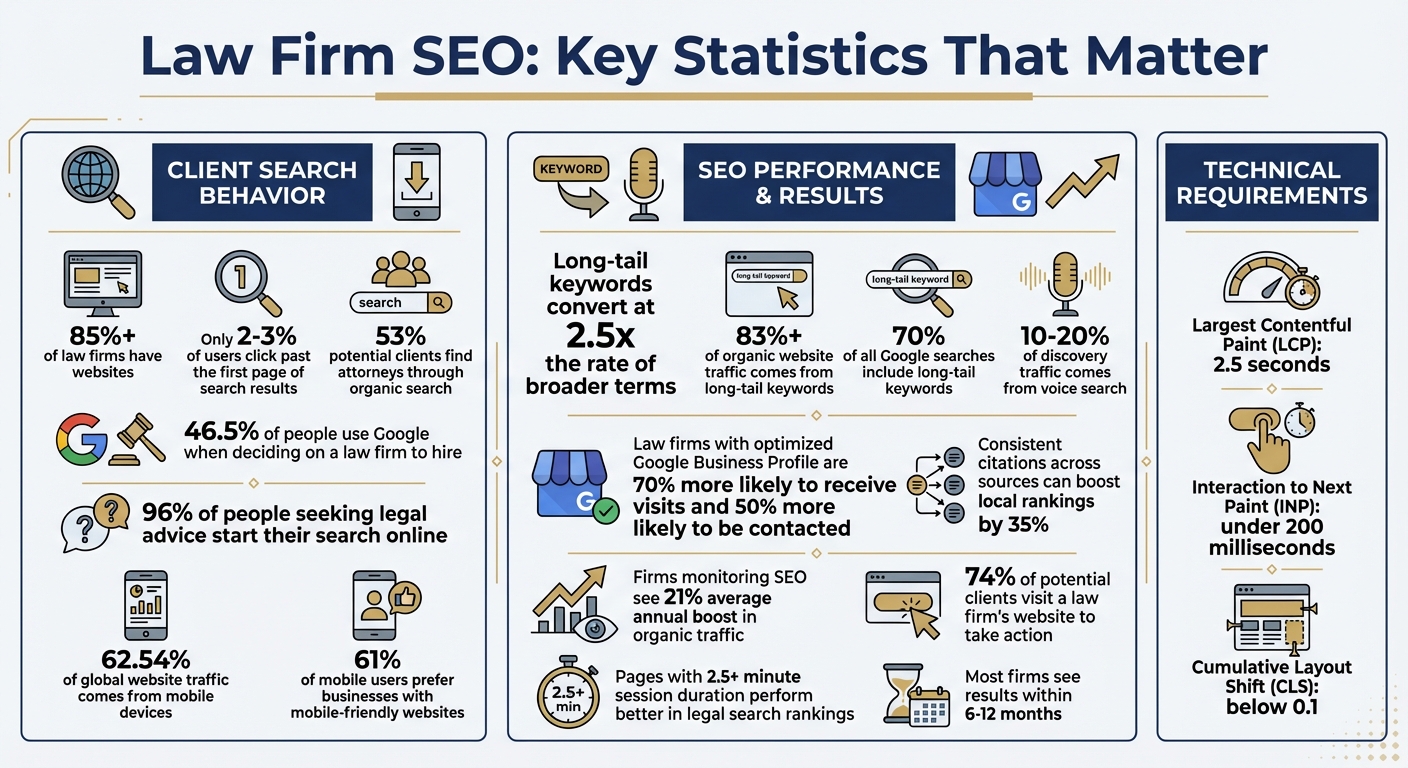
Law Firm SEO Statistics: Client Search Behavior and Conversion Rates
SEO For Lawyers: A Step by Step Guide
Use Keyword Research to Target Legal Search Terms
Keyword research is your roadmap to understanding the exact phrases potential clients type into search engines when they’re looking for legal help. For instance, someone searching for "car accident lawyer near me" or "how much does a divorce cost in Illinois" is signaling a clear intent. Your goal is to identify these phrases and craft content that speaks directly to those needs.
Here’s why this matters: 53% of potential clients find attorneys through organic search. And those who land on your site through targeted keywords are far more likely to take action. While a phrase like "workers’ comp lawyer free consultation Chicago" might only generate 20 searches a month, those 20 searchers are highly motivated and ready to convert.
Identify Search Intent and Legal Keywords
Not every search carries the same level of urgency. Someone typing "how does divorce work in Illinois?" is likely gathering information, while "divorce attorney near me" signals they’re ready to hire. This difference, known as search intent, is crucial when deciding which keywords to prioritize.
Search intent generally falls into three categories:
- Informational searches: These include phrases like "what is workers’ compensation?" and are geared toward people in the early research phase.
- Transactional searches: High-value queries like "personal injury lawyer consultation" indicate a readiness to hire.
- Commercial investigation searches: These, such as "best DUI lawyer in Boston reviews", suggest the user is comparing options.
Your energy should go toward transactional and commercial investigation keywords. These terms might have lower search volumes, but they attract users who are actively seeking legal representation. They’re past the research phase and ready to make a decision.
A great way to uncover these keywords is by listening to your clients. Review intake call recordings, live chat transcripts, and frequently asked questions from consultations. These real-life conversations often reveal keyword opportunities that automated tools might miss.
From there, refine your strategy by focusing on long-tail keywords tailored to your specific practice areas.
Target Long-Tail Keywords for Your Practice Areas
Long-tail keywords – phrases with four or more words – are a goldmine for law firms. While a term like "personal injury lawyer" might generate 10,000 searches a month, it’s incredibly competitive. On the other hand, a phrase like "best personal injury lawyer for car accidents in Chicago" may have fewer searches but converts at 2.5 times the rate of broader terms.
In fact, over 83% of organic website traffic comes from long-tail keywords, and 70% of all Google searches include them. For example, "uncontested divorce attorney near me" might get 1,000 searches a month with a low keyword difficulty score of 8, making it far more achievable to rank for.
Law firms like HagEstad Law Group have seen impressive results by targeting these specific phrases. In 2025, they increased qualified leads by 54% by focusing on localized terms like "estate planning attorney [city name]" and "probate lawyer consultation [neighborhood]" instead of chasing generic, high-competition keywords.
Voice search is also driving this trend. With 10–20% of discovery traffic now coming from conversational queries, people are asking more natural, question-based searches like "Who’s the best DUI lawyer near downtown Chicago that’s open right now?" Building your keyword list around these kinds of phrases can give you an edge.
Once you’ve identified your core keywords, leverage research tools to uncover even more high-value opportunities.
Find High-Value Keywords with Research Tools
Start with Google’s free tools before diving into paid options. The "People Also Ask" section and "Related Searches" at the bottom of Google results pages are treasure troves of real client questions and related terms. For example, searching for "divorce attorney" might lead you to variations like "collaborative divorce attorney", "uncontested divorce cost", or "child custody lawyer."
For deeper insights, consider using services like SearchX‘s SEO Keyword Research Service. This tool helps law firms pinpoint keywords with strong commercial intent and reasonable competition. It also filters out irrelevant terms like "lawyer jobs" or "free legal advice" so you can focus on phrases that align with your practice areas and geographic location.
Don’t overlook the opportunities hidden in your Google Search Console. Look for "easy-win" keywords – terms where your site is already ranking on pages two or three. A few small tweaks to your content can push these keywords to page one, driving significant traffic with minimal effort. For example, Tomkiel & Tomkiel, a New York law firm, used this approach to dominate their local market in 2025.
Finally, keep an eye on forums like Avvo, Justia, and relevant subreddits. These platforms often reveal how potential clients naturally describe their legal issues. The conversational language used here can inspire keyword ideas that traditional tools might miss but that resonate with real people.
Fix Technical SEO Issues to Improve Search Rankings
After refining your content strategy, it’s time to strengthen your website with solid technical SEO.
Even the most compelling legal content won’t make an impact if search engines can’t access or understand your site. Technical SEO is the backbone that ensures Google can crawl, index, and rank your pages accurately. For law firms, this means potential clients can actually find you when they need assistance the most.
Technical SEO also plays a key role in how smoothly your site performs. About 61% of mobile users prefer businesses with mobile-friendly websites, and since over half of all web traffic comes from mobile devices, neglecting these basics can drive away a significant number of potential clients before they even engage with your content.
Make Your Website Mobile-Friendly and Fast
Your site’s speed and mobile performance aren’t optional – they’re direct ranking factors that Google evaluates through its Core Web Vitals. These metrics include:
- Largest Contentful Paint (LCP): Should load in around 2.5 seconds.
- Interaction to Next Paint (INP): Ideally under 200 milliseconds.
- Cumulative Layout Shift (CLS): A score below 0.1 is recommended.
"User experience – including load speed – makes up for much of Google’s Core Web Vitals." – dNOVO Group
Think about it: when someone needs legal help, they’re often in a stressful situation – whether it’s dealing with an accident, facing charges, or navigating a divorce. A slow or frustrating website only adds to their stress. Sites that take longer than 2.5 seconds to load risk losing these visitors.
Start by testing your site on your phone. Is the text easy to read without zooming? Are contact details and call-to-action buttons visible and user-friendly? Make sure phone numbers are clickable so mobile users can call you with a single tap. To improve load times, compress images, remove unnecessary plugins, and enable browser caching. These tweaks can reduce bounce rates and keep potential clients engaged.
Add Local Business Schema Markup
Schema markup is structured data that helps search engines understand your business. For law firms, the LegalService schema is particularly useful for highlighting your practice areas, office locations, and business hours in a way that’s easy for Google to interpret.
Search engines don’t interpret websites like humans do – they rely on clear signals to determine relevance. Schema markup provides these signals, helping your firm appear in local search results, Google Maps, and even voice search queries.
To implement LegalService schema, gather accurate details about your firm, such as your name, address, phone number (NAP), website URL, business hours, and specific legal services. Platforms like WordPress offer plugins to simplify this process, but it’s important to double-check that the schema code is correct. If you’re unsure, SearchX provides a step-by-step guide to adding local business schema markup. This strategy boosts your local visibility and aligns with broader local SEO efforts to connect with nearby clients.
Check Indexing and Fix Crawl Errors
Even if your content and schema are perfect, they won’t matter if Google can’t crawl or index your pages. Crawling is how search engines discover and read your pages, while indexing stores them for display in search results. Although Google typically takes 4 days to 4 weeks to index a new site, technical issues can prevent even established sites from ranking.
One common issue is misplaced noindex tags, which can accidentally block important pages from appearing in search results. Use tools like Screaming Frog to identify and fix these tags.
Another problem is duplicate content, title tags, or meta descriptions. When multiple pages have identical metadata, Google struggles to determine which one is most relevant, which can hurt your rankings. Use tools like Google Search Console to identify duplicates and rewrite each title tag and meta description with unique details, such as your city, case type, or specific services. Keep title tags under 60 characters and meta descriptions under 155.
To monitor and resolve indexing errors, use Google Search Console’s Inspect URL tool to see how Google renders each page. Check the Coverage report for indexing issues and look out for crawl anomalies that could signal deeper technical problems. If you need expert help, SearchX’s Technical SEO Services can ensure your site maintains a strong technical foundation.
Technical SEO is an ongoing process. As you add pages, update content, and adapt to Google’s frequent algorithm changes – about 500 updates a year – regular audits are essential to keep your site competitive and visible in search results.
Optimize Local SEO to Attract Nearby Clients
Local SEO is all about connecting with potential clients in your area. Most people looking for legal help want someone close by – someone who knows the local court system and state laws inside and out. Consider this: 46.5% of people turn to Google when deciding on a law firm to hire. And many of those searches include location-specific terms like "personal injury lawyer near me" or "divorce attorney in Austin." By fine-tuning your local SEO, you make sure your law firm shows up when people in your area need legal assistance.
Local SEO gets you into Google’s Local Pack, Google Maps, and other location-based search results – prime spots to capture attention at the exact moment someone is searching for help. Let’s break down how to improve your local visibility step by step.
Set Up and Optimize Your Google Business Profile
Your Google Business Profile (GBP) is like your law firm’s storefront on Google Maps and Search. An optimized GBP can significantly boost your visibility. For example, law firms with a well-maintained profile are 70% more likely to receive visits and 50% more likely to get contacted. Plus, clicking through to your website is often the first action people take when they find your profile.
Start by claiming and completing your Google Business Profile. Be thorough – include your firm’s official name, address, phone number, website URL, and business hours. Use keywords relevant to your practice, and select a primary category that best matches your specialty, like "Family Law Attorney" or "Personal Injury Attorney." Add secondary categories if needed, and write a client-focused description that naturally incorporates those keywords.
Visuals matter too. Upload high-quality photos of your office, team, or even local landmarks to build trust. Encourage happy clients to leave reviews and be proactive in responding to feedback. Keep your profile active by sharing posts about legal topics, recent case wins, or updates about your firm.
Keep NAP Information Consistent Across Directories
Consistency is key when it comes to your firm’s Name, Address, and Phone number (NAP). These details need to match across every online listing, social media profile, and directory. Even small differences – like "Street" versus "St." – can confuse search engines and hurt your rankings.
"The number one rule in creating your law firm’s profile in citation sites is to use consistent NAP + W (Name, Address, Phone, and Website) details. These should reflect exactly what appears in your GBP in order to improve your rankings in the Google 3-Pack." – onthemap.com
Search engines double-check your firm’s legitimacy by comparing your information across various platforms. Inconsistencies can cause your rankings to drop – or even prevent you from appearing in local results. Start with an audit: search for your firm on Google and review every listing, including your website, GBP, social media profiles, and directories like Avvo, FindLaw, Justia, Martindale-Hubbell, Yelp, Bing Places, and Apple Maps. Correct any errors and ensure your information matches your official firm name as registered with your state bar. If you’ve moved or changed phone numbers, update everything immediately. Tools like Birdeye or Whitespark can help you track and manage these details efficiently.
Once your NAP is consistent, take it a step further by creating unique landing pages for each area you serve.
Create Landing Pages for Each Location You Serve
If your practice spans multiple cities or regions, dedicated landing pages for each location can make a huge difference. These pages tell Google – and potential clients – that you specifically serve those areas, helping you rank higher in local searches.
Each landing page should feature 1,500–2,000 words of content tailored to that specific location. Include details about local court systems, state-specific laws, and community examples. Use geo-targeted keywords naturally in your title tags, meta descriptions, headers, and body text. This localized content works hand-in-hand with your broader SEO strategy to boost your visibility.
"A generic website won’t cut it. You need location-specific landing pages that tell prospective clients, ‘Yes, I serve clients in [city], I understand your needs, and I’m the right lawyer for you.’" – Sasha Berson, Law Firm Marketing Growth Expert, Grow Law
The results speak for themselves. In 2025, Omar Ochoa Law Firm created location-specific pages that accounted for 25% of their total website traffic and generated 46% of their conversions in just three months.
To make these pages even more effective, include local testimonials and case studies, embed a map to highlight your proximity, and use LocalBusiness and Attorney schema markup to help search engines identify your services and target areas. Ensure these pages are mobile-friendly – most local searches happen on smartphones – and integrate them into your main site navigation for better structure. Avoid duplicate content and clearly outline the jurisdictions where you’re licensed to practice law. With these steps, you’ll position your firm as the go-to choice for local clients.
Create Content That Answers Client Questions
When potential clients land on your website, they’re looking for straightforward answers. They want to know if you can handle their specific legal issue, what the process will involve, and whether you’re the right attorney for them. Addressing these questions not only builds trust but also increases your site’s value in the eyes of search engines. This makes content creation a powerful tool for attracting inquiries while complementing your keyword research and technical SEO efforts.
One way to understand what clients are looking for is by reviewing questions posted on legal forums. This helps you identify the language they use and the issues they care about most. Keep in mind that 96% of people seeking legal advice start their search online. Your content needs to meet them where they are by providing clear, helpful answers. While the average Google first-page result is around 1,500 words, the key to success lies in quality and relevance. By addressing client concerns effectively, you create content that informs both your blog and service page strategies.
Publish Regular Blog Posts on Legal Topics
Consistently publishing blog posts about common legal questions can strengthen client engagement and position you as an expert in your field. Regular updates not only keep your website fresh but also create multiple opportunities for potential clients to discover your services.
Focus on topics that resonate with your target audience. For example, a family law attorney might write about custody arrangements, divorce timelines, or child support modifications. A criminal defense lawyer, on the other hand, could explain what happens after an arrest, how bail works, or the differences between misdemeanors and felonies. Provide clear, concise answers that address your clients’ specific needs, location, and practice area.
A useful strategy is to compile a list of 50–100 common client questions and create individual blog posts for each. For broader subjects, consider creating comprehensive "hub pages" or "resource centers" that range from 2,500 to 3,500 words. These can be supported by shorter, related articles that dive into specific details. Use clear headings, naturally integrate relevant keywords, and include internal links to connect related pages or direct readers to contact forms. Make your content original, informative, and actionable by including calls to action that encourage readers to request a free case evaluation or reach out. This approach not only establishes your authority but also keeps your site active and visible to search engines.
Optimize Service Pages to Attract and Convert Visitors
While blog posts are great for education and engagement, your service pages play a critical role in converting visitors into clients. These pages should do more than just list your services – they need to address client concerns directly and guide them toward taking action. A well-optimized service page not only ranks well in search results but also helps visitors decide to contact you.
Each service page should focus on specific aspects of your practice. For example, a family law page might include sections on adoption, marriage, custody, and divorce. Use language that speaks directly to client concerns, avoiding overly complex legal jargon. If someone is searching for a DUI attorney, they want to know what happens next, what their options are, and how you’ve successfully handled similar cases.
Service pages should be thorough – main practice area pages often exceed 2,000 words. Incorporate target keywords naturally in title tags, meta descriptions, headings, URLs, and throughout the text. A well-crafted title tag can boost your click-through rate by 20–100%. For example, instead of a generic title like "DUI Defense", use something more specific, such as "Experienced DUI Defense Attorney in [City] | Free Case Review." Tailor your content to your local audience by referencing specific courts, laws, and jurisdictional processes. A page titled "Filing Divorce in [County] Circuit Court" not only attracts qualified prospects but also strengthens your geographic relevance.
Including FAQs directly on service pages can address common questions without requiring visitors to click elsewhere. Also, ensure each page has clear calls to action, such as contact forms and phone numbers. Given that 62.54% of global website traffic comes from mobile devices, your service pages must be mobile-friendly to accommodate users on all devices. By combining comprehensive content with intuitive design, you can turn visitors into clients.
Build Backlinks to Increase Your Website’s Authority
Once you’ve laid the groundwork with local and technical SEO, the next step to boosting your law firm’s online presence is building backlinks. Backlinks from respected websites signal to search engines that your content is reliable and worthwhile. When a well-known site links to your law firm, it essentially vouches for your credibility. This can improve your domain authority, helping you climb higher in search engine rankings. For law firms, these high-quality backlinks are key to improving visibility, supporting local SEO efforts, and ultimately drawing in more clients. A single link from a reputable legal publication often outweighs dozens of links from irrelevant or low-quality sites.
The focus should always be on quality. Search engines prioritize links from authoritative, relevant, and well-trafficked websites. A strong backlink typically comes from a site with a domain authority of 30 or higher, robust organic traffic, and a diverse backlink profile. For instance, a link from your state bar association or a respected legal news platform carries far more weight than one from an obscure blog. Similarly, legal-specific directories hold more sway for attorney rankings compared to general business directories.
Get Listed in Reputable Legal Directories
A simple and effective way to build backlinks is by listing your firm in trusted legal directories. These platforms not only provide valuable backlinks but also make your firm more visible to potential clients searching for attorneys. Start with well-known directories like FindLaw, Justia, SuperLawyers, Avvo, Martindale-Hubbell, and LegalMatch. Additionally, general business directories such as Yelp, Facebook, Bing Places, Apple Places, and Yellow Pages can support your local SEO strategy.
Before submitting your firm’s details, assess the credibility of each directory. Tools like Moz’s free Domain Analysis tool can help you check a directory’s Domain Authority (aim for 30 or above) and spam score (less than 5% is ideal). Once you’ve identified reputable directories, ensure your NAP (Name, Address, Phone number) details are consistent across all listings. Inconsistent information can confuse search engines and hurt your rankings. Studies show that consistent citations across multiple sources can boost local rankings by 35%. Conduct quarterly audits to correct discrepancies or remove duplicate listings that could negatively impact your ranking signals.
Partner with Related Businesses for Backlinks
Beyond directories, you can expand your backlink profile by collaborating with local professionals who serve similar clients but aren’t direct competitors. For example, a family law attorney might partner with a family therapist or a real estate agent specializing in divorce-related sales. These partnerships can lead to mutual backlinks, guest blog opportunities, or co-hosted events that naturally generate links.
Engaging with local organizations also opens doors to valuable backlinks. Sponsor community events, volunteer, or get involved in local initiatives. These efforts not only build goodwill but can also earn backlinks from local news outlets, chambers of commerce, or nonprofit websites. Services like Help A Reporter Out (HARO) can connect you with journalists seeking expert input, leading to media mentions and backlinks. Additionally, press releases, community-focused data, or appearances on legal podcasts can create natural linking opportunities.
Prioritize Quality Over Quantity in Link Building
When it comes to backlinks, quality always trumps quantity. Google evaluates the value of links, and filling your backlink profile with low-quality links can lead to penalties or a drop in rankings. As PaperStreet explains:
"When link building, it is very important to only secure high quality backlinks, don’t simply get every possible link available to you. Review each opportunity to check for spam and also evaluate if it is topically or locally relevant to your website. Too many spammy, low quality websites linking back to you can result in a Google penalty or a decrease in rankings."
Focus on earning backlinks from domains that are relevant to the legal field, have high authority, and attract strong organic traffic. Carefully evaluate each opportunity for its relevance to your practice and your local market. Avoid harmful practices like link farms, private link networks, comment spam, or excessive reciprocal linking. Instead, create content that naturally attracts links – such as legal guides, case studies, or research-backed articles. If needed, consider working with professionals who specialize in link-building services tailored to the legal industry. Remember, backlink building is an ongoing process that requires consistent effort and refinement.
Track Performance and Adjust Your SEO Strategy
Building backlinks is just one piece of the puzzle. To truly get the most out of your law firm’s SEO efforts, you need to keep an eye on how things are working and tweak your approach as needed. SEO isn’t a one-and-done deal – it requires ongoing tracking and fine-tuning. In fact, law firms that consistently monitor and improve their SEO strategies see an average annual boost of 21% in organic search traffic. Yet, a surprising 65% of attorneys are unsure which key performance indicators (KPIs) they should be tracking, leaving plenty of room for improvement.
Once you’ve optimized your content, technical setup, and backlinks, tracking performance helps you confirm what’s working and what isn’t. This ongoing process ensures all your SEO efforts – whether technical or local – are driving measurable growth and, ultimately, more inquiries from potential clients.
Monitor Traffic and Conversion Rates
Start by focusing on the metrics that truly matter. Tools like Google Analytics can give you a clear picture of how visitors interact with your website, what keeps them engaged, and how they convert. Pay close attention to organic conversions, such as how many consultations are booked, forms are submitted, or phone calls are made through your site. Keep an eye on organic traffic growth and keyword rankings to see if your visibility in search results is improving.
Engagement metrics like session duration and bounce rate are also critical. For instance, pages where users spend over 2.5 minutes tend to perform better in legal search rankings. If some pages are getting a lot of traffic but aren’t holding visitors’ attention, it’s a sign that the content or user experience needs work. A real-life example? Moore Ganske Murr PLLC saw 60% of their calls come directly from their optimized Google Business Profile.
Once you’ve got a handle on these metrics, regular audits can help you refine your strategy further.
Run Regular SEO Audits
Start with an initial audit to address any technical issues right away. Then, make it a habit to review your SEO plan monthly, with more comprehensive updates every quarter. Most firms begin to see noticeable results within three to six months of consistent SEO efforts.
During these audits, check in on Core Web Vitals – if they’re slipping, it might be time to revisit image optimization or other technical factors. Don’t forget to evaluate your backlink profile for quality and relevance. Are the sites linking to you authoritative? Are they driving referral traffic? These are key questions to ask. For example, an Amsterdam personal injury firm improved its Largest Contentful Paint from 4.2 seconds to 1.1 seconds through technical fixes. The result? Organic calls jumped from 12 to 68 per month, leading to a 280% increase in signed case revenue within six months.
Compare Your Performance Against Competitors
Tools like Semrush and Ahrefs can help you analyze your competitors’ keyword rankings, backlink profiles, and content strategies. Look for gaps in your own approach – are there keywords they’re ranking for that you’re not targeting? Focus on filling those gaps. Similarly, examine their backlink profiles to identify authoritative sites linking to them but not to you, and prioritize those domains in your link-building efforts.
Competitors’ local SEO strategies can also provide valuable insights. Check how they’ve optimized their Google Business Profiles and whether their citations are consistent across platforms. Spotting opportunities early – like emerging “near-me” search phrases – can give you an edge in both content creation and link-building.
Finally, track your progress over time, ideally year-over-year, to account for seasonal trends and avoid misinterpreting short-term changes. If your organic traffic is climbing, double down on the strategies that are driving that success. On the flip side, if keyword rankings drop or certain content underperforms, dig into the data to refine your approach and better align with search intent.
Conclusion
SEO is not a one-and-done task – it’s an ongoing process that involves technical fine-tuning, boosting local visibility, creating high-quality content, and building strategic links. While many law firms begin to see noticeable increases in traffic and client conversions within 6–12 months, staying competitive means continuously adapting to changes in search engine algorithms and client behavior.
Focus on 3–4 core strategies that align with your practice areas and local market. This could mean optimizing your Google Business Profile, regularly publishing blog posts that address common client concerns, or tackling technical issues that may be slowing down your website. Consistency is crucial, especially when 74% of potential clients visit a law firm’s website to take action. Your SEO efforts directly impact how clients engage and inquire about your services.
In today’s highly competitive legal landscape, it’s important to monitor key metrics monthly and conduct quarterly SEO audits. This helps you keep pace with shifting algorithms and evolving client expectations. By doing so, you ensure that your firm’s SEO strategy continues to generate meaningful inquiries.
The steps you take now – whether it’s refining your approach or doubling down on what works – can translate your digital presence into measurable business growth. With effective SEO, you’re not just driving traffic; you’re turning that traffic into real opportunities for consultations, inquiries, and new cases. Every effort you invest today builds the groundwork for sustained success.
FAQs
How can law firms use long-tail keywords to improve their SEO and attract more clients?
Law firms can tap into the power of long-tail keywords by targeting highly specific phrases that align with what potential clients are searching for. For example, phrases like “top divorce lawyer in Los Angeles” or “DUI attorney near me” often indicate clear intent from the searcher. These keywords are typically less competitive, making it easier for your website to rank higher in search results.
To make the most of long-tail keywords, weave them naturally into your website’s content. This includes blog posts, service pages, meta descriptions, and headings. Pair this approach with local SEO techniques – like optimizing your Google Business Profile, using schema markup, and keeping your NAP (Name, Address, Phone number) details accurate and consistent. Together, these strategies can enhance your online visibility and attract clients who are ready to take the next step.
What technical SEO elements should law firms focus on to improve their online presence?
Law firms need to prioritize key technical SEO elements to ensure their websites rank well in search engines while offering a seamless experience for users. Start by focusing on website speed and making sure your site is mobile-friendly – both are crucial for search engine rankings and user satisfaction. Incorporating structured data, such as local business and attorney schema, can also help search engines better interpret your content and boost visibility in local search results.
Another important aspect is maintaining a clean and descriptive URL structure. Pay close attention to on-page elements like title tags, meta descriptions, and header tags, as these directly impact how search engines and users perceive your site. Don’t forget to fix any broken links, set up and submit an XML sitemap, and ensure your site runs on a secure HTTPS protocol. These steps not only improve your site’s credibility but also build trust with visitors. By tackling these technical SEO essentials, law firms can strengthen their online presence and connect with more potential clients.
How can local SEO help law firms attract more clients in their area?
Local SEO plays a crucial role in helping law firms reach potential clients within their community by boosting visibility in local search results, including Google Maps and the Local Pack. This is especially important for people conducting "near me" searches or using mobile devices to find legal services nearby.
To make the most of local SEO, law firms can focus on targeting location-specific keywords, ensuring their business details – such as address and phone number – are accurate across online directories, and leveraging tools like schema markup to stand out in search results. This targeted strategy makes it easier for people in your area to find and contact your firm when they need legal assistance.