
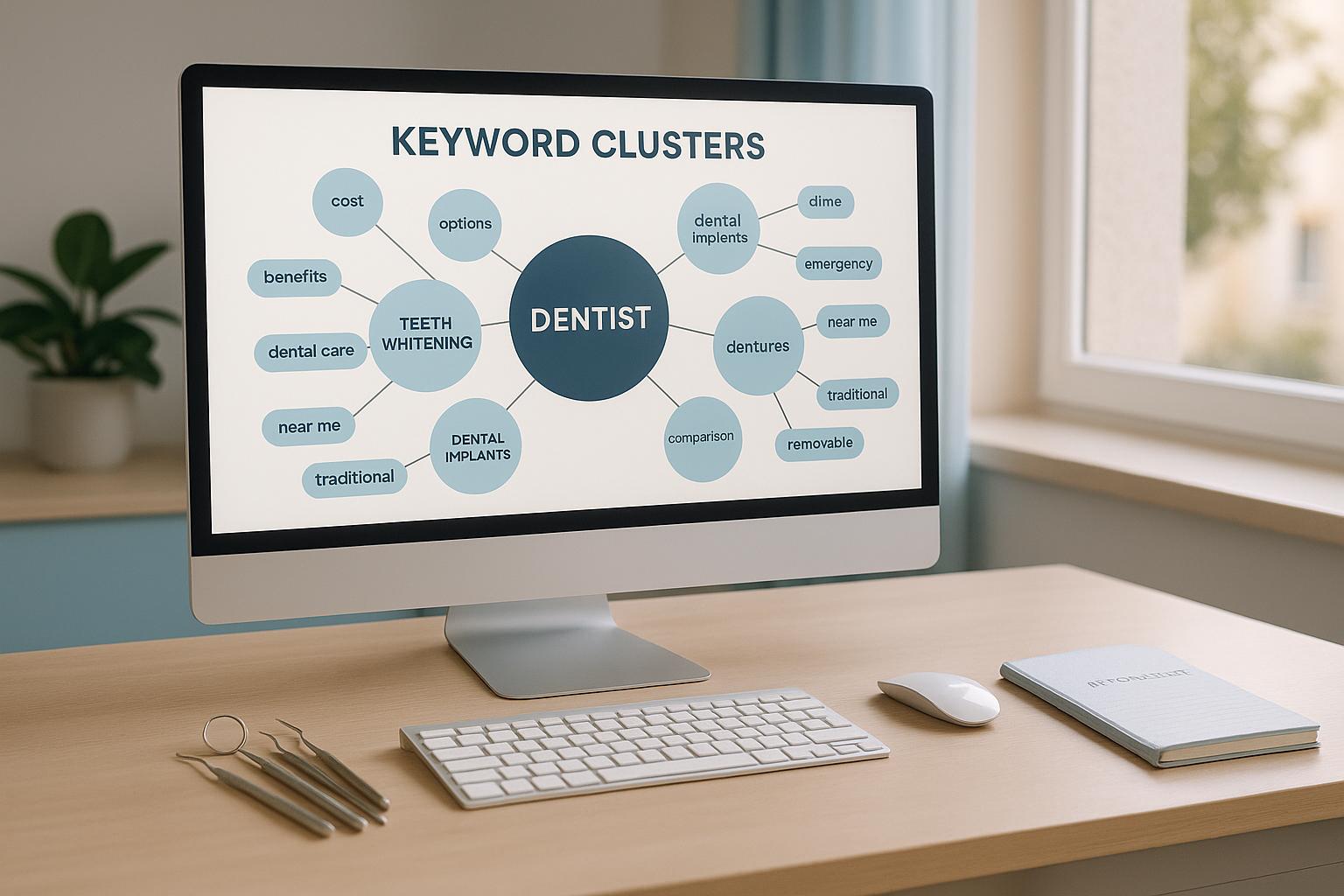
Keyword clusters are a game-changer for dental practices looking to improve their online visibility. Instead of focusing on individual keywords, this strategy groups related terms based on user intent, helping your practice rank for multiple search queries while aligning with how search engines evaluate content. Here’s the gist:
- What Are Keyword Clusters?
They’re groups of related keywords tied to a central topic. For example, a page on "Dental Implants" can link to related subtopics like "Cost of Dental Implants" or "Implant Aftercare Tips." - Why They Work:
Search engines prioritize content that addresses user intent comprehensively. By covering multiple aspects of a topic, keyword clusters improve rankings, drive organic traffic, and build authority. - How to Use Them:
Create pillar pages for broad topics (e.g., "Cosmetic Dentistry") and link them to cluster pages (e.g., "Teeth Whitening", "Veneers"). Incorporate location-specific keywords to target local searches like "Best Dentist in [City]." - Key Benefits:
- Rank for multiple related terms.
- Attract local patients with location-based keywords.
- Address patient questions at every stage of their decision-making process.
This approach not only improves rankings but also enhances the user experience by providing in-depth, well-organized content.
Master Keyword Clustering in 13 Minutes: Step-by-Step Guide for SEO
Matching Keyword Clusters to Patient Needs
Dental SEO Statistics: Local Search Impact and Patient Behavior
How Dental Patients Search Online
Understanding how dental patients search online is essential for creating keyword clusters that align with their needs. Patients often use everyday language to describe their concerns. For instance, someone searching for "why do my teeth hurt with cold drinks" isn’t looking for "dentin hypersensitivity treatment." Instead, they’re using terms that reflect how people naturally talk about their symptoms. Your content needs to mirror this conversational style, not the technical jargon of dental professionals.
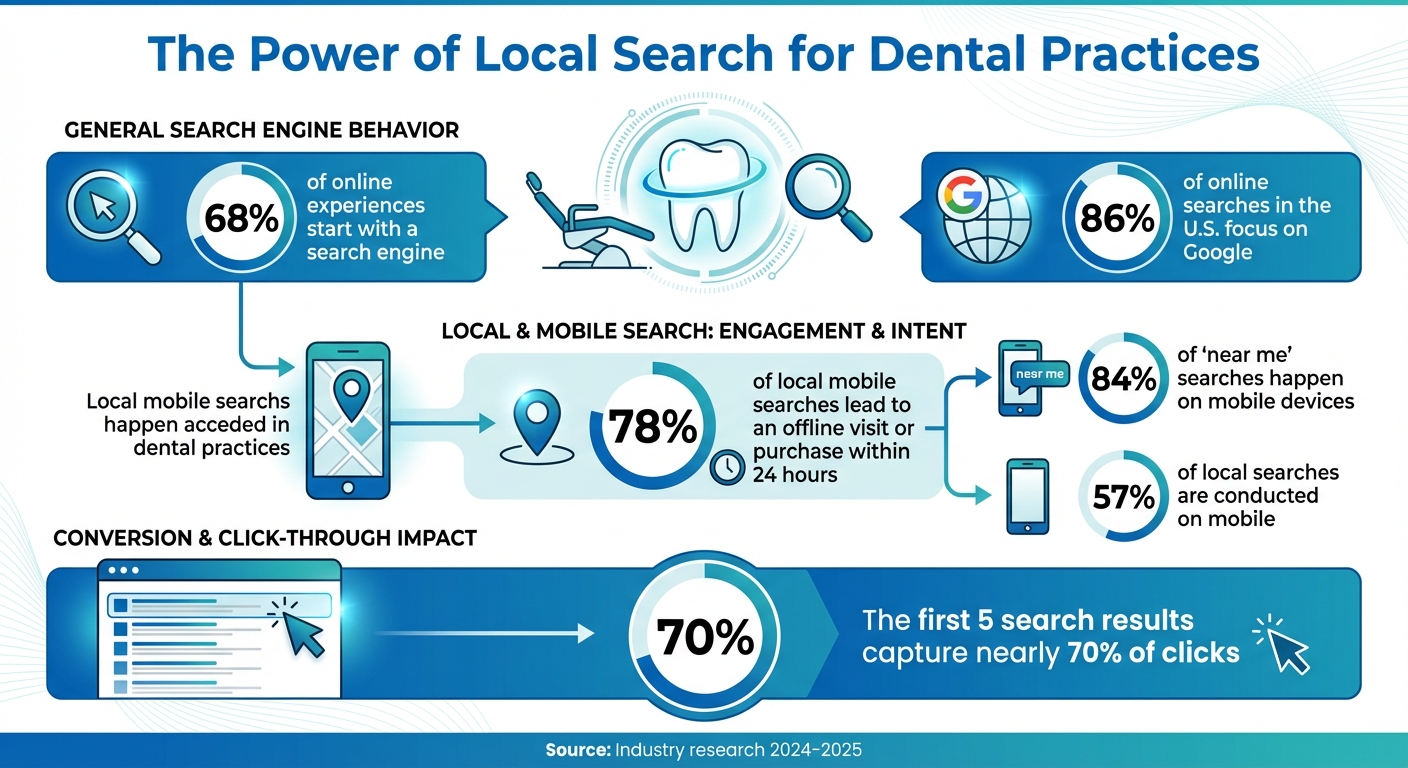
The patient journey typically involves several stages: awareness (identifying a problem), research, comparison, booking, and retention. Each stage prompts different search behaviors. For example, someone in the awareness stage might search for "tooth pain relief", while someone ready to book an appointment might type "dentist near me open now". Since 68% of online experiences start with a search engine and 86% of online searches in the U.S. focus on Google, it’s crucial to target the right keywords for each stage.
To meet these needs, match keyword clusters to different search intents – informational, commercial, and transactional. This might involve creating blog posts, comparison guides, or service pages with clear calls-to-action.
Long-tail keywords are especially effective because they’re more specific and often indicate higher intent. Instead of aiming for a broad term like "dentist", focus on phrases such as "emergency dentist open on Sunday in [City]" or "painless root canal dentist in Ogden." These terms not only face less competition but also attract patients who know exactly what they’re looking for. Considering that 78% of local mobile searches lead to an offline visit or purchase within 24 hours, targeting these high-intent searches can directly boost appointment bookings.
Organizing Keywords by Dental Service Type
Start by listing all the dental services your practice offers. Then, group related keywords into clusters for each service. For example, a cosmetic dentistry cluster might include terms like "veneers", "teeth whitening", "dental bonding", and "smile makeovers." An emergency services cluster could feature keywords such as "emergency dentist", "tooth extraction", "broken tooth repair", and "dental abscess treatment".
ProSites suggests grouping terms with similar search intent. For instance, "braces for teeth alignment", "Invisalign clear aligners", and "orthodontist for kids" can form one cluster because they address the same underlying need. This approach allows a single, well-optimized page to rank for multiple related queries, reducing the need for separate pages for every minor keyword variation.
Different services attract different types of searches. Preventive care keywords, like "teeth cleaning" or "dental checkup", tend to be broader, while specialty services generate more specific queries, such as "wisdom tooth removal near me" or "Invisalign provider in [City]". By recognizing these patterns, you can prioritize building clusters that align with your practice’s strengths and meet patient demand.
To strengthen your strategy, create dedicated service pages for each major keyword cluster. Then, add supporting content that answers related questions. For example, a "Dental Implants" page could link to articles like "Dental Implant Costs" or "What to Expect During Implant Recovery". This interconnected structure signals to Google that your site offers in-depth expertise, improving your chances of ranking for a broader range of related terms.
Adding Location-Based Keywords
Since dental care is a local service, location-based keywords are a must. Patients generally won’t travel far for routine care, so including geographic terms like city names, neighborhoods, ZIP codes, and "near me" phrases in your keyword clusters is critical. With 84% of "near me" searches happening on mobile devices and 57% of local searches conducted on mobile, optimizing for these terms is key.
Incorporate your city, neighborhood, and ZIP code into service-specific keywords. For example, instead of just "cosmetic dentist", use variations like "cosmetic dentist [City]", "cosmetic dentist [Neighborhood]", or "cosmetic dentist [ZIP code]." DDSrank offers examples such as "pediatric dentist [location]", "dental implant cost [location]", and "root canal specialist [location]" to help capture searches from patients using different variations to find the same service.
"Near me" phrases are especially valuable for improving local visibility. Google prioritizes nearby practices for these searches, and since the first five search results capture nearly 70% of clicks, ranking for these terms can significantly increase patient inquiries.
To make your content more relevant to local audiences, naturally combine service keywords with geographic terms. For instance, write about "emergency dental care in downtown [City]" or "family dentistry serving [Neighborhood] and surrounding areas." This added specificity helps search engines connect your website with patient searches that include location details, making it easier for potential patients to find you.
Building Keyword Clusters With Research Tools
Once you’ve grasped the importance of aligning keyword clusters with patient needs, the next step is using research tools to pinpoint and organize dental-related keywords effectively.
Finding Keywords for Dental Practices
Start by exploring tools like Google Keyword Planner, Ahrefs, and SEMrush to uncover high-volume keywords that indicate strong purchase intent. These platforms reveal exactly what potential patients are searching for and how frequently.
Free tools can also offer valuable insights. Google Autocomplete provides instant suggestions as you type – try entering phrases like "dentist for" or "teeth whitening" to see what pops up. Similarly, the "People Also Ask" section in Google search results can highlight common patient concerns and long-tail keywords.
Don’t overlook competitor analysis. Tools like SEMrush and Ahrefs can help you identify keywords your competitors rank for that you might not be targeting yet. By reviewing keyword gap reports regularly, you can stay ahead of shifts in patient intent and competitive trends. Additionally, listening to patient questions during appointments or keeping an eye on social media comments can help you tap into the language your audience actually uses.
Evaluating Keywords for U.S. Markets
When evaluating keywords, focus on factors like search volume, competition level, and local market relevance. For example, Google Keyword Planner provides U.S.-specific data, such as "1,200 searches per month" or "850 monthly searches." Prioritize keywords that have adequate search volume, low competition, and direct relevance to your dental services.
Targeting low-competition, high-intent keywords is especially effective for driving growth. Balance high-volume, short-tail phrases like "dentist near me" with long-tail alternatives such as "dentist that accepts medical insurance" or "all on four dental implants near me." Given that 78% of local mobile searches result in an offline visit or purchase within 24 hours, focusing on locally driven keywords – like "same-day crown Sarasota" – can make a big impact.
Stick to keywords directly related to your services. Since patient search behavior and search engine algorithms are constantly evolving, revisiting and refining your keyword strategy regularly is essential.
Once you’ve validated your U.S.-specific keywords, organize them strategically to target patient needs more effectively.
Organizing Keywords by Intent and Topic
Group keywords based on search intent – whether informational (e.g., "what causes tooth sensitivity"), commercial (e.g., "best cosmetic dentist in [City]"), or transactional (e.g., "book emergency dentist appointment") – to create content that aligns with each stage of the patient journey.
Using keyword clusters, or groups of related terms with the same intent, allows a single web page to rank for multiple keywords while establishing authority on a topic. For example, you could cluster terms like "dental implants", "implant cost", "implant procedure", and "implant recovery time" under one main topic to demonstrate expertise.
Organize keywords by specific dental services and the questions they address. Tools like spreadsheets or SEO software can help you cluster keywords by service, intent, and location, making it easier to plan content that meets patient needs comprehensively.
For more in-depth strategies on refining your keyword research, check out our SEO Keyword Research Service.
Using Keyword Clusters to Optimize Dental Websites
Once you’ve grouped your keywords by intent and topic, it’s time to weave them into your website’s structure and content. This means organizing a clear content hierarchy, fine-tuning individual page elements, and adding technical tweaks that make it easier for search engines to understand your dental practice.
Setting Up a Pillar-Cluster Content Structure
Start by building your website around pillar pages that cover broad dental topics like "Dental Implants in Austin, TX" or "Cosmetic Dentistry." These pillar pages act as hubs, linking to cluster pages that address specific patient questions, such as "How much do dental implants cost in Austin?" or "Are dental implants painful?".
This setup not only establishes your authority but also makes it easier for patients to find the information they need. To make this work, group related keywords with similar search intent into clusters. Then, use internal links to connect the pillar page with its cluster pages, clearly showing how the content is related.
Once your structure is in place, focus on optimizing each page element to seamlessly incorporate these clusters into your SEO strategy.
Optimizing Page Elements for Keyword Clusters
Incorporate your target keywords naturally into key areas like titles, headings, meta descriptions, and URLs. For example, include the primary keyword in the H1 tag and early in the page content. Keep title tags under 60 characters and meta descriptions under 160 characters to ensure they display properly in search results.
Imagine you’re promoting teeth cleaning services in Manhattan. A well-optimized title tag might be "Teeth Cleaning Services in Manhattan", paired with a meta description like "Experience top-quality teeth cleaning at our Manhattan practice. Book your appointment today!". When linking between pillar and cluster pages, use descriptive anchor text with relevant keywords. Organize your content with clear subheadings, ideally phrased as questions that directly address patient concerns. Avoid stuffing keywords into your content – write naturally and focus on clarity for your readers.
For an extra boost, enhance your site’s technical SEO with schema markup.
Adding Schema Markup for Local Search
Schema markup helps search engines better understand your content, enabling enhanced search result features. For dental practices, useful schema types include LocalBusiness, Dentist, Review, and FAQ. Review schema is especially effective – those 5-star ratings can make your practice stand out and attract more patients.
If coding isn’t your thing, tools like Google’s Structured Data Markup Helper, Rank Math, or AIOSEO’s Schema Generator can make adding schema markup much easier. Use structured data and clear Q&A formats to improve visibility, especially for AI-driven search results. While schema markup isn’t something visitors will see, it can make your content shine in search results through rich snippets that grab attention.
Updating and Growing Your Keyword Clusters
Keyword clusters aren’t something you set and forget. They need to be monitored and refined as search algorithms evolve, competitors adjust their strategies, and patient needs shift. Dental practices that see 25% or more annual growth in branded search volume often enjoy a 40-60% boost in high-value treatment consultations within a year. That kind of success comes from consistently analyzing what’s working and making thoughtful updates.
Measuring Keyword Cluster Performance
Once your keyword clusters are in place, keeping an eye on their performance is essential. Identify which clusters are driving traffic and, more importantly, conversions. Look at metrics like appointments booked, phone inquiries, and contact form submissions. It’s important to focus on both immediate results and the long-term value your brand is building. For example, if your "emergency dental care" cluster is attracting visitors but not converting them into appointments, it might be time to refine the content or tweak your call-to-action. Regularly reviewing analytics helps you catch trends early, allowing you to adjust underperforming clusters without delay.
Updating Content With Current Information
Your content should always reflect the latest information about your services. Update pages with details like pricing, insurance options, and new treatments such as clear aligners or same-day crowns. If you add a new service or change your office hours, make sure those updates are reflected in the relevant cluster pages immediately. Modern search engines reward quality and relevance over repetitive keyword stuffing, so focus on aligning your content with current search intent. Patients researching treatments often use long-tail, question-based queries, so fresh, detailed content can significantly improve your visibility in search results.
Adjusting for Seasonal and Local Patterns
Some keywords spike in popularity during specific times of the year, driven by predictable patterns like holidays, weather changes, or annual events. For U.S.-based dental practices, this might mean creating content around back-to-school checkups, pre-holiday teeth whitening, or end-of-year insurance deadlines. Local keywords can also be a goldmine, often facing less competition than broader terms. Incorporate neighborhood names or well-known landmarks into your clusters to strengthen your local connection. Use historical data and competitor insights to identify seasonal trends, and adjust your content calendar and keyword focus accordingly. By continuously refining your clusters to reflect these patterns, you’ll maintain a strong local SEO presence. These updates not only boost your authority but also support the pillar-cluster strategy discussed earlier.
Conclusion
Keyword clusters are a powerful tool for boosting local SEO, increasing patient appointments, and giving your practice a competitive edge. By organizing content around key topics and linking related pages, you signal authority to search engines. This strategy doesn’t just help you rank for a single keyword – it allows you to appear in dozens of related searches at once. The results speak for themselves. In 2025, practices like Dentologie in Chicago secured the #1 spot for "dentist chicago" (8,100 monthly searches), while LA Dental Clinic topped the rankings for "veneers cost Los Angeles" (480 monthly searches) by implementing focused keyword cluster strategies. These successes highlight the real-world impact of a well-executed cluster strategy.
The numbers back it up. One dental practice experienced a 50% jump in new patient inquiries after adopting a tailored SEO approach. Another achieved first-page rankings for competitive keywords, driving both traffic and conversions.
If you’re ready to see similar results, SearchX is here to help. Their SEO keyword research service and technical SEO services are designed specifically for dental practices. From identifying high-value keyword clusters to optimizing site structures and tracking performance, SearchX provides the tools and expertise to keep your practice visible in local search results. Whether you’re starting with DIY local SEO or need a comprehensive SEO solution, the right support can make all the difference.
FAQs
How can keyword clusters help dental practices improve local SEO?
Keyword clusters are a smart way for dental practices to boost local SEO. By grouping related terms like "teeth cleaning," "dental check-ups," and "family dentistry," you can create a more organized site that improves its relevance to search engines. This approach allows practices to target a wider variety of search phrases, increasing their chances of connecting with potential patients.
Another benefit of keyword clusters is how they enhance internal linking. This makes it easier for search engines to understand your website’s structure and helps visitors find the information they need quickly. The result? Better visibility in local search results, Google Maps, and the Local Pack – key areas for attracting nearby patients actively searching for dental care.
What are the best tools to find effective keywords for my dental practice?
To find the best keywords for your dental practice, tools like Google Keyword Planner, Semrush, and Ahrefs can be incredibly helpful. These platforms are designed to uncover keywords relevant to services like teeth whitening, emergency dental care, and family dentistry.
They offer valuable data on search volume, competition levels, and related keyword ideas. This information can guide you in creating content that ranks higher in local search results, helping you reach more potential patients in your area and enhancing your practice’s online visibility.
How often should I refresh my keyword clusters to keep my dental practice’s SEO effective?
To keep your dental practice’s SEO in top shape, it’s smart to revisit and refresh your keyword clusters every 3 to 6 months. This approach keeps your strategy in sync with shifting search trends, local competitors, and the evolving needs of your patients.
By updating regularly, you ensure your content stays relevant, tap into emerging keywords, and adjust to changes in search engine algorithms. This can give your practice a stronger presence in local search results and help you stay ahead of the competition.