

Keyword clustering is no longer optional for law firms looking to rank on Google. Instead of focusing on single keywords, grouping related terms into clusters helps establish authority, improve rankings, and align content with user intent. For legal SEO, this means creating pillar pages for broad topics and supporting them with detailed cluster pages on subtopics. This strategy avoids keyword cannibalization, enhances site structure, and meets Google’s E-E-A-T standards for high-quality content.
Key Takeaways:
- What It Is: Keyword clustering organizes related keywords into groups, creating a content hub with a main pillar page and supporting cluster articles.
- Why It Matters: It builds topical authority, prevents keyword cannibalization, and improves rankings for competitive legal terms.
- How to Do It: Use tools like Ahrefs or SEMrush to identify related terms, group them by search intent, and map them into a clear content structure with internal links.
- Challenges: Legal content must balance technical accuracy with accessibility, address state-specific laws, and comply with bar regulations.
- Benefits: Stronger rankings, clearer site architecture, and better alignment with client search behavior.
This method simplifies content planning and ensures your site stays competitive in the crowded legal market.
How to Create Topic Clusters for SEO AKA Keyword Content Clusters
Core Principles of Keyword Clustering in Legal SEO
Grasping the principles of keyword clustering is key to organizing your website’s content effectively and showcasing your law firm’s expertise to search engines.
Understanding Keyword Clusters and Topic Clusters
Let’s break down the idea of keyword clustering. Essentially, keyword clusters are groups of closely related terms that potential clients might use when searching for legal services. For example, terms like "divorce attorney [Your City]", "filing for divorce in [Your State]", and "uncontested divorce lawyer" all revolve around the same topic and can be grouped together.
This approach goes beyond simply listing keywords. It structures your content around core topics (pillar pages) and their related subtopics (cluster content). Picture a hub-and-spoke model: the pillar page serves as the hub, covering a broad topic like "Car Accident Claims", while the cluster content dives into specifics, such as "What to Do Right After a Car Wreck" or "How to Handle Insurance Adjusters After an Accident".
Here’s the big difference from older SEO practices: instead of optimizing individual pages for single keywords, which often caused pages to compete against each other, clustering creates a unified content ecosystem. Walter McCorkle, Business Development and Marketing Technology Manager at Bradley Arant Boult Cummings LLP, puts it this way:
"Optimizing a page for a single keyword is outdated; Google now recognizes entities and their relationships."
By linking cluster articles back to the pillar page and to each other, you create a content hub that not only avoids keyword cannibalization but also signals your authority on the topic to search engines.
How Search Engines Interpret Legal Content
Search engines have evolved. Instead of simply counting keyword appearances, they now focus on semantic relationships – how terms and concepts are connected. This shift is especially important for legal content, which falls under Google’s YMYL (Your Money or Your Life) category. YMYL content must meet high standards of accuracy and transparency.
Google now prioritizes factors like semantic search, user intent, and topical authority over the outdated practice of keyword stuffing. For instance, when you build a cluster around "personal injury lawyer", search engines will also associate it with related terms like "accident attorney", "injury compensation", and "settlement negotiation".
This means your content must align with a single, clear intent – whether it’s informational, commercial, or transactional. For example, if someone searches for "filing for divorce in Texas", they’re likely looking for detailed, step-by-step guidance, not a sales pitch. The rise of voice search and AI tools has only amplified this trend, as users increasingly ask longer, conversational questions that demand thorough and natural answers.
Given these dynamics, legal firms face some unique challenges when implementing keyword clustering.
Challenges in Legal Keyword Clustering
Legal keyword clustering isn’t without its hurdles. The legal SEO landscape is fiercely competitive, making it hard to rank for broad, generic terms. Additionally, state-specific legal language requires tailored clusters. For example, divorce laws in California differ from those in New York, so you’ll need separate clusters addressing each state’s unique requirements, waiting periods, and property division rules.
Overlapping practice areas add another layer of complexity. Where does a car accident case end and a personal injury case begin? How do you separate workers’ compensation from personal injury? Careful planning is essential to ensure your clusters remain distinct and effective.
Then there’s the challenge of balancing technical accuracy with accessibility. Legal content often involves complex terms, but it must also be clear to potential clients who may not understand distinctions like "tort" versus "negligence." Striking this balance is critical under Google’s E-E-A-T (Experience, Expertise, Authoritativeness, and Trustworthiness) guidelines.
Finally, legal marketing must comply with U.S. bar regulations. Your content strategy must establish authority and attract clients without making guarantees about case outcomes or using promotional language that could violate ethical guidelines. This requires a careful and thoughtful approach to both keyword selection and content creation.
Key Benefits of Keyword Clustering for Law Firms
Now that you’ve grasped the basics and challenges of keyword clustering, let’s dive into how this strategy can directly benefit your legal practice.
Enhanced Topical Authority and Rankings
Keyword clustering strengthens your online presence by showcasing your expertise in a structured, comprehensive way. Instead of scattering unrelated terms across your site, clusters create a central hub that demonstrates your mastery over a legal topic. This approach signals to search engines that your content is authoritative and well-organized.
Search engines increasingly favor content hubs, especially for YMYL (Your Money or Your Life) topics like legal advice. Research highlights that YMYL content often overlaps significantly with AI citations – 68–75% – and 45% of AI overviews appear alongside featured snippets. As Lexicon Legal Content explains:
"Topic clusters signal authority stronger than random blog posts because they demonstrate comprehensive, organized expertise."
By aligning your content into a cohesive structure, you not only boost your rankings but also ensure your site meets the needs of both search engines and potential clients.
Improved Alignment with Search Intent
Keyword clusters don’t just enhance authority – they also help you address the diverse needs of your audience. Legal SEO often involves tackling varied search intents, and clustering allows you to create content tailored to specific questions or goals. Whether someone is researching legal processes, comparing attorneys, or ready to hire, your content can meet their intent head-on.
Here’s how different search intents can translate into effective content:
| Intent Type | Example Search | Content Response |
|---|---|---|
| Informational | "How does divorce work in Illinois?" | A detailed guide explaining the divorce process |
| Commercial Investigation | "Best DUI lawyer in Boston reviews" | Case studies, client testimonials, and attorney profiles |
| Transactional | "Car accident lawyer near me" | Contact information, availability, and local expertise |
When your keyword clusters align with these intents, users find what they need quickly, leading to higher engagement and more consultations. As Law Quill puts it:
"When you group your keywords, the search engine is more likely to recognize how your services answer searchers’ questions."
Cleaner Site Architecture and Reduced Keyword Cannibalization
A well-structured keyword strategy also helps streamline your website’s architecture. Without clustering, law firms risk creating multiple pages that compete for the same keywords, which can dilute their ranking potential. Clustering resolves this by establishing a clear hierarchy: a primary pillar page for the main topic, supported by subtopic pages.
Internal linking plays a key role here. Supporting pages link back to the pillar using descriptive anchor text, while related clusters interconnect to form a seamless content hub. Brian Walker from LawProration.com explains:
"Interlinked, relevant content improves crawlability and context for search engines."
This structure not only boosts your rankings but also makes your site easier to navigate for potential clients. It creates a foundation for sustainable organic visibility, which builds trust and delivers long-term results. Unlike PPC campaigns that stop working the moment you pause your budget, a well-organized, cluster-based strategy continues to drive traffic and leads over time.
How to Build Keyword Clusters for Legal SEO
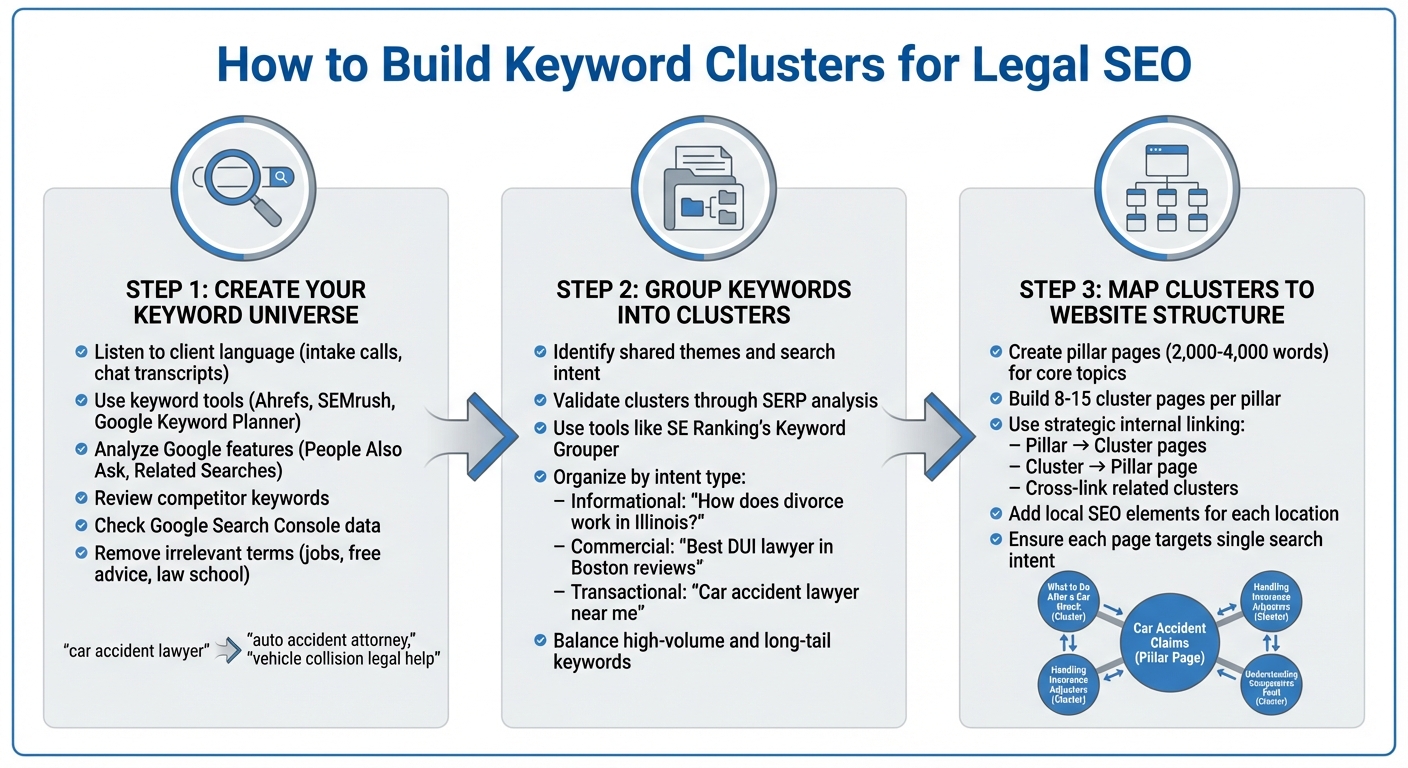
3-Step Keyword Clustering Process for Law Firms
Creating keyword clusters involves turning scattered keywords into a structured content plan that works for both search engines and potential clients. Here’s how to approach it step by step.
Creating Your Keyword Universe
Start by gathering all relevant keywords that reflect how potential clients search for legal help.
Begin with the language your clients actually use. Listen to intake call recordings, review live chat transcripts, and consider the questions your staff handles daily. Clients often avoid legal jargon. For instance, instead of "wrongful termination attorney", they might search for "fired for no reason lawyer".
Expand your list using tools like Ahrefs Keyword Explorer, SEMrush, or Google Ads Keyword Planner. These tools provide insights into search volumes, competition, and related terms. For example, a personal injury firm researching "car accident lawyer" might uncover variations like "auto accident attorney", "vehicle collision legal help", or other long-tail phrases that reflect real searches.
Utilize Google’s features, such as "People Also Ask", "related searches", and Google Trends, to capture real-time queries and seasonal patterns. For example, family law searches often increase in January, while estate planning sees a rise during tax season.
Check out your competitors’ keyword strategies using tools like SEMrush or Ahrefs. Additionally, analyze your own Google Search Console data to identify keywords where you rank on secondary pages. These can be optimized for quicker improvements with minimal effort.
Refine your keyword list by removing terms that don’t align with your practice areas or client intent. For instance, exclude phrases like "lawyer jobs", "free legal advice", or "law school requirements", as they attract traffic unlikely to convert into clients. As Sasha Berson, a Law Firm Marketing Growth Expert, explains:
"If your keyword strategy is lacking, you’ll end up wasting your marketing dollars on irrelevant traffic, generating clicks that never convert into paying clients".
Once you’ve compiled a focused list, the next step is organizing these keywords into meaningful clusters.
Grouping Keywords into Clusters
Organize your keywords by identifying shared themes and validating clusters through search engine results. When multiple keywords produce similar top-ranking URLs, it indicates that Google sees them as closely related. Tools like SE Ranking‘s Keyword Grouper can simplify this process, saving time and uncovering patterns you might miss manually.
Group keywords based on shared search intent – whether informational, investigational, or transactional. For instance, "How does divorce work in Illinois?" is informational, while "divorce lawyer near me" is transactional. These serve different stages of the client journey and require tailored content strategies.
Balance your clusters by including both competitive, high-volume keywords and easier-to-rank long-tail terms. For large keyword lists, combining automated tools with manual refinement ensures your clusters align with your practice areas and website goals.
After grouping your keywords, the next step is mapping them into a logical website structure.
Mapping Clusters to Website Structure
With your keyword clusters ready, map them to create a clear content hierarchy that showcases your expertise.
Pillar pages serve as the foundation of your structure. These are comprehensive pages (usually 2,000–4,000 words) that cover core practice areas like "Car Accident Claims", "Estate Planning", or "Intellectual Property Law." Each pillar page should include sections previewing related cluster topics, with links to detailed articles.
Cluster pages focus on specific subtopics or long-tail keywords. For example, a "Car Accident Claims" pillar might link to cluster articles like "What to Do Right After a Car Wreck", "How to Handle Insurance Adjusters After an Accident", and "Understanding Comparative Fault in Car Accident Claims." Each cluster page should address one specific question or topic.
Use internal linking strategically. Link from pillar pages to cluster articles using descriptive anchor text, ensure each cluster page links back to its pillar, and cross-link related cluster articles when topics overlap naturally. This creates a network of interconnected content that helps search engines understand your authority.
Incorporate local SEO into your structure. For firms with multiple locations, create dedicated landing pages for each location and practice area. For instance, a personal injury firm with offices in Boston and Chicago might create pages like "Personal Injury Lawyer Boston" and "Personal Injury Lawyer Chicago", including location-specific details like court procedures and state laws. For single-location firms, weave local references into your pillar and cluster content naturally.
Lastly, ensure each page targets a single, clear search intent. Pillar pages often address informational needs, cluster pages handle specific inquiries or commercial investigation, and service pages focus on transactional intent for users ready to hire. Mixing intents on one page can confuse both users and search engines, leading to lower engagement and rankings.
Maintaining and Scaling Keyword Clusters Over Time
Creating keyword clusters is just the start – you need to treat them as living, breathing assets that require ongoing attention. Search trends shift, regulations evolve, and competitors emerge, so your clusters must adapt to stay effective. Here’s how to track their performance and keep them relevant over time.
Tracking Cluster Performance
To truly understand how your keyword clusters are performing, you need to go beyond basic traffic stats. Use tools like Google Search Console, Google Analytics, and platforms such as Ahrefs or SEMrush to monitor cluster-wide performance. Instead of focusing on individual pages, look at how an entire cluster, like a "Car Accident Claims" pillar and its related pages, is driving organic traffic. If the cluster sees steady growth in visits, it’s a sign that your visibility is improving.
Keep an eye on keyword rankings within each cluster. Check whether more of your pages are appearing in search results for related terms and whether your average ranking position is climbing. For accurate results, use an incognito browser to avoid personalized search data.
Measure metrics tied directly to client actions – like form submissions, phone calls, and consultation requests – to link your SEO efforts to tangible business outcomes. Also, evaluate user engagement by tracking how many pages visitors view within a cluster. This can indicate whether your content is resonating with your audience. Interestingly, 65% of lawyers admit they’re unsure which metrics matter most in their marketing campaigns.
To stay organized, set up a straightforward dashboard that highlights key performance indicators like site traffic, traffic sources, conversion rates, and domain authority. This makes it easy to track progress at a glance.
Updating and Refining Clusters
Refreshing your top-performing content every 6–12 months is crucial. Update statistics, case studies, and legal insights to keep your material accurate and relevant. For example, personal injury law firms often need to revise content to reflect new settlements or changes in legislation.
Adding a "Last Updated" date to your pages signals to both users and search engines that your content is current. During updates, make sure to refresh attorney bios, highlight recent cases, and incorporate the language clients are using in their searches. Always have a licensed attorney review these updates to ensure accuracy.
Pay attention to seasonal trends using tools like Google Trends. For instance, DUI-related searches might surge around holidays, while divorce or estate planning queries could peak at specific times of the year. Adjust your content calendar and resources to align with these patterns.
Social listening can also help you stay ahead of emerging topics. Platforms like Reddit, Avvo, and Justia reveal how people describe their legal issues in everyday terms, offering insights into shifting search behavior. Rankings.io emphasizes this point:
"Your keyword strategy should evolve with your practice and market conditions. Regular research, performance analysis, and strategic refinement ensure your SEO efforts continue generating results as competition intensifies and search behavior changes".
Stay informed about Google’s algorithm updates, as these can significantly impact your rankings. Resources like Search Engine Land and Google’s Search Central blog can help you address technical issues or content gaps quickly.
Once your clusters are updated and optimized, make sure they’re seamlessly integrated into your overall content strategy.
Integrating Clusters with Content Strategy
Your keyword clusters should serve as the foundation for your entire content workflow. Start by identifying which clusters need the most attention – whether they’re high-volume keywords with low rankings or topics where your expertise could shine but your coverage is lacking.
Create detailed content briefs for new cluster pages. These should include the primary keyword, related terms, search intent, target word count, and necessary internal links to ensure that every piece fits into your site’s broader structure.
Develop a content calendar that balances creating new cluster content with updating existing pages. Dedicate time to both expanding and maintaining your clusters.
Adapt your clusters to match how clients search. With 10–20% of discovery traffic now coming from conversational, voice-based queries, your content should address full questions like, "What happens to my house if I don’t have a will?" rather than focusing only on short-tail keywords.
Keep an eye on your competitors using tools like Ahrefs or SEMrush. If they rank well for subtopics you haven’t covered, consider adding those topics to your content plan. Look for opportunities to create content that’s even more detailed and authoritative.
Conclusion: Using Keyword Clustering to Improve Legal SEO
Keyword clustering plays a crucial role in how search engines and AI assess legal expertise today. By grouping content around main topics and their related subtopics, you showcase in-depth knowledge that can help your firm stand out in a crowded legal market.
This approach strengthens topical authority, aligns your content with user intent, and attracts more qualified leads, ultimately boosting conversion rates. Data from the industry consistently shows that well-structured content strategies lead to measurable performance improvements.
Keyword clustering also simplifies operations. It streamlines content planning by clearly defining topics and target keywords, saving time and effort during content creation. Additionally, it supports better site organization by reducing keyword cannibalization and encouraging intentional internal linking.
Start with pillar pages as your foundation, then build 8–15 supporting cluster pages. Use internal links to connect these pages and incorporate localized content where relevant. Tools like Google Search Console and Google Analytics can help you monitor performance, focusing on metrics tied to client actions such as form submissions, phone calls, and consultation bookings.
As LawProration aptly states:
"topic clustering’s true ROI comes from qualified leads and client sign-ups".
Keeping your keyword clusters updated with market trends ensures your firm stays competitive and continues to attract valuable traffic. This structured approach fits seamlessly into a broader legal SEO strategy, driving meaningful results for your practice.
FAQs
What is keyword clustering, and how does it help improve SEO for law firms?
Keyword clustering involves grouping closely related keywords to craft content that’s more targeted and relevant. For law firms, this method plays a key role in improving SEO rankings by addressing user intent more precisely, making it easier to attract potential clients searching for specific legal services.
When you organize related keywords into clusters, you can optimize a single page for multiple search terms, elevate the quality of your content, and demonstrate to search engines that your site offers rich, well-rounded information. This not only increases your visibility in search results but also creates a better experience for users by providing content that directly matches their needs.
What challenges do law firms face when using keyword clustering for SEO?
Implementing keyword clustering for law firms comes with its own set of hurdles, largely because legal keywords are both highly specific and fiercely competitive. The legal field often involves complex jargon and topics that overlap, making it tricky to group keywords in a way that maintains a sharp focus on the content.
Another significant challenge is deciphering user intent. People searching for legal help often phrase their queries in nuanced ways. Some may be looking for general advice, others for legal representation, or even answers to very specific legal questions. To tackle this, it’s crucial to group keywords based on the specific needs of potential clients. With thorough research and the right tools, these obstacles can be addressed, leading to more precise and relevant content.
How can law firms create keyword clusters that match user search intent?
Law firms can better connect with potential clients by organizing keywords into clusters that match specific search intents. These intents generally fall into four categories: informational, navigational, transactional, and commercial. By aligning keywords with these categories, your content can more effectively address what users are searching for.
Start by analyzing the purpose behind search queries tied to your target keywords. For instance, a query like "how to file for divorce" reflects informational intent, as the user is likely seeking guidance or knowledge. On the other hand, a search for "divorce lawyer near me" shows transactional intent, signaling that the user is ready to take action and hire a professional. Grouping keywords into clusters based on these intents allows you to create content that resonates with users and aligns with their needs.
To keep up with changing search behaviors and trends, it’s important to regularly review and adjust your keyword clusters using performance data. This ongoing process ensures your content remains relevant and continues to drive results.