

TL;DR:
- Tracking local SEO involves measuring visibility across geographic points using geo-grid data, Google Business Profile insights, and monthly reports. Small businesses benefit from detailed geo-grid tracking and consistent monthly reviews to identify ranking gaps and optimize effectively. Focusing on metrics like Local Pack position and conversions helps turn data into meaningful growth.
Tracking local SEO progress means measuring your business’s visibility across specific geographic points using geo-grid data, Google Business Profile metrics, and monthly reporting to make accurate, revenue-focused decisions. The industry term for this practice is local search performance monitoring, and it goes far beyond checking a single keyword ranking. Local SEO tracking is a continuous improvement process focused on finding ranking opportunities and measuring ROI, not watching vanity metrics. For small business owners competing in tight geographic markets, knowing exactly where you rank and why is the difference between growing your customer base and losing ground to a competitor two blocks away.
How to track local SEO progress: the tools you need
The right data sources define the quality of your local SEO monitoring. Three layers of data give you a complete picture: geo-grid rank tracking, Google Business Profile (GBP) insights, and Google Analytics 4 (GA4) for post-click behavior.

Geo-grid rank trackers plot your rankings across dozens or hundreds of real-world coordinates in your service area. This gives you street-level precision that a single-point rank check cannot provide. GBP insights show calls, website clicks, and direction requests directly tied to your Google Maps listing. GA4 connects those clicks to actual on-site behavior, letting you see whether visitors from local search convert into leads or sales.
Emerging metrics are also worth watching. AI-powered visibility metrics like Share of AI Voice (SAIV) track your appearances in AI-generated answers from ChatGPT, Google Gemini, and Google AI Overviews. These complement traditional metrics like Share of Local Voice (SoLV) and Average Rank Position (ARP). They are not yet primary KPIs for most small businesses, but they signal where local search is heading.
| Data source | What it measures | Unique benefit |
|---|---|---|
| Geo-grid rank tracker | Rankings at specific coordinates | Reveals blind spots and competitor positions |
| Google Business Profile insights | Calls, clicks, direction requests | Direct local intent signals |
| Google Analytics 4 | Sessions, conversions, bounce rate | Connects rankings to revenue |
| Share of Local Voice (SoLV) | Visibility share vs. competitors | Benchmarks competitive standing |
| Share of AI Voice (SAIV) | AI answer appearances | Future-proofs visibility measurement |
Pro Tip: Connect your GBP account to GA4 using UTM parameters on your website link. This lets you track exactly how many GBP visitors convert, not just how many click through.
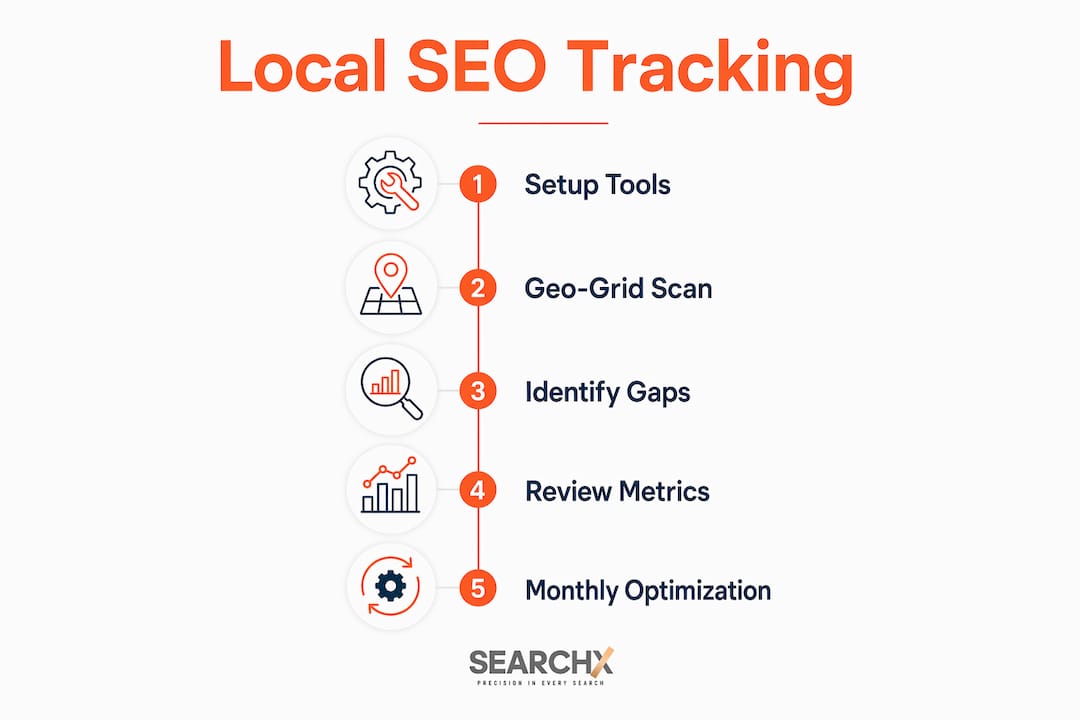
How does geo-grid tracking work for local rankings?
Geo-grid tracking is the most precise method available to analyze local search rankings at the street level. Standard grids like a 7×7 configuration cover a 6km x 6km area with 49 measurement points, with scan times under 90 seconds. That means you get a detailed ranking heatmap across your entire service area in less than two minutes.
Setting up geo-grid tracking correctly takes a few deliberate steps:
- Define your service area. Map the geographic boundaries where your customers actually come from. A plumber serving a single zip code needs a smaller grid than a landscaper covering three towns.
- Choose your grid size. Grids range from 3×3 (9 points, tight neighborhood focus) to 21×21 (441 points, large metro coverage). A 7×7 or 9×9 grid suits most small businesses.
- Set coordinate spacing. Spacing of 0.5km to 1km between points works well for dense urban areas. Wider spacing fits suburban or rural service areas.
- Run your baseline scan. Your first scan establishes the benchmark. Every future scan compares against this baseline to show movement.
- Schedule recurring scans. Monthly scans are the minimum for meaningful trend detection. Weekly scans work if you are actively running a campaign.
- Read the heatmap. Green cells show strong rankings (positions 1–3). Yellow signals mid-pack (positions 4–10). Red reveals areas where you are invisible or outranked.
Geo-grid insights reveal competitor positions and visibility gaps that raw Google dashboard data cannot show. A business might rank #1 at its own address but drop to #8 just one mile away. That blind spot costs real customers. Tracking only from a single location is misleading because hyper-local ranking gaps exist even within a few miles of your front door.
Pro Tip: After your first geo-grid scan, identify the three coordinates with the weakest rankings. Focus your next optimization cycle on those specific areas before expanding your efforts elsewhere.
Which local SEO metrics actually matter?
Measuring local SEO effectiveness requires knowing which numbers drive decisions and which ones just fill a report. The Local Pack, the top 3 Google Maps listings, generates the highest click-through rates of any local search result. Tracking your Local Pack position for your top five to ten keywords is the single most important measurement you can make.
Beyond Local Pack position, these metrics deserve regular attention:
- GBP views: Total impressions on your Google Maps listing. Rising views with flat calls suggest a title or description problem.
- Direction requests: A direct signal of purchase intent. Someone asking for directions is almost always ready to visit.
- Phone calls from GBP: The clearest conversion metric available in GBP insights. Track this monthly, not daily.
- Impressions vs. clicks in Search Console: High impressions with low clicks point to a title or content issue. Low impressions point to a core ranking problem. Distinguishing these two scenarios prevents wasted optimization effort.
- Share of Local Voice (SoLV): Your percentage of total local pack appearances for a keyword set compared to competitors. This is the best competitive benchmark available.
| Metric | What a problem looks like | Likely fix |
|---|---|---|
| Local Pack position | Ranking #4 or lower consistently | Build citations, earn reviews, improve GBP completeness |
| High impressions, low clicks | CTR below 5% for local queries | Rewrite GBP title and primary category |
| Low impressions | Ranking outside top 20 | Address technical SEO and local content gaps |
| Direction requests flat | No growth over 3 months | Run a geo-targeted Google Business post campaign |
AI-powered metrics like SAIV are worth monitoring as a secondary layer, especially as AI Overviews claim more screen space in Google results. They do not replace traditional metrics yet, but they add context about where your brand appears in AI-generated answers.
Pro Tip: Pull your 12 core localization metrics into a single monthly dashboard. Reviewing everything in one session prevents the distraction of reacting to individual data points out of context.
How to build a monthly local SEO review workflow
A sustainable monthly cadence is the most practical way to monitor local SEO performance without burning out or making reactive changes. Monthly reporting spots genuine trends and prevents counterproductive over-tinkering that daily or weekly check-ins often trigger.
A reliable monthly workflow looks like this:
- Run your geo-grid scan on the same date each month. Consistency in timing removes seasonal noise from your comparisons.
- Pull GBP insights for calls, clicks, direction requests, and photo views. Compare month over month, not day over day.
- Check GA4 organic sessions from local search. Use the organic traffic report in GA4 to isolate local landing page performance.
- Review Search Console for your top local queries. Flag any keywords where impressions dropped more than 20% month over month.
- Identify one specific action item. Pick the single highest-impact change you can make this month. Examples include adding five new photos to GBP, responding to all unanswered reviews, or updating a local service page with a new FAQ section.
- Log your change with a date. This creates a record so you can measure 30, 60, and 90-day impact in future scans.
The one-action-per-month rule is not a limitation. It is a discipline. Businesses that change five things at once cannot tell which change moved the needle. Businesses that change one thing learn exactly what works in their specific market.
Your local SEO checklist should also include a quarterly review of your citation consistency across directories, your review velocity on Google, and your GBP category accuracy. These slower-moving factors rarely need monthly attention but can quietly drag down rankings if ignored.
Pro Tip: Set a 90-minute calendar block on the same day each month for your SEO review. Treat it like a financial review. Businesses that schedule it complete it. Businesses that do it “when they have time” rarely do.
Key Takeaways
Tracking local SEO progress requires geo-grid monitoring, consistent GBP metric review, and a monthly optimization cadence to turn data into real ranking improvements.
| Point | Details |
|---|---|
| Use geo-grid tracking | Map rankings across dozens of coordinates to find blind spots a single-point check misses. |
| Prioritize Local Pack position | The top 3 Google Maps listings generate the highest click-through rates for local searches. |
| Separate impressions from clicks | High impressions with low clicks signal a content issue; low impressions signal a ranking problem. |
| Adopt a monthly cadence | Monthly reporting reveals genuine trends without triggering reactive, counterproductive changes. |
| Pick one action per month | Changing one thing at a time shows you exactly what moves the needle in your market. |
What I have learned from tracking local SEO for small businesses
Most small business owners check their Google ranking once, feel good or bad about it, and move on. That single data point tells you almost nothing useful. The businesses I have seen grow their local visibility consistently share one habit: they track rankings across their entire service area, not just at their front door.
Geo-grid data is the single biggest shift in how I think about local SEO measurement. Before it, a business could rank #1 at its own address and have no idea it was invisible to customers searching from the other side of town. That is a real revenue gap hiding in plain sight. Geo-grid tracking exposes those blind spots and shows exactly which competitor is winning the customers you are missing.
The other mistake I see constantly is reacting to daily ranking changes. Rankings fluctuate for dozens of reasons that have nothing to do with your SEO. Google tests results, user behavior shifts, and competitors make small changes. None of that requires your immediate response. A monthly review rhythm keeps you focused on patterns, not noise.
Lorenz Esposito, CEO of SearchX, puts it directly: “The businesses that win local search are not the ones checking their rankings every day. They are the ones who measure the right things monthly, make one deliberate improvement, and let the data confirm what works. That discipline is what separates growing businesses from ones that spin their wheels.”
The local SEO metrics that link to marketing ROI are always the ones tied to customer actions: calls, direction requests, and conversions. Rank is a means to an end. Keep your eye on what rank produces.
— SEO
SearchX resources for local SEO tracking and growth
Local SEO tracking is only as good as the keywords you are tracking and the strategy behind them. SearchX helps small business owners identify the local keywords that actually drive calls and visits, not just impressions.

The SearchX keyword research guide walks you through finding high-intent local terms that map directly to your service area and customer intent. Pair that with the search intent analysis framework to make sure your local pages answer exactly what nearby customers are searching for. If you want a team that builds and manages this tracking system for you, contact SearchX to talk through what a custom local SEO strategy looks like for your business.
FAQ
What is geo-grid rank tracking?
Geo-grid rank tracking measures your search rankings at dozens or hundreds of real-world coordinates across your service area. A standard 7×7 grid covers a 6km x 6km area with 49 measurement points, revealing ranking gaps that single-location checks miss.
How often should I check my local SEO rankings?
A monthly review cadence is the recommended standard for most small businesses. Daily or weekly checks create noise and often trigger reactive changes that do not improve performance.
What is Share of Local Voice (SoLV)?
Share of Local Voice measures the percentage of Local Pack appearances your business earns for a set of keywords compared to competitors. It is the most direct competitive benchmark in local search monitoring.
Why do my rankings differ by location?
Local search rankings vary by the searcher’s physical location. A business can rank #1 near its address and rank #8 one mile away. Geo-grid tracking maps these variations so you can target the areas where you are losing customers.
What does high impressions but low clicks mean for local SEO?
High impressions paired with low clicks signal a title or content issue on your listing or page, not a ranking problem. Rewriting your GBP business title, primary category, or page meta description typically resolves this gap.