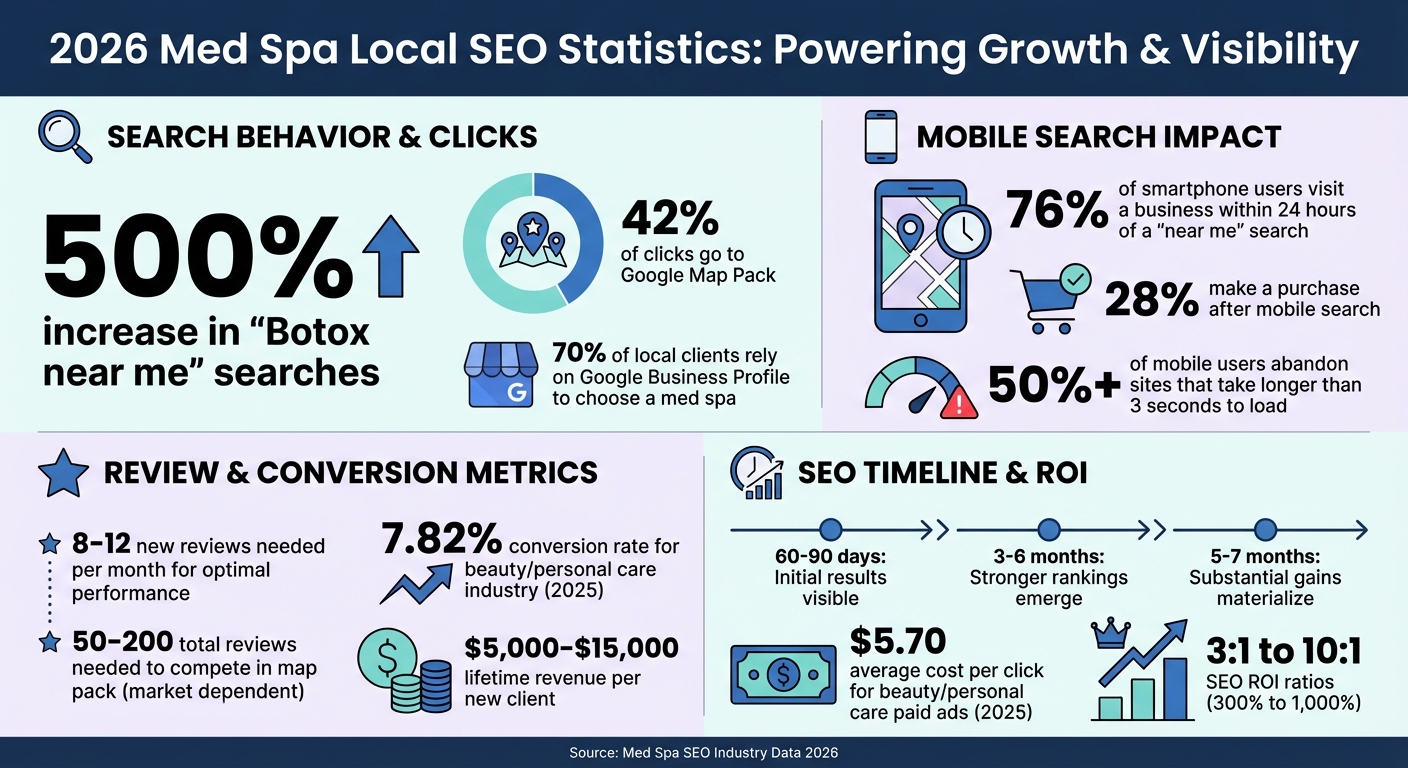
If your med spa isn’t ranking in the top three local search results, you’re missing out on nearly half of potential clients. With searches like "Botox near me" increasing by 500%, standing out with medical spa SEO is more important than ever. Here’s what you need to know:
- Google Map Pack captures 42% of clicks: Being in the top 3 local results is critical.
- Mobile "near me" searches drive action: 76% of smartphone users visit a business within 24 hours, with 28% making a purchase.
- AI tools like ChatGPT are reshaping search: Local SEO now influences AI-driven recommendations.
To succeed, focus on optimizing your Google Business Profile, targeting high-intent keywords, creating dedicated service pages, and maintaining consistent reviews. These strategies help build visibility, attract high-value clients, and drive sustainable growth.
Let’s dive into how to make it happen.
Med Spa Local SEO Statistics 2026: Search Behavior and Conversion Data
How To Beat Competition with Google Maps 3-Pack | Moving The Needle | Local SEO for MedSpa
Google Business Profile Optimization for Local Search
Your Google Business Profile (GBP) is often the first thing potential clients notice when they search for services like "Botox near me" or "laser hair removal" in your area. With around 70% of local clients relying on GBP to choose a med spa, making sure your profile stands out is essential. Think of it as your digital storefront – especially now, as tools like ChatGPT and Google’s AI Overviews pull data directly from these profiles to recommend local providers.
"Your Google Business Profile is not ‘set it and forget it.’ It’s an active SEO machine that can bring dozens of booked appointments each month." – Jennifer Orechwa, Salt Marketing
Setting Up and Optimizing Your Profile
Start by setting your primary category to "Medical Spa" to align with the high-intent searches your ideal clients are performing. Then, add up to nine secondary categories such as "Laser Hair Removal Service", "Skin Care Clinic", and "Cosmetic Surgery Clinic" to capture more specific treatment-related searches.
Consistency is key when it comes to your NAP (Name, Address, Phone). Ensure the information matches exactly across your GBP, website, Yelp, Healthgrades, and other directories. Even a small inconsistency like "Suite 200" versus "Ste 200" can negatively impact your rankings.
In the services section, list each treatment individually. For example, instead of grouping everything under "Injectables", create separate entries for "Botox Injections", "Dermal Fillers", and "Lip Filler." Use the full 750-character limit to describe each service, incorporating the treatment name and your city for better local SEO.
Photos are more impactful than you think. Profiles with 100+ images tend to generate far more direction requests and website clicks compared to those with fewer photos. Upload 5–10 high-quality photos weekly, showcasing your treatment rooms, staff in action, equipment, and real client results. Avoid stock photos – both Google and potential clients can spot them a mile away.
Using Google Business Profile Features
Take advantage of GBP features to engage potential clients. Post weekly updates about promotions, equipment upgrades, or treatment insights. Use the Q&A section proactively by adding and answering common questions like "Do you offer payment plans?" or "What’s the downtime for laser treatments?" Answer these from your business account to provide immediate value to prospects.
Enable Google Business Messages to let clients text you directly. Responding within five minutes can significantly boost conversion rates. Add attributes such as "Wheelchair accessible", "LGBTQ+ friendly", and "Appointment required" to help clients find and filter options that suit their needs.
To encourage reviews, place QR codes at your checkout desk that link directly to your review form. This makes it easy for satisfied clients to share feedback while their experience is still fresh.
Monitoring Performance with Profile Insights
Keep an eye on the "Search Queries" report in GBP Insights to see which treatments are driving the most traffic. For example, if "lip filler" is outperforming "Botox", adjust your service descriptions and posting strategy to focus more on what’s working. Metrics like direction requests, website clicks, and direct calls also provide valuable clues about what’s resonating with potential clients.
To track bookings more effectively, add UTM tracking codes to your GBP website link. This allows you to use Google Analytics to see exactly how many appointments are coming from your profile. By analyzing this data, you can refine your approach and focus on the features that are converting visitors into clients.
| GBP Feature | Recommended Frequency | Impact on Ranking |
|---|---|---|
| Photo Uploads | Weekly | High (Prominence) |
| Google Posts | Weekly | Medium (Relevance/Freshness) |
| Review Responses | Within 48 Hours | High (Trust/Prominence) |
| Q&A Updates | Monthly/As Needed | Medium (Relevance) |
| Service List Audit | Quarterly | High (Relevance) |
Keyword Research for Botox, Fillers, and Laser Treatments
When it comes to keyword research for med spas, it’s all about finding phrases that show intent to book rather than just chasing high search volumes. A query like "Botox for forehead lines in [Your City]" signals someone is ready to take action.
"The right keywords do not just bring traffic. They bring patients who are ready to book." – NeurDigital
Finding Local and Treatment-Specific Keywords
Start by categorizing keywords based on search intent. For example, informational searches like "What is microneedling?" attract people looking for knowledge, while transactional queries like "Book Botox near me" show they’re ready to schedule an appointment. Localized searches, such as "Medspa in Chicago" or "lip filler cost in [Your City]", combine intent with location, making them especially valuable.
Google Autocomplete is a great tool to uncover hyper-specific phrases that people in your area are searching for. You might discover terms like "Botox for crow’s feet near [Landmark]" or "Botox cost in [Neighborhood]" that more general tools might overlook.
In competitive metro areas, hyper-local targeting can set you apart. Instead of going after broad terms like "Botox in Austin", focus on specific neighborhoods, such as "Botox in West Lake Hills" or "Botox near The Domain." Google’s local algorithm now prioritizes results at a hyper-local level, which can help you rank in the Maps 3-pack [13, 14].
Don’t overlook Google’s "People Also Ask" section. This feature can reveal long-tail keywords like "How long does Botox last?" or "Does lip filler hurt?" that you can target with FAQs or blog content.
Review your Search Console data for "quick-win" keywords – those with high impressions but low click-through rates. Tweaking title tags and meta descriptions for these terms can help you capture more traffic [1, 13]. This kind of precise keyword targeting is key to building service pages that convert.
Tools for Keyword Analysis
After identifying localized keywords, refine your strategy using specialized tools. Services like SearchX’s keyword research services focus specifically on med spas, helping you pinpoint treatment-related keywords with booking potential. Unlike generic tools, these services emphasize local modifiers and service-specific combinations.
Free tools like Google Search Console can show you the queries already bringing traffic to your site, letting you fine-tune your content strategy. For deeper analysis, platforms like Ahrefs or Semrush (costing $99 to $999 per month) allow you to reverse-engineer competitor strategies. If budget is a concern, Ranktracker offers similar features starting at $19 per month [11, 13]. To visualize your local rankings, Local Falcon provides a grid view of your performance on Google Maps, which is especially helpful for tracking your reach.
| Tool | Primary Use Case | Price Range |
|---|---|---|
| SearchX | Med spa-specific keyword research and analysis | Contact for pricing |
| Google Search Console | Tracking actual search queries and ranking opportunities | Free |
| Ahrefs / Semrush | Competitor research and keyword volume analysis | $99 – $999/mo |
| Ranktracker | Monitoring keyword rankings and finding local terms | $19 – $200+/mo |
| Local Falcon | Visualizing local ranking radius on a grid | Varies |
Targeting Long-Tail Keywords
Once you’ve identified your keywords, focus on long-tail phrases that align with natural search patterns. Phrases like "Botox for crow’s feet near me" or "microneedling for acne scars in [City]" often face less competition and attract high-intent users. While broad terms like "Botox" are dominated by national brands with massive budgets, long-tail keywords let you compete on relevance.
These specific phrases also align with how people speak, especially with the rise of voice search. Someone is more likely to ask, "Where’s the best med spa near me for lip filler?" than just search "lip filler". Optimizing for conversational phrases positions your med spa to capture this growing audience.
For treatments like laser hair removal, refine your targeting by addressing specific needs. For instance, use phrases like "laser hair removal for dark skin in [City]" or "laser hair removal in [Neighborhood]" [11, 12].
To maximize results, create dedicated landing pages for each long-tail keyword cluster. A page optimized for "double chin treatment in [City]" will perform better than a generic "body contouring" page because it directly matches the searcher’s query. Aim for 600–800 words per page to provide enough context for search engines.
Lastly, consider the competitive landscape. The beauty and personal care industry boasted conversion rates of 7.82% in 2025 – far above the 2–3% average in other sectors. By targeting specific, long-tail keywords that address client needs, you not only drive traffic but attract high-value visitors. Each new client could represent $5,000 to $15,000 in lifetime revenue.
On-Page SEO for Service Pages
Once you’ve identified the right keywords, it’s time to create dedicated service pages to improve your rankings. Avoid cramming all your treatments onto a single page. For example, a page trying to rank for "Botox near me" won’t perform well if it’s also targeting keywords like "laser hair removal", "CoolSculpting", and "microneedling" all at once. Instead, each primary treatment should have its own page with a clear URL structure, such as /botox, /dermal-fillers, or /laser-hair-removal.
How to Structure Service Pages
Start your page with a clear and targeted H1 heading that combines the treatment, location, and a key benefit. For instance: "Botox in [City Name] for Natural-Looking Results." This helps Google understand the page’s focus while aligning with common search queries. Use H2 headings to organize content into sections like the treatment process, benefits, and FAQs. For more specific details, such as individual treatment areas, use H3 headings (e.g., "Botox for Forehead Lines" or "Botox for Crow’s Feet").
Place your phone number and a prominent call-to-action – like "Book Now" or "Schedule a Consultation" – at the top of the page. This makes it easy for visitors to take action.
Aim for at least 800 words per page, as longer content (up to 1,500 words) often performs better by providing enough detail for search engines. Avoid thin content or duplicate text, as these can hurt your rankings. Make sure each service page has a unique title tag, H1, and well-rounded content.
Adding client testimonials and before-and-after galleries can increase conversions by building trust. Videos showing the treatment process can also boost engagement, keeping visitors on the page longer – a factor that can positively influence rankings.
Once your structure is in place, focus on creating content that turns visitors into clients.
Writing Content That Converts
Your service page should answer the key questions potential clients are likely to ask. Cover areas like how the treatment works, pricing, how many sessions are needed, and what the recovery process looks like. Organize your content to guide visitors through their decision-making journey – from learning about the treatment to scheduling an appointment. This approach not only satisfies search intent but also strengthens your local SEO strategy.
When adding images, name the files descriptively and include alt text that clearly describes the treatment and the targeted body area. Additionally, use schema markup to help search engines better understand your content.
A great example of this strategy in action comes from Aurora Medical Spa in Missouri. Between 2023 and 2024, they partnered with Studio 3 Marketing to overhaul their web content. By doubling their content volume and targeting high-value keywords, they saw a 199% increase in website traffic within six months. This success was driven by detailed, patient-focused content that answered real questions instead of just listing services.
Internal Linking Strategies
Content alone isn’t enough – how you link your pages also plays a big role in boosting your site’s authority. Dedicated service pages not only improve user experience but also enhance search rankings. Internal links help users navigate your site while signaling to search engines which pages are most important. Ensure your homepage links to all core service pages, and make every page accessible within two clicks.
Use contextual links to connect related treatments. For example, if someone is reading about microneedling, link to your PRP (Platelet-Rich Plasma) page since these treatments are often complementary. Similarly, blog posts like "Botox vs. Dysport" should link back to your Botox service page using descriptive anchor text, such as "professional Botox treatments in [City]." Avoid generic phrases like "click here."
This strategy not only builds topical authority by showcasing expertise but also passes link equity from high-performing pages (like popular blogs) to deeper service pages. Just be sure to integrate links naturally into the text, rather than forcing them into headings.
| Primary Service Page | Link To | Purpose |
|---|---|---|
| Botox Injections | Dermal Fillers / Dysport | Comparison and complementary treatments |
| Microneedling | PRP Treatments / Chemical Peels | Related skin rejuvenation services |
| Laser Hair Removal | IPL Photofacial | Related light-based therapies |
| CoolSculpting | Body Contouring / Skin Tightening | Related body aesthetic goals |
| Homepage | All Core Service Pages | Establishing primary site hierarchy |
Technical SEO and Local Schema Markup
Even the most polished service pages won’t succeed if Google can’t properly crawl or interpret them. Technical SEO lays the groundwork for everything else to function effectively.
"Doing the dishes doesn’t make your house more valuable; it just ensures it isn’t a disaster." – Ricky Shockley, Med Spa Magic Marketing
Fixing technical issues alone won’t skyrocket your rankings, but ignoring them will almost certainly hold you back.
Mobile Optimization and Site Speed
Most people browsing your site will be doing so on a mobile device. If your site isn’t mobile-friendly or takes more than 3 seconds to load, you risk losing those potential clients. With Google’s mobile-first indexing, your mobile site is the primary version Google evaluates for rankings. Plus, over 50% of mobile users abandon websites that take longer than 3 seconds to load [1, 13].
To meet this standard, focus on:
- Compressing images to reduce file sizes.
- Enabling lazy loading so images load only when needed.
- Using a Content Delivery Network (CDN) to speed up delivery.
Make sure your site is easy to navigate on smaller screens by testing your site for mobile-first indexing. Buttons should be large enough to tap, text should be legible without zooming, and forms should be straightforward to complete.
Once your site performs well on mobile, take the next step by helping Google better understand your business with structured data.
Adding Local Business Schema Markup
Schema markup is like a cheat sheet for Google, explaining exactly what your business does and where it’s located. For med spas, using the LocalBusiness schema – or a more specialized option like MedicalBusiness or HealthAndBeautyBusiness – can define critical details such as your name, address, phone number, hours, and services [2, 7, 13].
Embed JSON-LD code on your site that includes:
- Business name, address, and phone number (NAP)
- Operating hours
- Geographic coordinates
For treatment-specific pages (e.g., Botox or dermal fillers), include Service schema that outlines the treatment name, a brief description, and your city. This helps Google connect your pages to searches like "Botox near me" or "laser hair removal in [City]."
If you collect client reviews, consider adding an AggregateRating schema to display star ratings directly in search results, which can improve click-through rates. Ensure your schema’s NAP matches exactly with your Google Business Profile and other directories. Once implemented, use Google’s Rich Results Test to validate your schema and fix any errors.
"Schema markup provides that structure – helping Google know exactly who you are, what you offer, where you are, and why your content matters." – Gatha Kher
For step-by-step guidance, check out how to add local business schema markup.
After setting up your schema, it’s time to tackle other technical SEO challenges that could be holding you back.
Resolving Technical SEO Problems
Even with excellent content and schema, technical issues can quietly undermine your rankings. One frequent problem is keyword cannibalization – when multiple pages target the same keyword, causing Google to struggle with ranking them correctly. For example, if both your Botox service page and a blog post target "Botox in [City]," they could end up competing against each other. Use the search operator site:yourwebsite.com "Botox in [City]" to find overlapping pages, then consolidate them into one authoritative resource.
To avoid confusion, create separate URLs for each treatment, like /botox, /dermal-fillers, and /laser-hair-removal [1, 3, 15]. Regular audits with tools like Screaming Frog or Sitebulb can help identify broken links, duplicate tags, and crawl errors. Address 404 errors by redirecting outdated URLs, and keep your sitemap updated in Google Search Console [1, 13].
"The difference between ranking third and thirteenth is the difference between a full calendar and empty treatment rooms." – Mohanraj Reddy, Kolavi Studio
If you’re unsure where to start, performing a technical SEO audit can help pinpoint and resolve these issues effectively.
Reviews and Local Citations for Med Spas
Reviews are a powerful way to showcase your med spa’s credibility and play a major role in local rankings. At the same time, consistent NAP (Name, Address, Phone Number) citations across directories confirm your business’s legitimacy. Together, these elements work hand-in-hand with your optimized Google Business Profile to solidify your med spa’s local presence. When reviews and citations are active and consistent, they help search engines like Google – and even AI tools – rank your business higher for searches like "Botox near me" or "laser hair removal in [City]." This approach complements the medical SEO strategies discussed earlier, creating a well-rounded local SEO strategy.
"If local SEO were a game, reviews would be the scorecard." – Jennifer Orechwa, Salt Marketing
Getting More Client Reviews
Having a consistent flow of reviews is essential. Aim for 8–12 new reviews each month, as this signals to search engines that your med spa is active and trusted. To compete in the map pack, you’ll need at least 50 reviews, but in highly competitive areas, you might need anywhere from 100 to 200 reviews.
To encourage reviews, send requests via SMS or email within 48 hours of a client’s visit while their experience is still fresh. Automating this process can save time and ensure consistency. You can also place QR codes at your front desk or in treatment rooms to make it easier for clients to leave feedback. When asking for reviews, suggest that clients mention the specific treatment they received – such as "Botox" or "fillers." This not only personalizes their feedback but also helps Google associate your business with relevant keywords. However, avoid offering incentives like discounts or gifts in exchange for reviews, as this violates Google’s guidelines.
Responding to Negative Reviews
Responding to all reviews – positive and negative – shows engagement and is a known ranking factor. For negative reviews, respond professionally and aim to address the issue within 48 hours. Acknowledge the client’s concerns without being defensive, and invite them to continue the conversation privately. For example, you could say: "We’re sorry to hear about your experience. Please contact us directly so we can address your concerns." This approach not only helps resolve issues but also demonstrates your commitment to customer service.
Maintaining Consistent Business Listings
Consistency is key when it comes to your business listings. Your NAP details must be identical across all platforms, as even small discrepancies – like using "Suite" on one site and "Ste" on another – can hurt your rankings. Beyond your Google Business Profile, ensure your med spa is listed on key directories, especially those specific to the medical or aesthetic industry. Platforms like RealSelf, Healthgrades, Zocdoc, Vitals, and the American Med Spa Association directory are excellent options to expand your visibility and reinforce trust signals to Google.
| Directory Type | Key Platforms for Med Spas |
|---|---|
| General Local | Google Business Profile, Yelp, Facebook |
| Medical/Physician | Healthgrades, Zocdoc, Vitals, WebMD |
| Aesthetic Specific | RealSelf, American Med Spa Association (AmSpa) |
| Local Authority | Chamber of Commerce, local business associations |
Measuring SEO Performance and ROI
After optimizing your Google Business Profile, building citations, and gathering reviews, the next step is figuring out if your SEO efforts are actually bringing in clients and revenue. Without tracking, you’re essentially flying blind. Measuring your SEO performance means focusing on the right metrics, using the right tools, and having a clear framework for calculating ROI. This ensures all the work you’ve put into optimizing your strategy translates into actual results.
Key SEO Metrics to Track
Start by monitoring organic traffic and sessions on your treatment pages with Google Analytics. This will show you how many visitors land on pages for services like Botox, fillers, or laser hair removal each month. Keep an eye on keyword rankings, especially for high-intent local terms like "Botox near me" or "laser hair removal [city]" in both organic search and the Google Map Pack. Google Search Console can help you track impressions and your click-through rate (CTR), which reveals how often your med spa appears in search results and how many users click through to your site.
Conversion rates are another critical metric. In 2025, the beauty and personal care industry saw an impressive conversion rate of 7.82%, far exceeding the 2–3% average in other industries. Track how many visitors complete bookings or submit inquiry forms. Google Business Profile insights can also provide data on "hard" local actions like phone calls, direction requests, and website clicks from your listing. Don’t forget to monitor review velocity and sentiment – how many new reviews you’re getting each month and your overall star rating can directly influence local rankings.
Tools for Tracking SEO Results
Several tools can make tracking SEO results easier. Google Search Console is a free resource for identifying traffic-driving keywords and spotting quick-win opportunities for pages ranking between positions 8 and 20. Pair it with Google Analytics to measure conversions on booking pages. For a more localized view, tools like Local Falcon provide a grid-based ranking map, showing how your med spa ranks in different areas near you. Since most local searches for med spas happen on mobile devices, Google PageSpeed Insights can help you keep an eye on mobile load speeds, which is crucial. To stay on top of algorithm changes, review these metrics monthly.
SearchX offers performance tracking tools and technical SEO services to help med spas refine their strategies. With the right tools and metrics, you’ll have a clear picture of how your SEO efforts are driving revenue.
Calculating SEO Return on Investment
To calculate SEO ROI, use the formula:
((Total Revenue – Total Spend) / Total Spend) × 100.
A ratio of 3:1 (300% ROI) is considered the minimum benchmark, while 4:1–6:1 is solid, and 10:1 (1,000%) is outstanding. For context, one new client can bring in $5,000–$15,000 in lifetime revenue. To calculate Customer Lifetime Value (CLV), use this formula:
(Average Spend Per Visit) × (Visits Per Year) × (Average Patient Lifespan in Years).
These calculations help confirm that your SEO efforts – whether it’s optimizing your Google Business Profile or focusing on targeted service pages – are delivering measurable results. Compare your SEO spend to the cost of acquiring the same traffic through paid ads. For instance, in 2025, the average cost per click for beauty and personal care ads was $5.70. Many med spas notice initial results within 2–3 months, with more substantial gains happening around months 5–7 as SEO momentum builds. For a more detailed breakdown, check out SearchX’s guide on how to measure SEO ROI from organic traffic growth.
In early 2026, Diamond Aesthetics in New York City pivoted from expensive Google and Instagram ads to focusing on organic search strategies. By automating local SEO and improving lead follow-up, they replaced their ad spend with a steady flow of high-value organic clients, achieving consistent monthly profits without overspending on ads.
"I’m not tech-friendly. I don’t know what SEO means. But I know I’m making profit – and that’s what matters." – Diamond Aesthetics owner
Conclusion: Building Your Med Spa SEO Strategy
Securing top rankings for Botox, fillers, and laser treatments in 2026 boils down to three key factors: an optimized Google Business Profile (GBP), dedicated service pages for every treatment, and a steady stream of fresh reviews. It’s not about having the deepest pockets – it’s about consistent effort. Google favors businesses that stay active. Regular GBP updates, structured schema markup, and collecting 8–12 new reviews each month signal to search engines that your med spa is trustworthy and relevant.
The problem isn’t a lack of knowledge; it’s a lack of consistency. Many med spas falter because they stop updating their profiles, let their listings become outdated, or abandon their content strategies too soon. SEO is a gradual process: you’ll see early results in 60–90 days, with stronger rankings emerging after 3–6 months. Considering that one client could bring in $5,000–$15,000 in lifetime revenue, maintaining those top local search positions is a smart move for sustainable growth.
But as you work on these updates, keep in mind that search itself is evolving. AI-driven tools like ChatGPT and Perplexity are changing the game. By 2026, these tools will prioritize businesses with frequently updated, clear, and well-structured local content. This shift – called Generative Engine Optimization (GEO) and Answer Engine Optimization (AEO) – means your med spa needs to provide accurate, well-cited, and regularly refreshed information to stay ahead.
"The defining word for 2026 is Authenticity. Whether it’s Google or an AI engine, these tools are getting better at finding the most reputable, trustworthy businesses." – Ricky Shockley, Owner, Med Spa Magic Marketing
SearchX can help lighten the load with technical SEO services, keyword research, and DIY local SEO tools. These tools automate tasks like managing your listings, posting weekly updates to your GBP, and sending review requests – letting you focus on what matters most: delivering exceptional patient care.
FAQs
How do I choose which treatments to create service pages for first?
To maximize local visibility and attract more clients, prioritize service pages for treatments that drive the most interest and bookings – like Botox, fillers, and laser treatments. Start by fine-tuning your Google Business Profile with precise and up-to-date service details. Then, develop location-specific pages for these key treatments.
This strategy not only helps you connect with high-intent local clients but also strengthens your local SEO performance, setting the stage for increased visibility and more appointments in 2026.
What should I do if my med spa isn’t showing in the Google Map Pack?
If your med spa isn’t showing up in the Google Map Pack, start by making sure your Google Business Profile is fully filled out and accurate. Include detailed information, high-quality photos, and a complete list of your services.
Work on getting consistent 5-star reviews from happy clients, as these can significantly boost your local ranking. Additionally, build local backlinks by connecting with other businesses or organizations in your area. Don’t forget to post regular updates to keep your profile active and engaging.
Make it simple for potential clients to book directly from the search results. Finally, track your progress every month. Use this data to tweak and improve your strategy, helping your med spa gain better visibility over time.
How can I track bookings that come from my Google Business Profile?
To keep tabs on bookings from your Google Business Profile, you can use unique tracking URLs or UTM parameters in your appointment links. By linking these to a platform like Google Analytics, you’ll gain insights into their performance. Additionally, some booking systems allow you to assign appointments to specific channels, including your Google Business Profile. This makes it easier to see exactly how many bookings are coming straight from your profile.