
Google Reviews are a key driver for dental clinic growth. They influence patient trust, decision-making, and online visibility. Here’s why they matter:
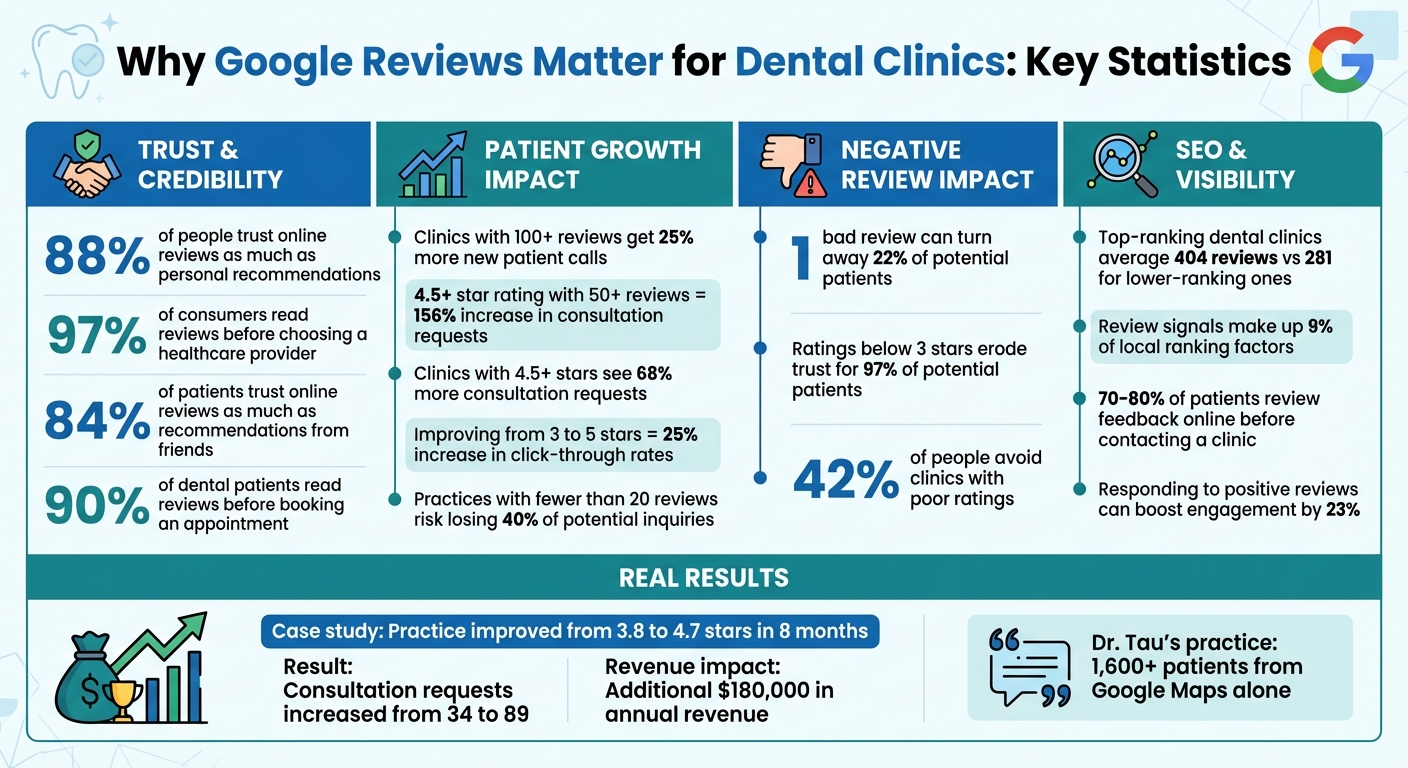
- Trust and Decisions: 88% of people trust online reviews as much as personal recommendations, and 97% read reviews before choosing a healthcare provider. A high number of reviews and strong ratings build credibility.
- Patient Growth: Clinics with 100+ reviews get 25% more new patient calls. A 4.5+ star rating with 50+ reviews can increase consultation requests by 156%.
- Local SEO: Google prioritizes clinics with frequent, high-quality reviews in local search results, helping you rank higher and attract more patients.
- Engagement: Responding to reviews – both positive and negative – boosts patient confidence and increases inquiries.
To succeed, ask satisfied patients for reviews, respond professionally, and monitor feedback regularly. Clinics that prioritize reviews see measurable growth in patient calls, bookings, and revenue.
Google Reviews Impact on Dental Clinic Growth: Key Statistics
How Google Reviews Affect Patient Trust and Decisions
How Positive Reviews Build Patient Confidence
When it comes to choosing a healthcare provider, patients heavily depend on online reviews to assess quality. These reviews essentially become your digital reputation, shaping trust even before a patient reaches out to your clinic. In fact, 84% of patients trust online reviews as much as personal recommendations from friends. That’s a powerful statement about how reviews can serve as evidence of reliability and the standard of care you provide.
The number of reviews and their star ratings are critical. A practice boasting 200+ five-star reviews instantly appears more trustworthy than one with just 15 reviews, even if both have similar average ratings. Why? A high volume of reviews signals consistency in delivering quality care. Detailed reviews also play a vital role. Comments that highlight specific treatments, staff members, or outcomes – like "Dr. Martinez explained every step of my root canal and made me feel at ease" – carry more weight than a simple "Great dentist!" These specifics paint a clear picture of what patients can expect, offering authenticity and reassurance. This, in turn, drives patient engagement and prompts potential patients to reach out.
"Most people now view a Google review as credible as a personal recommendation from a friend." – Brandon Groves
This kind of detailed feedback doesn’t just build trust – it actively influences patient decision-making, as we’ll explore below.
How Reviews Shape Patient Behavior
Once trust is established, reviews start to steer patient behavior. People compare clinics by reading reviews about factors like convenience, affordability, staff professionalism, and overall environment. Interestingly, even a practice with a slightly lower rating can attract more attention if it has a significantly higher number of positive reviews.
Recent reviews are especially important. For instance, fifty fresh reviews often outweigh a larger number of older ones in a patient’s eyes. They signal that your practice is currently delivering excellent care. Additionally, how you respond to reviews – both good and bad – matters a lot. Thoughtful and professional responses show that you value patient feedback and are committed to their satisfaction. This not only builds further trust but also encourages more patients to book consultations, ultimately driving the growth of your practice.
SEO Benefits of Google Reviews for Dental Clinics
Google Reviews as a Local SEO Ranking Factor
When it comes to local SEO, patient reviews now hold more weight than traditional factors like website optimization or how long your site has been active. For example, if someone searches for "dentist near me" or "cosmetic dentist in [city]", Google evaluates your clinic based on review signals. These include the number of reviews, how frequently new ones are added, overall star ratings, and even specific keywords used in the reviews. Together, these factors help Google determine if your practice is trustworthy, active, and relevant to searchers’ needs.
Here’s a telling statistic: top-ranking dental clinics with multiple locations average 404 reviews, compared to just 281 for those lower in the rankings. Review signals make up about 9% of local ranking factors and play a crucial role in boosting your visibility in Google’s Maps and local pack results. This is tied to Google’s "prominence" signal, which works alongside relevance and distance to determine rankings.
How Reviews Increase Click-Through Rates and Engagement
Beyond helping your clinic rank higher, a strong review profile can significantly enhance user engagement. For instance, improving your star rating from 3 to 5 stars can lead to a 25% increase in click-through rates. On the flip side, a rating below 3 stars erodes trust for 97% of potential patients.
The numbers back this up. Dr. Tau’s dental practice, for example, gained over 1,600 patients through Google Maps alone. In fact, Google Maps outperformed all other patient acquisition sources by 50%. Additionally, 70–80% of patients review feedback online before contacting a dental clinic – even if they were referred. When potential patients come across a well-maintained review profile with recent, high ratings, they’re far more likely to call, book an appointment, and choose your clinic.
Common Google Review Challenges for Dental Clinics
Low Review Volume and Visibility Problems
Having too few or outdated reviews can hurt your clinic’s reputation and reduce its online presence. When potential patients come across only a small number of old reviews, they’re more likely to pick a competitor with more recent feedback.
One reason for low review volume is that patients often don’t take the time to leave reviews. Busy schedules and the absence of easy-to-use tools – like QR codes or in-office tablets – make it less likely for them to share their experiences. On the clinic’s side, concerns about HIPAA regulations and patient confidentiality may discourage staff from actively asking for reviews, which leaves the practice with a sparse review profile.
But low review volume isn’t the only issue – handling negative reviews is another major challenge.
How to Handle Negative Reviews
Just one bad review can make a big impact. It can turn away up to 22% of potential patients and bring down your ratings enough to cause 42% of people to avoid your clinic altogether. It’s also worth noting that 90% of dental patients read reviews before deciding to book an appointment.
To address negative feedback, it’s important to respond carefully. Use neutral language that acknowledges the review without disclosing any patient information, ensuring you stay compliant with HIPAA. A good response might include thanking the reviewer for their feedback and inviting them to contact your office directly to discuss their concerns. This approach shows that you’re attentive while shifting the conversation offline, where you can address the issue privately and maintain confidentiality.
How to Generate and Manage Google Reviews for Your Clinic
Setting Up a Review Request System
Building patient trust and improving local SEO go hand in hand, and one of the best ways to achieve both is by collecting reviews right after a positive experience. Timing is everything – ask for a review when a patient is most satisfied. Train your front desk team to recognize these moments and share direct Google review links via SMS or email.
Consistency can be achieved with automation. Set up automated messages to go out within 24 hours of an appointment. A simple, polite message works best, such as:
"Hi [Patient Name], thank you for visiting [Clinic Name] today. We’d love to hear about your experience. Please take a moment to leave us a review: [Direct Link]."
How to Respond to Positive and Negative Reviews
Engaging with all reviews – both glowing and critical – is crucial. Positive reviews deserve brief, heartfelt responses, while negative ones call for empathetic, HIPAA-compliant replies that encourage offline resolution. Timely responses can lead to higher engagement with your Google Business Profile.
For positive feedback, keep it short and sincere. Avoid mentioning specific treatments to stay compliant, but show gratitude and invite the patient back. For example:
"Thank you for sharing your experience. We’re so glad you felt comfortable during your visit and that our team made a positive impression. We look forward to seeing you again soon."
Responding to positive reviews can boost engagement by up to 23% and improve local search rankings in as little as 30 to 60 days.
Negative reviews require a thoughtful approach. Respond within 24 hours to show you value feedback. Start with empathy, such as: "We’re sorry to hear about your experience." Then, invite the patient to discuss their concerns privately by sharing your practice manager’s contact information. This strategy shifts the conversation offline while showing potential patients that your clinic is attentive and committed to resolving issues. Always ensure your responses comply with HIPAA regulations.
Tools to Track and Improve Your Reviews
Once you’ve started engaging with reviews, monitoring them regularly is key to maintaining a strong online reputation. Set up notifications to alert you to new reviews. Check your profile daily, review competitor feedback weekly, and analyze overall trends monthly.
Pay attention to metrics like your total number of reviews, average star rating, response rate, and the tone of patient feedback. These insights can help you fine-tune your strategy. Reputation management tools can simplify this process, and AI-powered software can even assist in crafting personalized responses efficiently.
For additional support, services like SearchX‘s local SEO offerings can help you track review performance and enhance your online presence. With these tools and insights, you can develop targeted strategies to attract more patients and grow your clinic.
How To Get Google Reviews For Your Dental Practice: 4 Foolproof Steps
Conclusion
Google Reviews play a crucial role in the success of dental clinics. With 97% of consumers checking online reviews before selecting a healthcare provider, your online reputation has a direct impact on patient decisions. Positive reviews establish trust through social proof, improve your clinic’s visibility in local search results, and provide the reassurance many nervous patients need to book their first appointment.
Consider this: clinics with ratings of 4.5 stars or higher see 68% more consultation requests, while those with fewer than 20 reviews risk losing up to 40% of potential inquiries. A real-world example highlights this impact – a dental implant practice raised its Google review average from 3.8 to 4.7 stars in just eight months. The result? Consultation requests jumped from 34 to 89, translating into an additional $180,000 in annual revenue. These numbers underscore how Google Reviews not only enhance SEO visibility but also directly drive patient engagement and clinic growth.
To leverage this, establish a structured review process. Use automated systems to request reviews, respond to feedback promptly, and monitor key metrics like total review count, average star rating, and response rate. Consistency is key – these actions ensure your clinic’s reputation evolves into a powerful tool for attracting new patients.
Right now, potential patients are searching for a clinic they can trust. Your reviews could be the deciding factor that brings them through your doors.
FAQs
What’s the best way to get more patients to leave Google reviews for my dental clinic?
Getting more Google reviews can be as simple as asking your patients at the right time – right after a positive visit is usually ideal. Make it effortless for them by sharing a direct link to your Google review page or offering a QR code they can scan on the spot. If they don’t leave a review right away, sending a friendly follow-up via email or text can gently remind them.
Your team plays a key role, too. Let your staff know how valuable reviews are for your practice and encourage them to mention it during check-out. And don’t forget to respond to all reviews – positive or negative. A thoughtful, professional reply shows patients that you appreciate their feedback and take it seriously, strengthening their trust in your practice.
How can I respond to negative reviews while staying HIPAA compliant?
When addressing negative reviews, it’s crucial to remain HIPAA compliant. Avoid mentioning any patient-specific details or confirming the reviewer’s identity. Keep your tone professional yet empathetic, and refrain from admitting fault in a public forum. Instead, express gratitude for their feedback and encourage them to reach out privately – whether through a phone call or email. This not only demonstrates that you value their concerns but also ensures patient privacy is protected and legal guidelines are followed.
How do Google reviews help grow my dental practice and improve local SEO?
Google reviews are a powerful tool for growing your dental practice, especially when it comes to improving your local SEO rankings. Positive reviews act as a signal to Google’s algorithm, showcasing trust, reliability, and relevance. This can help your clinic rank higher in local search results and on Google Maps, making it easier for potential patients to discover your practice.
But the impact of reviews doesn’t stop at SEO. They play a key role in shaping patient decisions. A solid collection of glowing reviews builds trust and can make your clinic stand out from competitors. Plus, positive feedback often leads to higher click-through rates to your website, bringing in more traffic and, ultimately, more patients. By actively encouraging and managing reviews, you can strengthen your online presence and drive the growth of your practice.