

Google’s EEAT – Experience, Expertise, Authoritativeness, and Trustworthiness – plays a key role in determining how law firm websites rank in search results. While not a direct ranking factor, EEAT serves as a guiding principle for Google’s algorithm to evaluate the quality and reliability of content. For law firms, this means:
- Experience: Highlighting case results, client testimonials, and jurisdiction-specific expertise.
- Expertise: Showcasing attorney qualifications like education, certifications, and bar admissions.
- Authoritativeness: Earning recognition through backlinks, awards, and media mentions.
- Trustworthiness: Ensuring accuracy, transparency, and secure website practices.
Law firm websites fall under Google’s "Your Money or Your Life" (YMYL) category, requiring higher content standards. By aligning with EEAT principles, firms can improve rankings, attract more clients, and build credibility online. This guide explains how to audit and enhance your EEAT signals effectively.
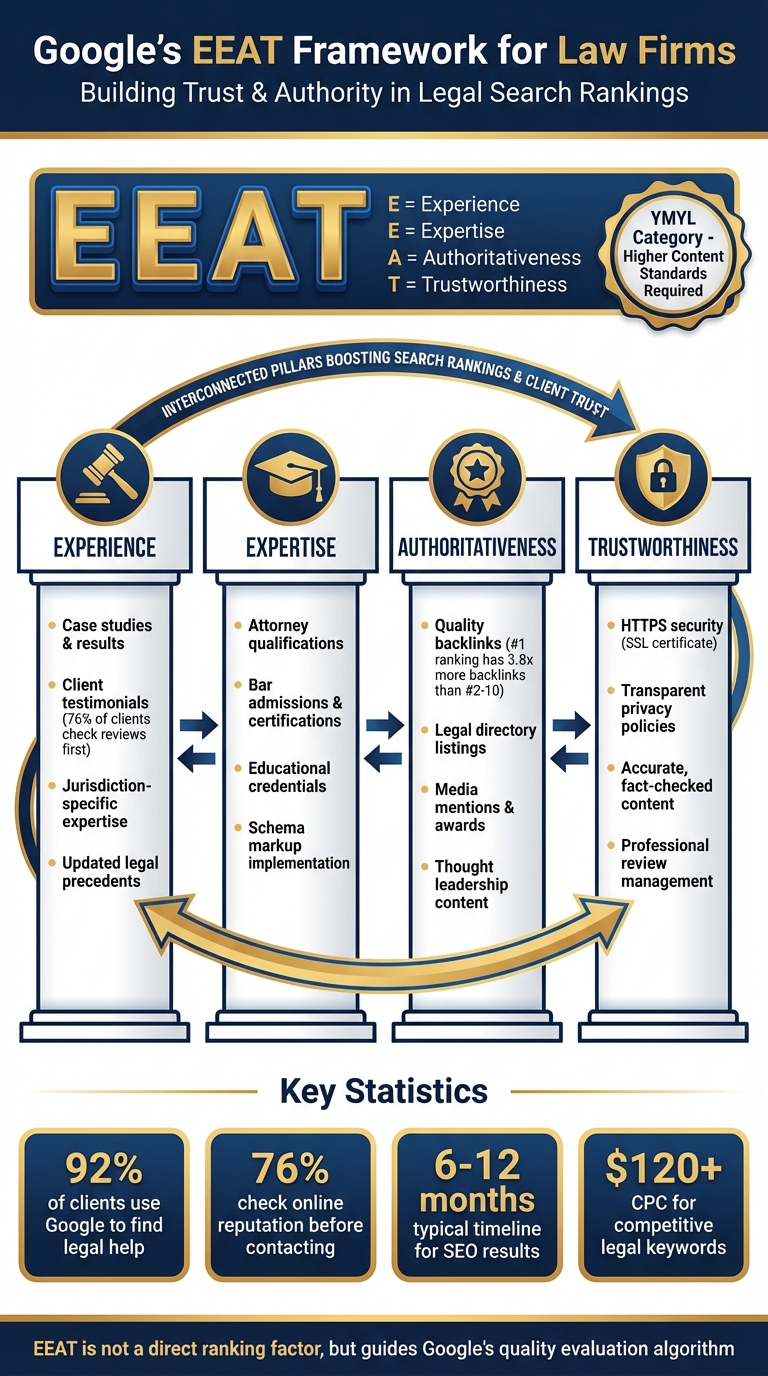
Google EEAT Framework for Law Firm SEO Rankings
How to Improve Google’s E-E-A-T for Your Law Firm’s SEO
The 4 Components of EEAT for Law Firms
Understanding and refining each component of EEAT is crucial for improving your law firm’s visibility online. These four pillars guide where to focus your efforts and highlight the signals that matter most to search engines and potential clients.
Experience: Highlight Your Legal Track Record
Experience showcases your firm’s legal accomplishments. It’s not just about saying you’ve been in practice for years – it’s about proving it with real results.
Case studies are a powerful way to do this. For instance, a personal injury firm might share how it secured a settlement for a client injured in a workplace accident, detailing the legal strategy and challenges faced, especially in key areas like medical malpractice.
Client testimonials are equally important. Did you know that 76% of potential clients check a law firm’s online reputation before reaching out? Display these reviews prominently on your Google Business Profile and consider embedding video testimonials on your website to make them more engaging.
Attorney bios should go beyond listing degrees and licenses. Include years of experience, specific practice areas, bar admissions, speaking engagements, and any awards. Add a personal touch – share stories about community involvement or professional milestones. Linking these profiles to respected legal directories adds extra credibility.
Don’t forget jurisdiction-specific details. Referencing state-specific laws, like "California Divorce Law" or "Texas Probate Code", shows your firm’s local expertise. Keep older content updated with current laws and case precedents to ensure accuracy and relevance.
Now, let’s dive deeper into showcasing your legal credentials.
Expertise: Showcase Your Legal Qualifications
Your attorneys’ qualifications are one of your firm’s strongest assets. Google prioritizes clear evidence that skilled professionals are behind your content and services.
Make sure attorney profiles are concise but comprehensive. Include education, bar admissions, certifications, and awards. These profiles should be easy to find on your homepage and practice area pages. Using schema markup (like Person, Attorney, or LegalService types) can also help search engines verify your expertise.
When crafting these profiles, incorporate keywords potential clients might use. For example, if an attorney specializes in estate planning for high-net-worth individuals, phrases like "trust administration attorney" or "wealth preservation lawyer" can be effective. And always ensure your legal content is either authored or reviewed by a qualified lawyer – not just by a staff writer.
From expertise, let’s move to building recognition within the legal community.
Authoritativeness: Gain Industry Recognition
Authoritativeness is about how your firm is viewed by the legal community and the public. This comes from external validation like backlinks, media mentions, awards, and thought leadership.
Focus on earning backlinks from credible sources, such as legal publications, industry associations, and universities. A mention from a state bar association, a legal journal, or a law school can carry immense weight. Consider speaking at events or contributing articles to established legal platforms to gain authoritative backlinks while positioning your attorneys as thought leaders.
Showcase badges for legal awards and certifications. Include links to respected legal directories like Avvo, Martindale-Hubbell, Super Lawyers, and your state bar association. Media mentions from trusted outlets further reinforce your authority.
Client endorsements also play a big role. Encourage reviews on platforms like Google Business Profile and Avvo, but always follow ethical guidelines when requesting them.
These external signals demonstrate your firm’s standing in the industry and improve your search rankings.
Trustworthiness: Be Transparent and Accurate
Trustworthiness is the cornerstone of EEAT. Without it, even strong experience, expertise, and authoritativeness won’t hold up.
Start by securing your website with HTTPS. Browsers flag sites without SSL as "non-secure", which can instantly harm trust. Clearly display privacy policies, office locations, and service details. Be upfront about fees and set clear expectations for client interactions.
Ensure all content is meticulously fact-checked and backed by credible sources. Link to respected websites – like state legislature pages, court opinions, or government agencies – to further validate your information.
"Google rewards law firms that publish content with the same care and accuracy they’d bring to a client case – thorough, reliable and rooted in real expertise." – Conroy Creative Counsel
Engage with client reviews professionally, demonstrating your commitment to client satisfaction. Maintain a fast, mobile-friendly, and ADA-compliant website with simple navigation. And when using AI-generated content, always have it reviewed by an attorney to ensure accuracy and reliability.
How to Audit Your Law Firm’s EEAT
Taking a closer look at your current EEAT signals is crucial. A thorough audit helps pinpoint what’s working and what needs fine-tuning by examining your content, technical setup, and external reputation.
Review Content Quality and Expertise
Start by evaluating every page on your site as Google would. Since legal content falls under the "Your Money or Your Life" (YMYL) category, it’s held to higher standards for accuracy, expertise, and trustworthiness. Each piece of content should either be written or reviewed by a licensed attorney, with credentials and relevant U.S. legal references clearly displayed.
Make sure blog posts and guides cite trustworthy sources and include up-to-date legal and financial details. Depth is also key – while a brief overview might be useful, it won’t hold up against in-depth guides that cover case timelines, evidence requirements, and settlement processes in detail.
Check Technical and On-Site Trust Signals
After reviewing your content, shift your focus to your website’s technical setup and trust indicators. Ensure your site uses HTTPS, as browsers flag non-secure sites, which can erode trust. Confirm that your privacy policy is current and complies with regulations like the California Consumer Privacy Act (CCPA) if you serve clients in California. Display your contact information, office addresses, and attorney licensing details prominently on every page.
Also, evaluate your site’s mobile performance. Pages should load quickly, and navigation should be straightforward. Disclaimers about attorney-client relationships must be clearly visible where needed, and fee structures should be transparent to build trust.
Analyze Off-Site Authority Indicators
Once your on-site elements are solid, turn your attention to external authority signals. Start by auditing your backlink profile. Top-ranking websites often have thousands of unique backlinks, and the #1 result typically has 3.8 times more backlinks than sites ranked #2 through #10. Aim to secure links from high-authority sources, like state bar associations, legal journals, universities, and reputable news outlets.
Check your listings on legal directories such as Avvo, Martindale-Hubbell, and Super Lawyers. Ensure the information is accurate and complete. Review your Google Business Profile and other platforms where clients leave reviews – consistency is key. With 92% of potential clients using Google to find legal help, maintaining a strong and uniform online presence is critical. Pay attention to your firm’s name, address, and phone number (NAP) across various platforms; inconsistencies can confuse search engines and hurt your local rankings.
How to Improve EEAT for Your Law Firm
After identifying gaps in your EEAT (Expertise, Authoritativeness, and Trustworthiness) profile, it’s time to address them. Using your audit findings, you can strengthen your site’s EEAT signals through thoughtful content creation, technical updates, and strategic relationship-building.
Create High-Quality Legal Content
Your content should dive deep into legal topics rather than skimming the surface. For more complex subjects, aim for detailed articles that exceed 1,500 words and provide unique insights. The goal is depth and completeness, not just meeting a word count.
Start by analyzing user search intent. Determine whether visitors are looking for information, comparing services, or ready to hire, and structure your content accordingly. Use semantic clusters to cover related terms naturally. For instance, a page about real estate closings might include terms like "title insurance", "escrow agent", and "deed transfer" to demonstrate comprehensive knowledge.
Highlight attorney credentials prominently in every piece of content. Include detailed author bylines that showcase education, bar admissions, litigation experience, certifications, and awards. Link these bylines to professional profiles on trusted directories like Avvo or Martindale-Hubbell to further establish authority.
Make your content easy to read, especially on mobile devices. Break text into short paragraphs, use descriptive headings (e.g., "What documents do I need for probate?"), and provide concise answers. Use bullet points or tables to clarify complex legal processes. Cite credible legal sources and include links to authoritative sites like government agencies, court opinions, or state legislature websites to build trust.
Case studies and client testimonials can also demonstrate expertise. Share anonymized examples of real cases or success stories (with proper permissions) to highlight your experience and results. Regularly update your content with a "Last Updated" date to reflect current laws and statistics.
If you use AI tools to draft content, ensure a qualified attorney reviews, fact-checks, and adds original insights before publishing. Unverified content can damage your EEAT signals.
"Google rewards law firms that publish content with the same care and accuracy they’d bring to a client case – thorough, reliable and rooted in real expertise."
– Conroy Creative Counsel
Add Structured Data for EEAT
In addition to refining your content, structured data can enhance your site’s trust signals. Schema markup helps search engines interpret your credentials and expertise, directly boosting your EEAT. Use schema types like Person or ProfessionalService on attorney bio pages to highlight qualifications. Similarly, apply Attorney and LegalService schema to blog posts and practice area pages to improve search visibility. For FAQ sections, integrate FAQ schema to further enhance technical trust signals.
"Use schema markup: Add Person, Attorney, and LegalService schema types to attorney bios and blog posts. This makes credentials machine-readable, strengthening search visibility."
– Grow Law Firm
Structured data ensures your qualifications are clearly displayed to search engines, reinforcing your authority.
Earn Quality Backlinks
Once your content and technical signals are in place, focus on earning external endorsements. High-quality backlinks from reputable sources act as endorsements, signaling credibility to search engines. Prioritize earning links from respected sites rather than chasing large quantities of low-value links.
Create content that naturally attracts backlinks, such as legal guides, surveys, expert commentary, or infographics. Guest blogging and content collaborations with legal publications or industry websites can also help you earn credible backlinks.
List your firm in trusted legal directories like Martindale-Hubbell, Super Lawyers, Avvo, and Justia. Ensure your Name, Address, and Phone number (NAP) information is consistent across all listings. Linking to awards, bar association profiles, and legal memberships further solidifies your expertise.
Engage with your local community through sponsorships, legal aid initiatives, or seminars to earn backlinks from local organizations, schools, or news outlets. Platforms like Qwoted and HARO can also connect you with opportunities to provide expert commentary and earn links. Tools like BuzzSumo or Google Alerts can help you find unlinked mentions of your firm, which you can turn into backlinks.
"With lawyers, trust signals are going to be a huge focus. Things like attorney bios, blog posts authored by attorneys, awards, and similar trust-building elements on a website are going to go a long way. These things are typically valuable in most industries, but are even more so when optimizing a site for attorneys."
– Aaron Mackel, Director of Strategy at Hurrdat Marketing
Avoid purchasing backlinks at all costs – search engines penalize this practice, which can harm your rankings. Use the KPIs mentioned earlier to track your progress and measure the impact of these efforts effectively.
How to Measure EEAT’s Impact on Rankings and Leads
To gauge the impact of EEAT on your rankings and lead generation, focus on tracking metrics that reflect both visibility and client engagement. Keep in mind that noticeable progress often takes six to twelve months, with the legal industry typically requiring more time due to its competitive nature.
Track Key Performance Indicators (KPIs)
Start by monitoring metrics that highlight both your visibility and the quality of your online presence. Organic traffic growth is a key indicator of how many users discover your site through search engines. Similarly, tracking keyword rankings for your practice areas and location helps you understand how well you’re competing in search engine results pages (SERPs). Higher rankings often lead to significantly increased clicks.
Pay close attention to user engagement metrics like dwell time and bounce rate. These metrics reveal whether visitors find your content useful and engaging. Additionally, measure conversion rates – such as form submissions or phone calls – on high-authority pages to assess how well your site turns visitors into leads. Considering that 76% of potential clients research a law firm’s online reputation before contacting them, improvements in EEAT should not only boost traffic but also attract higher-quality visitors.
Don’t overlook Domain Authority and the quality of backlinks your site earns. These off-site signals reflect how credible and trustworthy your firm appears to other authoritative sources. Comparing your performance against competitors in SERPs can also provide valuable insights into your market position. Once you’ve identified your key metrics, use SEO tools to stay on top of your performance.
Use SEO Tools to Monitor Progress
To make sense of your data, leverage SEO tools that provide actionable insights. Google Search Console and Google Analytics are indispensable free tools for this purpose. Search Console helps you identify which queries trigger your pages, your average keyword positions, and any technical issues affecting your rankings. Meanwhile, Analytics dives into user behavior, traffic sources, and the paths visitors take to convert.
For more advanced insights, consider using specialized SEO tools to track ranking fluctuations, spot content gaps, and analyze competitor activity. This is particularly important in competitive legal niches where the cost-per-click for terms like "car accident lawyer" can exceed $120.
Enable AI alerts within your SEO tools to stay updated on ranking changes, algorithm updates, and potential content decay. To get an unbiased view of your visibility, check rankings in an incognito browser, as personalized search results can sometimes skew data. Make it a habit to review your progress monthly, aligning your findings with your broader content strategy.
Run Regular EEAT Audits
In addition to ongoing monitoring, periodic audits ensure your EEAT efforts remain effective. Remember, EEAT isn’t a one-and-done task – it requires consistent upkeep as Google’s guidelines evolve and your firm grows. Conduct thorough audits every 6-12 months to evaluate technical performance, the accuracy of your content, and how well your credentials are displayed. Make sure "Last Updated" dates are clearly visible and accurate, signaling freshness to search engines.
During these audits, check for outdated information, ensuring that statistics, legal citations, and attorney credentials are current. Assess the results of any changes after 1-2 months to measure their effectiveness.
If you’re not seeing the desired improvements, consider refining your content to provide more depth or strengthening your authority signals by securing additional backlinks and updating your credentials. This iterative approach helps maintain your competitive edge in search rankings and lead generation.
Conclusion: Building a Long-Term EEAT Strategy
EEAT Essentials Recap
Google’s EEAT framework – Experience, Expertise, Authoritativeness, and Trustworthiness – is a cornerstone for law firms aiming to stand out in search rankings. While EEAT itself isn’t a direct ranking factor, Google consistently rewards websites that embody these qualities, particularly for legal topics where trust is non-negotiable. Highlighting your legal experience, credentials, industry accolades, and transparency can significantly boost your site’s credibility. This becomes even more critical as Google rolls out multiple algorithm updates each year, demanding constant attention to your SEO strategy.
SEO isn’t a quick win; it requires persistence. Law firms often take up to 14 months to see a return on investment, but consistent efforts to strengthen EEAT pay off in the long run. As Sasha Berson, a Law Firm Marketing Growth Expert, emphasizes:
"While E-E-A-T itself isn’t directly measurable, its effects on your ranking factors are observable through several key metrics"
. This philosophy should guide every decision in your EEAT strategy.
Next Steps for Law Firms
To enhance EEAT, start with a comprehensive audit of your website. Evaluate your content quality, ensure attorney credentials are easy to find, verify technical trust signals like SSL certificates, and review your backlink profile. Create detailed legal content that highlights your firm’s experience, such as case studies or insights into complex legal matters.
Use structured data markup to help search engines understand your credentials and practice areas. Pursue high-quality backlinks from reputable sources like legal directories, industry journals, and local business organizations. SEO is an ongoing process – test your strategies, identify what works, and refine what doesn’t.
Schedule EEAT audits every 6–12 months and track key performance metrics to ensure your strategy remains effective as your firm grows and Google’s standards shift. Focus on quality over quantity in your content, recognizing that building trust and authority takes time, consistency, and strategic adjustments. By following these steps, you can establish a long-term EEAT strategy that aligns with your firm’s goals and the evolving SEO landscape.
FAQs
How can law firms showcase their experience to improve EEAT signals?
Law firms can showcase their expertise by featuring detailed attorney bios, which include qualifications, areas of practice, and years of experience. This not only builds credibility but also gives potential clients a clear understanding of the firm’s capabilities.
Highlighting case studies with successful outcomes and sharing client testimonials can add a personal touch, reinforcing trust and reliability. Awards and recognitions are another great way to emphasize your firm’s achievements and authority.
It’s also crucial to maintain a professional, user-friendly website that’s easy to navigate. Regular updates ensure that your site reflects your current expertise and stays relevant in the competitive legal field.
How can a law firm build online authority to improve its search rankings?
To establish a strong online presence, law firms should prioritize gaining backlinks and mentions from trusted sources like legal organizations, bar associations, universities, and well-regarded industry publications. Another critical factor in building trust and credibility is gathering positive client reviews and testimonials on verified platforms. On top of that, creating high-quality, informative content that resonates with your audience can showcase your expertise and encourage meaningful engagement.
What factors does Google consider to determine trustworthiness for law firm websites?
Google evaluates the trustworthiness of law firm websites by focusing on several important factors. These include having clear disclaimers, privacy policies, and secure forms to safeguard user information. Additionally, positive client reviews and easily accessible contact details – like a physical address and phone number – are essential for building trust.
When law firms prioritize these elements and keep them up to date, they not only enhance their credibility but also boost their visibility in search results.