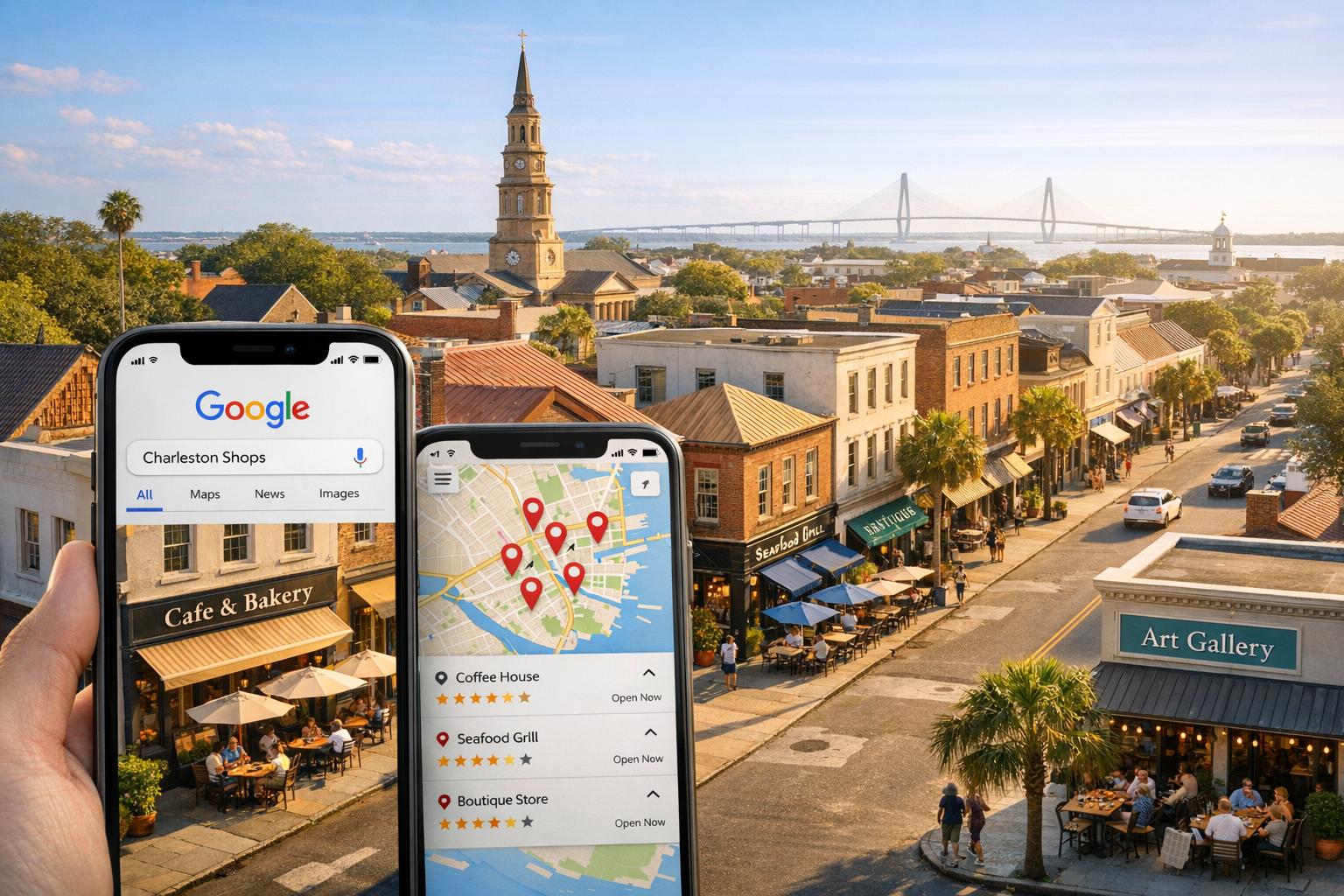
Local businesses in Charleston face a new challenge: the rise of AI-driven search tools like ChatGPT and Google’s AI integrations. These tools prioritize direct answers over traditional search links, creating a "zero-click" environment where businesses not mentioned in AI summaries risk losing visibility. With 53% of consumers using AI tools by 2025, adapting your SEO strategy is no longer optional.
Key Takeaways:
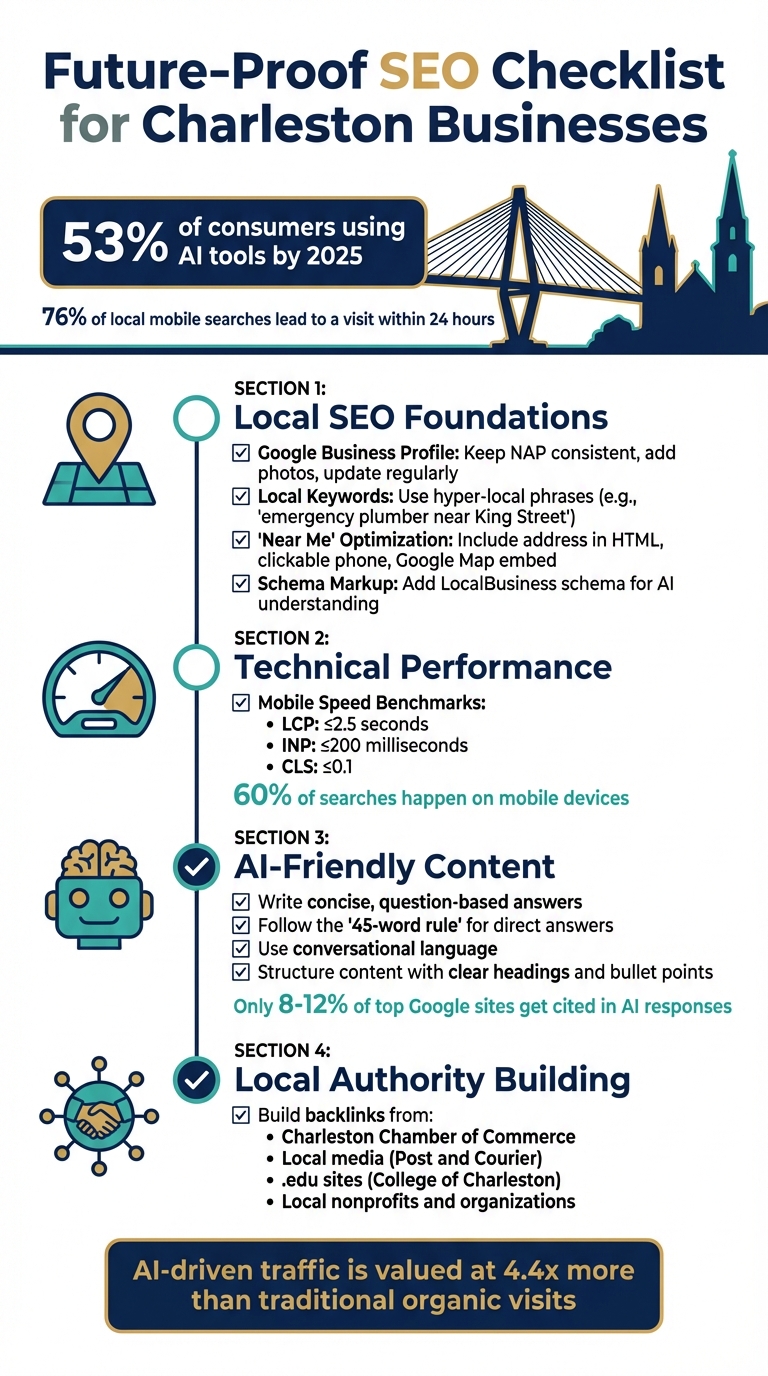
- Google Business Profile (GBP): Keep it accurate and updated with consistent Name, Address, and Phone (NAP) details. Add high-quality photos and posts to boost visibility.
- Local Keywords: Use hyper-local phrases like "emergency plumber near King Street" or "best seafood in Charleston" to target specific searches.
- ‘Near Me’ Optimization: Ensure your website includes your address in crawlable text, a clickable phone number, and a Google Map embed.
- Schema Markup: Add LocalBusiness schema to help AI tools understand your business details, like location and hours.
- Mobile Speed: Improve website performance to meet Google’s Core Web Vitals benchmarks (e.g., ≤2.5s load time).
- AI-Friendly Content: Write concise, question-based answers tailored for AI extraction. Use conversational language and structure content for clarity.
- Backlinks: Build links from trusted Charleston organizations, media, and directories like the Charleston Chamber of Commerce or local nonprofits.
Charleston businesses can thrive in this AI-driven landscape by combining local SEO tactics with technical optimizations. Focus on creating specific, structured content that answers customer queries directly while ensuring your digital presence is easy for both search engines and AI tools to understand.
Local SEO Checklist for Charleston Businesses: Traditional vs AI Search Optimization
How to Build a Local SEO Strategy in 2026 (Full Blueprint!)
Local SEO Basics for Charleston Businesses
Local SEO connects your business with Charleston residents and tourists in specific neighborhoods – whether it’s West Ashley, Mount Pleasant, or downtown near Rainbow Row. With over 76% of local mobile searches leading to a visit within 24 hours, the stakes are high. When someone searches for "plumber near King Street" or "best seafood in Charleston", your goal is to make sure your business is the one Google and AI tools suggest.
The cornerstone of local SEO is your Google Business Profile (GBP). Think of it as your digital storefront in Google’s Local 3-Pack – the top three businesses that show up alongside a map for local searches. A well-maintained GBP not only boosts your visibility but also doubles customer trust and clicks. To make it work, ensure your Name, Address, and Phone (NAP) details are accurate and consistent across all platforms. Add high-quality photos, list your hours of operation, and regularly update your profile with posts about specials or events. Inconsistent information can confuse search engines and hurt your rankings.
"SEO is the modern-day equivalent of having the biggest, brightest sign on Main Street – but in the digital world, that ‘street’ is Google." – Mr. Marketing SEO
With over 60% of all searches happening on mobile devices, optimizing your website for mobile users is critical. Tourists walking through Charleston’s Historic District often search on the go, so your site needs to load quickly, look great on a smartphone, and feature click-to-call buttons for instant contact. A slow or unresponsive site can drive potential customers straight to your competitors.
A big part of local SEO success lies in using the right keywords tailored to Charleston’s unique search habits.
Finding Charleston-Specific Keywords
To stand out, focus on hyperlocal keywords that reflect what your customers are actually searching for. Phrases like "Charleston personal injury lawyer", "homes for sale in West Ashley", or "best seafood in Charleston" are great examples.
Start by exploring Google’s search results for your industry. Type in a service you offer along with "Charleston", and scroll to the bottom of the page. The "Related searches" section provides insight into popular queries, while the "People also ask" box highlights common questions your content should address.
Another effective strategy is connecting your business to local landmarks and events. For instance, an Italian restaurant near Waterfront Park could mention its proximity to the landmark or create content tied to Charleston Restaurant Week. Similarly, a real estate agent might write about "top neighborhoods in Mount Pleasant" or "historic Charleston lodging options". These efforts help search engines and AI tools recognize your business as a trusted local authority.
To refine your keyword strategy, use tools like Google Keyword Planner to find terms with decent search volume and low competition. Create a spreadsheet to organize keywords by service area – such as downtown Charleston, James Island, or Summerville – so you can easily build targeted landing pages later.
| Target Industry | Example Charleston-Specific Keywords |
|---|---|
| Real Estate | "homes for sale in Charleston SC", "top neighborhoods in West Ashley" |
| Legal | "Charleston personal injury lawyer", "family law Charleston SC" |
| Food/Dining | "best seafood in Charleston", "Charleston organic café" |
| Home Services | "Charleston roofer", "Charleston plumber near me" |
| Tourism | "historic Charleston lodging", "Charleston walking tours" |
Now, let’s talk about optimizing for those all-important "near me" searches.
Optimizing for ‘Near Me’ Searches
Accurate location signals are key to ranking well in "near me" searches and improving AI-driven recommendations. When someone searches for "restaurants near me" in Charleston, Google uses GPS data to apply location filters, even if the phrase "near me" isn’t explicitly on your website. Your job is to ensure Google knows exactly where you are and which areas you serve.
Here’s how:
- Add your full business address in crawlable HTML text in your website footer.
- Include a clickable phone number for easy contact.
- Embed a Google Map on your Contact or About page.
If you serve multiple areas, create unique landing pages for each one. For example, a plumber covering Mount Pleasant and North Charleston should have separate pages with original content tailored to each location. Mention specific streets, landmarks, and services to strengthen your presence. Avoid duplicate content, as it can hurt your rankings.
Another must-do is implementing LocalBusiness Schema markup on your site. This structured data helps search engines and AI tools understand your exact address, service areas (like "Charleston County"), and operating hours. While setting this up might require some technical know-how, plugins for platforms like WordPress can make it easier.
With 76% of consumers visiting a business within 24 hours of a "near me" search, these efforts directly translate into foot traffic. Make sure your Google Business Profile reflects accurate hours, especially during holidays. Use the Q&A section to answer common questions like "Do you offer emergency services?" or "Are you open during Spoleto Festival?". This ensures AI tools have all the correct details when recommending your business.
Technical SEO and Schema Markup
Once you’ve nailed the basics of local SEO, it’s time to dive into the technical side. Tools like schema markup and performance optimization can strengthen your online presence. While your content explains what your business does, schema markup translates that information into structured data that search engines and AI, like ChatGPT, can easily interpret and display.
"Local business schema markup is like hiring a perfect translator – it converts your business details into Google’s native language, ensuring nothing gets lost in translation." – Sebastian Żarnowski, Co-founder & CEO, Localo
Schema markup essentially organizes your business details into a format that search engines trust and use. Why does this matter? Businesses that show up with rich results in local searches often see a 20% to 30% increase in clicks. And with 26.6% of internet users already encountering Google AI Overviews, structured data is becoming a must-have for visibility.
But technical SEO isn’t just about schema. Website performance, especially mobile speed, plays a critical role in keeping users engaged. Google prioritizes mobile performance when ranking sites, so a slow-loading page could mean lost revenue. The technical foundation you set today will influence your visibility in tomorrow’s AI-driven search landscape.
Adding Local Business Schema Markup
Schema markup labels essential business details – like your name, address, and hours – so search engines don’t have to guess. To make your schema as effective as possible, include specific properties like name, address, telephone, openingHours, geo, image, and url. If your business falls into a specific category, such as Restaurant, Dentist, or LegalService, use those subtypes instead of the generic LocalBusiness tag .
Here’s how to get started:
- Use tools like Localo’s schema generator or Google’s Structured Data Markup Helper. For WordPress, plugins like Yoast Local SEO, Rank Math Pro, or Schema Pro simplify the process.
- For non-WordPress sites, you can generate JSON-LD code using ChatGPT by providing your business details. Then, paste the code into the
<head>section of your homepage or contact page.
Key Schema Properties to Include:
| Property | Description |
|---|---|
name |
Your official business name as listed on your Google Business Profile |
address |
Full physical address, including street, city, region, and postal code |
telephone |
Primary contact number with country code |
openingHours |
General operating hours (e.g., Mo-Fr 09:00-18:00) |
geo |
Latitude and longitude to pinpoint your location |
image |
A photo of your storefront or logo |
url |
Your official website URL |
If you’re a mobile service provider, like a plumber or contractor, without a physical storefront, use the areaServed property to define your service areas, such as "Mount Pleasant", "Summerville", or "Charleston County" .
Once your schema is ready, test it using Google’s Rich Results Test or Schema Markup Validator to ensure there are no errors. Double-check that every detail in your schema matches your Google Business Profile exactly .
"Schema markup for local business turns your website into structured facts AI can read, trust, and summarize accurately." – Joey Pedras, Writer, True Future Media
With schema in place, your next focus should be on improving website speed and mobile performance, as these factors directly affect your ranking in AI-driven search results.
Improving Website Speed and Mobile Performance
Website speed isn’t just about convenience – it’s a ranking factor. Google evaluates your site using Core Web Vitals, which include:
- Largest Contentful Paint (LCP): Measures loading speed.
- Interaction to Next Paint (INP): Assesses responsiveness.
- Cumulative Layout Shift (CLS): Tracks visual stability .
For businesses in Charleston, where customers are often searching on mobile, a fast-loading site is essential. Aim for the following benchmarks:
- LCP: ≤2.5 seconds
- INP: ≤200 milliseconds
- CLS: ≤0.1
Start by optimizing images. Switch to WebP format and enable lazy loading so off-screen images load only when needed . If your site relies heavily on visuals, this can significantly reduce load times.
Next, tackle server response time (TTFB). Improve hosting, optimize your database, and use a content delivery network (CDN) . Enable Gzip or Brotli compression and upgrade to HTTP/2 or HTTP/3 protocols to allow faster file transfers.
For your site’s code, minify and combine CSS, JavaScript, and HTML files to reduce page weight and HTTP requests . Audit your CMS plugins regularly – unused or poorly optimized plugins can slow down your site. Use resource hints like dns-prefetch, preconnect, and preload to speed up critical resource loading .
Pay particular attention to INP, which replaced First Input Delay (FID) in March 2024 as the key metric for responsiveness. To meet the INP target of ≤200ms, optimize JavaScript execution and minimize main thread blocking.
| Core Web Vital | Good Threshold | Poor Threshold | Primary Impact |
|---|---|---|---|
| LCP | ≤2.5s | >4.0s | Perceived load speed |
| INP | ≤200ms | >500ms | Interaction responsiveness |
| CLS | ≤0.1 | >0.25 | Visual stability |
| TTFB | <200ms | >600ms | Server responsiveness |
Finally, use semantic HTML elements like <article> and <nav> instead of generic <div> containers. This improves AI tools’ ability to interpret your site structure, boosting extraction accuracy by 34%. For Charleston businesses, linking your local entity to nearby landmarks or neighborhoods – like King Street or Mount Pleasant – can further establish your local presence.
With AI-driven search visits projected to overtake traditional search visits by 2028, and clicks from AI search results valued at 4.4 times more than standard organic visits, these technical upgrades are key to staying ahead in Charleston’s competitive market.
Creating Content for ChatGPT and AI Search
Once your technical SEO is in place, the next step is creating content that’s easy for AI tools like ChatGPT to extract and present. Unlike traditional search engines that display a list of links, AI tools provide direct, conversational answers. For businesses in Charleston, this means crafting content that’s concise, specific, and structured in a way that AI can easily pull and cite.
"Google was an answer engine. AI is an action engine." – Rick Kranz, Founder, AI Marketing Automation Lab
Even though traditional SEO still drives about 84% of site traffic, only 8–12% of top-ranking Google sites are cited in AI-generated responses. This means ranking high on Google doesn’t guarantee visibility in AI-driven results – you need to optimize for both.
Charleston businesses have a distinct edge in this new landscape. AI tools can’t handle local, physical tasks – they can’t unclog a drain or cater a wedding. When someone asks, “Who’s the best emergency plumber in Charleston?”, your business can shine by offering hyper-local, unique content that national competitors can’t match. Think detailed neighborhood guides, insider tips on Charleston hotspots, or expert advice that only a local would know.
The secret lies in passage-level optimization. AI models pull specific passages that directly answer a user’s question. Each section of your content should focus on a single, clear intent. For instance, if someone searches, “What are the best venues for small weddings in Charleston County?”, aim to answer this in the first 45 words and follow it with bullet points or a table summarizing your recommendations.
To align with AI content extraction, refine your tone to sound natural and engaging.
Writing in a Conversational Style
Your content should feel approachable and customer-focused, not like a stiff corporate brochure. Shift from "we" language to a "you" perspective. For example, instead of saying, "We provide HVAC repair services across Charleston", try, "You can book same-day HVAC repairs anywhere in Charleston, from Mount Pleasant to Summerville."
Many people use voice assistants for local searches, often phrasing queries as full questions. Structure your content to answer these conversational prompts directly.
Follow the "45-word rule": start with a clear, concise answer to the question, then provide a brief summary of key points. For example, a Charleston wedding planner addressing "How much does a small wedding cost in Charleston?" might write:
"A small wedding in Charleston typically costs between $8,000 and $15,000, depending on the venue, guest count, and catering. Here’s a breakdown of common expenses."
"Originality or invisibility. AI engines don’t need another generic remix of what already ranks." – Rick Kranz, Founder, AI Marketing Automation Lab
AI prioritizes content that is original, specific, and well-structured. Instead of generic topics like “Top 10 Neighborhoods,” focus on niche subjects like “Best Charleston Neighborhoods for Families with Young Kids Under $500,000” or “Walkable Charleston Neighborhoods Within 10 Minutes of MUSC.” Comparison tables can also boost your content’s AI readability. For example, a Charleston restaurant could create a table like this:
| Best For | Not Best For |
|---|---|
| Date nights with waterfront views | Large groups over 12 people |
| Fresh Lowcountry seafood | Vegan or gluten-free diets |
| Outdoor dining in spring and fall | Quick lunches under 30 minutes |
When including directions or location details, reference well-known Charleston landmarks, such as "a block north of the Battery" or "across from Marion Square." This reinforces your local expertise and helps AI understand your geographic relevance – building on the local SEO strategies discussed earlier. Since AI extracts standalone passages, make sure every sentence delivers complete information without relying on surrounding context.
Once your tone is conversational, focus on answering specific, question-based searches.
Targeting Question-Based Searches
AI-driven searches are longer and more conversational, often averaging 10 to 25 words compared to the six-word average for traditional searches. For example, someone might ask, “What’s the most reliable HVAC repair service in Charleston for emergency weekend calls?” Your content should address these types of questions directly.
Start by identifying the questions your customers are likely to ask. Tools like Google’s “People Also Ask” can help you uncover common queries. For instance, a Charleston dentist might see questions like “How much does teeth whitening cost in Charleston?” or “Do Charleston dentists accept CareCredit?” Create dedicated sections or pages to answer each question clearly.
Use FAQ schema with JSON-LD structured data to label questions and answers, ensuring your HTML aligns with the structured data. This makes your content easier for AI to parse.
Organize information with clear headings and bullet points to simplify complex topics. Use a direct tone, such as: “Hire a licensed plumber if you see water pooling around your water heater.” Cover each topic thoroughly by creating separate pages for specific services or features. For example, a Charleston landscaping company could have individual pages for “Lawn Aeration in Charleston,” “Native Plant Installation for Coastal Gardens,” and “Hurricane Cleanup Services in Mount Pleasant,” with each page targeting a unique customer need.
"If your content isn’t structured, high-quality, and clear, it won’t make the cut. Structured data is now the foundation for getting surfaced in this answer-first world." – Rio SEO
Be sure to include your brand name in factual statements so AI tools can attribute the information to you. For instance, instead of saying, “Our team helped a local client increase conversions by 40%,” specify, “Charleston Digital Marketing helped Sullivan’s Island Surf Shop boost online conversions by 40% in Q2 2025.”
Finally, remember that AI tools analyze sentiment using data from platforms like Reddit, local forums, and reviews. Actively engaging in Charleston community discussions on platforms like Reddit or Facebook can further establish your local authority.
With AI-driven traffic valued at 4.4 times more than traditional search traffic – and AI projected to surpass search engines in traffic generation by 2028 – optimizing your content for conversational, question-based searches is essential. This approach not only boosts your visibility but solidifies your reputation as a trusted local expert in Charleston.
Building Charleston Backlinks and Local Authority
To complement the technical and local SEO strategies already discussed, building a strong network of quality backlinks is essential for Charleston businesses. Backlinks serve as trust signals for search engines – when respected Charleston-based websites link to your business, it boosts your credibility and strengthens your connection to the local community.
Focus on earning links from websites deeply rooted in Charleston. For instance, being mentioned by The Post and Courier or the College of Charleston can carry far more weight than a generic directory link. These connections emphasize your local relevance, which is especially important as Google’s 2026 algorithm emphasizes "entity strength." This means businesses linked to prominent Charleston landmarks, institutions, or organizations are more likely to rank higher in local searches.
"The main takeaway here is that the more involved you are in the communities you serve, the more reason you will be giving local people to talk about and link to your business." – Miriam Ellis, Local Search Scientist, Moz
Start by analyzing your competitors’ backlinks using tools like Semrush‘s Backlink Gap. This can reveal opportunities you might have missed, such as links from local resource pages, event sponsors, or Charleston-specific directories. Once identified, build relationships with these sites by offering value to the community rather than simply asking for links.
Working with Local Organizations
Teaming up with local organizations, charities, and events not only strengthens your community ties but also helps earn high-quality backlinks. These partnerships show search engines that your business is an engaged and trusted part of Charleston’s ecosystem. Plus, they often result in links from high-authority domains like .edu or .gov websites.
Consider supporting local nonprofits like the Charleston Animal Society, Charleston Moves, or Charleston Young Life. Many nonprofits acknowledge their sponsors with backlinks on their websites. If monetary sponsorship isn’t an option, in-kind contributions – like donating services for events – can work just as well.
Educational institutions such as the College of Charleston (charleston.edu) and Charleston Southern University (charlestonsouthern.edu) offer additional opportunities. Their resource pages or local business directories can be a goldmine for backlinks. Reach out to their career services, alumni relations, or community outreach departments to explore potential collaborations. Even one .edu backlink can make a noticeable difference in your domain’s credibility.
Government partnerships are another excellent avenue. Organizations like the City of Charleston Department of Recreation or Charleston County Parks and Recreation might offer sponsorship opportunities that include links on their websites. For example, sponsoring an event like Charleston Race Week could secure a .gov mention, which is one of the most trusted backlink sources available.
| Partnership Type | Specific Charleston Examples | Benefit |
|---|---|---|
| Media | The Post and Courier, WCIV, Charleston City Paper | Guest posts and digital PR links |
| Education | College of Charleston, Charleston Southern University | High-quality .edu backlinks |
| Government | Charleston County Parks & Rec, City of Charleston Recreation | Trusted .gov backlinks |
| Non-Profit | Charleston Animal Society, Charleston Moves, Young Life | Community recognition and local links |
| Business | Charleston Chamber of Commerce, BBB | Trust signals and NAP consistency |
Engage with local media outlets to position yourself as a Charleston expert. Publications like The Post and Courier, WCIV, and Charleston City Paper offer opportunities to contribute guest articles or feature in local stories. These placements not only boost your authority but also drive referral traffic.
Lastly, don’t overlook existing business relationships. Ask local suppliers, distributors, or neighboring businesses to include your website on their "Partners" or "Suppliers" pages. While these links may seem small individually, they collectively strengthen your local SEO footprint. For a more streamlined approach, consider working with an agency that specializes in link building services.
Listing in Charleston Business Directories
In addition to partnerships, consistent directory listings are a key part of building your local presence. Search engines rely on consistent Name, Address, and Phone number (NAP) information across platforms to verify your business. Even small inconsistencies in your details can confuse algorithms and hurt your rankings.
Start with prominent directories. Joining the Charleston Chamber of Commerce is a simple way to gain a trusted local backlink while also benefiting from networking opportunities. On a broader scale, the South Carolina Chamber of Commerce offers similar advantages at the state level.
Next, focus on directories specific to your industry. For example:
- Contractors should list on Angi and the Better Business Bureau (BBB).
- Healthcare providers can benefit from Healthgrades.
- Lawyers should leverage platforms like Avvo.
- Restaurants should ensure they’re listed on Yelp.
These directories not only provide backlinks but also drive targeted referral traffic.
| Directory Type | Examples for Charleston Businesses | Benefit |
|---|---|---|
| General Local | Charleston Chamber of Commerce, SC Chamber of Commerce | Boosts local trust and relevance |
| Media/News | The Post and Courier, Charleston City Paper | Referral traffic and authority |
| Educational | College of Charleston, Charleston Southern University | High-quality .edu backlinks |
| Community/Non-Profit | Charleston County Parks, Charleston Animal Society | Local trust signals and engagement |
| Industry-Specific | Yelp, BBB, Angi, Avvo, Healthgrades | Niche-specific authority |
Ensure your NAP information is 100% identical across all platforms. For example, if your Google Business Profile lists your address as "123 King St., Charleston, SC 29401", use that exact format everywhere. Even minor variations can weaken your local signals.
Add an embedded Google Map to your contact page and link it to your directory profiles. This reinforces your geographic relevance and helps search engines associate your business with iconic Charleston landmarks like King Street or the Ravenel Bridge. With 76% of consumers visiting a business within 24 hours of a "near me" search, these details can directly lead to more foot traffic.
Finally, consider manual citation building over automated services. While automation might save time, manual submissions allow you to target niche Charleston directories that automated tools could overlook. For guidance, check out DIY local SEO resources to help with this process.
How SearchX Helps Charleston Businesses
SearchX makes it easier for Charleston businesses to put SEO strategies into action without feeling overwhelmed. For busy business owners, juggling tasks like local business schema and mobile performance optimization can be daunting. That’s where SearchX steps in, delivering measurable improvements in traditional search rankings and even on AI-driven platforms like ChatGPT.
Here’s how SearchX simplifies SEO for Charleston businesses.
SearchX Local SEO Services
SearchX offers a full range of SEO services tailored specifically for Charleston businesses. Their approach begins with keyword research, focusing on terms that resonate locally. They also manage business listings across more than 50 directories, ensuring your business details remain consistent across all major platforms.
But they don’t stop at the basics. SearchX incorporates technical SEO services to build a strong foundation for your online presence. This includes adding local business schema markup to help search engines pinpoint your Charleston location, improving mobile speed, and structuring content in a way that AI tools can easily extract. They also help businesses adapt from traditional SEO to strategies designed for visibility on AI-driven platforms like ChatGPT, emphasizing structured data, modular content, and clear entity definitions.
SearchX offers flexible plans to meet different needs:
- $3,000/month: Covers local listing management, Google Business Profile (GBP) optimization, and three optimized content pieces monthly.
- $6,000/month: Adds competitor analysis and technical audits.
- $12,000+/month: Includes comprehensive AI visibility tracking and advanced services.
Not ready to dive into a full plan? SearchX also provides free tools to help you get started.
Free SEO Tools for Small Businesses
Charleston businesses can take advantage of SearchX’s free GMB and Website Audit Tools to identify quick wins. The GMB Audit Tool flags issues like missing categories or inconsistent operating hours, while the Website Audit Tool highlights technical and content-related problems.
For instance, you might learn that your website takes 8 seconds to load on mobile – far slower than Google’s recommended 3 seconds. Or you might discover your business lacks the structured data needed for AI tools to accurately reference your services. Armed with these insights, you can either tackle the fixes yourself using SearchX’s DIY local SEO resources or enlist their team to handle the heavy lifting.
These tools provide a straightforward starting point, helping Charleston businesses improve their online visibility step by step.
Conclusion
Search habits are changing faster than ever. With 60% of searches now ending without a click and 80% of users relying on AI-generated responses, businesses in Charleston can’t afford to see SEO as a one-and-done effort.
To keep up, businesses need a strategy that speaks clearly to both Google and emerging AI tools like ChatGPT. This means focusing on local relevance, structured data, and creating content that directly answers customer questions.
"Relevance Engineering is the art and science of improving visibility for any search surface. It’s the intersection of information retrieval, user experience, artificial intelligence, content strategy, and digital PR".
SearchX offers tailored local SEO services designed to help Charleston businesses adapt to these shifts. From free tools like their GMB and Website Audit Tools to advanced solutions like AI visibility tracking and structured data implementation, they provide the resources you need to stay ahead.
In this new era, success won’t come from stuffing in the most keywords. It will come from delivering clear, authoritative, and well-structured answers that AI tools trust and reference. The time to lay that groundwork is now.
FAQs
How can businesses in Charleston stay visible on Google and AI tools like ChatGPT?
To maintain visibility on Google and AI-driven tools like ChatGPT, businesses in Charleston should focus on crafting content that’s both user-friendly and optimized for AI. Start with the basics of SEO: ensure your website loads quickly, is mobile-friendly, has quality backlinks, and offers easy navigation. AI tools like ChatGPT favor well-structured, authoritative content, so make sure your site is seen as a reliable resource.
A few key strategies can make a big difference. Add structured data like local-business schema, service areas, and FAQs to help AI platforms better understand your site. Incorporate high-quality visuals, such as photos of the Charleston waterfront or iconic historic landmarks, to make your content more engaging. Encourage customers to leave reviews – these build trust and boost credibility. Also, create concise, conversational content that answers common local questions like, "Where can I find the best seafood in Charleston?" or "What are the top walking tours in the historic district?"
Don’t overlook your Google Business Profile. Keep it up-to-date with accurate details like U.S.-formatted phone numbers (e.g., (843) 555-0123), local ZIP codes, and operating hours. Consistency is key – make sure your name, address, and phone number (NAP) are the same across all online platforms. By blending locally relevant content with solid SEO practices, Charleston businesses can stay visible on both traditional search engines and AI-powered platforms.
What are hyper-local keywords, and how do they help improve local SEO?
Hyper-local keywords are ultra-specific search phrases that tie a product or service to a particular location – like a neighborhood, street, or even a well-known local spot. Think of examples like "plumber near King Street," "coffee shop in West Ashley," or "hair salon by Waterfront Park" for businesses in Charleston.
These terms match exactly what nearby users type into Google, ask voice assistants, or input into AI tools like ChatGPT. By showing search engines that your business is highly relevant to these local queries, you can increase your chances of showing up in local search results, Google Maps, or AI-driven answers. And here’s the bonus: because fewer businesses compete for such specific phrases, even smaller companies can climb the rankings and attract local customers who are ready to act.
Why does schema markup matter for improving visibility in local AI-driven searches?
Schema markup is a type of structured data that helps AI tools, such as ChatGPT and search engines, better process and interpret your business information. This added clarity makes it easier for these tools to include your business in local search results and AI-driven recommendations.
With schema markup, you can emphasize essential details like your address, business hours, and the services you offer. This ensures your business is accurately presented and increases its chances of standing out in local searches. It’s an effective way to keep your business visible as search technologies continue to advance.