

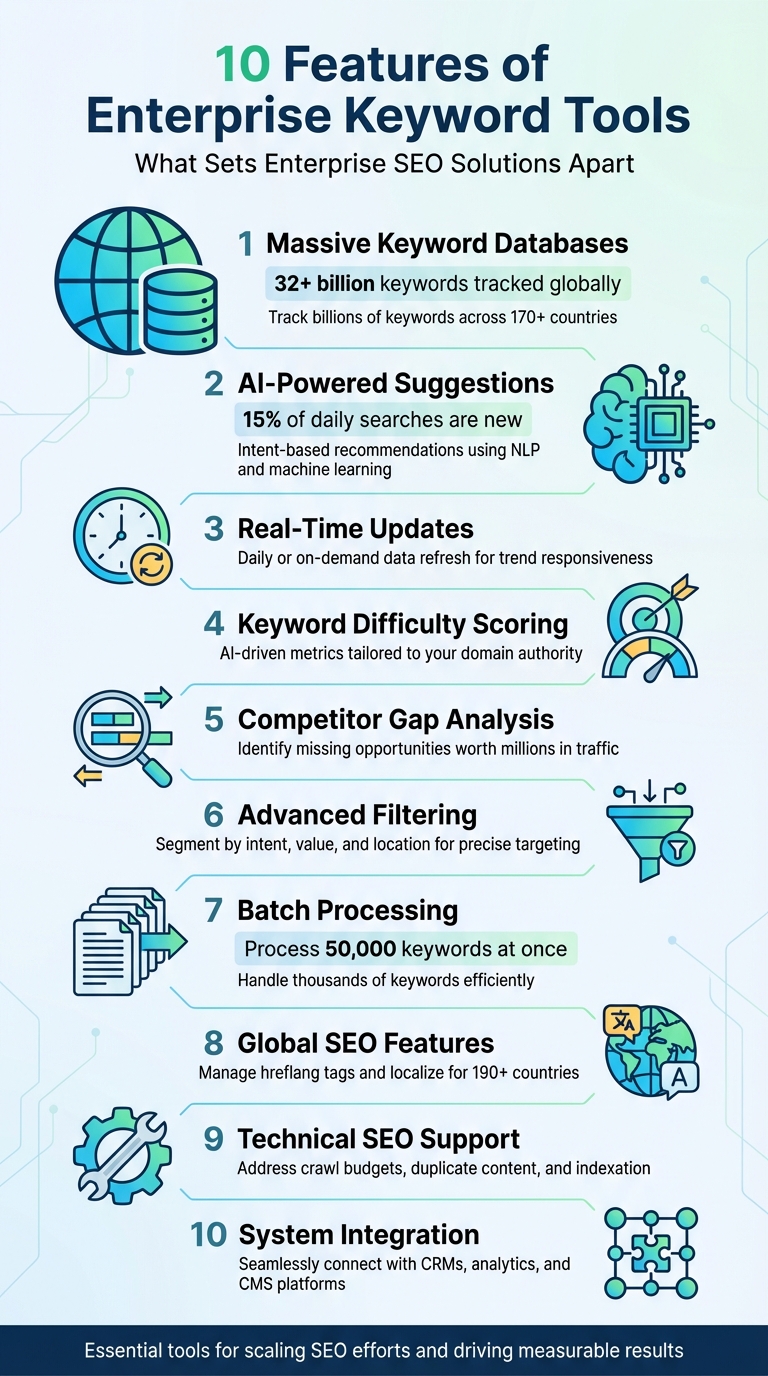
Managing SEO at scale requires tools designed for enterprise needs. Unlike standard keyword tools, enterprise solutions handle vast data volumes, automate processes, and integrate with other systems to demonstrate ROI. Here’s what sets them apart:
- Massive Keyword Databases: Tools like seoClarity and Ahrefs track billions of keywords globally, offering detailed insights across regions and industries.
- AI-Powered Suggestions: Advanced AI and NLP provide intent-based keyword recommendations, semantic clustering, and uncover long-tail opportunities.
- Real-Time Updates: Daily or on-demand updates ensure responsiveness to trends and algorithm changes.
- Keyword Difficulty Scoring: AI-driven metrics provide precise difficulty scores tailored to your domain.
- Competitor Gap Analysis: Identify missing opportunities by analyzing competitors’ keywords and strategies.
- Advanced Filtering: Segment keywords by intent, value, and location for precise targeting.
- Batch Processing: Handle thousands of keywords efficiently, saving time on large-scale campaigns.
- Global SEO Features: Manage hreflang tags and localize strategies for international audiences.
- Technical SEO Support: Address crawl budgets, duplicate content, and indexation issues.
- System Integration: Seamlessly connect with CRMs, analytics tools, and CMS for streamlined workflows.
These tools are essential for scaling SEO efforts effectively, saving time, and driving measurable results. Below, we dive into each feature in detail.
10 Essential Features of Enterprise Keyword Tools for SEO at Scale
1. Large-Scale Keyword Databases
Data Scale and Coverage
Enterprise-level keyword research begins with access to massive, globally diverse databases. For instance, seoClarity monitors over 32 billion keywords across more than 170 countries, adding around 1 billion new terms every month. Similarly, Ahrefs offers a database of 28.7 billion keywords across 226 regions, while Semrush tracks 26.5 billion keywords spanning 142 databases. Searchmetrics goes even further, with 250 billion data points covering 134 countries and seven years of historical SEO data. These historical insights are crucial for identifying seasonal trends and long-term shifts in the market. For brands navigating multiple regions, this global reach ensures they can address diverse audience needs effectively. Such extensive keyword databases form the backbone of enterprise-level SEO strategies.
Advanced Technologies
Yet, sheer data volume isn’t enough. Enterprise tools leverage AI and machine learning to refine keyword metrics, uncovering insights that simpler platforms might miss. For example, BrightEdge employs big data, AI, and natural language processing (NLP) to recover exact-match search volumes that were obscured after Google’s algorithm changes. This also helps identify related keyword opportunities using advanced techniques. These refined metrics allow enterprises to discover niche long-tail keywords, often signaling untapped content opportunities. By focusing on these advanced technologies, brands can craft more precise and impactful strategies.
Scalability for Enterprise-Level SEO Campaigns
Refined data, combined with advanced analysis techniques, enables enterprise tools to handle massive workloads seamlessly. Take Semrush, for instance – it processes 500TB of data daily using machine learning. This capability empowers SEO teams to analyze competitive landscapes across thousands of keywords without delays. Additionally, these tools support batch processing, streamlining workflows and allowing teams to efficiently manage large-scale keyword analysis. This scalability is critical for executing enterprise-level SEO campaigns that demand speed, precision, and depth.
2. AI-Powered Keyword Suggestions
Advanced Technologies (AI, NLP, Machine Learning)
Enterprise keyword tools have taken a big leap forward by using large language models (LLMs) to understand the relationships between keywords. For example, they recognize that phrases like "best running shoes" and "top sneakers for jogging" reflect the same user intent. This is especially important because 15% of Google’s daily searches are completely new queries with no previous data to rely on. While older tools struggle with these fresh searches, AI-powered systems can generate relevant variations that match the intent behind them.
Natural Language Processing (NLP) plays a key role here. It digs into user queries, voice search trends, and contextual relationships. Many enterprise tools now use GPT-4 for intent analysis, organizing keywords into four main categories: Informational, Navigational, Commercial, and Transactional. This ensures your content meets users’ needs at every stage of their journey. On top of that, some platforms combine NLP with machine learning to uncover keyword opportunities that traditional keyword research tools and strategies might miss.
"AI understands semantic relationships… enabling capabilities impossible with traditional tools, like generating keyword variations for topics with no search history." – DigitalApplied
Another standout feature is semantic clustering, which groups keywords based on meaning rather than just word similarity. This approach helps create content strategies that focus on related ideas, not just isolated terms. Some tools even provide AI-powered relevance scores, which measure how closely suggested keywords align with your target topic. These scores filter out keywords that may look similar at first glance but lack true semantic relevance. By using these scores, SEO teams can quickly prioritize the most valuable keywords without spending hours sorting through massive lists.
Customization and Integration Capabilities
Enterprise keyword tools also offer tailored difficulty scores, which take your domain authority into account. This means a Fortune 500 company and a smaller business might see different difficulty ratings for the same keyword, reflecting their unique competitive landscapes. Intent filters are another helpful feature, allowing teams to sort keywords into categories like "know", "buy", or "local." This makes it easier to align keyword strategies with specific business goals. These customization options turn generic keyword lists into actionable strategies that play to your organization’s strengths.
3. Advanced Filtering and Segmentation
Data Scale and Coverage (Global/Local Databases, Keyword Volume)
When dealing with massive keyword datasets, advanced filtering becomes essential. Enterprise-level tools handle billions of keyword entries by offering sophisticated filtering options that allow users to narrow down from broad global datasets to highly specific local insights. Some platforms boast keyword databases with tens of billions of entries, even exceeding 250 billion tracked data points. These tools enable segmentation at various levels – national, local, or even down to individual cities. For instance, a keyword that performs well in New York might behave very differently in Austin or Seattle due to variations in search volume and competition.
Filters based on technical metrics like search volume, cost-per-click (CPC), and competitive density make it easier to identify high-value opportunities. For example, you can set parameters to focus on keywords with monthly search volumes between 1,000 and 10,000 or target specific CPC ranges to align with your budget and campaign goals. This layered approach to filtering ensures that your keyword strategy is both precise and actionable.
Customization and Integration Capabilities
No two organizations operate the same way, and that’s where customization comes into play. Many enterprise platforms allow users to create custom tagging systems to organize keywords by factors such as product lines, regional markets, or even team responsibilities. These tools often include built-in workflows that automatically assign segmented keyword lists to the right teams, complete with visual aids to simplify analysis.
Integration takes this customization a step further. By linking keyword data with internal systems like CRMs or analytics platforms, you can refine segmentation based on real-world customer behavior. Imagine filtering keywords by conversion rates, customer lifetime value, or other business-specific KPIs – this kind of tailored approach ensures that your campaigns are not just data-driven but results-focused. These integrations make it easier to manage large-scale operations efficiently.
Scalability for Enterprise-Level SEO Campaigns
For enterprise SEO teams, advanced segmentation is a game-changer in managing overwhelming amounts of data. Grouping keywords by intent – such as informational, transactional, or commercial – helps allocate resources effectively without relying on manual sorting. Regular audits can also identify cases of keyword cannibalization, allowing you to consolidate competing pages into a single, authoritative resource.
This kind of precise segmentation ensures that your site remains well-structured, even as you scale across thousands of pages and multiple markets. By focusing on intent and streamlining your architecture, every piece of your keyword strategy can directly contribute to measurable SEO results.
4. Intent-Based Keyword Grouping
Advanced Technologies (AI, NLP, Machine Learning)
When crafting a keyword strategy for large-scale enterprises, intent-based grouping becomes a game-changer. It’s not just about knowing what users are searching for but understanding why they’re searching. This is where advanced tools using Natural Language Processing (NLP) come into play. These tools can group keywords with similar meanings, even if the wording varies. For instance, "running shoes" and "athletic footwear" may look different, but NLP identifies that they address the same user intent.
Today’s enterprise tools go beyond basic semantic analysis. Retrieval-Augmented Generation (RAG) takes intent discovery to the next level by rooting it in real enterprise data – like emails, chats, and internal documents. This ensures that keyword grouping reflects the authentic language of your customers and aligns with your business’s unique terminology. These advancements enable businesses to seamlessly integrate keyword strategies into their workflows.
Customization and Integration Capabilities
While AI insights form the backbone of intent grouping, the real strength lies in how well these insights integrate with enterprise systems. One of the most effective methods is SERP-based clustering, which focuses on URL overlaps in the top 10 search results. Instead of relying solely on linguistic similarities, this method uses search engine behavior as a guide. As Risto Rehemägi, Co-Founder of ContentGecko, puts it:
"If two keywords share 70% of the same top-10 URLs, Google is explicitly telling you they belong on a single page".
This approach eliminates the need for guesswork, ensuring your content aligns perfectly with search engine expectations.
Systems like SharePoint also play a vital role by offering features like "Enterprise Keywords" columns. These allow businesses to classify and organize content into categories that sync across the organization. For companies with unique requirements, API-first tools let you feed raw search data into custom dashboards or automation workflows. This flexibility ensures that keyword clusters align with both user intent and business goals, while advanced filtering keeps everything streamlined and relevant.
Scalability for Enterprise-Level SEO Campaigns
To make intent-based clustering work at scale, start by labeling keyword clusters based on intent – whether informational, navigational, transactional, or commercial. This labeling helps determine the most suitable content type for each cluster. For example, in e-commerce, it’s more effective to focus on category pages rather than individual product pages, as category pages tend to attract broader, higher-intent traffic. By aligning each cluster with a clear purpose, you ensure that your content reaches the right audience by mapping search intent to buyer journey stages.
5. Competitor Keyword Gap Analysis
Data Scale and Coverage (Global/Local Databases, Keyword Volume)
When it comes to crafting a strong keyword strategy, identifying gaps in your competitors’ approach can make all the difference. This process relies on massive, regularly updated databases. Some enterprise tools can add up to 1 billion new keywords each month, ensuring coverage of everything from high-volume commercial terms to niche, long-tail keywords and emerging trends. This level of detail is crucial because competitors often target not just broad, popular searches but also specific local queries that lead to conversions.
Take IBM, for example. In 2025, their Digital Marketing team, led by Bryan Casey, conducted an in-depth analysis of competitor backlink strategies and keyword gaps. The result? They uncovered opportunities worth $80 million in annual traffic over two years. Achievements like this are only possible with tools that capture the full spectrum of search behavior – from global, high-traffic terms to highly localized searches.
Advanced Technologies (AI, NLP, Machine Learning)
Having access to vast data is just the beginning. Advanced technologies like AI, natural language processing (NLP), and machine learning turn raw data into actionable insights. These tools can detect patterns in competitor strategies that might otherwise go unnoticed. For instance, a global retailer used Botify‘s AI-powered tools to speed up page delivery to search engines by 40x, leading to over 1 million new pages indexed and an additional $10 million in SEO-driven revenue.
Machine learning takes this a step further by categorizing gaps into groups like "Missing", "Untapped", and "Weak" keywords based on where competitors rank. This structured approach eliminates guesswork, helping teams focus on the gaps with the most potential impact and competitive relevance.
Customization and Integration Capabilities
Once gaps are identified, customization and integration turn insights into actionable strategies. The best tools allow for granular analysis, going beyond domain-level comparisons to examine subfolders, subdomains, or even specific URLs. This level of detail uncovers niche opportunities that might otherwise be overlooked.
For example, a hospital network in the Midwest achieved a 220% increase in organic traffic by using Moz Pro’s tools to target over 250 metro areas across the U.S.. Another effective method is using intersection filtering to zero in on high-priority keywords that are missing from your rankings but are driving traffic for competitors. These refined strategies ensure you’re targeting the right opportunities with precision.
6. Real-Time Search Volume Updates
Data Scale and Coverage (Global/Local Databases, Keyword Volume)
Keeping up with real-time search volume updates is essential for enterprise tools, as it allows teams to respond swiftly to market changes. Unlike the standard tools that rely on 12-month averages – which often fail to reflect sudden shifts – real-time updates capture seasonal spikes, emerging trends, and immediate impacts of algorithm changes. Without this capability, businesses risk missing out on new opportunities that lack historical patterns.
The difference lies in how frequently data is refreshed. Most standard tools update monthly or weekly, but enterprise platforms like AccuRanker stand out with daily or even on-demand updates. This constant flow of fresh data enables more precise, AI-driven adjustments to keyword strategies.
Advanced Technologies (AI, NLP, Machine Learning)
AI-driven platforms take search volume analysis to the next level. BrightEdge’s Data Cube X, for instance, uses big data and AI algorithms to refine exact match search volumes – something standard tools like Google Keyword Planner typically group into broader categories.
"Data Cube X exclusively features BrightEdge volume, which uses big data analysis and AI algorithms to restore the precise exact match search volume that was lost when Google switched to broad search volume." – BrightEdge
Machine learning also plays a pivotal role in real-time intent classification, categorizing keywords based on user intent – whether informational, navigational, commercial, or transactional. As the industry shifts toward Answer Engine Optimization (AEO), tools increasingly combine insights from AI platforms like ChatGPT Search and Google AI Overviews with traditional search data.
Scalability for Enterprise-Level SEO Campaigns
For businesses managing thousands of keywords across multiple markets, real-time monitoring is indispensable. AccuRanker, for example, offers daily keyword updates starting at $129/month for 1,000 keywords. This agility is particularly valuable during major Google updates, as highlighted by Zephyr Chan, Founder and Growth Marketer at Better Marketer:
"AccuRanker is the best SEO keyword tracker we’ve used. It offers real-time keyword tracking, updating rankings daily to keep us informed." – Zephyr Chan
This ability to adapt quickly during core updates or unexpected algorithm changes ensures that strategies remain effective and competitive.
7. Accurate Keyword Difficulty Scoring
Advanced Technologies (AI, NLP, Machine Learning)
Enterprise keyword tools are leveraging cutting-edge AI to deliver more accurate keyword difficulty assessments. For example, in October 2023, seoClarity introduced a new Keyword Difficulty metric based on "Page Strength." Developed over three years by Co-founder Mitul Gandhi and his team, this metric uses AI to analyze tens of billions of pages. The result? A correlation of 0.51 to rankings – more than double the 0.233 correlation achieved by traditional link-based models.
Similarly, in May 2021, Semrush revamped its Keyword Difficulty formula after 4,500 hours of research. Led by Product Owner Pavel Kolesnikov, the team examined over 100,000 keywords and 100+ parameters. Their machine learning model now assigns significant weight to the median number of referring domains (41.22%) and Authority Score (16.99%), resulting in more reliable scores across regional databases.
"seoClarity’s approach is significantly different and takes into account everything known about a page to create a composite score called Page Strength."
– Mitul Gandhi, Co-founder and Chief Architect, seoClarity
Customization and Integration Capabilities
Modern tools are taking precision a step further with domain-specific adjustments. Personal Keyword Difficulty (PKD) scores, for instance, calculate ranking effort based on a domain’s authority and topical relevance rather than relying on general averages. This means a keyword marked as "Difficult" may still be within reach for your site. Franco Valentino, Founder of Narrative SEO, LLC, notes:
"The calculation that takes into account the median # of backlinks & Authority Score PLUS the relative weight of the links really helps nail down a more precise score."
Scalability for Enterprise-Level SEO Campaigns
For enterprises managing vast keyword lists, precise difficulty scoring is a game-changer. It prevents wasted efforts on keywords that are unlikely to rank in the short term. Many platforms now allow filtering by difficulty ranges – making it easier to prioritize. For example, keywords with 0–14% difficulty can be targeted for "quick wins", while those in the 50–100% range are better suited for long-term plans. Additionally, tools are refining scores by factoring in SERP feature density (like Featured Snippets and Knowledge Panels) and tailoring results by country and region, ensuring global strategies stay relevant locally. These advancements help SEO teams allocate resources wisely and design strategies that align with both short- and long-term goals.
8. Semantic and Long-Tail Discovery
Enterprise-level keyword tools have taken a big leap forward with semantic and long-tail discovery. By using AI to uncover hidden content opportunities, these tools build on advanced filtering and intent grouping techniques to refine keyword strategies for enterprise SEO.
Advanced Technologies (AI, NLP, Machine Learning)
Modern enterprise tools go beyond simple keyword matching to understand search intent. AI now identifies semantic connections between different phrases, making long-tail discovery more precise. This shift is crucial because search engines like Google now focus on context and relevance rather than just exact-match keywords. Algorithms like BERT and MUM have played a big role in this evolution.
Some tools use SERP overlap clustering to find semantic relationships automatically. For example, when the same URLs appear across multiple queries, machine learning groups them into a single semantic cluster. These platforms also extract entities and link them to Knowledge Graphs, helping uncover topical gaps and relationships that go beyond basic keyword counts.
"Search intent today is semantic, not literal. Google evaluates context, entity relationships, and conceptual similarity when ranking content." – ThemeXpert
This process of creating semantic clusters opens up new opportunities that traditional keyword databases might miss.
AI also powers Zero Search Volume (ZSV) discovery, which identifies emerging, high-intent long-tail queries from unconventional data sources. This is especially valuable since 15% of daily searches are completely new. Unlike traditional tools, AI-driven platforms can detect these opportunities before they gain traction in standard keyword databases.
Scalability for Enterprise-Level SEO Campaigns
For enterprises dealing with thousands of keywords, AI and NLP simplify the process by clustering semantically related terms. This automation streamlines analysis and ensures comprehensive topical coverage across large websites. Notably, 86% of SEO professionals are already using AI for keyword research. Some tools rely on Natural Language Processing to identify related topics from a single seed phrase, while others expand their databases by adding about 1 billion new keywords every month to keep up with evolving search trends.
These advanced tools also highlight semantic queries that trigger Google’s featured snippets or "zero-click" results, helping enterprises gain visibility even when users don’t click through. To optimize performance, tools like Google Search Console can identify semantic variations where your site ranks in positions 8–20. With minimal adjustments, these keywords can often be pushed to page one.
9. Batch Processing for Scale
Enterprise keyword tools are designed to handle massive datasets in batches, streamlining processes that would otherwise require extensive manual effort. These platforms can process tens of thousands of keywords at once, cutting down what used to take weeks into just minutes.
Data Scale and Coverage (Global/Local Databases, Keyword Volume)
These tools are capable of analyzing up to 50,000 keywords in a single batch, making them indispensable for managing large-scale operations like multiple brands, international markets, and extensive e-commerce catalogs. For example, one case study highlighted a team that consolidated scattered data into a unified platform. The result? A 30% increase in organic search traffic, a 25% improvement in global keyword rankings, and a weekly savings of 12 hours of manual work. Batch processing eliminates the inefficiencies of sequential analysis, especially when dealing with multilingual and multi-country keyword tracking.
Advanced Technologies (AI, NLP, Machine Learning)
To maintain speed and precision, batch processing relies on cutting-edge technologies like AI, natural language processing (NLP), and machine learning. Automated keyword clustering, for instance, can group thousands of terms based on user intent and SERP similarities in a matter of minutes, replacing tedious manual categorization. Enterprise crawlers are equally impressive, auditing up to 250 URLs per second to keep millions of pages updated. Additionally, API integrations – handling up to 500,000 calls per day – enable seamless connections with business intelligence tools, data warehouses, and custom dashboards. With data refresh rates every 2–4 hours, SEO teams are better equipped to react quickly to changes in SERP rankings. These technologies make managing large-scale SEO campaigns both faster and more efficient.
Scalability for Enterprise-Level SEO Campaigns
Batch processing doesn’t just save time – it transforms how enterprise SEO campaigns are managed. By centralizing keyword data into scalable data lake solutions, these platforms allow for integrated reporting that ties keyword performance directly to revenue and conversions. This approach shifts the focus from just search volume to metrics that genuinely impact the business, helping teams prioritize efforts based on overall financial outcomes rather than isolated keyword rankings. The result is a more cohesive, data-driven strategy that scales effortlessly with the needs of the organization.
10. Integration with Enterprise Systems
Customization and Integration Capabilities
Managing vast datasets and real-time updates can be a challenge, but integrating with enterprise systems ensures smoother data flows. Enterprise keyword tools are designed with an API-first approach, which means they can seamlessly deliver ranking and keyword data directly to internal reporting systems, dashboards, and BI tools. This allows teams to access keyword insights within platforms they already rely on, such as web analytics tools (like GA4 and Adobe Analytics), content management systems, and project management tools like Jira and Asana. Some platforms even go a step further by offering direct CMS integrations. For instance, tools like Siteimprove and Searchmetrics connect effortlessly with WordPress, Drupal, and Joomla, enabling users to tackle on-page SEO issues without having to leave their editing environment. This kind of integration helps cut down on manual data transfers and saves time.
This unified approach to data flow is addressing a major issue for marketers: 72% of in-house marketers report feeling overwhelmed by the sheer amount of data they manage. By consolidating technical SEO, content optimization, and competitive intelligence into one workspace, enterprise tools transform scattered data into actionable insights. A great example of this is from 2025, when Ron Weber, Teradata‘s Global Digital Strategist, used the BrightEdge platform to combine technical diagnostics and content strategies for a large enterprise site. The result? A staggering 723% increase in traffic to key content within five months, along with a threefold boost in leads. These integrations also enhance AI-driven insights, making SEO workflows even more efficient.
Advanced AI Workflows
With integration as the foundation, advanced AI workflows take SEO efforts to the next level. These workflows allow teams to harness AI-driven insights directly within broader marketing technology stacks. For example, Conductor‘s Model Context Protocol (MCP) enables teams to query SEO and Answer Engine Optimization (AEO) intelligence seamlessly within AI tools. As of early 2026, over 90% of SEO professionals have either integrated or are testing AI search capabilities in their workflows.
One standout example comes from late 2025, when Overdrive Interactive launched "The Authority Project" using BrightEdge’s integrated Data Cube X and Copilot tools. Within just three months, they achieved a 710% increase in AI Overview citations.
Another trend is the merging of Paid Search (PPC) and Organic Search (SEO) data into a single platform. This integration eliminates inefficiencies in budget allocation and allows teams to share high-performing keyword insights across both channels. The result is a more cohesive and effective search strategy.
Conclusion
Enterprise keyword tools have revolutionized how SEO is managed on a large scale. Shelly Fagin, Director of SEO at DigitalOcean, highlighted this transformation, stating that tasks that used to take 20–30 hours each month can now be completed almost instantly.
These tools combine multiple advanced features into a seamless ecosystem designed for scalability and precision. This approach not only increases efficiency by over 70% but also provides deeper insights through historical and multi-location data spanning 190+ countries. With access to five to seven years of data, businesses can identify seasonal trends and search forecasts and craft strategies that look beyond short-term gains.
For content teams, the integration of AI-powered recommendations simplifies the content creation process. Tools like seoClarity’s "Sia" and BrightEdge’s "Copilot" use real-time search data to generate content outlines, meta descriptions, and even first drafts, making it easier to produce relevant, high-quality material.
These platforms ultimately empower enterprises to turn massive amounts of data into actionable strategies. By streamlining workflows and enabling faster decision-making, enterprise keyword tools provide the strategic edge businesses need to stay ahead in today’s competitive SEO landscape.
FAQs
Which enterprise keyword tool features matter most for my site?
Scalability and in-depth insights often play a key role, depending on your specific goals. Scalability is crucial when managing extensive keyword datasets across multiple regions or websites. Meanwhile, advanced tools like AI-powered analytics and competitor analysis provide the information needed to make smarter, data-backed decisions. Other helpful features include SERP tracking, multi-language capabilities, and integration with analytics tools – especially valuable for global or intricate enterprise SEO strategies.
How do AI keyword suggestions avoid irrelevant ideas?
AI-driven keyword suggestions focus on delivering relevant ideas by examining search data, user behavior, and contextual signals. This process ensures the keywords align with the target audience and niche. By categorizing search intent – whether it’s informational or transactional – AI tools match keyword suggestions to user goals effectively.
These tools also monitor real-time trends and analyze competitors, keeping recommendations current and on-point. This dynamic approach helps eliminate outdated or irrelevant keyword ideas, ensuring the suggestions are both targeted and aligned with strategic objectives.
How does keyword data connect to revenue and ROI reporting?
Keyword data ties directly to revenue and ROI by revealing how specific terms influence traffic, conversions, and income. With advanced tools, businesses can monitor metrics like rankings and visibility, linking them to financial performance. This approach pinpoints high-performing keywords, aligns SEO strategies with business objectives, and provides solid, data-backed arguments for investments. The result? SEO efforts that clearly support measurable financial outcomes.