

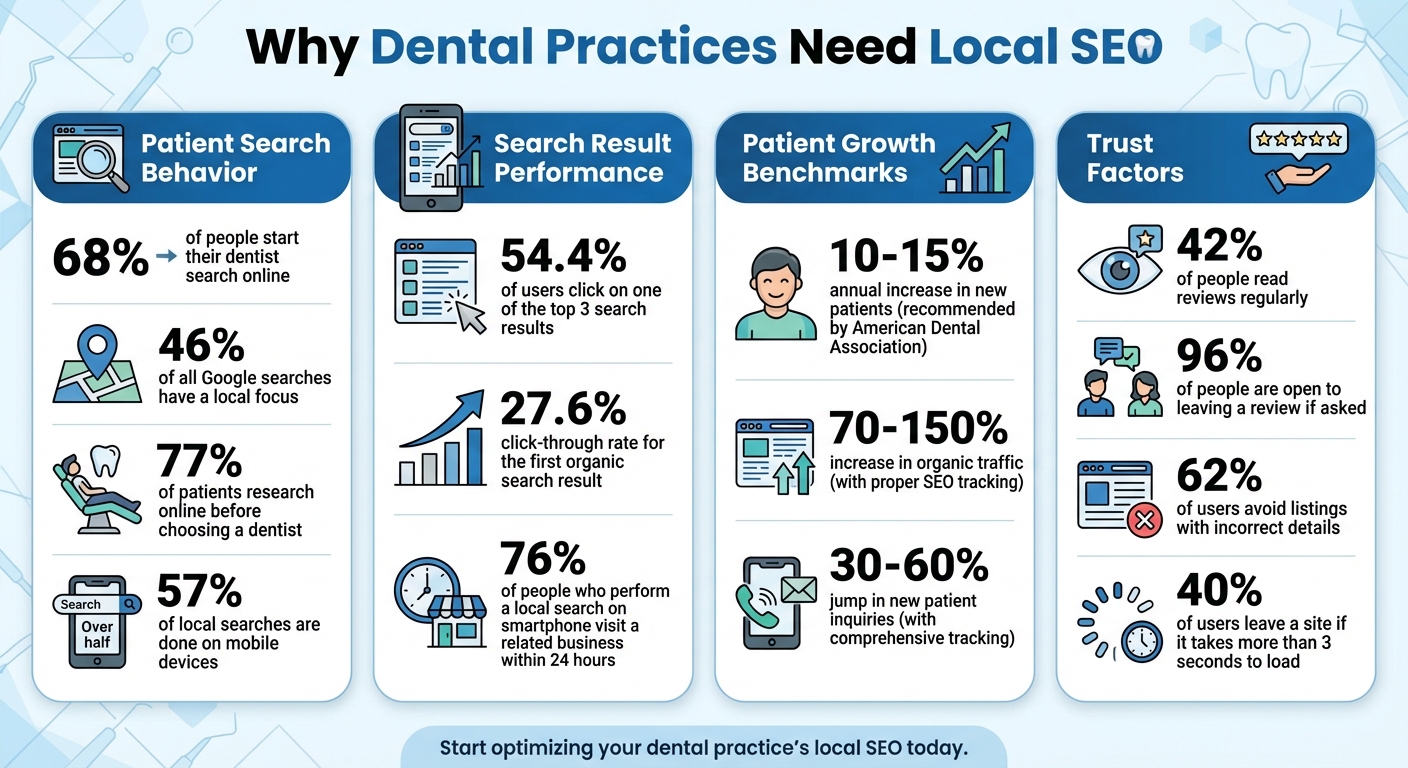
When people search for a dentist, 68% start online, often typing terms like "dentist near me." If your practice isn’t visible in these searches, you’re losing potential patients. Local SEO ensures your dental practice ranks higher on search engines and reaches people actively looking for care. Here’s how:
- Local SEO is key: 46% of Google searches have a local focus, and 77% of patients research online before choosing a dentist.
- Mobile matters: Over half of local searches are done on mobile, so your site must be mobile-friendly.
- Google Business Profile: A well-maintained profile increases visibility and trust. Most patients read reviews before booking.
- Track performance: Tools like Google Analytics and call tracking help measure calls, bookings, and traffic from SEO efforts.
- Content and keywords: Create service-specific pages, use location-based keywords, and write patient-focused blogs to attract searchers.
- Backlinks and citations: Partner with local organizations and keep your business info consistent across directories.
SEO is about being where your patients are searching. With the right strategies, you can improve visibility, gain trust, and grow your practice.
Dental SEO Statistics: Why Local Search Matters for Dentists
Set Goals and Track Patient Acquisition
Define Measurable SEO Goals
Before diving into SEO strategies, it’s crucial to establish clear, measurable goals. Focus on outcomes that directly reflect patient conversions, like phone calls, appointment bookings, or completed form submissions. These metrics are the real indicators of success when it comes to attracting new patients.
Your goals should align with patient growth benchmarks. For instance, the American Dental Association suggests aiming for a 10% to 15% annual increase in new patients. Since nearly half (46%) of Google searches have a local focus, prioritize location-based keywords such as "dentist in [your city]" or "emergency dental care near me." And don’t forget – over half of users (54.4%) click on one of the top three search results. Reaching those top positions should be a key objective.
Once your targets are set, the next step is to measure progress effectively.
Track SEO Performance
Tracking your SEO performance is just as important as setting goals. Tools like Google Analytics can help you monitor key metrics such as organic sessions, bounce rates, and time spent on your site. To get a clearer picture of your efforts, set up conversion tracking to measure exactly how many phone calls, form submissions, and appointment bookings stem from your SEO initiatives.
For even deeper insights, consider using call tracking software to measure search-to-call conversions. Google Search Console is another essential tool – it lets you audit your site and ensure your pages maintain strong rankings. When done right, comprehensive tracking can result in a 70–150% increase in organic traffic and a 30–60% jump in new patient inquiries.
Perform Local Keyword Research for Dental Services
Identify High-Intent Keywords
The first step is understanding the exact phrases potential patients use when searching for dental services. Think about every service your practice provides, from routine cleanings to specialized procedures like dental implants or emergency care.
Use tools like Google Keyword Planner, SEMrush, Moz, and Ahrefs to analyze search volume and competition for dental-related terms. Features like autocomplete and "People Also Ask" can also uncover valuable keywords.
Focus on long-tail keywords, such as "emergency dentist open on Sunday in Mesa AZ." These highly specific searches often indicate that the person is ready to schedule an appointment rather than just gathering information. You can also examine the keywords your local competitors are ranking for. This can reveal gaps in their strategies and confirm which terms are driving patient searches in your area. If keyword research feels overwhelming, professional keyword research services tailored for local businesses can simplify the process.
Once you’ve identified high-intent keywords, organize them into groups based on the services you offer and the needs of your patients.
Organize Keywords by Service Type
To make your strategy actionable, group your keywords into categories based on service types and location. For example, pair service-related terms with location-specific modifiers, like "Houston teeth cleaning" or "pediatric dentist in [your area]. You can also add descriptors like "affordable" or "top-rated" to appeal to specific patient preferences.
Develop keyword clusters for each major service. For instance, a cluster for teeth whitening might include terms like "teeth whitening," "whitening strips," and "professional whitening." Don’t forget to address patient concerns with phrases like "bleeding gums treatment" or "fix gum recession" to attract patients actively seeking solutions.
Another way to organize keywords is by search intent:
- Informational queries: For people researching their options (e.g., "what is teeth whitening?").
- Commercial searches: For those comparing practices (e.g., "best dentist for teeth whitening near me").
- Transactional terms: For patients ready to book (e.g., "schedule teeth cleaning appointment in Dallas.").
For practices with multiple locations, create unique keyword combinations for each office. Incorporate local landmarks or neighborhood names to capture hyper-local searches, such as "dentist near Central Park" or "family dentist in Downtown Austin".
SEO for Dentists (Complete 2026 Guide)
Optimize Your Dental Website for Local Search
Once you’ve nailed down your keyword strategy and started tracking performance, it’s time to fine-tune your website for local search. This step is crucial for attracting new patients in your area. Structuring your site for easy navigation – both for search engines and potential patients – is key. With the rise of local and mobile searches, your website should cater to both. A great way to start is by creating dedicated pages that focus on your services and locations.
Create Service and Location Pages
Make sure each dental service you offer has its own dedicated page. For example, services like teeth whitening, Invisalign, dental implants, root canals, and emergency care should all have individual pages. These pages should target specific keywords and provide detailed information about what the procedure entails, how long it takes, what patients can expect, and even pricing details if applicable.
If you have multiple office locations, create a unique page for each one. Avoid duplicating content – write original descriptions that include the office’s address, phone number, hours, and directions. To capture hyper-local searches, mention nearby landmarks or neighborhoods. For instance, phrases like "family dentist near Memorial Park" or "pediatric dentist in Downtown Phoenix" can help you rank better for local queries.
Implement On-Page SEO Basics
Start with your title tags – keep them under 60 characters and place your primary keyword at the beginning. For example: "Dental Implants in Austin, TX | [Practice Name]." Your meta descriptions should be between 155 and 160 characters, packed with relevant keywords, and written to encourage clicks.
Consistency is key when it comes to your practice’s name, address, and phone number (NAP). Display this information clearly across your site to build trust and credibility. Use descriptive URLs with hyphens to separate words (e.g., yourpractice.com/services/teeth-whitening-dallas). For added SEO benefits, implement JSON-LD schema markup to provide search engines with structured data about your business – like your name, address, phone number, services, provider credentials, reviews, ratings, and hours. Also, link your service pages to relevant blog posts using keyword-rich anchor text to enhance navigation and SEO.
Improve User Experience
A great user experience is vital for turning visitors into patients. Did you know that 40% of users will leave a site if it takes more than 3 seconds to load? To speed things up, consider upgrading your web hosting, using a Content Delivery Network (CDN), and compressing images with formats like WebP or AVIF to maintain quality while reducing file sizes.
Your site also needs to be mobile-friendly, as 57% of local searches are done on mobile devices. Ensure your website looks good and works smoothly on smartphones and tablets. Simplify navigation menus for mobile users, and include clear calls-to-action – like "Schedule Appointment", "Call Now", or "Request Consultation" buttons – on every page. Features like online scheduling tools or live chat can make it even easier for patients to connect with you. And remember, avoid intrusive pop-ups to keep the browsing experience seamless and engaging.
Build and Optimize Local Listings and Reviews
Your website’s local SEO is great for drawing in visitors, but it’s the combination of well-maintained listings and patient reviews that turns those visits into actual appointments. Think of your Google Business Profile as your most powerful local SEO tool. It’s the key to showing up in the Google 3-Pack and catching the attention of potential patients searching for dental services nearby. Beyond Google, keeping your information consistent across online directories and managing reviews helps build trust and boosts your local search rankings. When someone looks up a dentist, they’ll often check your listings, read reviews, and decide whether to call your office – all before they even visit your website. To make the most of this, focus on optimizing your Google Business Profile and managing patient feedback effectively.
Optimize Your Google Business Profile
Start by claiming and verifying your Google Business Profile. Fill out every section with accurate and up-to-date information, including your practice name, address, phone number, business hours, services, and a well-written description. Use natural keywords like "family dentist in Phoenix" or "cosmetic dentistry in Austin" to improve search relevance. Add high-quality photos showcasing your office, staff, and equipment to create a welcoming first impression.
Keep your profile active by posting updates regularly. Share news about your practice, dental health tips, special promotions, or patient success stories (with their permission). Google values profiles that stay updated and engaged, factoring in review volume, recency, and sentiment when ranking businesses. A well-maintained profile not only improves your visibility but also signals to potential patients that your practice is reliable and approachable. Once your profile is polished, shift your attention to leveraging patient reviews to strengthen your reputation.
Manage Patient Reviews
Patient reviews are a big trust factor – 42% of people read them regularly, and about one-third need to see 20–49 reviews before trusting a business. Interestingly, 96% of people are open to leaving a review if you simply ask them. Encourage satisfied patients to share their experiences before they leave your office. You can send follow-up emails or texts with a direct link to your Google Business Profile review page. Another option is to include QR codes on appointment cards or receipts that take patients directly to your review page.
Make it a habit to respond to all reviews, whether they’re glowing or critical. For positive feedback, thank the patient while respecting their privacy and staying compliant with HIPAA regulations. When addressing negative reviews, show understanding, apologize if necessary, and invite the patient to contact your office directly to resolve the issue. Adding relevant keywords, like "gentle family dentist in Salt Lake City", to your responses can also improve your profile’s relevance and click-through rates.
Build Local Citations
Citations – mentions of your practice’s name, address, and phone number (NAP) across the web – play a crucial role in verifying your business for Google and improving local search rankings. In fact, 62% of users avoid listings with incorrect details, so accuracy is key. Claim your practice on major directories like Yelp, Bing, Facebook, and healthcare-specific platforms such as Healthgrades, Zocdoc, RateMDs, Vitals, and Dental Insider.
Regularly audit your online directories to ensure all details are accurate and consistent. Use tools like the USPS Zip Code lookup to standardize your address format. Keeping your NAP consistent across all directories prevents confusion and helps maximize your visibility. Services like BrightLocal, Whitespark, Moz Local, or Chatmeter can simplify the process of managing and updating multiple directories, saving you time and effort.
Create Patient-Focused Dental Content
Educational content goes beyond just listing your services – it builds trust with potential patients and boosts your search engine rankings. By creating service-specific pages and blog posts that answer the exact questions people are asking, you can address concerns about dental procedures, costs, and treatment options. This approach also strengthens your local SEO strategy.
Develop Service-Specific Pages
A well-optimized website should include pages dedicated to each dental service you offer. These pages should be tailored to meet patient needs by clearly explaining the procedure, addressing common concerns, and answering frequently asked questions. Use location-specific keywords naturally, such as "teeth whitening in Austin" or detailed phrases like "family dentist accepting new patients in Carrollton, Texas with Saturday hours."
Each page should provide a clear picture of what the procedure involves, what patients can expect, and its benefits. Including videos can be a great way to visually explain the process and help ease any anxiety. This is especially helpful for patients who may feel nervous about certain treatments.
Publish Educational Blog Content
Posting regular blogs that tackle common dental concerns, debunk myths, or explain procedures in simple terms positions your practice as a go-to resource. For example, topics like "When should kids start seeing a dentist?" or in-depth guides on treatments like root canals, crowns, or Invisalign can attract readers who are actively searching for answers.
Seasonal content works well too – think back-to-school dental checklists or holiday oral care tips. Sharing patient success stories (with proper consent and before-and-after photos) also helps build trust and allows potential patients to see the results they could achieve.
Localize Content for U.S. Audiences
Adding regional touches to your content can make it more relatable for your audience. For instance, write about topics like "The Benefits of Teeth Whitening in Phoenix" or offer dental care tips specific to your area’s climate and seasons. Mentioning nearby schools, neighborhoods, or community events can create a stronger connection with readers. Aligning your content with local interests not only enhances engagement but also supports the patient journey initiated by your local SEO efforts.
Build Authority with Backlinks and Mentions
Backlinks from well-regarded websites act like endorsements for your dental practice. When respected local organizations, health blogs, or professional associations link to your site, it signals to Google that you’re a trusted member of the community. But here’s the key: quality trumps quantity. A handful of strong, local backlinks will do more for your rankings than dozens of low-quality ones.
Acquire Local and Niche Backlinks
Start by joining your local Chamber of Commerce or professional dental organizations. Groups like the Academy of General Dentistry (AGD) often maintain public directories where your practice can be listed, which adds credibility and earns you a valuable backlink. Another great strategy? Sponsor local events or programs. Whether it’s a youth sports league, a charity run, or a school fundraiser, these organizations typically thank their sponsors with a link on their websites.
You can also contribute guest posts to local health and wellness blogs or offer expert insights to newspapers – both of which can lead to mentions and backlinks. Building partnerships with nearby businesses, like pharmacies or orthodontists, opens opportunities for cross-promotion. These relationships can lead to shared backlinks or other local endorsements, boosting your visibility online. After securing backlinks, take the time to evaluate their quality to ensure they’re helping, not hurting, your SEO efforts.
Evaluate Link Quality
Not all backlinks are beneficial. Links from websites with high Domain Authority (DA) and Page Authority (PA) usually carry more weight and positively impact your rankings. Make sure the linking sites are relevant to healthcare or your local area, and that the links are naturally placed within the main content – not buried in sidebars or footers.
Keep an eye out for potential issues, like sudden increases in spammy backlinks, links from irrelevant sites, or multiple links coming from the same IP address. Avoid buying backlinks or participating in link schemes – these can lead to penalties from search engines. Regularly monitor your backlink profile with tools like Google Search Console to spot and disavow any harmful links. A diverse range of backlinks from unique domains shows search engines that your practice is a trusted and respected authority.
Conclusion
Attracting new patients through SEO is all about building a long-term strategy that ensures your practice shows up where people are actively searching for dental care. Your online visibility plays a crucial role in how many new patients walk through your doors.
The tactics we’ve covered – like fine-tuning your Google Business Profile, targeting local keywords, crafting patient-centered content, and earning quality backlinks – work together to boost your presence in local search results. Here’s something to think about: 76% of people who perform a local search on their smartphone visit a related business within 24 hours. That’s a clear opportunity to connect with potential patients right in your community. By combining these strategies, you can lay the groundwork to extend your practice’s reach effectively.
SEO isn’t just about quick wins – it delivers results that keep working for you, attracting patients month after month. And when you consider that the first organic search result on Google grabs an average 27.6% click-through rate, you can see how strong rankings can dramatically increase your practice’s visibility.
If you’re just getting started, claim your Google Business Profile, ensure your NAP (name, address, phone number) details are consistent, and encourage happy patients to leave reviews. From there, build on this foundation with targeted content, mobile-friendly updates, and strategic backlinks. Don’t forget to track your progress and adjust your approach as needed – those earlier sections have all the details to guide you.
Dental practices that invest in local SEO today set themselves up for success tomorrow. Be where your patients are searching, and you’ll stay ahead.
FAQs
How can I make my dental website easier to use on mobile devices?
To ensure your dental website works well on mobile devices, prioritize a responsive design that adapts effortlessly to any screen size. Aim for fast loading times – under 3 seconds is ideal – and make navigation simple with easy-to-read menus and buttons designed for touchscreens. Simplify the appointment booking process with a straightforward form, and add a click-to-call feature so patients can quickly reach your office, especially during emergencies.
What are the best tools to track SEO performance for a dental practice?
To keep tabs on your dental practice’s SEO performance, tools like Google Analytics and Google Search Console are essential. They offer valuable insights into your website’s traffic and search visibility. For a more detailed look, platforms such as Ahrefs, SEMrush, and Moz can help you uncover keyword opportunities, monitor rankings, and evaluate backlinks. If local SEO is your priority, BrightLocal is an excellent choice for managing and improving your visibility in local searches. These tools deliver useful data that can help fine-tune your strategies and bring in more patients through organic search.
How can I get more patients to leave positive online reviews?
Encouraging patients to share positive reviews doesn’t have to be complicated. A good time to ask for feedback is right after their appointment, while their experience is still top of mind. To make it even easier, provide direct links or QR codes that take them straight to your review pages.
Your staff can also play a key role by casually mentioning reviews during conversations. Highlight how their feedback helps others discover reliable care. And don’t forget to respond to every review – positive or negative. A professional and thankful response shows patients that their opinions truly matter.