
Want your dental practice to thrive in 2026? SEO is no longer just about Google rankings – it’s about being recognized by AI systems like ChatGPT, Google Gemini, and Perplexity. These tools now control most search results, referencing only a few trusted dental websites. If your site doesn’t meet AI standards, your visibility could vanish.
Here’s what you need to know:
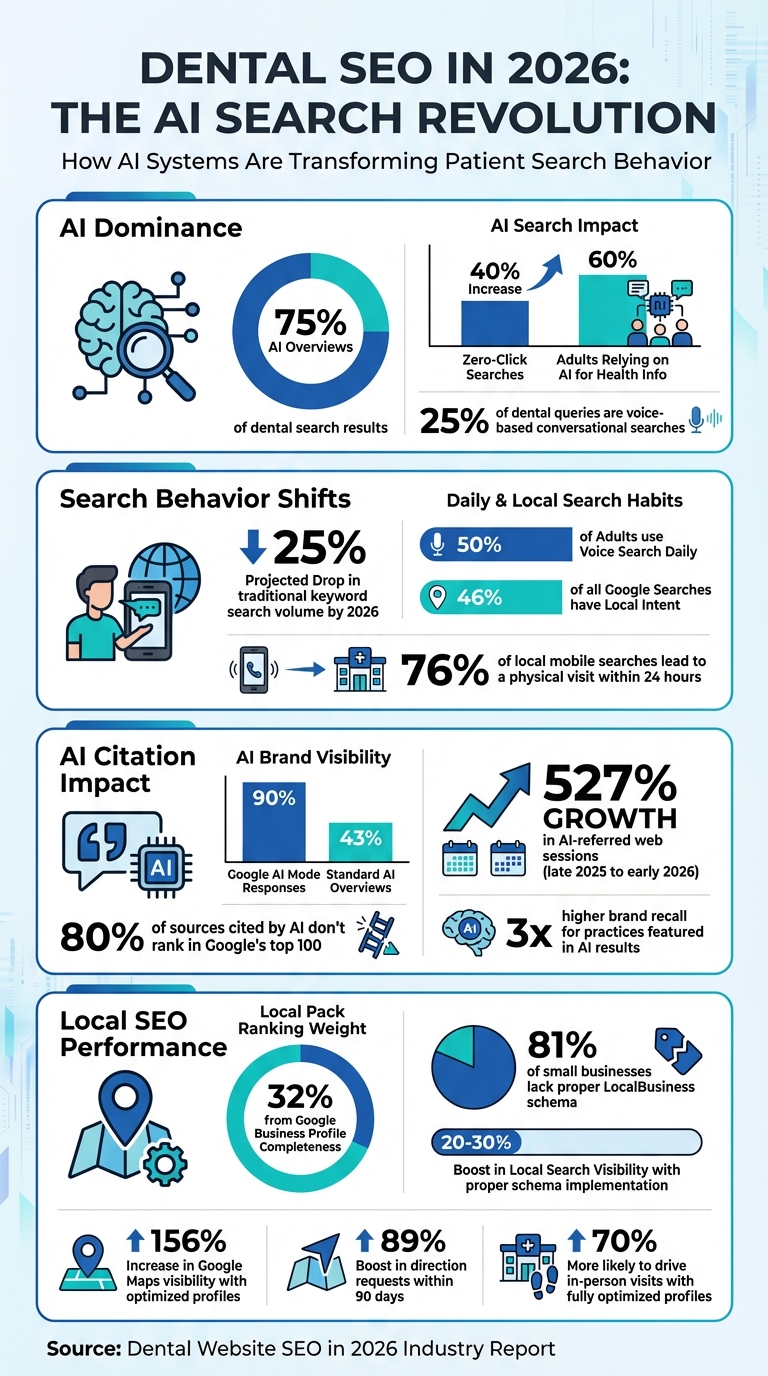
- AI Overviews dominate 75% of dental search results, answering patient questions directly.
- Zero-click searches are up 40%, with 60% of adults relying on AI for information.
- Voice search matters: 25% of dental queries are conversational, like “Who’s the best emergency dentist near me?”
To stay visible, focus on Generative Engine Optimization (GEO) – structuring content to meet AI criteria. This includes:
- Creating detailed, conversational content that answers specific patient questions.
- Using schema markup (e.g., LocalBusiness, FAQ) to help AI understand your services.
- Optimizing for speed and mobile performance to ensure AI systems can crawl your site.
The bottom line: If your dental website isn’t AI-ready, you risk losing patients to competitors who are. Let’s explore how to stay ahead.
Dental SEO Statistics 2026: AI Search Impact and Patient Behavior
Dental AI SEO: How Do I Build Dental Authority to Be Recommended by AI Search?
Keyword Strategies Based on Patient Search Behavior
To stay ahead in both traditional SEO and emerging AI-driven search trends, it’s crucial to rethink your keyword strategies. Patients no longer search for generic terms like "dentist Phoenix." Instead, they ask detailed, conversational questions like, "Which dentist near me takes my insurance and can see me today?" or turn to AI tools with prompts like, "I need a pediatric dentist who does sedation for anxious kids." With traditional keyword search volume projected to drop by 25% by 2026, and 50% of adults already using voice search and local SEO daily, adapting to this shift is essential.
The old approach of targeting single keywords, such as "dental implants", is becoming obsolete. AI systems now prioritize topical authority, favoring content that covers an entire subject comprehensively. For instance, instead of a single page on "root canals", create multiple pages addressing questions like, "How long does a root canal take?", "What does it cost in [City]?", or "Can I eat after one?". This signals to AI models that your practice is a trusted, expert source.
"Rankings in 2026 will favor clinics that understand what patients are saying aloud, and what they are typing into AI – not just what they used to type." – Case Dentistry
Your keyword strategy should mirror the way patients actually speak and search at different stages of their journey. For example:
- A general inquiry like, "How often should I see a dentist?" reflects early research.
- A comparison search, "Invisalign vs. braces cost," shows someone evaluating options.
- A booking query, "emergency dentist open now," indicates an immediate need.
Each stage requires tailored content that uses conversational language AI systems can easily interpret and recommend.
Using AI Tools for Keyword Research
AI-powered tools can uncover the exact phrases patients use when interacting with voice assistants or typing into platforms like ChatGPT. These tools perform Answer Gap Analysis, identifying questions where competitors appear in AI-generated responses but your practice does not. For instance, you might find that AI systems frequently recommend other practices for "sedation dentistry for children", even if your practice offers that service.
Advanced AI tools can also track how often platforms like ChatGPT or Perplexity crawl your site and which pages they access. This data helps you understand if your key service pages are being indexed for conversational queries. Tools like Promptwatch offer plans starting at $99/month (Essential), $249/month (Professional), and $579/month (Business), while more basic options like Otterly.AI start at $29/month.
Focus on hyper-local, long-tail keywords that align with patient intent. Instead of broad terms like "comprehensive dental care", aim for specific phrases such as "emergency dentist in Gilbert accepting Cigna insurance" or "same-day dental crown in Chandler". These detailed keywords help AI systems connect your practice with patients who have immediate needs, especially for voice searches that often include location, insurance details, and urgency.
Matching Keywords to the Patient Journey
Once you’ve identified conversational phrases using AI tools, align your content with the stages of the patient journey. Each stage benefits from specific keyword types and content formats:
- Awareness Stage: Patients ask educational questions like, "Why do my gums bleed when I brush?" Blog posts and FAQ pages answering such questions establish your practice as a helpful resource.
- Consideration Stage: Patients compare options and search for terms like, "cost of dental implants in Phoenix vs. bridges" or "best pediatric dentist in Scottsdale". Detailed guides and comparison pages work well here.
- Decision Stage: High-intent keywords, such as "dentist accepting Blue Cross near me" or "emergency dentist open now," capture patients ready to book immediately.
For example, from August to November 2025, a pediatric dental practice in California partnered with Titan Web Agency to refine its content. By addressing parent-focused questions at each stage, the practice clarified its core services – like preventive care, sedation dentistry, and frenectomies – into well-organized topics. This approach boosted their visibility in AI-generated answers for high-intent queries like "emergency pediatric sedation" and "early childhood dental care".
To ensure your content stands out, provide clear, concise answers that voice assistants can summarize easily. Keep FAQ responses between 30–50 words, use headings that directly reflect patient questions, and implement Schema markup (Service, FAQ, LocalBusiness) to help AI systems interpret your content. By doing this, your practice can secure visibility in both traditional search results and AI-generated responses.
Local SEO and Schema Markup Implementation
For dental practices in 2026, local SEO isn’t just a nice-to-have – it’s the backbone of attracting new patients. Nearly 46% of all Google searches now have a local focus. And while having a Google Business Profile is critical, it’s only part of the equation. In fact, the completeness of your profile accounts for 32% of local pack ranking weight. To stay ahead, leading dental practices are taking it a step further by implementing schema markup. This provides search engines and AI systems with structured, machine-readable data about your business – like your services, hours, and location.
Why does schema markup matter? It eliminates guesswork for search engines and AI systems. Tools like ChatGPT, Perplexity, and Google Gemini now rely on structured data to pull key details like business hours, contact info, and service areas for direct recommendations. This not only improves your visibility in local search results but also strengthens your presence in voice search and conversational queries.
"AI search engines are becoming the new local directory. When someone asks ChatGPT for ‘the best dentist near me,’ your local schema determines whether you’re in that conversation." – Yue Zhu, Product Manager, Seenos.ai
The results are hard to ignore. Properly implementing LocalBusiness schema can boost local search visibility by 20–30%. Yet, an audit of small businesses in 2026 revealed that 81% lacked proper LocalBusiness schema on their websites. This gap represents a huge opportunity for dental practices willing to invest in structured data.
Implementing Schema Markup for Local Search
To get started, use the specific Dentist schema subtype instead of the more generic LocalBusiness tag. This ensures AI systems can accurately categorize your practice. The preferred format in 2026 is JSON-LD, which is easy for Google and AI crawlers to process.
Key elements to include in your schema:
- Practice name, address, and phone number (NAP): Ensure this information is consistent with your Google Business Profile.
GeoCoordinates: Include latitude and longitude for precise map placement, especially if you’re in a busy medical complex.OpeningHoursSpecification: Clearly outline your hours of operation.
For high-value treatments like dental implants or Invisalign, you can nest a Service schema within your LocalBusiness data. This helps search engines understand your offerings and improves visibility for commercial-intent searches like "dental implants near me". Adding FAQPage schema to service pages also allows AI systems to pull direct answers to common patient questions about procedures or costs.
Consistency is key. Your NAP information in the schema must match your Google Business Profile and online directories exactly. Even minor differences – like "Ste 100" versus "Suite 100" – can hurt your rankings. Once implemented, validate your schema using tools like Google’s Rich Results Test or Schema Markup Validator to ensure everything is formatted correctly.
If your practice has multiple locations, create a dedicated landing page for each office. Each page should include its own unique Dentist schema. This allows each location to rank independently in local search results.
Standard Local Listings vs. Schema-Enhanced Profiles
The difference between a plain local listing and one enhanced with schema is dramatic. Standard listings rely on search engines piecing together unstructured text, while schema provides direct, structured data that AI systems trust.
| Feature | Standard Local Listing | Schema-Enhanced Profile |
|---|---|---|
| Search Appearance | Plain text | Rich snippets (e.g., star ratings) |
| AI Visibility | Often excluded from AI summaries | Used as a primary source for AI answers |
| Map Accuracy | Relies on address text | Precise placement via GeoCoordinates |
| Click-Through Rate | Baseline | Up to 35% higher with review stars |
| Trust Signals | Basic NAP information | Verified entity data, FAQs, and detailed service lists |
Schema-enhanced profiles deliver measurable results. Practices with optimized profiles see, on average, a 156% increase in Google Maps visibility and an 89% boost in direction requests within 90 days. Moreover, fully optimized profiles are 70% more likely to drive in-person visits. These improvements can be the difference between being discovered or overlooked.
"Local business schema markup is no longer optional in 2026. It is a structural trust layer that helps Google, Maps, and AI systems understand exactly who you are." – LocalMighty
The cost of SEO services that include schema implementation varies. For small clinics, prices range from $1,500–$3,500 per month, while mid-sized or multi-location practices pay $4,000–$7,000 per month. Large dental networks in competitive markets can expect to spend $10,000+ per month. These investments often pay off quickly, thanks to the boost in patient acquisition.
Content Optimization for AI and Geographic Targeting
Building on earlier SEO strategies, optimizing your site for AI and geographic targeting – under the framework of Generative Engine Optimization (GEO) – is now essential. Your content must cater to AI for seamless extraction while maintaining local relevance. With zero-click searches for healthcare topics increasing by 40%, structuring content for AI engines becomes critical, even if click-through rates remain low.
The challenge is stark: 80% of sources cited by large language models don’t even rank in Google’s top 100 for the original query. Traditional SEO alone won’t suffice. Instead, you need to position your practice as a trusted source for AI-generated answers, embracing GEO to stay ahead.
"Writing for the AI era of 2026 requires a shift in mindset. We are moving from Search Engine Optimization (SEO) to Generative Engine Optimization (GEO)." – Marketing 360 Team
The rewards are hard to ignore. Dental practices featured in AI results see triple the brand recall compared to traditional rankings, and AI-referred web sessions grew by an astounding 527% in just five months during late 2025 and early 2026. For local practices, this shift is a game-changer, offering new ways to connect with patients through conversational AI platforms and voice assistants.
Writing Location-Specific Content
Gone are the days when generic location pages were enough. Today, you need unique, hyperlocal pages that emphasize specific neighborhoods, landmarks, and reviews. Google’s 2026 algorithm evaluates businesses as entities, cross-referencing your website with your Google Business Profile, social media, and online reviews for a complete picture.
To stand out, focus on hyperlocal targeting. For example, a generic "Dallas dentist" page won’t cut it in competitive markets. Create dedicated pages for neighborhoods, suburbs, school zones, and commuter areas. Include practical details like local landmarks, parking options, and transit routes.
Incorporate localized social proof. Patient reviews tied to specific neighborhoods strengthen your credibility in those areas. Highlight specific services you’ve provided, such as "Invisalign treatment for a patient in Lakewood" or "emergency dental care for a family in East Dallas."
Use insurance-specific keywords to capture high-intent searches. For example, create content targeting phrases like "emergency dentist accepting Blue Cross Blue Shield in Uptown Dallas" or "pediatric dentist taking Medicaid near Richardson". These long-tail keywords often face less competition and attract patients ready to book.
Keep your location pages concise and high-quality. Instead of producing dozens of thin, templated pages, aim for 12–15 well-crafted ones. Use advanced schema markup – such as LocalBusiness, Dentist, and FAQ schema – to help AI systems extract and summarize your practice information.
Once your localized content is in place, the next step is structuring it for AI-generated summaries.
Structuring Content for AI-Generated Summaries
AI systems prioritize clarity and structure over keyword stuffing. To make your content "AI-ready", stick to the 50-Word Rule: include concise, ~50-word summaries for each major topic on your service pages. These summaries help AI engines easily extract and reference your content.
Use an inverted pyramid style for your writing. Start with the most important information or direct answers, followed by supporting details. For example, a dental implant page might begin with: "Dental implants take 3–6 months, including a 3–4 month healing period before crown attachment."
Headings should mirror patient queries. Instead of vague titles like "Treatment Duration", use specific, question-based headings such as "How long does Invisalign take?" or "What is the cost of dental implants in [City]?" This aligns with conversational and voice-based searches, which now account for 25% of all dental-related queries.
Enhance readability with clear formatting. Use lists, tables, or step-by-step guides – formats that AI systems can easily parse. Adding FAQPage schema to Q&A sections ensures AI engines can extract direct answers for summaries, with each answer standing on its own.
Quantified claims, like "73% of patients report reduced anxiety with sedation dentistry", help build trust with AI systems. Display your credentials prominently, as AI values Experience, Expertise, Authoritativeness, and Trustworthiness (E-E-A-T). Include details like dental license numbers, specialist qualifications, years in practice, and case volumes. For example: "Dr. Sarah Johnson has completed over 500 Invisalign cases since 2018 and is a certified Invisalign Diamond Provider."
Encourage patients to leave reviews mentioning specific treatments. AI scans review text to justify recommendations for particular services. A review like "Dr. Smith did an amazing job with my dental implants" is far more impactful for AI visibility than a generic "Great dentist."
"In SEO, you competed for ten blue links. In GEO, you compete for one synthesized answer. The AI reads hundreds of sources, picks a handful it trusts and stitches together a response." – Abhinav Chetan, Founder, Digicated.ai
One example of success comes from a pediatric dental practice in California. By organizing content for AI summarization and addressing parent-focused questions naturally, they improved their AI visibility from August to November 2025. The result? Consistent appearances in AI-generated summaries for high-intent searches like emergency care and sedation dentistry. Their strategy of clarifying services and emphasizing local details made all the difference.
Technical SEO: Speed and Mobile Performance
Content optimization often takes the spotlight, but the technical side of your site is what ensures AI systems and Google can access it. In 2026, speed isn’t just about keeping users happy – it’s about whether AI crawlers like GPTBot can properly index your content for AI Overviews and LLM-generated answers. The stakes are high: brands show up in 90% of Google AI Mode responses, compared to just 43% of AI Overviews, making technical optimization non-negotiable.
This is especially crucial for dental practices. AI search engines have stricter standards than traditional Google search, often cutting off page loads at a 100-millisecond limit. Emily Richardson, COO and Founder of KNWN, highlights this point:
"AI stops trying to load your page at 100 milliseconds".
If your page takes longer than that, AI systems may skip indexing or misread critical details about your practice.
By 2026, traditional search engine use is expected to drop by 25% as AI and voice assistants become dominant. This shift means your site must cater to both human users and autonomous AI agents that might book appointments directly, bypassing user interaction. Google’s local algorithm now evaluates your site speed and technical health alongside social profiles and directory listings to determine authority. These factors lay the groundwork for improving page speed and mobile performance.
Improving Page Load Speed
For 2026, aim for a mobile PageSpeed Insights score of 70+, a desktop score of 85+, and total load times under 3 seconds. These benchmarks aren’t random – they define whether AI systems can reliably crawl your site or skip it.
Start by upgrading your hosting setup. Performance-focused hosting and a Content Delivery Network (CDN) can significantly reduce Time to First Byte (TTFB). If you’re using WordPress, prioritize database health. Clean up post revisions and spam comments regularly to speed up database queries.
Optimize images by using WebP or AVIF formats, which reduce file sizes by 30–50%. Use the srcset attribute to deliver appropriately sized images for different devices. For above-the-fold hero images, preload them using <link rel='preload'> to cut Largest Contentful Paint (LCP) times by 0.5–1 second.
Security is a must. Your entire site should run on HTTPS, as Google favors secure websites in healthcare-related searches. Beyond rankings, HTTPS builds patient trust and ensures compliance with healthcare privacy standards.
| Speed Issue | Solution |
|---|---|
| Slow DNS lookup | Upgrade to a faster DNS provider |
| Large image files | Convert to WebP/AVIF and use srcset |
| Slow TTFB | Use performance hosting and a CDN |
| Database bloat | Clean post revisions and spam comments |
Equally important is ensuring your mobile site meets modern indexing standards.
Mobile-First Indexing Requirements
Google’s mobile-first indexing means the mobile version of your site is the primary source for indexing. That means your mobile site must have the same core content, internal links, structured data, and meta tags as your desktop version to avoid ranking issues.
Responsive design is key. Use a single URL, CSS media queries, and the viewport meta tag: <meta name="viewport" content="width=device-width, initial-scale=1">. This ensures your site adjusts to different screen sizes without needing separate mobile URLs.
Interactive elements need to be touch-friendly. Buttons and links should have touch targets of at least 48x48px with 8px spacing, while form fields should have a minimum height of 44px. Body text should be at least 16px to maintain readability without zooming.
Critical content must load immediately in the initial HTML response. Avoid hiding important details behind "load more" buttons or complex JavaScript. Although content in tabs or accordions is indexed, any primary, keyword-rich content – like service descriptions – should be visible by default for maximum impact.
Stay away from intrusive interstitials. Full-screen popups that block your main content are penalized. However, overlays for age verification or cookie consent are acceptable. Keep in mind that 76% of local searches on mobile devices lead to a physical visit within 24 hours, making your mobile experience directly tied to appointment bookings.
Finally, optimize JavaScript performance. Mobile CPUs are slower than desktop ones, so scripts that take 150ms to execute on a laptop can take 600ms on a mid-tier Android device. This directly affects metrics like Interaction to Next Paint (INP). Always test your site on real mobile devices, not just desktop emulators.
| Mobile UX Element | 2026 Requirement |
|---|---|
| Font size | 16px minimum for body text |
| Touch targets | 48x48px minimum with 8px spacing |
| LCP threshold | Under 2.5 seconds on 4G connections |
| Form fields | 44px minimum height |
Building Backlinks for Industry Authority
Backlinks are still a cornerstone of SEO in 2026, but the game has changed. Google’s focus now leans heavily on treating your practice as a verified local entity with real-world credibility. This means quality and relevance trump sheer numbers. Instead of chasing hundreds of low-value links, aim for 40–50 high-quality links from respected sources.
For dental practices, the best backlinks come from local and industry-specific platforms that boost both your geographic presence and professional reputation. Think local newspapers, chambers of commerce, regional dental associations, and healthcare directories like Healthgrades, Zocdoc, and Vitals. These sources don’t just improve your rankings – they validate your practice. In fact, Google’s local algorithm cross-checks backlinks with your Google Business Profile, social media, and directory listings to confirm your authenticity.
Interestingly, about 40–60% of backlinks never get indexed by search engines, which means they don’t contribute to your rankings. Indexed links, on the other hand, can deliver ROI up to 3–5 times faster. Beyond traditional backlinks, AI-driven search systems now value brand mentions – instances where your practice is cited without a direct link. This means your overall digital footprint, not just individual backlinks, plays a big role in building trust.
Getting Links from Local Directories and Partnerships
Start by listing your practice on trusted healthcare directories like Healthgrades, Vitals, Zocdoc, and Doximity. Add geo-specific platforms like Yelp, Apple Maps, Yellowpages, and Foursquare to strengthen your local authority.
Building partnerships with other local health professionals can also be a goldmine. Collaborate with non-competing providers like pediatricians, family doctors, or nutritionists to exchange referrals and links. Sponsoring local events – youth sports teams, charity drives, or wellness programs – can generate strong local signals as well. Memberships in organizations like your local Chamber of Commerce or regional dental associations are another great way to secure high-trust links.
Content-driven link-building is another powerful strategy. Creating resources like oral health guides, localized FAQs, or original research can naturally attract backlinks. To find link opportunities, try search operators like "dental implants" + "resource list" or site:*.org "gum disease guide". Keep an eye on Google Alerts for unlinked mentions of your practice, and reach out to request clickable links. Also, ensure your Name, Address, and Phone number (NAP) details are consistent across all platforms to maintain trust signals. Finally, analyze your competitors’ backlink profiles to discover directories and categories worth pursuing.
Avoiding Harmful Link-Building Practices
While building backlinks, it’s equally important to avoid tactics that could hurt your rankings.
Manipulative strategies like link farms, private blog networks (PBNs), and excessive reciprocal links can lead to penalties. Buying or selling links for ranking purposes – like paying for "dofollow" links – violates Google’s guidelines. Automated link-building tools, spammy forum comments, and low-quality bookmarking sites can also result in de-indexing.
Over-optimized anchor text is another common mistake. Repeatedly using exact-match keywords like "best dentist in Chicago" can look unnatural. Instead, mix it up with branded terms, natural phrases, and varied anchor text. For guest posts, advertorials, or press releases, always use rel="sponsored" or rel="nofollow" attributes to avoid passing manipulative ranking credit.
A natural growth pattern is key – avoid building backlinks too quickly. Also, prioritize relevance over Domain Authority. A link from a local health blog often carries more weight than one from an unrelated high-DA site. Finally, steer clear of creating thin, cookie-cutter location pages (doorway pages) just to chase rankings, as these are considered spam.
"In a digital landscape defined by precision and proximity, ethical visibility not manipulation will define the most trusted dental brands of tomorrow." – Vigorant
Regularly auditing your backlink profile is a must. Use Google Search Console to identify toxic links and disavow them as needed. The focus should always be on building links that genuinely add value for your audience, rather than gaming the system with manipulative tactics.
Using SearchX for Dental SEO
SearchX brings together keyword research, local SEO, and technical optimization into one streamlined platform, tailored specifically for dental practices. By addressing the challenges posed by AI-driven search algorithms, SearchX helps dental offices enhance local visibility and attract more patients.
SearchX Tools for Keyword Research and Local SEO
SearchX takes the strategies we’ve discussed and makes them actionable through automation and precision. For keyword research, the platform categorizes terms based on search intent – whether informational, navigational, or transactional. This ensures your content aligns with every stage of a potential patient’s journey, ultimately turning searches into scheduled appointments. You can explore their keyword research services for more details.
When it comes to local SEO, SearchX simplifies managing your practice’s online presence. It ensures consistent NAP (Name, Address, Phone) details across 50+ directories, a critical factor for local search rankings. Additionally, it offers tools for adding local business schema markup to your website. This markup helps Google and AI systems clearly understand your location, services, and credibility, boosting your practice’s chances of appearing in local search results.
But it doesn’t stop there. SearchX also tracks review activity and sentiment, which are increasingly important signals for AI-driven recommendations. The platform’s analytics dashboard keeps everything in one place, letting you track metrics like Google Business Profile views, website sessions (aiming for 500+ per month), keyword rankings, and even direction requests. With its competitor SERP ranking comparison tools, SearchX also helps you identify gaps in your strategy and uncover opportunities your competitors may be missing.
Dental Practice Results with SearchX
SearchX’s tools deliver measurable results, with plans designed to fit practices of all sizes. Their SEO solutions are offered in three tiers:
- Starter Plan: $3,000/month. Includes up to three SEO content pieces, local listing management across 50+ directories, Google Business Profile optimization, and monthly keyword tracking.
- Growth Plan: $6,000/month. Expands to 6-8 content pieces, in-depth technical audits, and competitor analysis.
- Enterprise Plan: $12,000+/month. Delivers 10-15+ content pieces, AI visibility tracking, and custom dashboards.
All plans include ongoing technical SEO services and link building strategies, focusing on acquiring high-quality backlinks from healthcare directories and local partnerships. For those who prefer a hands-on approach, SearchX also offers DIY local SEO resources and free tools like a GMB Audit Tool and Website Audit Tool to evaluate performance before committing to a plan.
SearchX directly ties its SEO efforts to patient acquisition by tracking organic growth in Google Business Profile views, direction requests, and website sessions. This allows dental practices to clearly see how their investment in SEO translates into increased revenue.
Next Steps for Your Dental Website SEO
Now that you’ve fine-tuned your keyword strategies, local SEO, and technical performance, it’s time to shift gears and prepare for upcoming changes in how people search. With traditional search engine volume expected to drop by 25% by 2026 due to the rise of AI assistants and voice search, adapting early is the key to staying visible.
To keep up, start by updating your site’s technical and local signals. Use structured data like LocalBusiness, Dentist, FAQ, and Service schemas. It’s also essential to audit your existing schema to align with the latest AI standards. This ensures platforms like ChatGPT, Gemini, and Perplexity can accurately interpret and cite your practice details. Tyson Downs, Founder of Titan Web Agency, emphasizes:
"GEO is not an optional add-on. It is becoming essential to dental visibility in search and AI responses".
Your Google Business Profile should also be a priority. Fully optimized profiles are 70% more likely to attract visits to your location. Practices with 50+ photos see 520% more direction requests compared to those with fewer than 10. Make it a habit to upload fresh photos monthly, answer common patient questions in the Q&A section, and aim for at least 10 new reviews each month. These steps signal active engagement, which AI systems notice.
Once your technical foundation is solid, shift your focus to building broad topical authority. Instead of targeting individual keywords, develop content silos that cover entire treatment categories. For example, create a pillar page for "Dental Treatments in [Your City]" and link it to service pages, FAQs, and patient guides. This approach not only demonstrates your expertise but also increases the chances of being cited in AI-generated content.
Finally, expand your tracking efforts to include AI visibility alongside traditional SEO metrics. Tools like Promptwatch (starting at $99/month) or Otterly.AI (starting at $29/month) can help you monitor your presence in AI-driven platforms. With 60% of U.S. adults – and 74% of those under 30 – using AI for information, your goal should be to position your practice as a trusted recommendation source for these systems. By doing so, you’ll stay ahead in a landscape where trust and relevance are just as important as rankings.