
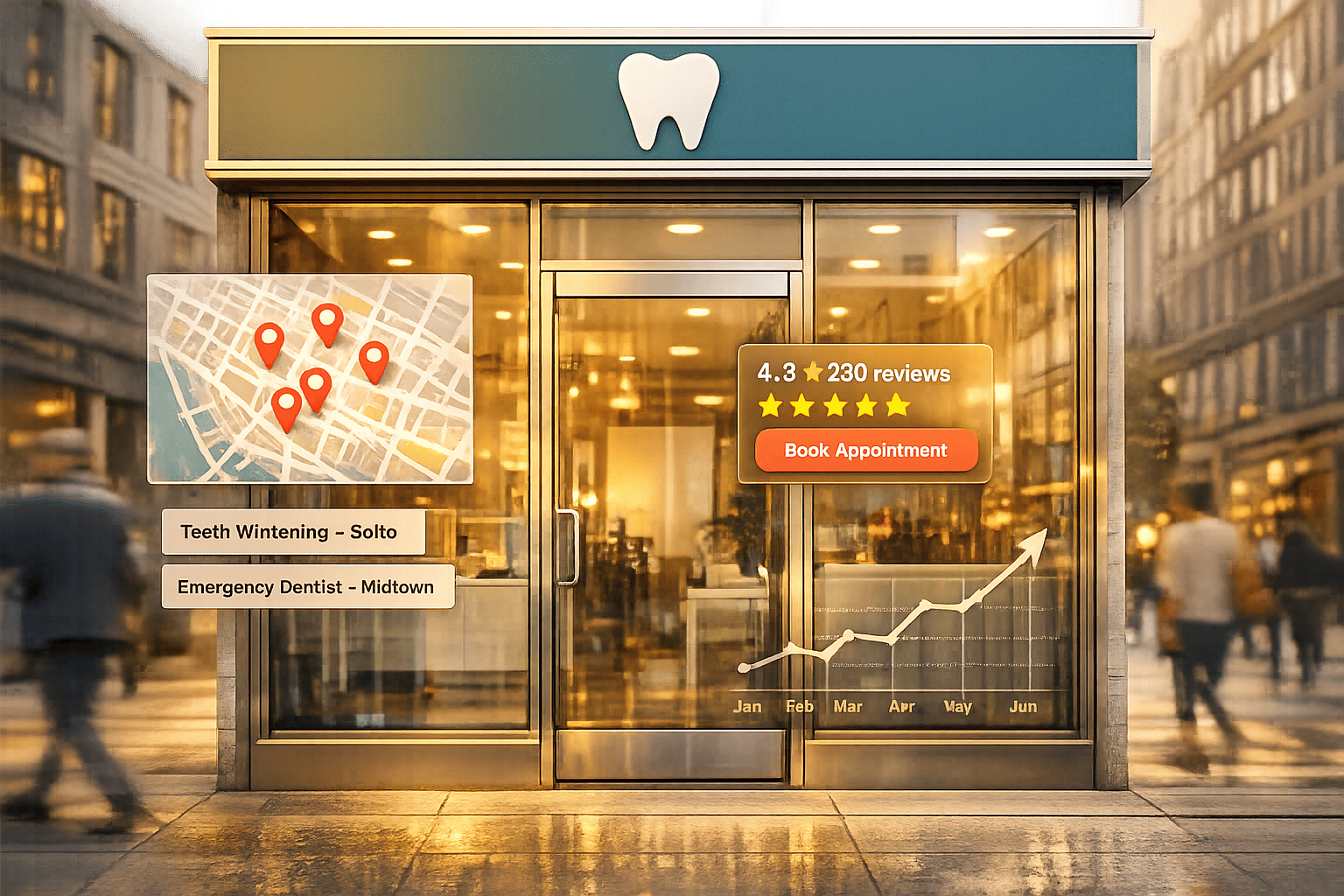
In 2026, standing out in competitive urban dental markets is all about visibility and trust. With patients relying heavily on local searches like "dentist near me", your practice’s online presence can make or break your success. Here’s a quick summary of what works:
- Google Business Profile (GBP): Optimize every field, use real photos, and maintain consistency in your Name, Address, and Phone number (NAP). Fully optimized profiles get up to 18x more visibility.
- Reviews: Aim for steady, recent reviews – 15–30 per month. Respond to all feedback within 24–48 hours to build trust.
- Dedicated Service Pages: Create individual pages for treatments like dental implants or Invisalign. These pages convert high-intent searchers into patients.
- Neighborhood-Specific Content: Target smaller areas within your city with tailored pages and content to reduce competition and increase conversions.
- Track Metrics: Use tools like Google Analytics 4 (GA4) and Search Console to monitor visibility, leads, and ROI. Focus on actions like calls and bookings.
The key takeaway: Patients choose practices they can find and trust online. By focusing on local SEO, reviews, and targeted content, you’ll attract more patients and reduce reliance on ads.
SEO for Dentists: The New Way to Rank Your Practice #1 on Google 🤯
Google Business Profile Optimization for Dental Practices

Dental SEO Statistics: Google Business Profile Impact and Performance Metrics
Local searches play a huge role in how patients choose their dental providers. Your Google Business Profile (GBP) is at the heart of your online presence, acting as the #1 driver for calls, website visits, and directions from local searches. With 46% of all Google searches having local intent and the Map Pack capturing over half of those clicks, your GBP is often the first impression potential patients get when they search for terms like "dentist near me" or "emergency dental care." It’s your digital storefront, and how you manage it can determine whether patients walk through your actual door.
Fully optimized profiles can achieve up to 18x more search visibility compared to incomplete ones. Even better, they receive 7x more clicks and are 70% more likely to lead to location visits. In a competitive field like dentistry, where decisions are made in seconds, these numbers can translate directly into new patient appointments.
Setting Up Your Profile Correctly
Your primary category is the most critical ranking factor for your GBP. Instead of defaulting to "Dentist", choose a category that reflects your specialty, like "Cosmetic Dentist", "Pediatric Dentist", or "Orthodontist".
Make sure every field is filled out. Use all 750 characters for your business description, including your city name and core services. Add service listings with pricing ranges, accessibility details, and a direct booking link. Consistency is key – ensure your Name, Address, and Phone number (NAP) are identical across your GBP, website, and third-party directories like Yelp and Healthgrades. Even small inconsistencies can hurt your rankings. To further strengthen your local presence, ensure you add local business schema to your website code.
Photos also play a big role. Upload at least 30 authentic images, including shots of your office exterior, interior, staff, and equipment. Avoid using stock photos. Profiles with real images see 42% more direction requests and 35% more website clicks. For instance, a Florida dental practice that optimized its GBP with professional photos and complete details saw 3,200 monthly views, 75–80 phone calls, and gained 30–35 new patients each month – adding over $100,000 in annual revenue. These local SEO tactics are crucial for standing out in competitive urban markets.
Getting and Managing Patient Reviews
Reviews are vital for building trust and credibility. 71% of consumers won’t consider a business with an average rating below 4.0 stars, and practices with 200+ reviews on Google typically earn about twice the revenue of those with fewer reviews. In the future, AI tools like ChatGPT and Google’s AI Overviews will likely analyze review content to recommend practices for terms like "best dentist."
Instead of focusing solely on the total number of reviews, prioritize review consistency. Aim for 15–30 new reviews each month, as 27% of patients expect reviews to be recent – posted within the last two weeks. Send patients an SMS with a review link within two hours of their appointment to capture their positive feelings while they’re still fresh. Train your staff to ask for reviews when patients express satisfaction with their visit.
Respond to all reviews – both positive and negative – within 24–48 hours. Practices that engage with reviews see 35% more conversions.
"A scathing review with a thoughtful response looks better to most patients than a glowing review that gets ignored." – PractiWrite.
Use the Q&A section of your profile to address common patient concerns, like insurance, parking, and services. This allows you to shape the narrative and provide clear, accurate information.
Using Posts to Keep Your Profile Active
Posting regularly signals to Google that your practice is active and engaged. Yet, 60% of dental practices never publish posts, leaving a big opportunity for growth.
Create posts that highlight treatments like Invisalign, dental implants, or emergency care. Share educational content about procedures, oral health tips, or what patients can expect during visits. Use "Offer" posts for seasonal promotions with clear expiration dates and include Call-to-Action buttons like "Book Now" or "Call Now".
Timing matters. Schedule posts for Tuesday through Thursday mornings (9:00 AM to 12:00 PM) to align with peak search times.
For example, a general dentistry practice in suburban Texas fully optimized their GBP, including service details, fresh photos, and a structured review strategy. Within six months, they ranked in the top three of the local Map Pack for their city. This shift allowed them to cut back on Google Ads spending, as organic search became their leading source of new patient inquiries. These efforts can make a big difference in competitive markets.
Creating Service Pages That Target High-Intent Searches
When someone searches for terms like "dental implants in Chicago" or "emergency tooth extraction near me", they’re not casually browsing – they’re ready to take action. A generic services page won’t meet their needs or convert them into patients. Instead, you need dedicated pages for each treatment to attract these high-intent searchers and turn clicks into appointments.
By creating separate pages for services like dental implants, Invisalign, teeth whitening, or emergency care, you not only organize your site better but also send a clear message to search engines: your practice specializes in these treatments. This focused approach can boost your visibility in organic search results by as much as 70%.
These pages also deliver a strong return on investment. With the average lifetime value of a dental patient ranging from $5,000 to $15,000+, even a single new patient from organic search can make a big impact. For example, a dental practice in Manchester saw its Invisalign consultations jump from 8 to 34 per month within six months by targeting high-value treatment keywords, adding $156,000 in annual treatment revenue. Think of these service pages as mini homepages, where you can showcase tailored calls-to-action, before-and-after photos, and clear pricing details to convert visitors into patients.
How to Structure Individual Service Pages
Start with a clear H1 header that includes the service and location (e.g., "Dental Implants in Austin"). Follow it with a short introduction and a strong call-to-action button, such as "Schedule Your Consultation" or "Call Now", so visitors immediately know what to do next.
Your content should address the questions patients are already asking. Include sections that explain who the treatment is for, the benefits, what to expect during the procedure, and pricing or financing options. For instance, a dental implant page should cover topics like recovery time, insurance coverage, and the qualifications of your practitioners. By answering these questions, you can capture long-tail search traffic and even earn and track featured snippets.
Make sure your primary keyword appears in the title tag, H1, meta description, and within the first 100 words. But don’t overdo it – Google’s algorithms are smart enough to recognize natural language. Use related terms like "tooth replacement options" or "permanent dental solutions" to build authority without sounding repetitive.
"A focused, single-keyword strategy supported by relevant context will always perform better than a scattershot approach." – Daryl Schmucker, President of Noble Webworks.
To improve rankings in Google’s AI Overviews, structure your content with short paragraphs, bulleted lists, and "Quick Answer" sections near the top of the page. Use schema markup like LocalBusiness, Dentist, and FAQ to help AI systems pull key details like your services, hours, and reviews. Replace generic stock photos with real images of your practice, team, and equipment. Geo-tagging these images adds another layer of local relevance. Finally, link your service pages to your main dental SEO pillar page and relevant location pages to create a strong content network.
Once your service pages are set, it’s time to integrate location-specific keywords to further enhance their reach.
Finding and Using Location-Specific Keywords
Patients often search for more specific terms like "dental implants in Lincoln Park" or "affordable Invisalign near Wicker Park." These location-based searches are especially valuable in competitive urban areas. Start by building a keyword map that matches each service to your city and nearby neighborhoods.
| Keyword Cluster | Target Page Example |
|---|---|
| Dental Implants + cost + financing | /dental-implants-chicago/ |
| Emergency Dentist + urgent care | /emergency-dentist-downtown/ |
| Invisalign + price + timeline | /invisalign-lincoln-park/ |
| Teeth Whitening + results + cost | /teeth-whitening-wicker-park/ |
This strategy reinforces your local expertise while complementing the dedicated service pages you’ve created.
To go beyond keywords, include local context in your content. Mention nearby landmarks, neighborhoods, or community ties. For example, highlight that you serve "families near Millennium Park" or "patients in the River North area." Embedding a Google Map on your service pages can also boost local signals.
With 27% of mobile queries now coming from voice searches, optimizing for conversational, long-tail questions is a must. Address queries like "Does insurance cover Invisalign in Chicago?" or "Where can I get emergency dental care in River North this weekend?" throughout your content. These natural language phrases align with how people use voice search and AI tools.
Finally, ensure your Name, Address, and Phone Number (NAP) are consistent across all platforms. This strengthens your local schema and helps search engines confirm your geographic relevance, improving your visibility in location-based searches.
Targeting Specific Neighborhoods Within Your City
This strategy takes your local marketing efforts to the next level by focusing on hyper-local audiences. By narrowing your reach to specific neighborhoods, you can reduce competition by 60–80% and increase conversion rates by 40–70%. Instead of casting a wide net across the entire city, concentrate on the neighborhoods where your patients live and work.
Start by examining your current patient base. Use your patient management system to analyze ZIP codes and identify which neighborhoods bring in the most patients – ideally within a 15–20 minute drive. Platforms like Nextdoor and Facebook groups can also reveal the informal names residents use for their areas, which often differ from official district names. Additionally, tools like Zillow can provide insights into neighborhood demographics, helping you target areas that align with your ideal patient profile.
"The search engine doesn’t care about city boundaries – it cares about proximity and relevance to the searcher’s exact location." – Phillip S, Techna Digital
Once you’ve identified 5–15 neighborhoods with high potential, create dedicated landing pages for each one. Don’t just copy your main page and swap out the neighborhood name – Google penalizes duplicate content. Instead, write 500–800 words of original content tailored to each area, addressing the specific needs and interests of local residents.
Building Pages for Each Neighborhood You Serve
Each neighborhood page should start with an H1 header that combines your service with the neighborhood name. Examples include "Family Dentist in Lincoln Park" or "Emergency Dental Care in River North." This makes it clear to both visitors and search engines what you offer and where.
Add details that matter to residents. Mention parking options, nearby transit routes, and well-known local landmarks like the Lincoln Park Zoo or Millennium Park to establish a connection with the area. Embed a Google Map showing your office location within the neighborhood and include geo-tagged photos of your office exterior with recognizable landmarks in the background. These elements signal your relevance to both users and search engines.
Make sure every page includes consistent NAP (Name, Address, Phone) details and features reviews from patients in that neighborhood. This builds trust and reinforces your local presence. Finally, link each neighborhood page to your main service pages and a central "Locations" hub to strengthen your internal linking structure.
By creating these neighborhood-focused pages, you expand your local reach while building trust within each community.
Writing Content for Local Communities
In addition to landing pages, consider writing blog posts and stories that connect with local audiences. Share details about neighborhood events your practice sponsors, like community fairs or sports events. This shows your involvement in the area and can also attract backlinks from local organizations.
Highlight patient success stories specific to the neighborhood, or address local concerns. For example, instead of a generic testimonial, share a story like "How We Helped a Busy Lincoln Park Mom Restore Her Smile" or "Emergency Dental Care for a River North Professional." These narratives resonate with local readers and can capture voice search queries.
Tailor your content to the unique needs of each area. If your office is near downtown, write about "Quick Lunch-Break Dental Cleanings for Loop Workers." For family-friendly suburbs, consider topics like "Choosing a Family Dentist Near [Local Elementary School]." This approach helps you appear in voice and conversational searches.
Add neighborhood-specific FAQs to your Google Business Profile, such as "Which bus lines stop near your office?" or "Is parking available for patients from [Neighborhood]?" These details can help your practice show up in zero-click search results, where Google provides answers directly.
Finally, make it easy for patients to find the right neighborhood page on your website. A simple table on your "Locations" hub page can do the trick:
| Neighborhood | Transit Access | Parking | Best For |
|---|---|---|---|
| Lincoln Park | Brown/Red Line | Street & garage | Families, young professionals |
| River North | Red/Brown Line | Paid garages | Downtown workers |
| Wicker Park | Blue Line | Street parking | Residents, creatives |
| Gold Coast | Red Line | Valet available | Established professionals |
Measuring Your Dental SEO Performance
Once you’ve optimized your profiles and content, the next step is to measure your efforts. This isn’t just about climbing search rankings – it’s about converting online visibility into actual appointments. Especially in competitive urban markets, tracking the right metrics can make all the difference in turning clicks into new patients and revenue.
Start by focusing on metrics that directly impact patient acquisition. For example, keep an eye on key actions from your Google Business Profile (GBP). Use Google Search Console to monitor organic clicks and impressions, particularly for high-intent service pages like "dental implants Chicago" or "emergency dentist near me" – these pages often drive the most valuable traffic. Beyond visibility, track conversion metrics like appointment form submissions, mobile click-to-call actions, and the ratio of answered to missed calls.
Your online reputation plays a critical role too. Pay attention to how frequently you receive new reviews, your average star rating, and how quickly you respond to feedback. These factors influence how trustworthy your practice appears in local searches. Looking ahead to 2026, tracking branded search volume and referral traffic from AI tools (like ChatGPT or Google AI Overviews) can also give you insights into your growing presence in the market.
"SEO is not just ‘ranking.’ It’s a visibility + trust + conversion system designed around how dental patients actually decide." – Geeks For Growth
Ultimately, success is about how many new patients book appointments, their show rates, and the types of treatments they choose. With patient lifetime values often ranging from $5,000 to $15,000+, remember that dental SEO is a long-term investment. It typically takes 3–6 months to see measurable progress and 6–12 months for consistent patient acquisition.
Which Metrics Matter Most
When tracking performance, focus on one key metric per goal to avoid data overload. For example:
- Use GBP calls to measure Maps visibility.
- Analyze Search Console clicks to assess organic reach.
- Track form submissions to gauge appointment generation.
Break down your results by neighborhood and service type. Comparing landing page performance across different areas can reveal where patients are more likely to convert. Use GA4’s location reports to ensure your traffic aligns with your service area instead of attracting visitors from outside your target zones.
Engagement metrics are also important. Aim for engagement rates between 50–70% and click-through rates of 3–6% for informational posts. For high-intent service pages, target CTRs of 6–10% or higher.
Operational efficiency matters too. Ensure your front desk promptly answers calls and track how many leads convert into scheduled appointments. On the technical side, keep mobile load times under 3 seconds and aim for Core Web Vitals scores of at least 70 on mobile and 85 on desktop. These factors directly impact both your rankings and user satisfaction.
Tools for Tracking Your Results
To track these metrics effectively, rely on tools like Google Analytics 4 (GA4) and Google Search Console (GSC). GA4 provides insights into on-site behavior, while GSC shows how users find your website through keywords and impressions. Linking these tools gives you a complete view of the patient journey.
In GA4, set up conversion events for key actions like calls, form submissions, and online bookings. Assign a monetary value to these actions (e.g., $350 per appointment click) to calculate your SEO ROI in real time. Use the formula: (Revenue – Cost) ÷ Cost × 100 to measure your return.
Call tracking software is another must-have. With Dynamic Number Insertion (DNI), you can assign different phone numbers based on whether visitors come from organic search, your GBP, or a specific landing page. This improves tracking accuracy for local leads. Additionally, apply UTM parameters to the website link in your GBP to measure traffic and conversions more precisely.
Regularly review your GBP Insights to monitor views, searches, and actions. Compare your performance with similar local practices to identify areas for improvement. For a complete picture, integrate your analytics with your CRM. This allows you to track which digital leads convert into paying patients and calculate their lifetime value. Finally, exclude internal traffic in GA4, identify low-CTR keywords in GSC, and use GA4’s "Assisted Conversions" reports to better understand the full patient acquisition journey.
Conclusion
Drawing from the strategies outlined earlier, here are some final takeaways. In urban markets, dental SEO offers a long-term path to consistent visibility. The practices that thrive by 2026 will recognize that their Google Business Profile (GBP) often holds more sway than their actual website, converting potential patients before they even visit the site. Keeping your GBP active with weekly updates, fresh images, and a steady stream of recent reviews is crucial. In fact, 52% of people trust reviews that are no older than 2–4 weeks – a clear sign that consistent activity builds credibility and trust.
In addition to maintaining your profile, each dental treatment you offer should have its own localized, detailed page. This approach is especially effective in dense urban areas, where proximity and relevance heavily influence visibility.
It’s important to remember that dental SEO is a long game. Results typically take 3–6 months to gain traction and 6–12 months to drive consistent patient acquisition. Unlike paid ads, which stop generating leads the moment your budget is depleted, SEO delivers lasting benefits, reducing your cost-per-patient over time. For instance, a two-doctor general dentistry practice in suburban Texas saw impressive results after implementing a comprehensive SEO strategy in 2025. They conducted a technical site audit, created dedicated service pages, and optimized their GBP with a structured review system. Within six months, they ranked among the top three in their local map pack, and by the end of the year, their SEO efforts significantly reduced their Google Ads expenses.
"In a digital landscape defined by precision and proximity, ethical visibility not manipulation will define the most trusted dental brands of tomorrow." – Vigorant
Think of SEO as an ever-evolving ecosystem. Practices that regularly update their profiles, refine their content, and monitor key metrics will maintain a competitive edge. The time and effort invested in ethical, well-planned SEO strategies will continue to yield benefits for years to come.
FAQs
How do I rank in the Map Pack in a big city?
To rank in the Map Pack in 2026, start by fully optimizing your Google Business Profile (GBP). Make sure every detail is complete, choose categories that align with your business, and regularly update your information to keep it accurate.
Next, build local relevance by gathering high-quality reviews from satisfied customers. Consistency is key, so ensure your NAP (name, address, phone) details are the same across all citations. Additionally, create content tailored to your specific location to enhance local connections.
Keep in mind that Google evaluates businesses based on three main factors: proximity (how close your business is to the searcher), relevance (how well your business matches the search intent), and prominence (your business’s reputation and visibility). Focusing on these areas will improve your chances of standing out in local searches.
How can I get more Google reviews without sounding pushy?
To naturally increase Google reviews, build a process that invites genuine feedback. Timing is key – ask for reviews right after a positive interaction, such as a successful appointment or a great customer experience. Automated tools can help by sending follow-up messages that include direct links to your Google review page, making it easier for customers to leave their thoughts.
You might also consider offering non-monetary incentives, like entering customers into a raffle, as long as it aligns with Google’s guidelines. Additionally, responding to reviews – both positive and negative – in a professional and thoughtful manner can encourage others to share their experiences as well.
Do neighborhood pages help, or can they hurt my SEO?
Neighborhood pages can help improve your SEO by focusing on specific areas with localized, relevant content. This approach can enhance your search rankings and attract potential patients who are actively looking for services nearby. However, there’s a catch – if these pages are poorly optimized or contain duplicate content, they can actually hurt your SEO efforts. To get the most out of neighborhood pages, prioritize creating unique, high-quality content for each area. This ensures you reap the benefits without risking penalties from search engines.