
When someone searches “dentist near me,” they’re ready to take action. If your practice isn’t showing up in the top results, you’re losing potential patients. Here’s how to improve your visibility:
- Optimize Your Google Business Profile (GBP): Claim and verify your profile, ensure your business details are accurate, and add high-quality photos. Use precise categories and update regularly.
- Build Localized Website Pages: Create unique pages for each location, use local keywords naturally, and include embedded maps and contact information.
- Encourage Reviews: Ask patients to leave reviews and respond promptly to both positive and negative feedback.
- Use Schema Markup: Add structured data to your website to help search engines display your details effectively.
- Track Results: Monitor metrics like GBP interactions, search rankings, website conversions, and review activity.
Ranking higher for local searches requires consistent effort, but the payoff is connecting with patients who are ready to book. Follow these steps to increase your practice’s visibility and grow your patient base.
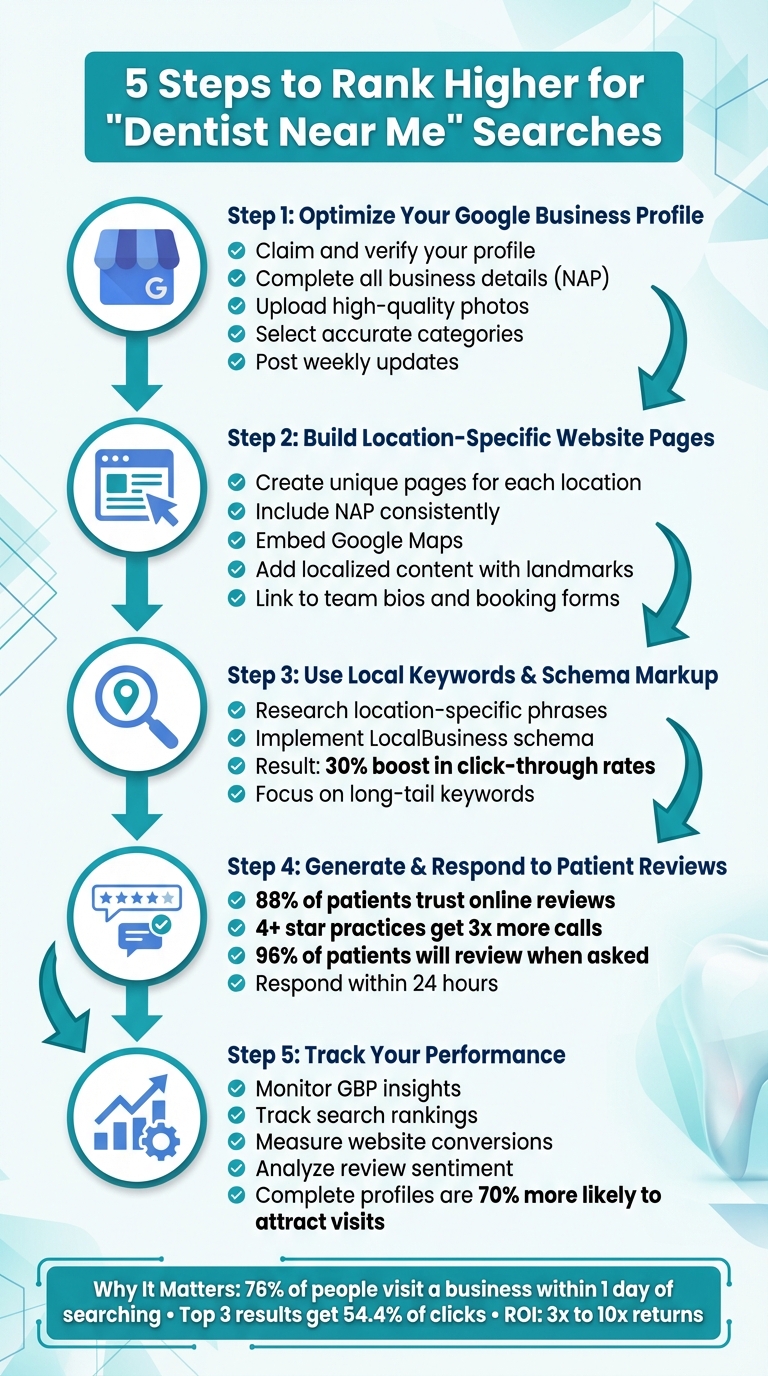
5-Step Guide to Ranking Higher for Dentist Near Me Searches
SEO for Dentists: The New Way to Rank Your Practice #1 on Google 🤯
How to Optimize Your Google Business Profile
Your Google Business Profile plays a crucial role in attracting patients who search for terms like "dentist near me". It’s a vital part of your local SEO strategy, helping you connect with individuals actively looking for dental services.
Claim and Complete Your Profile
To get started, log in with your practice’s Google Account or create one if you don’t already have one. Search for your practice on Google – if it’s listed, claim it. If not, you’ll need to create a new listing.
Once that’s done, complete the verification process. This step is essential for enabling features like responding to reviews and making updates. Verification methods are typically determined automatically and may involve a video or a postcard sent to your business address. If you’re using a postcard, keep in mind that the verification code will expire after 30 days.
Make sure to fill out every detail of your profile. Use your exact business name, a physical address (no P.O. Boxes), your phone number, website URL, and business hours. Consistency here is key to ensuring your listing is accurate and dependable. To make your profile visually appealing, upload high-quality photos of your office, team, and treatment results (with proper consent).
After verification and completing your profile, the next focus is on refining your categories and attributes to boost relevance.
Select the Right Categories and Attributes
Choosing the most accurate categories is essential to help potential patients find your practice. Start with "Dentist" as your primary category. If your practice offers specialized services, include additional categories like "Cosmetic Dentist" or "Pediatric Dentist".
"GBP categories help potential patients find your services when they’re searching for specific dental needs, like ‘cosmetic dentistry’ or ‘pediatric dentist.’ Be as specific as possible to stand out in the right searches." – BrightLocal
Clearly list all the services you offer, from teeth whitening and root canals to orthodontics and more. Defining your service areas is also important – it helps search engines understand your reach and connects you with patients in nearby locations.
Once your categories are set, keep your profile fresh with regular updates.
Post Regular Updates
Posting weekly updates can make a big difference in keeping your profile relevant. Share things like updated business hours, patient testimonials, or special offers. Google displays up to 10 of your most recent updates, while older posts (over six months) are archived.
Focus on content that adds value – educational posts, insights about your practice, or occasional promotions. Visual content performs especially well, so consider adding before-and-after photos or testimonial videos to increase engagement.
Don’t forget to include a clear call-to-action button, such as "Book Now", "Call Us", or "Learn More", and naturally weave in relevant keywords. Experiment with posting times; midweek mornings often see better engagement.
Local SEO Tactics for Your Dental Website
Your Google Business Profile might help local searchers find you, but your website is what convinces them to choose you. It’s where search engines and potential patients confirm your authority in the area. To stand out, your site needs to feature content tailored to the neighborhoods you serve and reflect the exact language your patients use when they’re searching for dental services.
Build Pages for Each Location
If your practice operates in multiple areas – or even if you cater to different neighborhoods from a single office – create a unique page for each location. These pages help search engines pinpoint where you operate and make it easier for you to rank for searches like "dentist near [neighborhood]".
Each location page should include:
- Your Name, Address, and Phone Number (NAP) displayed consistently across your website.
- An embedded Google Map to show your precise location.
- Localized content that references specific neighborhoods, nearby landmarks, or other community details.
It’s important to produce original content for every location page. For example, highlight unique features about each area, such as nearby schools or local events. Additionally, link to other parts of your website – like team bios, patient reviews, or appointment booking forms – to keep visitors engaged.
Use Local Keywords Throughout Your Site
Once your location pages are set up, it’s time to optimize your content with local keywords. These keywords act as a direct connection between your patients’ search queries and your website’s visibility. Instead of generic terms like "dental implants", focus on phrases people in your area might use, such as "dental implants near [your neighborhood]" or "emergency dentist in [City, ST]".
Here’s how to make the most of local keywords:
- Research phrases specific to your location and services.
- Incorporate these keywords naturally into page titles, meta descriptions (keep them under 160 characters), headers, and body text.
- Use tools like Google Search Console to identify what terms people are already using to find your site. You can also check Google Autocomplete and the "People Also Ask" sections for additional ideas.
For example, MB2 Dental suggests using terms like "dentist in Carrollton, TX", "teeth whitening in Carrollton", or even more detailed phrases like "family dentist accepting new patients in Carrollton, Texas, with Saturday appointments". These long-tail keywords may not generate massive search traffic, but they attract highly motivated patients who are ready to book an appointment.
Remember, keyword stuffing – cramming keywords unnaturally into your content – can hurt both your search rankings and your credibility with patients. Instead, aim for a conversational tone that resonates with readers while naturally incorporating keywords.
Add Local Business Schema Markup
Schema markup is a form of structured data that helps search engines understand your practice better. It highlights key details like your services, hours, location, and patient reviews, making it easier for search engines to display this information directly in search results. For dental practices, schema is essential for appearing in Google’s Local 3-Pack and map listings. Websites with schema markup often see a 30% boost in click-through rates compared to those without it.
Here’s how to get started:
- Run a schema audit using Google’s Rich Results Test to identify what structured data you already have and what’s missing.
- Focus on schema types that are most relevant to your practice, such as
LocalBusiness,Dentist,Service, andFAQschemas. - Ensure your schema data matches the details on your Google Business Profile and other directories exactly.
For example, one dental practice saw a 56% increase in views on Google Maps after implementing Local Business Schema. This also led to a noticeable uptick in customer engagement on both Maps and search results.
You don’t need to be a coding expert to implement schema. WordPress plugins like AIOSEO can simplify the process, or you can work with a web developer to add the code manually. Regularly validate your schema using Google’s Structured Data Testing Tool to ensure everything is working correctly and fix any errors.
Build Trust Through Reviews and Local Links
Even the best SEO strategies won’t work without patient trust. Here’s why: 88% of patients trust online reviews as much as personal recommendations. Plus, Google’s local search algorithm factors in the volume, recency, and sentiment of reviews when ranking businesses. Beyond reviews, backlinks from local organizations act as digital endorsements, signaling to Google that your practice is a trusted part of the community.
Get and Respond to Patient Reviews
Reviews don’t just build credibility – they directly impact your rankings. Practices with 4+ stars receive three times more calls. And since 84% of dental patients read online reviews before making a decision, reviews are often the deciding factor. The challenge? Many happy patients won’t leave a review unless you ask – but 96% of them are willing to do so when prompted.
Make review requests a natural part of your patient interactions. Ask satisfied patients in person before they leave, or follow up with an email or text message within 48 hours of their appointment. Tools like Chatmeter and Weave can automate these requests via email or SMS, ensuring you don’t miss any opportunities. You can also create QR codes that link directly to your Google Business Profile review page and include them on receipts, appointment reminders, or feedback cards.
But collecting reviews is only half the battle – responding to them is just as important. Practices that reply to reviews within 24 hours often outperform those with higher ratings but slower response times. For positive reviews, thank patients for their feedback while avoiding specific mentions of dental procedures to stay HIPAA-compliant. For negative reviews, acknowledge their concerns, offer a public apology, and invite them to discuss the issue privately. Thoughtful responses can even boost your SEO.
Beyond reviews, building trust also means earning quality local backlinks.
Secure Backlinks from Reputable Local Organizations
Local endorsements play a big role in building trust. When reputable local websites link to your practice, it signals authority and credibility. Start by joining organizations like your local Chamber of Commerce or regional dental associations, which often provide directory listings and backlinks. You can also list your practice on trusted healthcare directories like Healthgrades, Zocdoc, and 1-800-Dentist.
Sponsoring community events – like youth sports teams or charity runs – is another great way to earn mentions and backlinks. Partnering with nearby businesses or contributing expert commentary to local news sites can also help you secure high-quality links.
Lastly, make sure your practice’s Name, Address, and Phone Number (NAP) are consistent across your website, business listings, and social media profiles. This consistency strengthens your legitimacy and boosts your local visibility. Together, consistent NAP citations and trusted local backlinks help solidify your place in the community.
How to Track Your Local SEO Results
Once you’ve put effort into improving your local SEO, the next step is measuring how well it’s working. Tracking your performance helps you figure out what’s effective, what needs tweaking, and where your new patients are coming from. Focus on metrics that directly impact your practice’s growth – like new patient appointments – rather than getting distracted by superficial numbers.
Which Metrics to Track
Start by analyzing your Google Business Profile (GBP) performance. A complete profile can make your practice 70% more likely to attract visits. Pay close attention to key interactions, such as profile views in Google Search and Maps, website clicks, direction requests, and phone calls. These actions reflect genuine interest from potential patients.
Next, keep an eye on your search visibility and rankings for location-specific keywords like "dentist near me" or "emergency dentist in [your city]." Your position in the Map Pack is especially important since the top three local results capture over 70% of clicks. Use tools like Google Search Console to track which search queries bring visitors to your site. For more detailed insights, platforms like Local Falcon and BrightLocal can help you monitor rankings across specific neighborhoods.
Also, track website conversions, including phone calls, online bookings, form submissions, and chat interactions. Google Analytics can show you which pages lead to these conversions and how visitors navigate your site. Since more than half of local searches (57%) happen on mobile devices, it’s essential to monitor mobile traffic separately.
Finally, pay attention to your online reviews – their volume, how recent they are, and the sentiment behind them. Reviews play a crucial role in building your online reputation. As Miriam Ellis, a local search expert at Moz, points out:
"Ignoring reviews results in a failure to serve and engage with your existing consumer base, win back customers who have left negative reviews, and benefit from the business intelligence gained when review sentiment is analyzed".
This matters because 99% of potential patients read reviews, and 92% view business owner responses as a key indicator of quality customer service.
Once you’ve identified these key metrics, use the right tools to refine and optimize your strategy.
Tools for Monitoring Performance
Google offers several free tools that are excellent starting points:
- Google Business Profile Insights helps you understand how patients find and interact with your listing.
- Google Analytics tracks website traffic, user behavior, and conversions.
- Google Search Console reveals the keywords you rank for, your search visibility, and any technical issues.
For more advanced tracking, specialized local SEO tools can give you deeper insights. Platforms like Semrush offer features such as Map Rank Tracker and review management. Local Falcon provides geo-grid rank tracking and AI visibility monitoring, which is becoming increasingly important as search engines integrate AI into local results. BrightLocal helps manage citations and track rankings across multiple locations.
To stay ahead, review your GBP insights, website performance, reviews, and citations at least once a month. You can also manually check your key search terms in Incognito mode to see if your practice appears in AI-generated summaries.
Conclusion
Climbing the ranks for "near me" searches takes steady work across several areas – optimizing your Google Business Profile (GBP), crafting location-specific content, gathering patient reviews, and keeping a close eye on your performance metrics. The dental practices that thrive treat local SEO as an ongoing effort, not a one-and-done task.
Here’s why it matters: Over 80% of people research online before making health decisions, and 76% visit a business within a day of their search. On top of that, the top three search results scoop up 54.4% of clicks, while 75% of users never even glance past the first page. If your practice isn’t visible during these crucial moments, you’re missing out on valuable patient inquiries.
To build a strong local SEO foundation, focus on the essentials: optimize your GBP, ensure your NAP (Name, Address, Phone number) listings are consistent, and encourage patients to leave reviews. Beyond that, create location-specific pages for your website, use local business schema markup, and build links from trusted local organizations. These steps tell Google that your practice is relevant, reliable, and deserving of top rankings.
Remember, SEO is a long-term game. With these targeted strategies, your practice can establish a lasting local presence. While noticeable improvements often appear within 1–6 months, maintaining those results means staying on top of optimization efforts. Google’s algorithms are constantly evolving – especially with AI-driven advancements – so regular adjustments are key. A well-executed dental SEO campaign can deliver a return on investment of 3x to 10x, making it well worth the effort.
The dental practices that excel in local search by 2025 will be those that stay active, consistent, and committed to serving their communities – both online and in person.
FAQs
How do I optimize my Google Business Profile to attract more local patients?
To get the most out of your Google Business Profile, the first step is to claim and verify it. This ensures you have complete control over the information displayed. Make sure every section is filled out with accurate, up-to-date details – your business name, address, phone number, and operating hours should all be correct and consistent. Adding high-quality photos of your office, team, and services can also make your profile stand out and feel more inviting.
Incorporate location-specific keywords into your business description and across your website to boost your visibility in local searches. Ask happy patients to leave positive reviews, and take the time to respond to all feedback – whether it’s glowing or critical. This shows you care about your patients’ experiences and are actively engaged.
Keep your profile fresh by posting regular updates, such as new services, special promotions, or upcoming events. An active and well-maintained profile signals to potential patients that your practice is professional and trustworthy.
How can using local keywords improve my dental practice’s online visibility?
Using local keywords on your dental website is a smart way to boost your online presence and connect with patients in your area. These keywords signal to search engines where your practice is located, making it easier for you to show up in those valuable "near me" searches.
Including location-specific terms – like your city, neighborhood, or even nearby landmarks – throughout your website content can help draw in local patients. Not only can this improve your rankings in local search results, but it also shows potential patients that your practice is rooted in their community, building trust and familiarity.
Why do patient reviews matter for improving local SEO rankings?
Patient reviews are a powerful tool for improving your dental practice’s local SEO. They help establish trust and reliability with both search engines and potential patients, which can lead to better visibility in local search results.
Good reviews don’t just boost your reputation – they also impact key ranking factors like relevance and prominence. The more positive, high-quality reviews your practice gathers, the higher your chances of landing a spot in the Google Local Pack and drawing in patients from your area.