
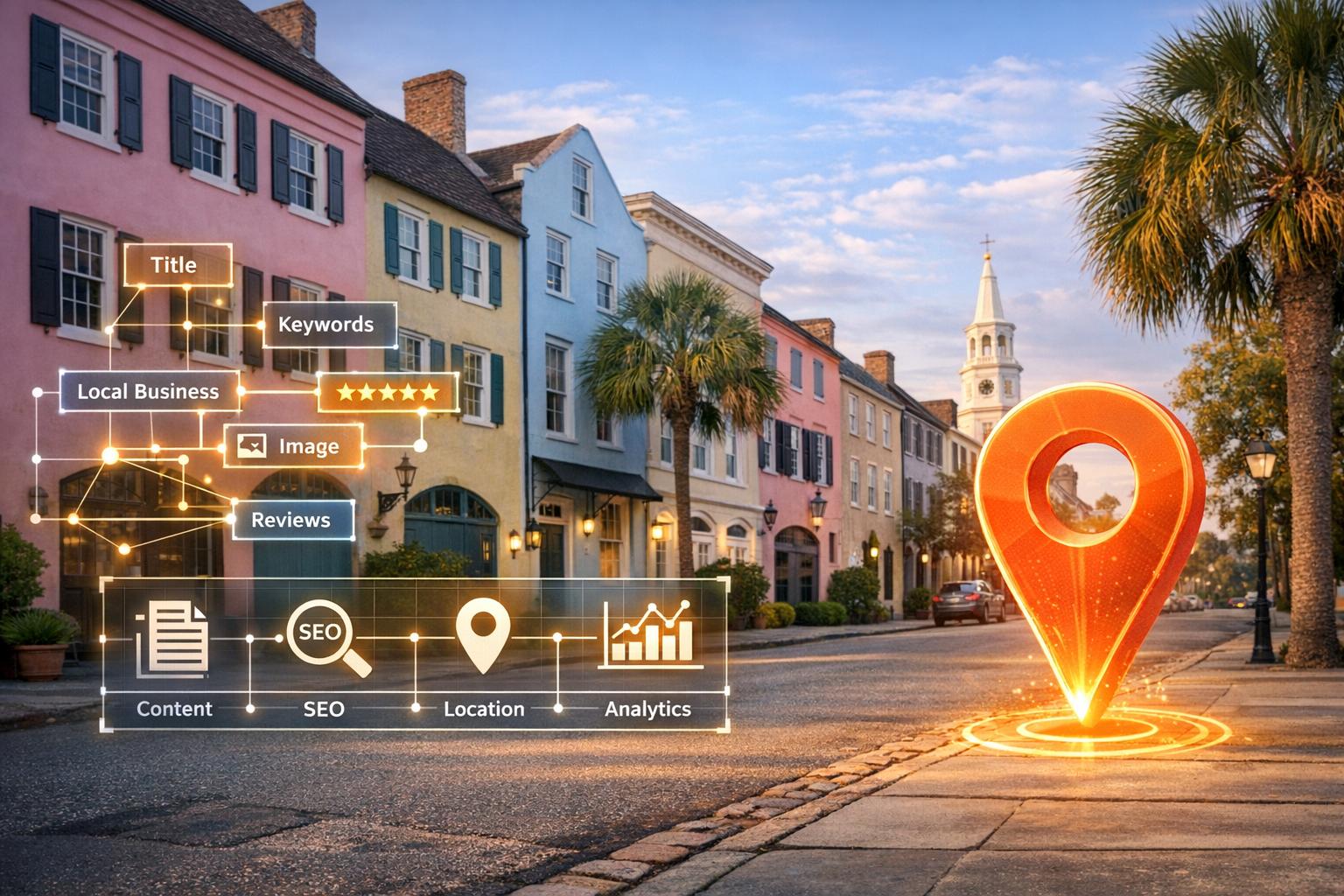
Want your Charleston business to stand out on Google and ChatGPT in 2026? Here’s how:
- Why it matters: By 2026, 53% of consumers will rely on AI-driven tools like ChatGPT for research, and only 62% of Google-ranked content overlaps with AI-generated results.
- The challenge: Ranking on Google doesn’t guarantee visibility in AI platforms. You’ll need to optimize for both.
- The solution: Combine local SEO essentials (like Google Business Profile updates) with AI-focused strategies (like conversational content and structured data).
Key Takeaways:
- Google Business Profile: Claim, verify, and keep your business info accurate. Add photos, update hours, and encourage customer reviews.
- AI Tools for Keywords: Use AI to find hyper-local keywords like "seafood restaurant near King Street" or "best brunch in Mount Pleasant."
- Conversational Content: Write in a natural tone, answer common questions directly, and focus on customer needs.
- Schema Markup: Add local schema to your site to help AI and search engines understand your business details.
- Local Backlinks: Partner with Charleston organizations, sponsor events, and ensure your business info (NAP) is consistent across directories.
By blending these tactics, your business can thrive in both search engines and AI-driven platforms. Start small, refine your strategy, and focus on what resonates with Charleston customers.
How to Build a Local SEO Strategy in 2026 (Full Blueprint!)
How to Optimize Your Google Business Profile for Local Search
Google Business Profile Verification Methods and Timelines
Your Google Business Profile is the cornerstone of your local search visibility in Charleston. Google uses three main factors to rank local businesses: relevance (how closely your profile matches a search query), distance (proximity to the searcher), and prominence (how well-known your business is, based on reviews, links, and articles). With nearly half of all Google searches (46%) having local intent, fine-tuning your profile can make a world of difference in helping Charleston customers discover your business. The first step? Claim your profile to unlock its potential for local SEO.
Claim and Verify Your Google Business Profile
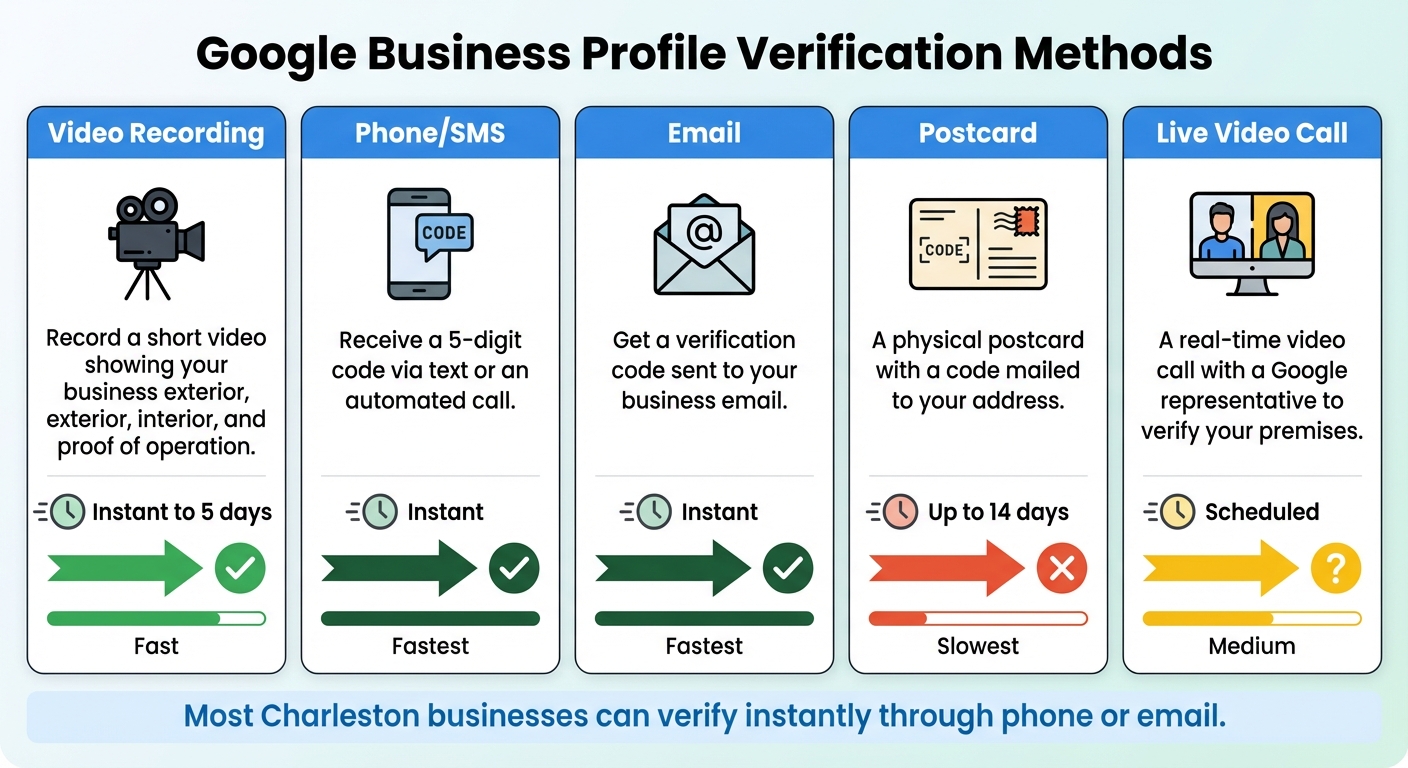
Claiming your profile establishes your authority over your business and increases your chances of showing up in search results. Google offers five verification methods, each with its own timeline:
| Verification Method | Description | Timeline |
|---|---|---|
| Video Recording | Record a short video showing your business exterior, interior, and proof of operation. | Instant to 5 days |
| Phone/SMS | Receive a 5-digit code via text or an automated call. | Instant |
| Get a verification code sent to your business email. | Instant | |
| Postcard | A physical postcard with a code mailed to your address. | Up to 14 days |
| Live Video Call | A real-time video call with a Google representative to verify your premises. | Scheduled |
Most Charleston businesses can verify instantly through phone or email, but some may need to wait for a postcard. Complete this step first – your profile won’t appear in search results until it’s verified.
Update Your Business Information for Local Search
After verification, it’s time to refine your profile details. Accuracy is key here – ensure your NAP (Name, Address, Phone) matches exactly across your website and other directories. Even small inconsistencies can hurt your rankings. In fact, 52% of customers have left negative reviews after encountering incorrect business information online.
Choose your primary business category wisely. For instance, if you own a Charleston restaurant, selecting "Restaurant" as your primary category and adding secondary ones like "Seafood Restaurant" or "Southern Restaurant" can help attract more targeted searches.
Write a compelling description that highlights your connection to Charleston. Mentioning specific neighborhoods or landmarks – like King Street, Mount Pleasant, or Charleston County – can help Google understand your local relevance.
"Ranking in Charleston’s local search isn’t just about keywords – it’s about semantic relevance and entity strength."
– Shanzaib, Charleston SEO Company
Adding photos tagged with Charleston locations further strengthens your geographic signals. Here are a few other tips to optimize your profile:
- Keep your hours updated, especially during holidays, and include details like parking availability, Wi-Fi, and wheelchair accessibility.
- Use the Google Updates feature to post weekly news or promotions, signaling activity to Google’s algorithm.
- Apply UTM tags to your website URL to track how many visitors come from your profile.
Use Customer Reviews to Build Trust and Rankings
Customer reviews are powerful tools for both building trust and boosting your rankings. They act as semantic signals, helping Google understand your services and location. With 96% of consumers reading local business reviews and 89% trusting them more than brand messaging, reviews are a critical part of your profile.
"Google reviews are not just trust signals – they act as semantic annotations that describe your brand through user-generated text."
– Shanzaib, Charleston SEO Company
Encourage customers to mention your Charleston location and services in their reviews. For example, when asking for feedback, you could say, "We’d love to hear about your experience at our Charleston location." Make it a habit to respond to every review – positive or negative. This shows both Google and potential customers that you’re engaged and attentive.
You can also feature snippets from positive reviews in your weekly Google Updates to showcase your business’s strengths and maintain an active profile. Finally, study the language used in your reviews – and even those of competitors in Charleston – to better understand what local customers value most.
How to Find Hyper-Local Keywords with AI Tools
Modern AI tools can reveal the specific search habits of Charleston residents, highlighting the differences between traditional search queries and conversational AI-driven ones. This means you can pinpoint exactly what locals are asking when they’re searching for your services.
Use AI Tools to Discover Local Search Terms
AI-powered keyword research goes far beyond just looking at search volume. Tools like SearchX incorporate metrics such as the Weighted Yield Number (WYN), which combines factors like search volume, ranking difficulty, commercial intent, trends, and seasonality. For example, if your core service is "lawn care" or "event rentals", AI can generate long-tail keyword variations with geographic modifiers. Instead of generic terms like "seafood restaurant", it might suggest more specific phrases such as "seafood restaurant near King Street" or "best oysters in Mount Pleasant."
Here’s where AI truly makes a difference: it distinguishes between traditional keywords (e.g., "Charleston dentist") and conversational AI search queries (e.g., "What’s the best family dentist near West Ashley?"). With over 40% of U.S. adults now using voice assistants for local business searches, this shift in search behavior is essential to understand.
By leveraging these insights, you can focus on targeting hyper-local, Charleston-specific search terms.
Target Charleston-Specific Search Terms
When it comes to Charleston, precision is key. Broad terms like "coffee shop Charleston" are less effective than highly specific phrases such as "coffee shop near Rainbow Row", "breakfast Mount Pleasant", or "urgent care West Ashley".
Consider the case of Just Beachy Carts, which partnered with SearchX in early 2024. By optimizing for the hyper-local keyword "Isle of Palms Golf Cart Rentals", they climbed into the top three search results within months, driving a significant increase in direct bookings. Similarly, CHEERS Event Rentals boosted their visibility and organic rankings by targeting "Event Rentals Charleston, SC".
AI tools also excel at identifying micro-location opportunities by analyzing entity relationships. Google’s algorithm now prioritizes entities – specific places like King Street, Folly Beach, or Charleston County – over simple keyword matching. This means hyper-local keywords can help you craft content that aligns directly with specific search goals.
Match Your Content to Local Search Intent
AI tools can group Charleston searches into four key intent types:
- Informational: Questions like "how to find parking downtown Charleston."
- Navigational: Searches for specific businesses, such as "Dave’s Burgers Charleston."
- Commercial: Queries like "best brunch near me."
- Transactional: Direct actions, such as "book Charleston harbor tour".
Understanding these intents allows you to create content that resonates with your audience. For example, someone searching "best seafood restaurant Charleston" is likely comparing options, so your content should highlight menu details, pricing, and what sets your business apart. On the other hand, a query like "seafood restaurant open now near me" requires you to provide up-to-date information about hours and location.
"Local businesses should focus on branding, customer experience, and developing their expertise. With generative AI coming into play, having lots of content about your topic isn’t enough."
– Amanda Jordan, RicketyRoo
AI can also analyze competitor content to identify gaps in your market. Look for keywords where your site ranks on page two or three – these are opportunities for quick wins. Small updates to your content could push you to the first page. Additionally, structuring your content to provide clear, direct answers at the beginning of sections makes it easier for AI tools to extract and highlight your information in search results.
How to Write Conversational Content for ChatGPT
Just like fine-tuning your Google Business Profile, crafting conversational content is crucial for connecting with AI-driven platforms like ChatGPT. These platforms thrive on natural, question-based language rather than keyword-heavy text. Adopting a conversational tone is key to staying visible in AI-powered search results.
Write in a Natural, Conversational Style
Ditch the corporate jargon and focus on engaging your audience like a real person. Instead of using "we" statements that center on your business, shift to "you" statements that prioritize your customers’ needs. For example, instead of saying, "We provide comprehensive dental care", you could say, "You can get everything from routine cleanings to emergency care at our West Ashley office."
"Better marketing starts with centering the customer’s questions, hopes, concerns, language, and experiences in both what you write, and how you write." – Miriam Ellis, Moz
AI platforms are better equipped to understand and use content that mirrors everyday conversation. Considering that over 40% of U.S. adults use voice assistants weekly for local business searches, aligning your content with the natural, conversational queries people use is more important than ever. This conversational tone also sets the stage for effectively addressing customer questions.
Answer Common Customer Questions Directly
Start with straightforward answers. For example, if someone asks, "Do you offer evening appointments?" respond with "Yes, we offer evening appointments Monday through Thursday until 8:00 PM." This "answer-first" method makes it easier for AI engines to extract and showcase your information.
To figure out what Charleston customers are asking, analyze question trends specific to conversational AI. Create concise FAQs with clear headings to help AI models process your content more effectively. Once you’ve covered the basics, use AI tools to uncover additional content opportunities that cater to local interests.
Use AI to Generate Content Ideas
AI tools are great for spotting content gaps and suggesting topics that work for both traditional SEO and AI-driven optimization. While AI can help with outlines and highlight common question patterns, it’s up to a human writer to bring in local expertise and add a personal touch.
"AI gives us speed and scalability… But at the core, our work is still about listening to clients and helping them reach the right audience." – Lorenz Esposito, CEO, SearchX
For instance, AI might suggest creating content about parking options in Charleston. You can take it further by including detailed insights about parking locations and practical tips that resonate with both locals and visitors. Combining AI’s efficiency with your local knowledge ensures your content stands out.
How to Add Local Schema Markup and Improve On-Page SEO
Once you’ve created conversational content, it’s time to use schema markup to clearly outline your Charleston business details. Schema markup helps search engines and AI platforms understand your business information, boosting your visibility in search results.
Add Local Business Schema to Your Website
Schema markup is a type of structured data that provides search engines with specific details about your business – like your address, operating hours, and services. The first step is to choose the schema type that fits your Charleston business. For instance, a restaurant on King Street might use the Restaurant schema to include details like price range and cuisine, while a Mount Pleasant law firm would benefit from the LegalService schema, showcasing its areas of expertise.
| Schema Type | Best For | Key Attributes to Include |
|---|---|---|
LocalBusiness |
General small businesses | NAP (Name, Address, Phone), Hours, Geo-coordinates |
Restaurant |
Dining establishments | Price range, Cuisine, Menu URL |
LegalService |
Law firms | Professional specialty, Address |
Including precise geo-coordinates can further establish your local relevance, helping Google associate your business with well-known Charleston landmarks like Waterfront Park or the Charleston City Market.
From there, adjust your meta tags and headers to reflect these localized details for even greater impact.
Write Location-Specific Meta Tags and Headers
Incorporate specific Charleston neighborhoods and landmarks into your title tags and meta descriptions. For example, instead of a generic title like "Emergency AC Repair | Business Name", use something more targeted, such as "Emergency AC Repair in Mount Pleasant, SC | Business Name." This level of detail helps both search engines and AI platforms align your content with local search intent.
"Spotlighting the geographic area serviced should be a priority. By featuring local content in context and placing it in the best spots within a website, you should encourage Google to feature your business in searches specific to your area." – Amy Toman, Digital Law Marketing
Organize your headers to move from broad to specific topics. For example, start with an H1 like "Family Dentist in Charleston, SC" and follow it with H2s that highlight specific areas, such as "Serving West Ashley and Mount Pleasant." This structured approach not only clarifies your local focus but also connects your business to iconic Charleston landmarks, such as "Located near Rainbow Row" or "Steps from the Charleston City Market."
Speed Up Your Site and Make It Mobile-Friendly
Site speed and mobile usability are major ranking factors for Google, and AI platforms like ChatGPT tend to favor fast-loading, user-friendly sites.
"A positive user experience is a key ranking factor that AI Overviews rely on." – Eldar Cohen, Founder, Local Dominator
To make your content mobile-friendly, use short paragraphs, bulleted lists, and clear subheaders. These elements improve readability on smaller screens, which is crucial since many Charleston tourists searching for restaurants or attractions near the French Quarter are likely using their phones. A fast, mobile-optimized site not only enhances user experience but also improves your search rankings.
How to Build Local Backlinks and Citations
Local backlinks and citations play a key role in establishing your Charleston business as a trusted authority in the eyes of Google. Backlinks act as endorsements from other websites, signaling your credibility and relevance to search engines. When paired with consistent citations – your business Name, Address, and Phone number (NAP) displayed across directories – you create a strong foundation that helps Google and AI platforms recognize your local presence.
The benefits are clear: businesses listed on 10 or more local platforms often see noticeable improvements in visibility, website traffic, and requests for directions. Let’s dive into strategies to secure local backlinks and maintain consistent citations.
Partner with Charleston Websites and Organizations
Collaborating with Charleston-based websites and organizations is a powerful way to earn quality backlinks and establish a stronger local presence. Search engines interpret links from local entities as signals that reinforce your connection to the area. Start by identifying local partners that align with your business goals.
| Partner Category | Example Organizations | Link Type |
|---|---|---|
| Local Media | The Post and Courier, Charleston City Paper | Guest Posts, Digital PR |
| Education | College of Charleston, Charleston Southern University | Resource Pages, Directories |
| Community/Non-Profit | Charleston Animal Society, Charleston Moves | Sponsorship Links |
| Government | Charleston County Parks, City of Charleston Recreation | Corporate Partnerships, Ad Banners |
| Business Groups | Charleston Chamber of Commerce, SC Chamber | Directory Citations |
To earn these backlinks, consider strategies like contributing guest articles, sponsoring local events, or sharing expert insights with local publications. For example, you might sponsor a charity run organized by Charleston Moves or provide expert commentary for an article in The Post and Courier. These efforts not only build valuable backlinks but also enhance your reputation as a community-focused business.
"Local business owners should seek to become known as the go-to resource in their town or city for a particular need, whether that’s bakery cakes, bee swarm relocation, or banking advice." – Miriam Ellis, Moz
Keep Your NAP Consistent Across All Directories
Consistency in your NAP information is critical. Even small discrepancies – like using "St." on one site and "Street" on another – can confuse search engines and weaken your local search rankings.
To avoid this, create a single, standardized NAP dataset for all platforms. Use a master spreadsheet to track your business details, including operating hours, for each location. If your business has multiple locations, Google’s bulk upload spreadsheet can help you manage data consistency more efficiently.
Begin with major platforms like Google Business Profile, Yelp, Facebook, and industry-specific directories. Once those are updated, expand to include local Charleston directories and chamber of commerce listings. This will help establish what Google refers to as "Prominence" – a measure of how much accurate information exists online to validate your business.
Use SearchX‘s Link-Building Services
With your NAP information standardized, you can focus on building a robust backlink profile. This process requires time, effort, and strategic outreach. SearchX’s link-building services can help streamline this process. Their team specializes in identifying relevant partnership opportunities, managing outreach efforts, and ensuring your citations remain consistent across all platforms. This way, you can focus on running your business while they handle the heavy lifting of boosting your local authority.
Conclusion
By 2026, Charleston businesses will need to go beyond the basics of SEO. The strategies outlined in this guide – fine-tuning your Google Business Profile, using AI tools to target hyper-local keywords, crafting conversational content, integrating local schema markup, and earning high-quality backlinks – create a well-rounded digital presence. Generative AI models depend on structured, well-organized content to deliver accurate answers.
This approach combines online techniques with establishing local authority. As search evolves toward entity-based results, businesses must build clear connections to local landmarks and community identifiers, rather than simply focusing on broad keywords. With the rise of zero-click searches, your content should be designed to feature in AI-generated summaries, even if users never visit your site.
Blending strong online optimization with a solid local reputation is essential. Supporting local events, engaging with the community, and delivering memorable customer experiences now play a direct role in shaping your online credibility. This dual approach not only boosts your Google rankings but also enhances your visibility in AI-driven tools like ChatGPT.
Executing these strategies requires a mix of focus and technical expertise. For those looking for guidance, SearchX offers local SEO services to help align these tactics with measurable growth.
Start small – choose one or two strategies from this guide to implement first, and then build on your success. The businesses that will thrive in 2026 are those that adapt quickly to meet the demands of both search engines and AI-powered platforms.
FAQs
What strategies can Charleston businesses use to rank higher on Google and AI platforms like ChatGPT?
To boost your Charleston business’s visibility on Google and AI platforms like ChatGPT, start by honing in on local SEO strategies. Make sure to claim and optimize your Google Business Profile. Keep your business’s name, address, and phone number (NAP) consistent across all online directories. Use location-based keywords such as "restaurants near Rainbow Row" or "Mount Pleasant coffee shops" to connect with local searches. Adding structured data, like Schema.org LocalBusiness, and mentioning well-known landmarks or neighborhoods can also help your business stand out.
Focus on creating engaging, conversational content that naturally answers common questions. Use AI tools for keyword research to uncover hyper-local search terms, and structure your content with clear headings, bullet points, and concise answers. This approach not only improves user experience but also makes your content more accessible to AI platforms.
Don’t forget the importance of local backlinks and citations. Collaborate with local organizations, news outlets, or tourism boards to build these connections. Regularly share community-focused updates to highlight your relevance and expertise. When these strategies come together, your business can secure spots in Google’s search results, the Maps “3-Pack,” and even AI-powered answer summaries.
What are the best ways to optimize your Google Business Profile for local SEO?
To get the most out of your Google Business Profile (GBP) for local SEO, the first step is to claim and verify your profile. Double-check that all essential details – business name, address, phone number (NAP), hours, website URL, and business categories – are accurate and match the information on your website and other directories. Keeping this information consistent helps build trust with Google and boosts your local rankings.
Make your profile stand out by uploading high-quality photos of your storefront, team, and products. Include detailed descriptions of your services or products, and keep your profile active by posting updates weekly. These updates can highlight promotions, events, or even local happenings to keep your audience engaged. Don’t forget about customer reviews – encourage satisfied customers to leave feedback and respond to all reviews, whether positive or negative, to show you value their input.
Use the Q&A section to address frequently asked questions, making it easier for potential customers to find the information they need. Regularly check your profile’s insights to monitor performance metrics like clicks, calls, and direction requests. Use this data to refine your strategy, ensuring your business maintains strong visibility in Google’s Local 3-Pack and map results.
How can Charleston businesses use AI tools to find highly targeted local keywords?
AI tools empower Charleston businesses to pinpoint precise local keywords by examining search trends, user behavior, and geographic data. These tools can highlight phrases associated with specific neighborhoods, landmarks, or highly localized services, helping businesses connect more effectively with their nearby audience.
By using AI, businesses can zero in on the keywords that matter most to their local customers. This not only enhances local SEO but also increases visibility in search results. The result? Your content matches what people in your area are actively searching for, bringing more relevant traffic straight to your business.