

When potential clients search for legal help, they want detailed, accurate answers. For law firms, creating thorough, well-researched content is critical for standing out online. Here’s why content depth is essential for SEO success:
- Higher Rankings: Google prioritizes detailed pages that address user questions comprehensively.
- Improved Authority: In-depth content positions your firm as a trusted legal resource.
- Client Engagement: Specific, detailed answers keep visitors on your site longer, boosting engagement metrics.
- E-E-A-T Compliance: Legal websites must meet Google’s high standards for Experience, Expertise, Authoritativeness, and Trustworthiness.
Key strategies include building pillar pages with related subtopics, addressing local legal nuances, and optimizing for both user intent and search engines. Detailed content not only improves rankings but also attracts high-intent clients actively seeking legal services.
Importance of High Quality, Original, Legal Website Content | Law Firm Content for SEO Part 7 of 10
How Content Depth Affects Rankings and Client Acquisition
Putting effort into crafting detailed legal content creates a strong foundation that not only improves your search rankings but also attracts clients who are actively seeking legal help. In 2023, Google dominated the search market with an 89% share, making it the top lead source for law firms that year. The depth of your content significantly impacts your firm’s visibility when potential clients search for legal assistance. Let’s dive into how creating in-depth content establishes topical authority and boosts keyword rankings.
Building Topical Authority and Boosting Keyword Rankings
Search engines reward websites that showcase thorough expertise on a subject. When you publish detailed content covering topics like claims processes, timelines, and client rights, you establish topical authority. Essentially, Google starts to see your site as a trusted resource on those subjects.
Comprehensive content also allows you to incorporate both primary and secondary keywords, which helps you rank for a wider range of search queries. Instead of competing for a single, highly competitive keyword, your content can appear for dozens of related searches that potential clients are actually using. This approach not only increases your visibility but also ensures you’re targeting high-intent queries that are more likely to convert.
Connecting with High-Intent Legal Searchers
People searching for legal services often use highly specific queries, especially when they’re close to making a decision. By creating detailed content that addresses state-specific laws, procedural questions, and nuanced legal concerns, you can capture these long-tail searches.
This level of specificity is crucial because it aligns your content with clients who are further along in their decision-making process. When your content answers their exact questions, it builds trust and credibility instantly. These visitors are more likely to reach out to your firm because you’ve already shown that you understand their needs and concerns.
Enhancing User Engagement Metrics
In-depth content, paired with strategic keyword use, also improves user engagement. Search engines closely monitor how users interact with your site. Well-structured, detailed pages encourage visitors to stay longer, explore more, and engage deeply with your content. These positive engagement signals can boost your rankings on Google.
For example, if a visitor spends three minutes reading your comprehensive guide on personal injury claims, it signals to Google that your content is valuable. This engagement can lead to higher rankings over time. On the flip side, thin or unhelpful content often results in quick exits, which can negatively affect your search performance in the long run.
Strategies for Creating Deep Content in Legal SEO
Crafting detailed legal content requires a well-thought-out plan. The goal is to organize your content around key practice areas while showcasing expertise in a way that appeals to both search engines and potential clients. Let’s dive into specific strategies to structure and optimize your content effectively.
Building Pillar Pages and Topic Clusters
Start by identifying your primary practice areas and aligning them with common client search queries. Think of a pillar page as a central hub – a comprehensive guide on a core topic, like personal injury or estate planning. From there, create cluster pages that focus on specific subtopics. For example, a personal injury pillar page could link to detailed pages on car accidents, slip-and-fall cases, medical malpractice, and workers’ compensation.
The backbone of this strategy is thorough keyword research. Tools like Google Keyword Planner, KWFinder, and Semrush can help you uncover both broad terms and long-tail phrases, such as "estate planning attorney near me". Map out your practice areas and jurisdictions to build depth in your content. For instance, if you’re writing about "real estate closing", include related terms like "title insurance", "escrow agent", "deed transfer", and "closing costs".
It’s also critical to consider user intent. Some people are looking for general information, others are comparing options, and some are ready to hire an attorney. Your pillar and cluster content should guide users through these different stages, helping them make informed decisions.
These strategies set the stage for creating impactful practice-area pages, which we’ll explore next.
How to Structure Practice-Area Pages
Practice-area pages should be designed with the client in mind, addressing their concerns and guiding them toward the next steps. Instead of simply listing credentials, focus on answering the questions potential clients are likely to have. For complex legal topics, aim for in-depth coverage, often exceeding 1,500 words.
Address key client concerns by including specifics like case types, timelines, and state-specific legal rules. For example, if you handle family law in California, explain how the state’s community property laws differ from those in other states. If you specialize in criminal defense, outline each stage of the process, from arrest to trial.
Use clear, question-based headings to make your content scannable and directly address client inquiries. Instead of vague subheadings like "Our Services", try specific ones like "What Compensation Can I Receive After a Car Accident?" or "How Long Does Probate Take in Texas?" This approach not only improves readability but also aligns with common search queries.
Adding E-E-A-T Signals to Your Content
Trust is at the heart of the E-E-A-T framework, making it essential to establish credibility. One effective way to do this is by showcasing professional expertise through author bios.
Include bylines and detailed bios for your content’s authors, ideally attributing articles to specific attorneys. Highlight their relevant experience, credentials, and areas of expertise. This personal touch not only builds trust but also reinforces your authority in the field. Avoid using anonymous authorship – clients and search engines alike value transparency and accountability.
Combining Local SEO and Technical Optimization with Deep Content
For deep content to be effective, it needs to reach the right audience and load quickly. That’s where local SEO and technical optimization come into play, ensuring your content connects with the right people at the right time.
Adding Location-Specific Details to Your Content
Did you know that 46% of all Google searches are tied to local intent? Even more interesting, “near me” legal service searches make up 42% of mobile queries. For law firms, this highlights how critical it is to weave location-specific details into your content.
One effective strategy is to create landing pages tailored to each city, town, or neighborhood you serve. Aim for at least 500 words of original content per page. Address questions your audience is asking, such as “How much does a divorce lawyer cost in Austin?”. Include local legal statistics, mention specific courts you work with (e.g., “Our firm regularly appears in Travis County District Court”), and reference local landmarks to solidify your geographic relevance.
Take Hipskind & McAninch, LLC as an example. In April 2025, they incorporated their primary location, Belleville, into key website elements like meta titles, headlines, and body content. Combined with city-specific landing pages and a polished Google Business Profile, this strategy helped them land their largest client yet. Similarly, in June 2025, Scott Jay Senf published a blog post explaining Florida’s no-fault car accident laws, showing how addressing state-specific nuances can build trust.
For technical local optimization, add LocalBusiness schema to your location pages. This schema should include your address, phone number, hours of operation, and geographic coordinates. Also, consider using Attorney and LegalService schema to define your practice areas and jurisdictions. Embedding Google Maps on your contact pages can further enhance user experience and signal Google that your business is tied to a specific area.
Once your localized content is in place, technical optimization ensures it performs well and keeps users engaged.
Technical SEO Basics for Large Content Libraries
As your content library grows with practice-area pages and location-specific content, technical SEO becomes essential. Pages that take more than 3 seconds to load experience a 32% higher bounce rate, and with 94% of people searching for lawyers on their phones, speed and mobile-friendliness are non-negotiable.
Start with page speed improvements. Compress images using formats like WebP, enable browser caching, and reduce HTTP requests by combining files. Use tools like Google PageSpeed Insights to identify and fix performance issues regularly. Given Google’s mobile-first indexing, ensure your site is responsive, easy to navigate, and free of intrusive pop-ups.
Site structure is just as important. Organize your content into clear categories, such as practice areas, and use breadcrumb navigation to help users and search engines find their way around. Create descriptive URLs (e.g., lawfirm.com/family-law/child-custody) instead of generic ones. Secure your site with HTTPS to protect user data, and schedule regular SEO audits to address broken links and remove duplicate content.
Using SEO Tools to Track and Improve Content
To complement your technical efforts, use SEO tools to monitor and fine-tune your content. Deep content requires ongoing tracking to stay effective. Platforms like SearchX offer law firms the ability to audit, monitor, and optimize content for better visibility and client acquisition.
These tools can help you spot technical issues like slow-loading pages or mobile usability errors. They also allow you to track how your location-specific pages rank for geo-targeted keywords and identify which practice-area pages drive the most engagement. Regular audits – checking for broken links, monitoring Core Web Vitals, and updating content like local court procedures or FAQs – are key to maintaining strong rankings and attracting quality leads.
Measuring the Impact of Content Depth on SEO Performance
To truly gauge the effectiveness of in-depth content, you need to track metrics that tie directly to your business goals. Metrics like website traffic, inbound leads, and overall content performance provide crucial insights into how your content is driving results. Without this data, you’re essentially navigating without a map. Here’s a breakdown of the key metrics to focus on.
Key Metrics for Tracking Content Performance
Start by monitoring organic traffic to your key pages and keeping an eye on ranking improvements for high-intent keywords. For example, phrases like "personal injury lawyer in Dallas" or "divorce attorney fees" can signal strong purchase intent. Tools like SearchX can help you track keyword rankings over time and pinpoint which content is gaining traction.
Next, dive into engagement metrics to understand whether visitors find your content useful. Metrics like time on page, page views per session, and bounce rates can reveal how well your content resonates. Content that keeps users engaged sends positive signals to search engines, often leading to better rankings. Finally, track lead conversions – whether it’s contact form submissions, phone calls, or consultation requests coming from organic traffic. These conversions are the ultimate measure of how your content translates into business results.
Connecting Content Depth to Rankings and Lead Quality
Once you’ve gathered the data, analyze how in-depth content impacts both rankings and lead quality. Comprehensive content helps improve rankings by establishing topical authority and meeting E-E-A-T (Experience, Expertise, Authoritativeness, Trustworthiness) criteria. When your site consistently publishes well-researched, detailed content, Google is more likely to view it as a reliable source, boosting its visibility for competitive keywords.
Pay close attention to which pages rank on the first page of search results and bring in the most qualified leads. For instance, are your 2,000-word pillar pages on family law driving more consultations than shorter blog posts? Does an in-depth guide on workers’ compensation claims attract clients with stronger cases? By linking specific content pieces to measurable business growth, you can identify what’s working and refine your strategy to focus on high-performing topics and formats.
Updating and Expanding Your Content Over Time
Content isn’t static – it requires regular updates to stay relevant. Refresh your top-performing articles every 6–12 months. This could mean updating statistics, revising citations, or including the latest legal rulings to ensure accuracy. If laws or regulations change, update your content immediately to maintain its relevance.
Additionally, look for ways to expand thin content. If a page ranks well but is only 800 words long, consider adding case studies, FAQs, or state-specific details to make it more comprehensive – ideally pushing it past 1,500 words. Consolidate outdated or redundant pages that cover similar topics to avoid content cannibalization. With Google’s Helpful Content Update now integrated into its core algorithm as of March 2024, these principles are more important than ever. Regular audits will help keep your content library fresh, relevant, and aligned with what both search engines and your potential clients are looking for.
Conclusion
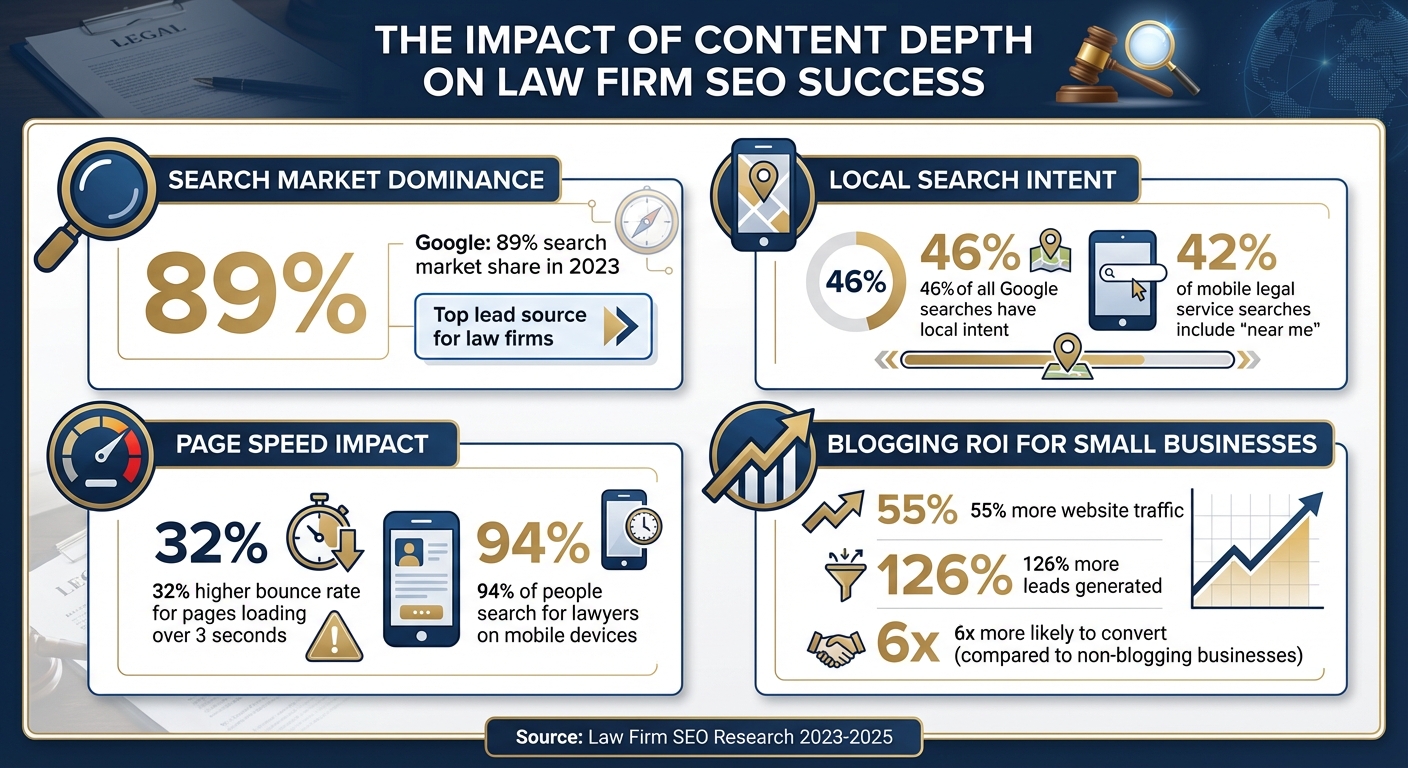
Law Firm Content Marketing Statistics: Traffic, Leads, and Conversion Impact
Creating in-depth content builds trust, establishes authority, and draws in potential clients. When you produce well-researched, detailed material that addresses the questions your audience is asking, you’re doing more than just aiming for better rankings. You’re positioning your law firm as a trusted resource in your field – exactly what both search engines and prospective clients are searching for. By consistently applying principles like Experience, Expertise, Authoritativeness, and Trustworthiness (E-E-A-T), you meet the expectations of both audiences.
Key Takeaways for Law Firm SEO
High-quality content forms the backbone of successful law firm SEO strategies. And the numbers back this up: small businesses that blog see 55% more traffic and generate 126% more leads, with those leads being 6x more likely to convert compared to businesses that don’t blog.
This approach works because it aligns with how search engines evaluate legal websites. Google enforces stricter standards for Your Money or Your Life (YMYL) topics, such as legal advice. This means your content must clearly demonstrate expertise, authority, and trustworthiness. Publishing detailed articles that answer key questions, showcasing attorney credentials, and keeping information up-to-date ensures you meet both user needs and algorithmic requirements. Firms that consistently do this achieve higher rankings and greater visibility, while others struggle to break through.
These insights highlight how engaging, detailed content turns online searches into real client inquiries. Ranking on page one connects you with clients at the exact moment they need help, and comprehensive content is the key to making that connection.
Next Steps for Creating Detailed Legal Content
To build on these takeaways, focus on actionable improvements. Start by auditing your current content library to identify areas that need pillar pages, updates for recent legal changes, or deeper insights that go beyond the basics. Prioritize topics where your firm has genuine expertise and can offer unique perspectives.
Use tools like SearchX to track performance and create a content calendar that emphasizes quality over quantity. Publishing one thorough, 2,000-word guide each month will yield better results than producing multiple shallow posts. Pay close attention to metrics like time on page, bounce rates, and conversion rates to understand what resonates most with your audience.
FAQs
Why is in-depth content important for improving a law firm’s SEO rankings?
In-depth content is key to improving a law firm’s SEO rankings because search engines favor well-rounded and credible information. By thoroughly addressing topics, your content is more likely to meet user needs, which can translate into better rankings.
This detailed approach also creates opportunities to naturally include relevant keywords and phrases, boosting your visibility across various search queries. Beyond rankings, comprehensive content positions your law firm as a reliable source, drawing in potential clients seeking legal guidance.
How can law firms create detailed and effective content for SEO?
Law firms can produce engaging and detailed content by starting with thorough keyword research to pinpoint the terms potential clients are actively searching for. Use this information to craft detailed service pages that not only outline your legal services but also resonate with the needs of your audience. Including attorney bios is another great way to highlight your team’s expertise and build credibility with prospective clients.
Another effective approach is creating content that addresses common client concerns or tackles specific legal issues. Think about developing educational materials like guides, FAQs, or blog posts that answer pressing questions. These resources not only position your firm as an authority in your field but also attract users who are actively seeking solutions. The key is to focus on your audience’s needs and concerns – this not only improves your search visibility but also fosters genuine engagement with your content.
Why is E-E-A-T critical for creating high-quality legal content?
E-E-A-T stands for Experience, Expertise, Authoritativeness, and Trustworthiness, and it’s a cornerstone of creating high-quality legal content that aligns with Google’s standards. Legal topics often fall under the "Your Money or Your Life" (YMYL) category, which includes subjects that can deeply influence a person’s finances, safety, or overall well-being. Because of this, search engines apply stricter criteria when evaluating such content.
To meet these expectations, it’s crucial to showcase expert knowledge, back your claims with accurate, well-researched information, and establish trust with your audience. Doing so not only enhances your content’s credibility but also boosts its visibility in search results. For law firms, this approach is essential in connecting with potential clients who are seeking dependable and professional legal advice.