
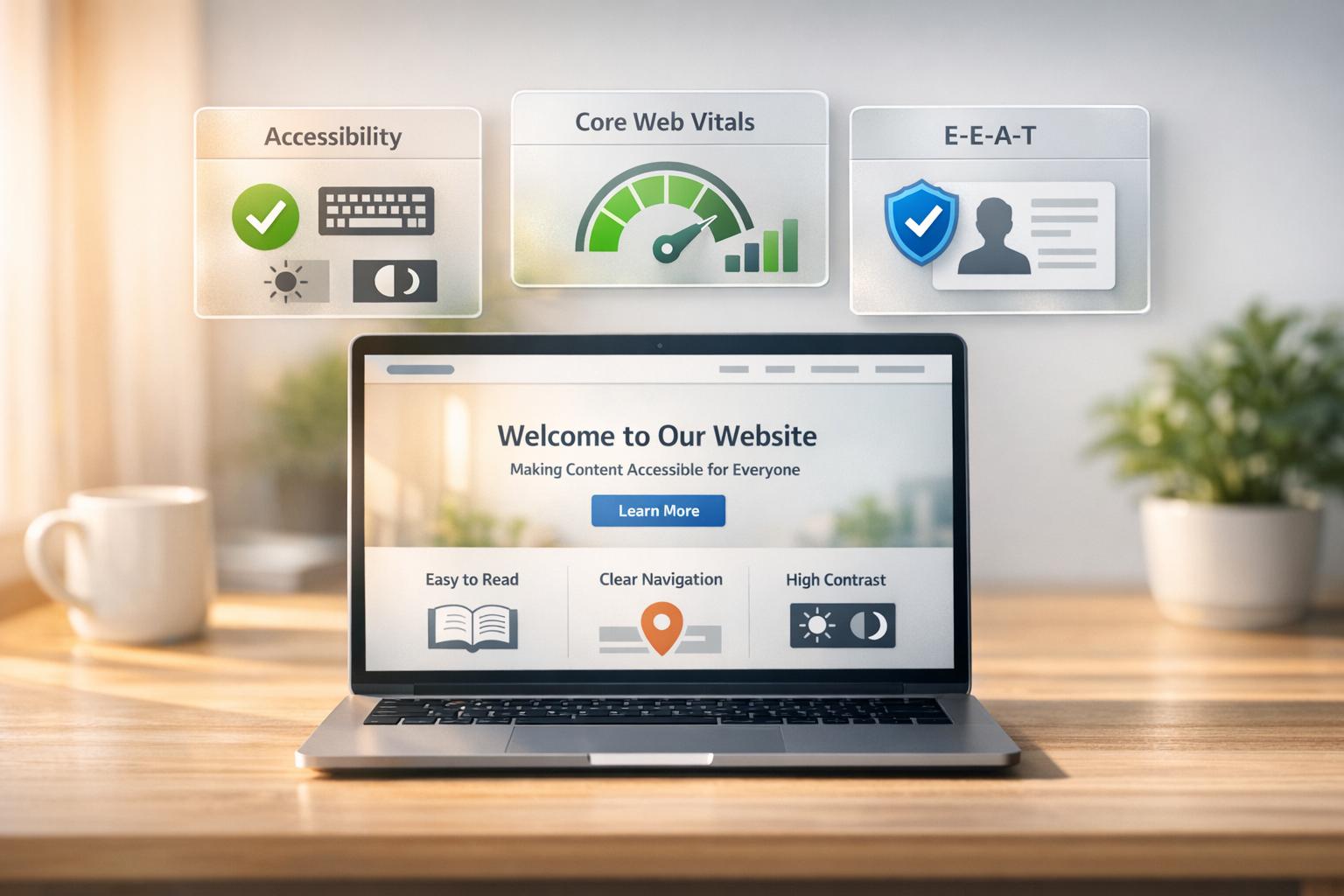
Content accessibility became a direct ranking factor in Google’s algorithm after the September 2025 update. This change has significantly impacted SEO, as websites that meet accessibility standards saw a 37% increase in organic traffic and ranked for 27% more keywords. With 16% of the global population – 1.3 billion people – living with disabilities, prioritizing accessibility is not just a legal requirement but also a way to improve search performance.
Key updates include:
- Google’s Core Web Vitals now factor in accessibility, improving metrics like load times and user interaction.
- E-E-A-T standards evaluate accessibility as part of a site’s quality, affecting rankings.
- Legal mandates, like the European Accessibility Act and ADA compliance, enforce WCAG 2.1 Level AA standards globally.
To align with these changes, websites should focus on:
- Using semantic HTML, descriptive alt text, and proper heading structures.
- Making multimedia content accessible with captions, transcripts, and touch-friendly designs.
- Conducting regular accessibility audits using tools like Lighthouse and manual testing.
Websites that prioritize accessibility not only comply with regulations but also benefit from improved user engagement and search visibility. The 2025 updates make accessibility a must-have for SEO success.
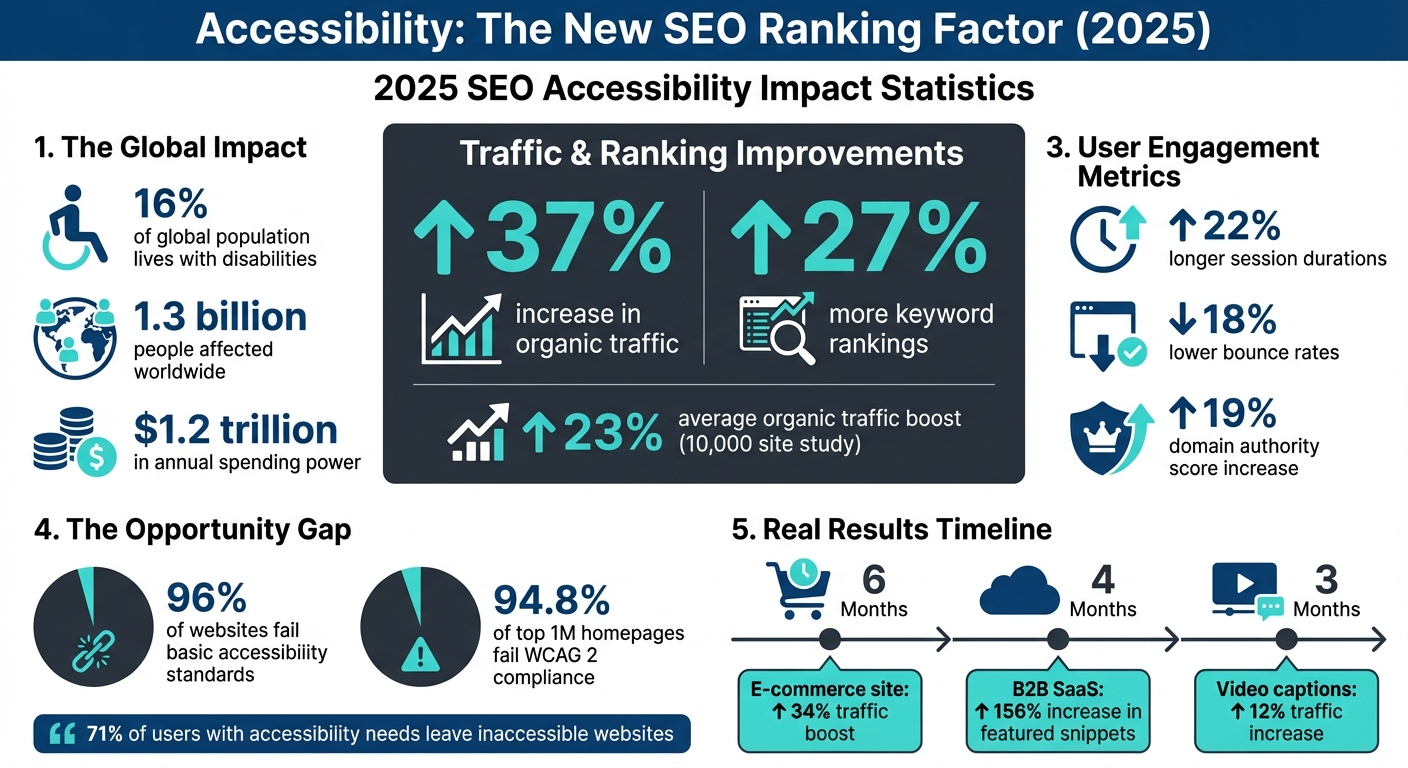
2025 SEO Accessibility Impact: Key Statistics and Performance Metrics
Accessibility SEO Connection | Google’s September 2025 Algorithm
2025 SEO Policy Updates: What Changed for Accessibility
Google’s September 2025 algorithm update introduced a major shift by making accessibility an official ranking factor. This marks a significant moment, as Google confirmed that sites meeting accessibility standards now directly influence rankings. The impact? Websites optimized for accessibility experienced a 37% increase in organic traffic and ranked for 27% more keywords.
Google’s Navboost system now plays a key role in this shift. It prioritizes engagement signals tied to accessibility, such as longer session durations (up by 22%) and lower bounce rates (down by 18%) on accessible sites.
Legal regulations have also stepped up. The European Accessibility Act, effective June 2025, mandates WCAG 2.1 Level AA compliance across the EU. Similarly, the U.S. Department of Justice has aligned ADA compliance with these standards. These developments make accessibility a critical component of SEO, moving it from a "nice-to-have" to a necessity.
This update also ties accessibility into Google’s Core Web Vitals and E-E-A-T standards, reshaping how SEO strategies are built.
Accessibility Now Part of Core Web Vitals
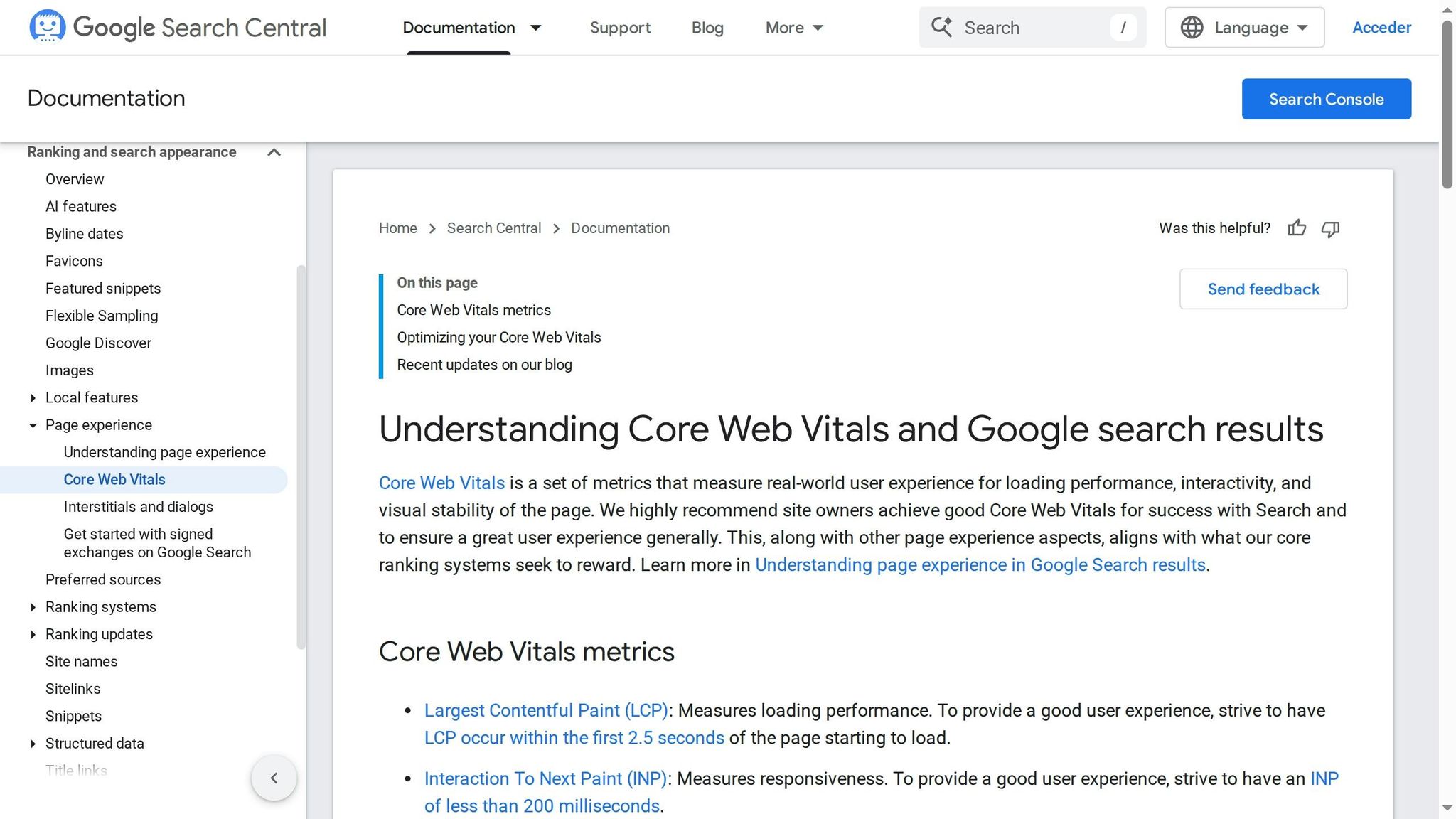
Core Web Vitals, Google’s performance metrics, now integrate accessibility factors. Here’s how:
- Largest Contentful Paint (LCP) benefits from clean, semantic HTML and optimized images with descriptive alt text. This reduces code bloat and improves load times.
- Interaction to Next Paint (INP), which replaced First Input Delay, measures how quickly a site responds to user actions like keyboard inputs. This is crucial for users relying on keyboard navigation.
- Cumulative Layout Shift (CLS) improves when image dimensions are defined, and navigation remains stable. These changes enhance both usability and speed.
Websites that focus on accessibility saw an average 23% increase in organic traffic across a study of 10,000 sites.
E-E-A-T Standards Now Include Accessibility
Google’s updated E-E-A-T (Experience, Expertise, Authoritativeness, Trustworthiness) framework now evaluates accessibility as part of a site’s overall quality. According to the 2025 Quality Rater Guidelines, sites that exclude users with disabilities are rated lower in "Experience" and "Trustworthiness".
To meet these standards:
- Use a clear content hierarchy with one
<h1>for the main title and logical<h2>to<h6>tags for structure. - Opt for descriptive anchor text like "download the 2025 SEO audit checklist" instead of generic phrases like "click here."
This approach not only improves accessibility but also helps screen readers and search engines better understand your content.
New Requirements for Multimedia Content
Stricter accessibility requirements now apply to multimedia content, enhancing user engagement and SEO performance. Key updates include:
- Video content must have synchronized captions and transcripts to ensure accessibility for all users, including search engines.
- Images need descriptive alt text that explains their content and context.
- Interactive elements on mobile must meet minimum touch target sizes of 24×24 pixels, with some guidelines recommending 44×44 pixels, to assist users with motor impairments.
These updates aren’t just compliance measures – they deliver results. For instance, adding captions and transcripts to videos can boost traffic by 12% within three months.
Despite these advancements, 96% of websites still fail to meet basic accessibility standards. This presents a huge opportunity for businesses willing to embrace these updates and gain a competitive edge in the SEO landscape.
Technical SEO Requirements for Accessibility
To meet the 2025 accessibility standards, websites must adopt specific technical updates that not only enhance usability for individuals with disabilities but also improve search rankings.
Mobile-First Design and Accessibility
With Google’s mobile-first indexing, accessibility has become a key ranking factor. To align with WCAG 2.2 guidelines, touch targets should be at least 24×24 pixels, with an ideal size of 44×44 pixels . Websites must function seamlessly in both portrait and landscape modes without losing features . For users who struggle with complex gestures, always provide tap or click alternatives. Text on mobile devices should scale correctly, maintaining a minimum line spacing of 1.4 times the font size to assist users with low vision. Avoid infinite scrolling unless accessible pagination is available, as it can trap users relying on keyboards or screen readers. This is particularly crucial since 71% of users with accessibility needs leave websites that are hard to navigate. These mobile design improvements not only enhance usability but also align with Google’s updated algorithms, paving the way for structured data solutions to further boost accessibility.
Leveraging Structured Data for Accessibility
Structured data, implemented through JSON-LD, makes content easier for both search engines and assistive technologies to interpret. Following Google’s best practices, focus on schema types like Organization, LocalBusiness, Product, FAQPage, HowTo, and Article to improve visibility in voice searches and AI summaries. BreadcrumbList schema helps users, especially those with cognitive disabilities or screen readers, understand their location within the site. FAQPage schema can also increase the likelihood of securing featured snippets. Additionally, Speakable schema highlights sections of content suitable for text-to-speech, making it easier for voice assistants to relay information. Use Google’s Rich Results Test to validate your markup and ensure eligibility for enhanced search features. Combined with clear site navigation, these structured data strategies significantly improve accessibility for all users.
Enhancing Navigation and Readability
Proper content hierarchy is essential. Use a single <h1> tag for the main title and follow with nested <h2> to <h6> tags to guide screen readers and search engines through your content. ARIA attributes, such as aria-label for buttons, aria-expanded for menus, and aria-describedby for forms, add clarity for assistive technologies. Include skip-to-content links to help users bypass repetitive navigation, and replace vague anchor text like "click here" with descriptive text, such as "download the accessibility audit checklist." To meet readability standards, ensure a contrast ratio of at least 4.5:1 and line spacing that is 1.5 times the font size . These adjustments enhance the experience for users with visual or cognitive impairments, which is especially critical given that 96% of websites currently fail to meet basic accessibility standards.
How Businesses Can Meet 2025 Accessibility Standards
With upcoming technical and policy updates, businesses can take actionable steps like conducting audits, improving content, and seeking professional expertise to align with accessibility standards.
Running Accessibility Audits
Start by performing both automated and manual audits. Tools like Lighthouse, axe, and WAVE can identify about 40% of technical issues automatically. However, context-sensitive problems often require human testers to uncover. For a thorough check, navigate your site entirely via keyboard and use screen readers like NVDA (Windows) or VoiceOver (Mac).
Keep an eye on metrics like bounce rates and session durations in Google Analytics after making accessibility updates. For example, a mid-sized e-commerce retailer revamped their semantic HTML, optimized alt text for over 15,000 images, and improved keyboard navigation. The result? A 34% boost in organic traffic, 22% longer session durations, and an 18% drop in bounce rates within six months. Document every update to showcase your compliance efforts.
These audits set the stage for creating content that’s truly inclusive.
Creating Content for All Users
Follow the POUR principles: Perceivable, Operable, Understandable, and Robust. This includes writing detailed alt text for images and providing transcripts for videos. A B2B SaaS platform that implemented these changes – along with correcting heading hierarchies – achieved a 156% jump in featured snippets (from 23 to 59) and a 47% rise in organic impressions in just four months.
Additionally, use descriptive anchor text and maintain a logical heading order (H1 through H6 without skipping levels). These adjustments not only aid screen reader users but also help search engines better understand your content. Results often become noticeable within two to four months.
Working with SEO Professionals
SEO professionals can streamline accessibility efforts by combining compliance fixes with strategies to improve search rankings. Agencies like SearchX specialize in technical SEO audits that identify accessibility gaps and implement impactful solutions. Their expertise is particularly helpful for navigating legal mandates like the European Accessibility Act and ADA standards. They can also add structured data markup and track behavioral metrics to measure ROI.
Accessible websites typically rank for 27% more organic keywords and experience a 23% uptick in organic traffic compared to non-compliant sites. With 94.8% of the top one million home pages still failing WCAG 2 standards in 2025, businesses that prioritize accessibility not only gain a competitive edge but also better serve the 16% of the global population living with disabilities.
Conclusion
The 2025 updates have reshaped the landscape of SEO, making accessibility a core priority. With Google’s September 2025 algorithm update, accessibility is officially a direct ranking factor – not just a secondary consideration anymore. The impact is clear: websites prioritizing accessibility saw a 37% increase in traffic and ranked for 27% more keywords after the update.
By embedding accessibility into Core Web Vitals and multimedia standards, compliance is no longer optional. Nearly 95% of top-ranking pages still fall short of WCAG 2 compliance, creating a golden opportunity for businesses that act early. Accessible design doesn’t just meet standards – it delivers measurable benefits, like reducing bounce rates by up to 18%, increasing session durations by 22%, and boosting domain authority scores by as much as 19%.
This shift isn’t just about algorithms. Accessibility connects with the 16% of the global population living with disabilities – equivalent to 1.3 billion people and over $1.2 trillion in annual spending power. Legal frameworks, such as the European Accessibility Act taking effect on June 28, 2025, add further urgency for businesses targeting or operating in EU markets.
To stay ahead, focus on regular technical audits, semantic HTML, well-structured content, and descriptive multimedia elements. Whether handled in-house or through experts like SearchX, the objective is clear: create user-friendly digital experiences that align with search engine standards. These efforts not only enhance search performance but also champion inclusivity.
Accessibility-driven SEO is now a cornerstone for maintaining strong search visibility. Businesses that adapt to these changes today will secure top rankings while others struggle to catch up. Take action now to build a future-proof, inclusive digital presence.
FAQs
What accessibility fixes impact rankings the most?
Making your website more accessible isn’t just about inclusivity – it can also improve your search engine rankings. Here are some key adjustments that can make a difference:
- Use semantic HTML: Properly structured HTML helps search engines and assistive technologies understand your content better, improving both accessibility and SEO.
- Optimize for mobile responsiveness: A mobile-friendly site ensures users on all devices have a seamless experience, which is crucial for rankings.
- Add descriptive alt text to images: Alt text not only makes images accessible to visually impaired users but also provides search engines with context about the images on your site.
- Ensure clear navigation: A well-organized menu and logical site structure improve usability for everyone, including search engine crawlers.
- Maintain proper heading structures: Using headings in a logical order (H1, H2, H3, etc.) helps users and search engines easily navigate and understand your content.
These changes not only align with search engine guidelines but also create a better experience for your audience.
How do I prove WCAG compliance on my site?
To show compliance with WCAG standards, combine automated tools and manual audits for accessibility testing. Check how well your site matches WCAG guidelines and document your findings. Creating materials like VPAT reports or accessibility statements can help in this process. You can confirm these documents’ accuracy using specialized tools or by following detailed testing methods from trusted accessibility resources.
How soon will SEO improve after accessibility updates?
SEO benefits from accessibility updates often start to surface within a few months. Improving accessibility not only helps search rankings but also enhances user engagement and technical performance. Some research indicates that these advantages could become even more apparent by 2025 or 2026, as search engines place greater emphasis on accessible content.