

When potential clients search for legal services online, your firm’s visibility can make or break your ability to attract them. Many law firms unknowingly hurt their rankings by making common SEO mistakes. Here’s a quick overview of the top issues and how to fix them:
- Ignoring Local SEO: Most legal searches are location-specific. Optimize your Google Business Profile, ensure NAP consistency, and use local keywords to capture nearby clients.
- Publishing Generic Content: Shallow, vague content fails to rank or engage users. Create detailed, actionable articles that address specific client questions.
- Weak Practice Area Pages: Copy-pasting content across pages leads to penalties. Tailor each page with unique, in-depth information about your services.
- Poor Keyword Strategy: Overloading keywords or targeting broad terms doesn’t work. Focus on long-tail keywords that match client intent.
- Ignoring Technical SEO: Issues like slow loading times, broken links, and non-mobile-friendly designs frustrate users and lower rankings. Conduct regular audits to fix these problems.
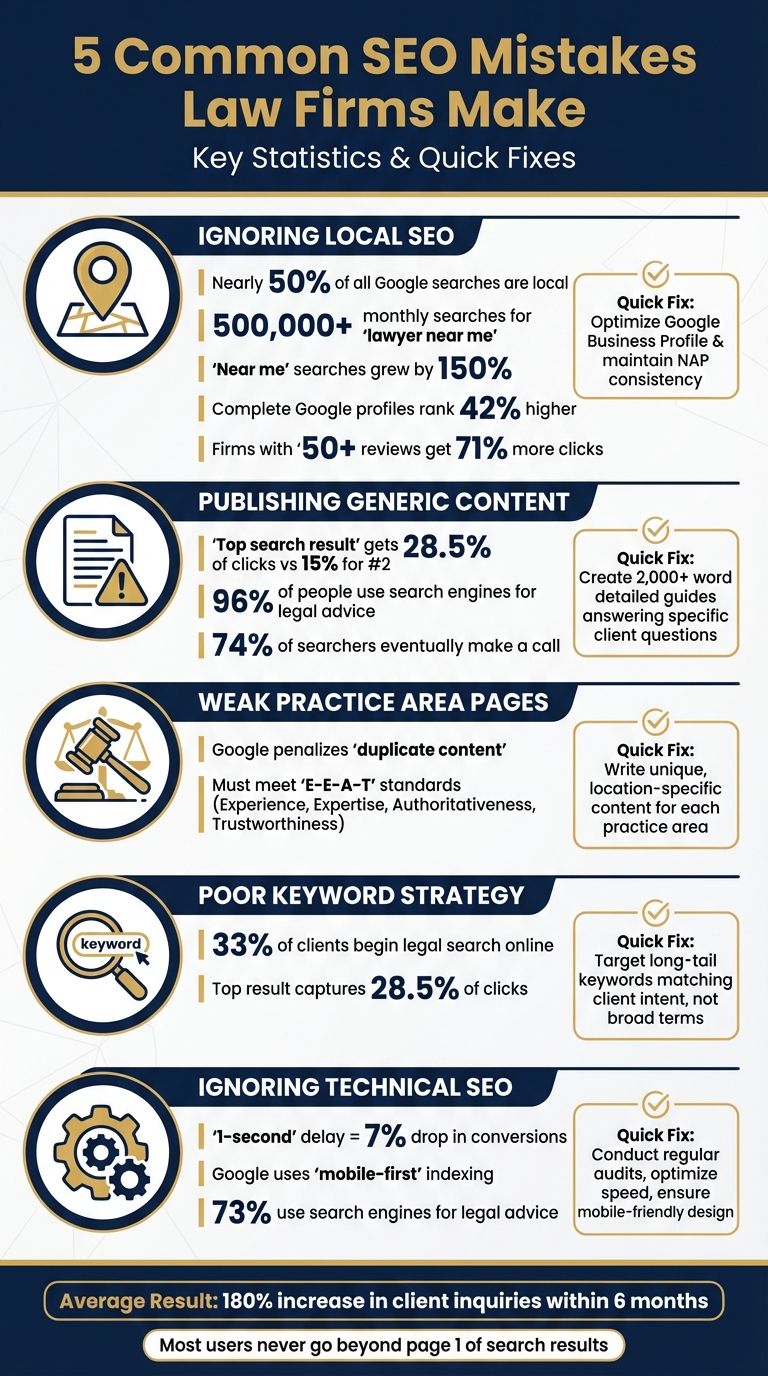
5 Common SEO Mistakes Law Firms Make: Key Statistics and Solutions
7 Common Lawyer SEO Mistakes And How To Avoid Them
Mistake 1: Ignoring Local SEO
Many law firms mistakenly approach their website as if they’re running a national campaign, rather than focusing on their local audience. Here’s the reality: nearly half of all Google searches are local, and there are over 500,000 monthly searches for "lawyer near me". Overlooking local SEO means you’re handing potential clients over to competitors who dominate Google Maps and local search results.
Why Local SEO Is Crucial for Law Firms
Legal services are deeply tied to local needs. Clients want attorneys who understand their state’s laws, are familiar with local courts, and have the right credentials. Think about it – when someone is dealing with a DUI, a divorce, or a workplace injury, they’re not searching for help several states away. They want someone nearby who can help them immediately.
"Google has essentially ‘localized’ everything – even law firms are treated like pizza shops now. When someone searches for a ‘criminal defense attorney,’ Google assumes they mean near them and shows localized results." – Justia
The numbers back this up: "near me" searches have grown by 150%. If your law firm isn’t showing up in those local results, you’re practically invisible to most people actively searching for legal help in your area.
Steps to Improve Your Local SEO
Your first priority should be optimizing your Google Business Profile. Start by claiming and verifying your listing. Then, fill out every detail – firm name, address, phone number, business hours, website, practice areas, and upload at least 10 photos of your office and team. Why? Because complete profiles rank 42% higher than incomplete ones, and including photos can boost engagement by 42%.
Consistency is key when it comes to your Name, Address, and Phone (NAP) details. Ensure these match perfectly across your website, Google Business Profile, and other directories like Yelp, Avvo, Justia, FindLaw, and Yellow Pages. Even minor inconsistencies can confuse Google and hurt your rankings.
Incorporate location-specific keywords naturally into your site’s content. For instance, phrases like "personal injury lawyer in Dallas" or "divorce attorney near Michigan" should appear in page titles, headers, and body text. Additionally, create dedicated landing pages for each city or area you serve. Don’t forget to add local business schema markup to help search engines understand your location and services. If you’re unsure how to do this, SearchX’s guide on adding local business schema markup offers step-by-step instructions.
Online reviews are another major factor in local rankings. Law firms with 50+ Google reviews see 71% more clicks from local search results. Encourage satisfied clients to leave reviews and respond to every review – positive or negative. Use the Q&A section on your Google Business Profile to address common client questions, effectively turning it into a mini FAQ.
The Payoff of Local SEO
Law firms that invest in local SEO often see an average 180% increase in client inquiries within six months. Regularly updating your Google Business Profile with posts and earning 50+ reviews can boost your Local Pack visibility by 67% and increase inquiries by 42%.
Beyond driving more traffic, local SEO builds trust. When your firm appears prominently in Google Maps and local search results, potential clients see you as an authority before they even pick up the phone. Establishing this trust early on sets a strong foundation for the rest of your digital strategy.
Mistake 2: Publishing Generic Content
A common misstep for many law firms is publishing generic content that lacks depth and specificity. Pages with titles like "Personal Injury Law" often provide nothing beyond a surface-level summary of the topic, paired with a generic call to action. In today’s competitive online landscape, this approach simply doesn’t cut it.
Why Generic Content Falls Flat
Google tends to view generic content as low-quality, which can result in it being ignored or heavily discounted in search rankings. For instance, when someone searches for "what to do after a car accident in Texas", they’re not looking for a basic definition of personal injury law. They want actionable, step-by-step advice tailored to their specific situation.
This type of shallow content also leads to poor user engagement. Visitors quickly leave the page, signaling to Google that the content isn’t relevant. And with the top search result commanding 28.5% of clicks (compared to just 15% for the second result), failing to provide meaningful content could cost you valuable traffic.
There’s another layer to consider: Google’s "Your Money or Your Life" (YMYL) standards. Legal content is held to these high standards, requiring it to demonstrate Experience, Expertise, Authoritativeness, and Trustworthiness (E-E-A-T). Thin, generic content fails to meet these criteria, sending the wrong message to both search engines and potential clients.
"Every piece of content is your chance to show what kind of lawyer you are." – Juris Digital
The solution? Create content that directly addresses the specific questions your clients have.
How to Write Content That Answers Client Questions
Start by focusing on the real questions clients frequently ask during consultations. Instead of a generic page titled "About Divorce Law", consider writing detailed guides like "How Long Does a Divorce Take in California?" or "Steps to Take After a Car Accident." These types of articles provide immediate value by addressing specific concerns.
When creating content, aim for in-depth articles of 2,000 words or more that thoroughly cover the topic. Use clear headers, subheadings, and bullet points to make the information easy to scan. Include practical examples to illustrate common legal scenarios, and add FAQ sections to answer additional questions directly. Avoid legal jargon – write in plain, accessible language to ensure readers can easily understand complex topics.
To strengthen your content strategy, build topic clusters. For example, create a central "Family Law Guide" page and link it to detailed articles on related subjects like child custody, divorce timelines, and financial settlements. This interconnected structure not only improves your topical authority but also aligns with Google’s ranking criteria. Additionally, keep your content fresh by regularly updating older articles with new legislation, data, and citations.
The Payoff of Better Content
Focusing on client-specific, detailed content delivers tangible results. Not only will your search rankings improve – since Google favors content that’s genuinely useful – but you’ll also earn the trust of potential clients before they even contact you. People will see you as a reliable, knowledgeable professional who understands their challenges.
"Content remains the strongest lever in your SEO arsenal – but only if it’s written for humans first and algorithms second." – Agile Agency
High-quality, client-focused content also leads to more consultation requests. With 96% of people turning to search engines for legal advice and 74% of those searchers eventually making a call, the quality of your content directly affects your bottom line. By prioritizing helpful, human-centered information, you’ll not only enhance your SEO performance but also build lasting connections with your audience.
Mistake 3: Weak Practice Area Pages
Many law firms fall into the trap of creating practice area pages that simply swap out keywords or city names, leading to duplicated content. This strategy often backfires. Google penalizes pages that recycle content, pushing them down in search rankings, which means fewer opportunities to connect with potential clients. Rather than boosting visibility, these weak pages squander chances to make meaningful connections with people searching for legal help.
Why Practice Area Pages Deserve More Attention
Practice area pages are often the first place high-intent searchers land when they’re looking for legal assistance. These visitors aren’t casually browsing – they’re actively comparing attorneys to decide who to contact. If your page only provides a surface-level summary and a generic "call us" button, you’re missing an opportunity to show why your firm is the right choice.
Google applies strict "Your Money or Your Life" (YMYL) standards to legal content, requiring pages to demonstrate Experience, Expertise, Authoritativeness, and Trustworthiness (E-E-A-T). Thin or generic content doesn’t meet these standards. Without detailed, personalized information about your services, you risk not only lower rankings but also losing credibility with potential clients. Next, let’s explore how to transform these pages into powerful tools for your firm.
How to Create Stronger Practice Area Pages
To stand out, you need to create original, detailed content for each practice area page. Tailor each page to include information specific to your location, such as local court procedures, state laws, and typical client concerns in your region. For instance, a personal injury page for a Texas-based firm should discuss the state’s statute of limitations and local insurance regulations instead of relying on generic national guidelines.
Write in plain, straightforward language. Legal issues are stressful for most people, so avoid overwhelming them with complicated legal jargon. Use clear headers and bullet points to make your content easy to read. Add client testimonials to build trust, and make sure every page includes a strong call-to-action, like "Schedule a Free Consultation" or a clickable phone number.
To ensure your content is unique, use tools like Copyscape or Siteliner to identify and fix duplicate content across your website. If you must have similar pages, use canonical tags to guide search engines on which version to prioritize.
The Payoff of Better Practice Pages
Well-crafted, detailed practice area pages don’t just help you rank higher – they also turn visitors into clients. When someone finds a page that directly addresses their concerns, explains the legal process clearly, and highlights your firm’s expertise, they’re much more likely to reach out. With the top search result capturing 28.5% of clicks, improving your practice area pages can significantly boost the number of inquiries your firm receives. These pages are a cornerstone of effective SEO and client engagement.
Mistake 4: Poor Keyword Strategy
Many law firms try to improve their online visibility by either overloading their content with keywords or focusing on overly broad terms like "lawyer" or "attorney." Unfortunately, both methods can do more harm than good. Stuffing keywords into content makes it sound robotic and unappealing, while generic terms are so competitive that they rarely attract the right audience.
Problems with Keyword Stuffing
Keyword stuffing is the practice of cramming excessive keywords into content, titles, meta descriptions, or even Google Business Profile names in an attempt to manipulate search rankings. This approach often results in awkward, unnatural text that turns off both readers and search engines. Search engines can penalize such pages by lowering their rankings – or worse, removing them entirely from search results. On top of that, visitors are likely to abandon pages filled with repetitive, cluttered phrases, which can hurt your site’s overall performance.
How to Build a Better Keyword Strategy
Instead of chasing broad, competitive terms, focus on long-tail keywords that align with what your potential clients are actually searching for. For instance, rather than targeting "personal injury lawyer", aim for specific, intent-driven phrases like "how to file a car insurance claim in Atlanta" or "immigration lawyer for H-1B issues in Boston." These long-tail keywords are less competitive and more likely to attract users who are ready to take action.
To find these keywords, use SEO tools like those provided by SearchX to identify terms with manageable competition and decent search volume. Once you’ve chosen your target keywords, weave them naturally into your titles, headings, and content. Always prioritize writing for humans – address their real questions and concerns instead of chasing arbitrary keyword density goals. This approach not only improves your search rankings but also ensures you’re connecting with potential clients who are serious about finding legal help.
Why Keyword Strategy Matters
A well-thought-out keyword strategy doesn’t just improve your search rankings – it also brings in the right kind of visitors. When you target specific, intent-driven phrases, you’re reaching people who are actively looking for the legal services you provide. Consider this: over 33% of clients begin their search for legal assistance online, and the top search result captures 28.5% of clicks. By refining your keyword strategy, you can enhance your visibility and increase inquiries from potential clients.
Mistake 5: Ignoring Technical SEO
Technical SEO is the backbone of your law firm’s online visibility. Even if you’re crafting excellent content and targeting the right keywords, technical issues on your website can render all those efforts ineffective. Problems like slow loading speeds, broken links, or poor mobile functionality can make your site invisible to search engines and frustrating for potential clients. These issues not only hurt your rankings but also drive visitors away.
Common Technical SEO Problems
Technical SEO issues often lurk in the background, unnoticed until they start damaging your rankings. One major culprit is slow page speed – a one-second delay in load time can result in a 7% drop in conversions. Mobile optimization is another frequent issue. With Google’s mobile-first indexing, the mobile version of your site is the primary factor in determining rankings. If your site isn’t mobile-friendly, you’re at a serious disadvantage. Other common issues include missing HTTPS security protocols, crawl errors, and duplicate content.
How to Fix Technical SEO Issues
Start by conducting regular site audits using tools like Google PageSpeed Insights, WebPageTest, GTmetrix, or Google Search Console. These tools help identify issues and offer actionable insights. To improve loading speed, compress and resize images using modern formats like WebP or AVIF, enable browser caching, minimize CSS and JavaScript files, and defer nonessential scripts. If performance issues persist, consider upgrading your hosting plan or using a Content Delivery Network (CDN).
For mobile optimization, ensure your site uses a responsive design that works seamlessly across all screen sizes. Make sure the mobile version of your site mirrors the content on the desktop version – Google penalizes sites that hide important information on mobile. Use larger fonts and design buttons and links that are easy to tap on smaller screens.
To address security and crawlability, implement HTTPS if it’s not already in place, fix broken links by setting up 301 redirects, and update both XML and HTML sitemaps to help search engines navigate your site efficiently. Adding structured data (schema markup), such as LegalService, FAQ, or Breadcrumb, can also improve how search engines interpret your content and display it in search results.
"We encourage you to start looking at your site’s speed (the tools above provide a great starting point) – not only to improve your ranking in search engines, but also to improve everyone’s experience on the Internet." – Google Search Quality Team
By addressing these technical issues, you’ll create a strong foundation for your overall SEO strategy.
Why Technical SEO Matters
Technical SEO is critical because it supports every other aspect of your online presence. Without a solid technical framework, even the best content and keyword strategies can fall flat. Google gives priority to websites with strong technical performance, especially in areas like mobile-first indexing and Core Web Vitals. Fixing technical issues can boost rankings while also improving the user experience. A fast, secure, and mobile-friendly site keeps visitors engaged, reduces bounce rates, and makes it easier for potential clients to connect with you. Even small improvements – like shaving a second or two off your load time – can lead to noticeable gains in both engagement and rankings. A technically sound website ensures proper crawling, indexing, and usability, forming the bedrock of your SEO efforts.
Conclusion
SEO missteps can cost law firms potential clients, but the good news is that every mistake has a solution. By prioritizing local SEO, crafting content that addresses real client concerns, fine-tuning practice area pages, building a strategic keyword plan, and resolving technical issues, your firm can position itself for long-term growth.
The online legal space is highly competitive. With 73% of people turning to search engines for legal advice and most users never venturing beyond the first page of results, an unoptimized website risks going unnoticed. Simple actions like improving page speed, updating outdated content, and ensuring accurate local listings can attract more qualified leads and boost conversions.
FAQs
What are the best ways for law firms to improve their local SEO?
Law firms looking to improve their local SEO can focus on a few impactful strategies. Start by claiming and fine-tuning your Google Business Profile. Make sure your business name, address, and phone number (NAP) are accurate and match across all online directories – consistency is key.
Next, incorporate local keywords into your website content and metadata. These should reflect both your legal services and the specific locations you serve. For example, if you’re a family law attorney in Chicago, phrases like "Chicago family lawyer" can help connect you with local clients.
Encouraging clients to leave positive online reviews is another effective way to build trust and boost your visibility in local search results. Reviews not only enhance your credibility but also make your firm stand out among competitors.
Creating localized content is also a smart move. Publish blog posts or landing pages that address legal concerns specific to your area. For instance, a blog about "property laws in Los Angeles" can attract local readers searching for expertise in that topic.
Finally, ensure your website is mobile-friendly and loads quickly. Many potential clients search for legal help on their phones, so a fast, user-friendly site can make a great first impression and keep visitors engaged.
These steps can help law firms strengthen their online presence and connect with more local clients effectively.
How can law firms create content that attracts and engages potential clients?
Creating content that truly connects with potential clients starts with understanding their specific needs and concerns. Focus on writing clear, informative pieces that address common legal questions and break down complicated topics into easy-to-understand language. This approach not only showcases your expertise but also makes your content more relatable and accessible.
To make your content more practical and engaging, include actionable tips, real-life examples, or explanations that align with your audience’s interests. For instance, if you’re targeting a local audience, referencing relevant local laws or notable cases can make your content feel more relevant and tailored. Well-crafted content doesn’t just build trust – it also boosts your online visibility, helping you reach the people who genuinely need your services.
Why do law firms need a strategic keyword plan for SEO?
A solid keyword strategy is crucial for law firms because it helps them connect with the right audience – people actively searching for legal services. By zeroing in on carefully researched and relevant keywords, law firms can boost their online presence and attract users who are specifically looking for the expertise they offer.
On the flip side, targeting irrelevant keywords or skipping the planning process can mean lost opportunities and lower website traffic. A thoughtful keyword approach not only sets law firms apart in a crowded market but also draws in more qualified leads, paving the way for meaningful growth in their client base.