

Running a dental practice without proper SEO can mean losing patients to competitors. Here’s the reality: over 90% of people use Google to find nearby healthcare providers. If your practice isn’t showing up, you’re missing out. Many dentists unknowingly make critical SEO mistakes like ignoring local SEO, targeting ineffective keywords, or having slow websites that frustrate visitors. These issues directly impact your rankings and patient inquiries.
Key Takeaways:
- Claim and optimize your Google Business Profile for better local visibility.
- Use consistent NAP (Name, Address, Phone) details across all directories.
- Focus on long-tail keywords to attract high-intent patients.
- Ensure your website is mobile-friendly and loads in under 3 seconds.
- Regularly update and remove duplicate or outdated content.
- Use structured data like
DentalClinicschema to improve search results.
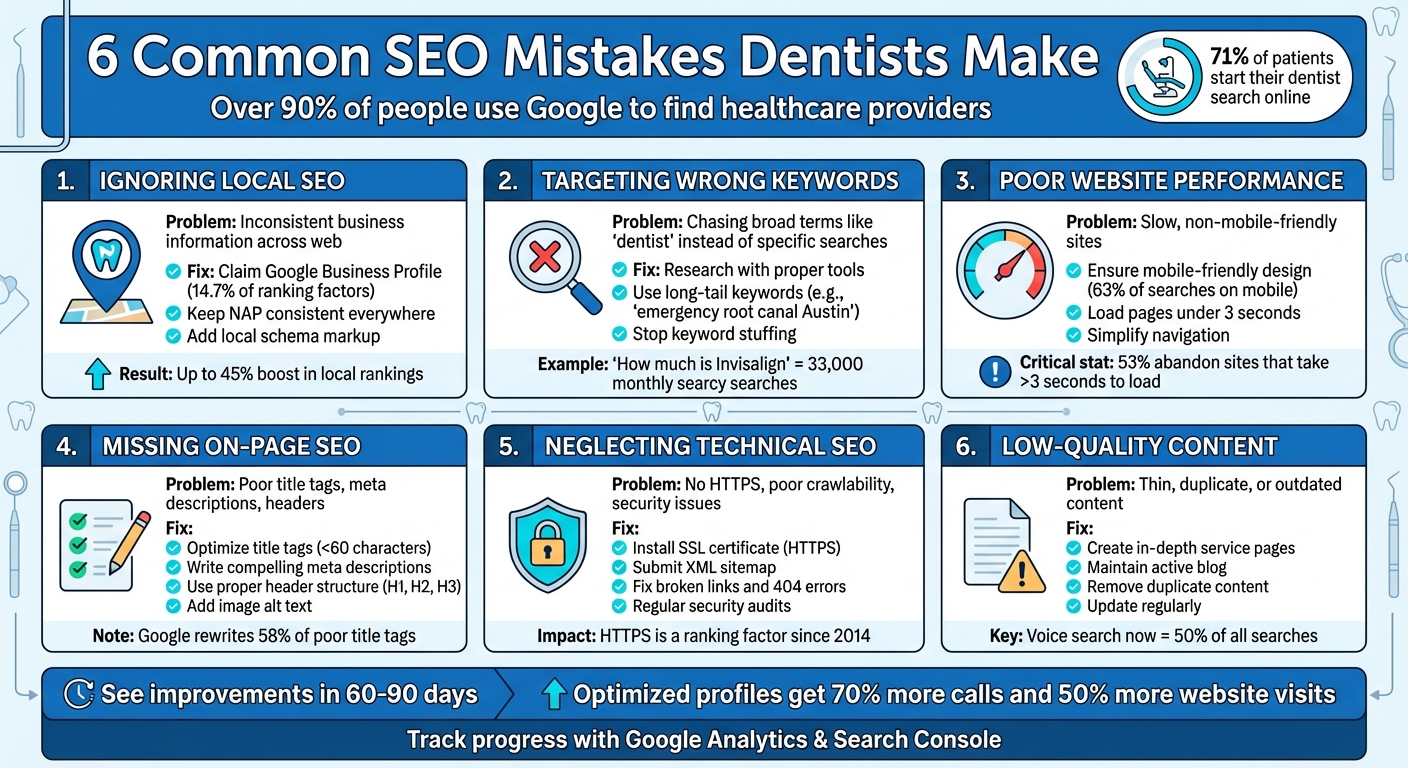
6 Common SEO Mistakes Dentists Make and How to Fix Them
Top 3 SEO Mistakes Every Dental Practice Makes (Stop Losing Google Rankings!)
Mistake 1: Ignoring Local SEO
Imagine someone searching "dentist near me" on their phone. You want your practice to show up in those top three map results, right? But many dental practices miss this opportunity because their business information is inconsistent across the web. This inconsistency can make your practice nearly invisible when potential patients are actively searching.
Google prioritizes three key factors – distance, relevance, and prominence – when deciding which practices appear in those coveted spots. If your Google Business Profile is unclaimed or your address varies across online directories, your chances of being seen drop significantly.
Here’s how to fix it: focus on three essentials – claim and optimize your Google Business Profile, ensure your business details match across the internet, and create content that highlights your local presence. These steps could boost your local rankings by as much as 45% in just two months. Let’s start with your Google Business Profile.
Claim and Update Your Google Business Profile
Your Google Business Profile is a game-changer for local visibility. It contributes to 14.7% of local ranking factors, and optimized profiles can receive 70% more calls and 50% more website visits than incomplete ones.
If you haven’t claimed your profile yet, do it now. Google will verify your ownership via postcard, phone, or video. Once verified, fill out every detail – your practice name, address, phone number, website, and business hours. Set "Dentist" as your primary category, and include secondary ones like "Cosmetic Dentist" or "Pediatric Dentist" to align with what patients are searching for.
Boost your profile further by adding a services menu. Include treatments like dental implants, teeth whitening, or root canals – this helps you rank for specific procedures. Don’t forget high-quality photos; listings with visuals get more clicks and calls. Use Google Posts to share updates, patient tips, or promotions regularly.
One major no-no: avoid keyword stuffing in your business name. For example, using "Best Dentist in Chicago" instead of your official name can lead to profile suspension. Stick to your actual practice name.
"To qualify for a Business Profile on Google, a business must make in-person contact with customers during its stated hours."
– Google Business Profile Guidelines
Keep NAP Information Consistent Across Directories
The term NAP stands for Name, Address, and Phone number. These details must be exactly the same across all online directories. Even small discrepancies can confuse Google’s algorithms and hurt your rankings.
To stay consistent, create a master spreadsheet with your official business name, full address, phone number, and hours. Use this as your "source of truth" for every directory submission. Regularly check platforms like Google Business Profile, Yelp, Healthgrades, and Facebook for any errors. Tools like Moz Local, BrightLocal, or Yext can help you sync your information across multiple directories automatically.
If you have multiple locations, make sure each office has unique NAP details and its own dedicated landing page on your website. This helps each location rank better in its specific area.
Now, let’s talk about reinforcing your local presence with targeted content and structured data.
Add Local Content and Schema Markup
Creating content that ties into your neighborhood or nearby landmarks signals to Google exactly where your practice operates. For example, you could develop landing pages for each neighborhood or city you serve. Include local maps, testimonials from area residents, and references to nearby streets or landmarks.
Schema markup – structured data you add to your website – further reinforces your business information. It can make you eligible for rich search results, like star ratings, operating hours, and photos, right on the search page. Use schema types like DentalClinic or MedicalBusiness rather than generic Organization markup. Include details such as your exact coordinates, operating hours, average ratings, and the areas you serve.
"Local business schema… reinforces that information [from Google Business Profile]. It makes it easier for search engines to understand and highlight your business."
– Alex Lindley, Managing Editor, Semrush
To ensure your schema is error-free, validate it using Google’s Rich Results Test. This step also helps AI tools and voice assistants recognize and recommend your practice.
Mistake 2: Targeting the Wrong Keywords
Many dental practices end up wasting resources by chasing the wrong keywords. Instead of relying on data-driven insights, they often guess what patients are searching for. For example, they might optimize for clinical terms like "halitosis", while most people simply search for "bad breath". Others aim for overly broad keywords such as "dentist" or "dental clinic", putting themselves in direct competition with large national directories instead of focusing on local search intent.
This misstep often results in low-value rankings – or no rankings at all. Considering that 71% of patients start their search for a dentist online, targeting the right keywords is critical. By conducting proper research, using long-tail keywords, and integrating them naturally into your content, you can significantly improve your visibility.
Research Keywords Properly
To find the right keywords, use professional tools like Google Keyword Planner, SEMrush, Ahrefs, or AnswerThePublic. Start with basic terms like "dental", "dentist", or "teeth", and let these tools generate specific, actionable long-tail keyword ideas. For instance, the phrase "how much is Invisalign" sees an average of 33,000 monthly searches in the U.S..
Focus on three key areas for keyword themes:
- Location-based terms: Examples include "dentist in Austin" or "emergency dentist near me."
- Service-related keywords: Phrases like "Invisalign provider" or "dental implants specialist."
- Problem-based queries: Questions like "why do my gums bleed" or "best treatment for tooth pain."
Review your Google Analytics and Search Console data to identify which search terms are already driving traffic to your site. You can expand on these topics to attract even more visitors. If keyword research feels overwhelming, professional services like SearchX can help identify high-value terms for your practice.
"If you skip keyword research, you’re seriously missing out on many crucial strategies."
– Mark Oborn, SEO Consultant
Once you’ve gathered your keywords, focus on refining them into long-tail phrases to capture high-intent searches.
Target Long-Tail Keywords
Broad terms like "dentist" often attract casual browsers rather than patients ready to schedule an appointment. On the other hand, long-tail keywords – such as "emergency root canal in Austin" or "Invisalign cost for adults" – help you connect with people who know exactly what they need. Combining service and location in your keywords (e.g., "dental implants in Miami" or "affordable dental implants near downtown Chicago") can make your practice more visible to these high-intent searchers.
Building content clusters is another effective strategy. Start with a pillar page focused on a major service like dental implants, and then create supporting blog posts. For example, you could write about "implants vs. bridges", "implant recovery time", or "how much do dental implants cost." This approach not only demonstrates your expertise but also signals authority to search engines.
| Keyword Type | Example | Intent Level |
|---|---|---|
| Generic | Dentist | Low (Researching) |
| Service-Specific | Dental Implants | Medium (Considering) |
| Long-Tail/Local | Emergency root canal Austin | High (Ready to Book) |
| Conversational | How much do veneers cost? | Medium (Informing) |
Stop Keyword Stuffing
Overloading your content with keywords not only makes it sound unnatural but can also drive patients away. Plus, Google’s algorithms might penalize your site for excessive repetition. Instead, use your primary keyword strategically in high-value areas like the title tag, H1 tag, meta description, and within the first 100 words of your content. Sprinkle related terms naturally throughout the page to ensure the language flows well.
Each page should focus on a single topic. For example, create separate pages for services like "Invisalign", "Veneers", and "Teeth Whitening." Adding a Frequently Asked Questions (FAQ) section can also help you incorporate long-tail keywords organically. Don’t forget to optimize images with descriptive file names and alt text to further support your SEO strategy.
"Shoehorning keywords" unnaturally into your site creates a "poor experience for visitors" and a "spammy appearance to search engines."
– Search Engine Journal
Mistake 3: Poor Website Performance
A slow, clunky website frustrates visitors and can tank your search rankings. With mobile-first indexing, speed is critical – if your page takes more than 3 seconds to load, you risk losing visitors instantly. In fact, 53% of mobile users abandon a site that takes longer than 3 seconds to load.
But poor performance isn’t just about speed. Issues like confusing navigation or broken links make it harder for both patients and search engines to find what they’re looking for.
"Think of [technical SEO] like the bones of your website – you might not see them, but if they aren’t strong, everything else collapses."
– Adrian Lefler, Vice President, My Social Practice
Make Your Site Mobile-Friendly
More than half of all web traffic now comes from mobile devices, and 63% of Google searches start on smartphones. If your site isn’t designed to adjust automatically to different screen sizes, you’re driving away potential patients. Google’s algorithms favor mobile-friendly sites, so a poor mobile experience will hurt your rankings.
Run your site through Google’s Mobile-Friendly Test Tool to check how it performs on smartphones. Common problems include text that’s too tiny, buttons that are hard to tap, or content that doesn’t fit smaller screens. Make sure essential elements – like your phone number and "Book Appointment" button – are easy to find and click. A responsive design isn’t a luxury; it’s the baseline for modern dental SEO.
Improve Page Speed and Simplify Navigation
Beyond mobile optimization, page speed and user-friendly navigation are key to keeping visitors engaged. Slow-loading pages are a dealbreaker – Google uses page speed as a ranking factor, and most visitors won’t stick around for a sluggish site. To improve speed, compress images, enable browser caching, use a CDN, and get rid of unnecessary plugins.
Navigation is equally important. If visitors can’t find your contact info or service pages quickly, they’ll leave – and search engines may struggle to index your site. Keep your menu structure simple and ensure important pages are just a click or two away. Fix broken links and remove outdated scripts or plugins that slow things down.
| Performance Element | Impact on SEO | Impact on Patient Experience |
|---|---|---|
| Page Load Speed | High (affects rankings and bounce rate) | High (slow sites drive visitors away) |
| Mobile Responsiveness | Critical (mobile-first indexing) | High (essential for smartphone users) |
| Site Navigation | Medium (affects crawlability) | High (helps users find key info quickly) |
Conduct Regular Website Audits
As your site grows with new content, plugins, or features, performance can degrade over time. Regular audits help you catch issues before they hurt your rankings. Tools like Google PageSpeed Insights offer actionable tips to speed up your site. Google Search Console can flag crawl errors or indexing problems that might prevent your pages from showing up in search results. For a deeper dive, platforms like SEMrush, Ahrefs, or Screaming Frog can help you identify broken links, duplicate content, and other technical issues.
Make audits a routine, especially after major updates. SEO isn’t a one-and-done task – search algorithms change, competitors improve, and technical issues can pop up unexpectedly. Staying proactive ensures your site stays fast, user-friendly, and easy to find for patients searching for dental care.
Mistake 4: Missing On-Page SEO Elements
Once you’ve worked on improving your website’s performance, the next step is to fine-tune your on-page SEO elements. These elements not only boost your visibility but also shape how potential patients perceive your practice online. While technical and local SEO help get you noticed, on-page SEO determines how effectively you communicate your services.
Key on-page elements – like title tags, meta descriptions, and header tags – form the clickable search results that represent your practice. If these elements are missing or poorly written, Google might struggle to understand what your practice offers, making it harder for potential patients to find you.
Many dental websites miss the mark here. They fail to optimize these elements, losing the chance to clearly communicate their services and location – both crucial for local SEO. Well-optimized on-page elements not only improve visibility but also increase click-through rates by highlighting what makes your practice stand out.
"Titles are important for SEO and are used as a ranking factor."
– John Mueller, Search Advocate, Google
Write Better Title Tags and Meta Descriptions
Your title tag is often the first thing people notice in search results, so it needs to make an impact. Include your primary service and location, like "Cosmetic Dentist in Austin, TX | ABC Dental", and keep it under 60 characters. Place your most important keywords at the beginning for maximum visibility. Google rewrites about 58% of title tags when they don’t align closely with page content, so matching your title tag to your main heading can help avoid this.
Meta descriptions, the short summaries under your title in search results, don’t directly affect rankings but play a big role in driving clicks. Write them in natural, engaging language that highlights your services, location, and what sets your practice apart. Each page on your site should have a unique title tag and meta description to prevent duplicate content issues.
Structure Content with Header Tags and Alt Text
Header tags (H1, H2, H3) help organize your content, making it easier for search engines and visitors to understand. Use a single H1 tag for your main page heading, such as "Family Dentist in Manchester, NH", and include your primary keyword. Use H2 tags for major sections and H3 tags for subtopics within those sections. This structure improves readability and navigation.
Don’t forget about image alt text. Descriptive alt text, like "dentist performing teeth whitening in Dallas", helps with image indexing and improves accessibility. When your content is well-structured with clear headings and optimized images, it becomes more engaging and search-friendly.
Add Structured Data Markup
Structured data, or schema markup, is extra code that helps search engines better understand your website’s content. Adding LocalBusiness or Dentist schema to your homepage and contact pages gives Google detailed information about your practice. This can make your site eligible for rich snippets, which display useful details like star ratings, reviews, and business hours directly in search results.
"Schema markup (such as LocalBusiness or Dentist schema) is extra code that helps Google better understand your content and can enable rich snippets (like star ratings, reviews, business hours) in search results."
– Mark Oborn
To create the proper schema, use Google’s Structured Data Markup Helper, and include key details about your practice. After implementing the markup, test it with Google’s Structured Data Testing Tool to ensure it’s error-free and ready to enhance your search results.
Mistake 5: Neglecting Technical SEO and Security
You might have nailed local and on-page SEO, but if you overlook the technical side, all that effort can crumble. Think of technical SEO and website security as the backbone of your online presence. Without a solid foundation, issues like missing SSL certificates, broken site architecture, or security vulnerabilities can hurt your rankings and shake patient trust.
When your site has technical flaws, it doesn’t just affect rankings – it sends a bad message to visitors. An unsecured website, for example, signals that patient data might not be safe. For healthcare practices, where sensitive information is often exchanged, this is a big red flag. Since 2014, Google has made secure websites a priority in search rankings.
"Technical SEO… [is] like the bones of your website – you might not see them, but if they aren’t strong, everything else collapses."
– Adrian Lefler, Vice President, My Social Practice
Secure Your Website with HTTPS
An SSL certificate is essential for encrypting the data exchanged between your site and its visitors. This layer of security protects sensitive details like appointment requests, contact forms, and patient portal logins from being intercepted by hackers. Beyond the technical benefits, the HTTPS protocol displays a padlock icon in the browser, giving visitors peace of mind that your site is safe to use.
To secure your site, obtain an SSL certificate, install it, and activate it to enable HTTPS. This not only protects user data but also reassures patients and boosts your search rankings.
"An unsecured (HTTP) site not only deters privacy-conscious users but also can hurt your rankings – search engines prioritize secure websites in their results."
– Mark Oborn, Dental Marketing Expert
Improve Crawlability and Indexing
Even the best content won’t rank if search engines struggle to find or understand your pages. Start by creating an XML sitemap and submitting it through Google Search Console. This gives search engines a clear map of your site’s structure. Additionally, check your robots.txt file to ensure it allows access to important pages while blocking irrelevant sections, like admin areas.
Fix broken links and 404 errors to improve how search engines and users navigate your site. Organize your content with a clear hierarchy and use clean, descriptive URLs – think yourpractice.com/services/dental-implants instead of a random string of characters. This makes it easier for search engines to understand the relationships between your pages.
These steps help ensure search engines can efficiently crawl and rank your site.
Check for Security Issues Regularly
Website security isn’t something you can set and forget. Regular audits are key to catching malware, outdated software, or crawl errors before they harm your rankings or compromise sensitive data. Make it a habit to use Google Search Console monthly to track crawl errors and confirm which pages are being indexed successfully.
If you want to be thorough, professional technical SEO services can conduct detailed audits to uncover vulnerabilities you might miss. These audits typically look for security risks, accidental "noindex" tags that block pages from showing up in search results, and ensure your site structure supports smooth crawling. For dental practices, these measures don’t just protect your rankings – they safeguard your reputation, too.
Mistake 6: Publishing Low-Quality or Outdated Content
Creating a technically sound website is just the beginning – what truly sets your site apart is the quality of its content. Even if your site runs flawlessly, it won’t attract or retain patients if the content is thin, outdated, or duplicated. Search engines, especially Google, are much better at identifying low-quality content. Updates like Google’s Panda specifically penalize sites with sparse or copied text, pushing them down in rankings. And for potential patients? Landing on a page with generic or unhelpful descriptions often means they’ll leave – and likely head to a competitor’s site that better addresses their needs.
Thin or outdated content doesn’t just hurt your rankings; it can ruin the first impression your website makes. If your site looks like every other dental practice’s, filled with cookie-cutter descriptions, it won’t inspire trust or confidence. Here’s how to ensure your content stands out and resonates with both search engines and potential patients.
"Content is king in SEO – and thin content… or duplicate text… can seriously undermine your rankings."
– Mark Oborn, Dental Marketing Expert
Build In-Depth Pages for Every Service
Each major service you offer deserves its own detailed, well-crafted page. Whether it’s dental implants, Invisalign, veneers, or emergency dentistry, avoid settling for one-paragraph summaries. Instead, create comprehensive pages that explain procedures thoroughly, address common patient concerns, and showcase what makes your practice special. Adding a FAQ section for each service can answer questions about costs, recovery times, or pain levels, helping patients make informed decisions while also capturing long-tail search queries.
Make originality a priority. Don’t rely on text provided by equipment manufacturers or copy descriptions from other practices. Share insights from your own experiences, highlight the specific technology you use (like intraoral scanners), and showcase your team’s credentials and training. By adding these personal touches, you’ll not only differentiate your practice but also build the expertise and trust that align with Google’s E-E-A-T (Experience, Expertise, Authoritativeness, and Trustworthiness) guidelines.
Keep Your Blog Active and Relevant
An inactive blog can give the impression that your practice is stagnant. Regularly publishing fresh content – whether weekly or monthly – keeps your site relevant in search results and positions your practice as a go-to resource. Focus on practical topics your patients care about, like tips for preventing cavities, what to do after a root canal, or advice on choosing the right toothbrush. Seasonal topics, such as back-to-school dental checkups or holiday smile makeovers, can also keep your content timely and engaging.
Blogging also allows you to target people who may not be ready to book an appointment but are researching their options. With half of all searches now happening through voice search, writing content that answers natural, conversational questions can help you connect with this growing audience. Plus, regular updates signal to search engines that your site is active, which can positively impact your rankings.
While fresh content is essential, removing repetitive or duplicate material is just as important.
Remove Duplicate Content
Duplicate content can severely hurt your rankings. To avoid this, ensure each page – especially location-specific ones – is unique. Include details like local landmarks, personalized staff introductions, and testimonials from patients in the area. Tools like Copyscape can help you identify plagiarized or repeated text that might trigger penalties. If you find duplicate pages, consider consolidating them into a single, comprehensive page or rewriting them entirely.
"Google hates duplicate content. Your website content should be original and specific to your practice and location."
– Adrian Lefler, Vice President, My Social Practice
Make it a habit to review and refresh your existing pages regularly. Update doctor bios with new credentials, add information about recently acquired technology, and revise service descriptions to reflect the latest standards. Outdated content not only confuses patients but also signals to search engines that your site isn’t being maintained, which can negatively affect your rankings over time.
Conclusion
SEO isn’t a one-and-done task – it demands consistent attention and periodic updates. The six pitfalls discussed – overlooking local SEO, targeting irrelevant keywords, slow website performance, missing on-page elements, neglecting technical SEO and security, and publishing outdated or low-quality content – are all solvable with a thoughtful approach. Here’s the foundation to focus on: ensure your Google Business Profile is optimized, maintain consistent NAP (Name, Address, Phone) data, and use proper schema markup. Additionally, craft detailed, unique content for each service you provide, and prioritize a fast-loading, mobile-friendly website.
Track your progress using tools like Google Analytics and Search Console. Many practices notice improvements within 60–90 days. With over 90% of patients relying on Google to find healthcare providers in their area, optimizing these basics can directly influence your practice’s growth. And as you start seeing results, keep in mind that the digital world is always evolving.
"SEO success comes down to consistency and attention to detail. By making small improvements and regularly updating your strategy, you’ll build trust with patients and grow your practice."
– Jonathan Fashbaugh, President, Pro Impressions Marketing
The dental SEO landscape is shifting with trends like voice search (which now accounts for 50% of all searches), AI-driven search tools, and mobile-first indexing. To stay ahead, make it a habit to audit your site, refresh your content, manage online reviews, and adapt to changing search behaviors.
While fully managed SEO campaigns often start at around $2,500 per month, many of the fixes mentioned here can be tackled in-house with some time and effort.
Taking action today can help you attract more patients, establish lasting trust, and maintain a competitive edge in your market.
FAQs
What are the best local SEO strategies for dentists to attract more patients?
To boost local visibility, dentists should start by claiming and fine-tuning their Google Business Profile. Make sure the profile is complete and accurate, including your name, address, phone number (NAP), office hours, high-quality photos, and a description featuring location-specific keywords like "family dentist in [City]." Consistency is crucial – your NAP details should match across all online directories, such as Yelp, Apple Maps, and Bing Places. Encourage happy patients to leave positive reviews and take the time to respond to them. This not only builds trust but also helps improve your rankings in local search results.
Another essential step is adding local business schema markup to your website. This helps search engines understand your location and the services you offer. Use tools like Google Keyword Planner to discover geo-targeted keywords, such as "cosmetic dentist in [Neighborhood]", and create specific landing pages or blog posts around those terms. Also, make sure your website is mobile-friendly and loads quickly, as most local searches are done on smartphones. These strategies can help your practice stand out and attract more patients in your area.
How can I optimize my dental website for mobile users?
To make your dental website work smoothly on mobile devices, start by implementing a responsive design. This ensures your site adjusts effortlessly to fit smartphones, tablets, and desktops, giving users a consistent experience across all screen sizes. Next, prioritize fast page load times – compress images, reduce CSS and JavaScript, and enable lazy loading for content further down the page. Mobile visitors expect pages to load quickly, ideally within 3 seconds.
Keep navigation straightforward and touch-friendly. Use clear menus, large buttons, and clickable phone numbers to make it easy for users to interact with your site. Opt for readable fonts (at least 14px), break up text into short paragraphs, and use bullet points to make information easy to skim. Finally, run your site through Google’s Mobile-Friendly tools to spot and fix any potential issues. Don’t forget to optimize your structured data for mobile-first indexing, ensuring your site meets both user expectations and search engine requirements.
Why should dental practices focus on long-tail keywords for SEO?
Focusing on long-tail keywords can make a big difference for dental practices. These keywords are more specific and often align closely with what potential patients are actively searching for. For instance, instead of going after a broad term like "dentist", using something like "emergency dentist in Dallas, TX" zeroes in on users who are likely ready to book an appointment.
Another advantage of long-tail keywords is that they typically face less competition. This gives smaller dental practices a better shot at ranking higher in search results. By targeting these detailed phrases, you’re not just driving traffic – you’re attracting the right audience, increasing the chances of turning visitors into actual patients.