

Despite advancements in digital marketing, many dental practices in 2026 still struggle with dental SEO. These mistakes can lead to lower visibility, fewer patients, and missed revenue opportunities. Here’s what you need to know:
- Ignoring Local SEO: Practices neglect updating their Google Business Profiles and fail to use service-specific, local keywords. This limits their visibility in local searches, which account for 46% of all Google searches.
- Poor Mobile Optimization: Slow-loading, non-responsive websites frustrate patients and hurt rankings. With mobile-first indexing and AI-driven recommendations, this can cost practices both visibility and conversions.
- Low-Quality Content: Generic or outdated content fails to engage patients or meet search engine standards. Practices need detailed, patient-focused content structured into clusters to rank higher and build trust.
- Neglecting Reviews: Many practices lack systems for collecting and responding to reviews, which are key trust signals and ranking factors.
- Focusing on Rankings Over Conversions: High rankings mean little if your website doesn’t convert visitors into booked appointments. Tracking user behavior and optimizing for conversions is essential.
These errors are avoidable. Focus on maintaining accurate local listings, optimizing for mobile, producing patient-centered content, managing reviews effectively, and prioritizing conversions over vanity metrics.
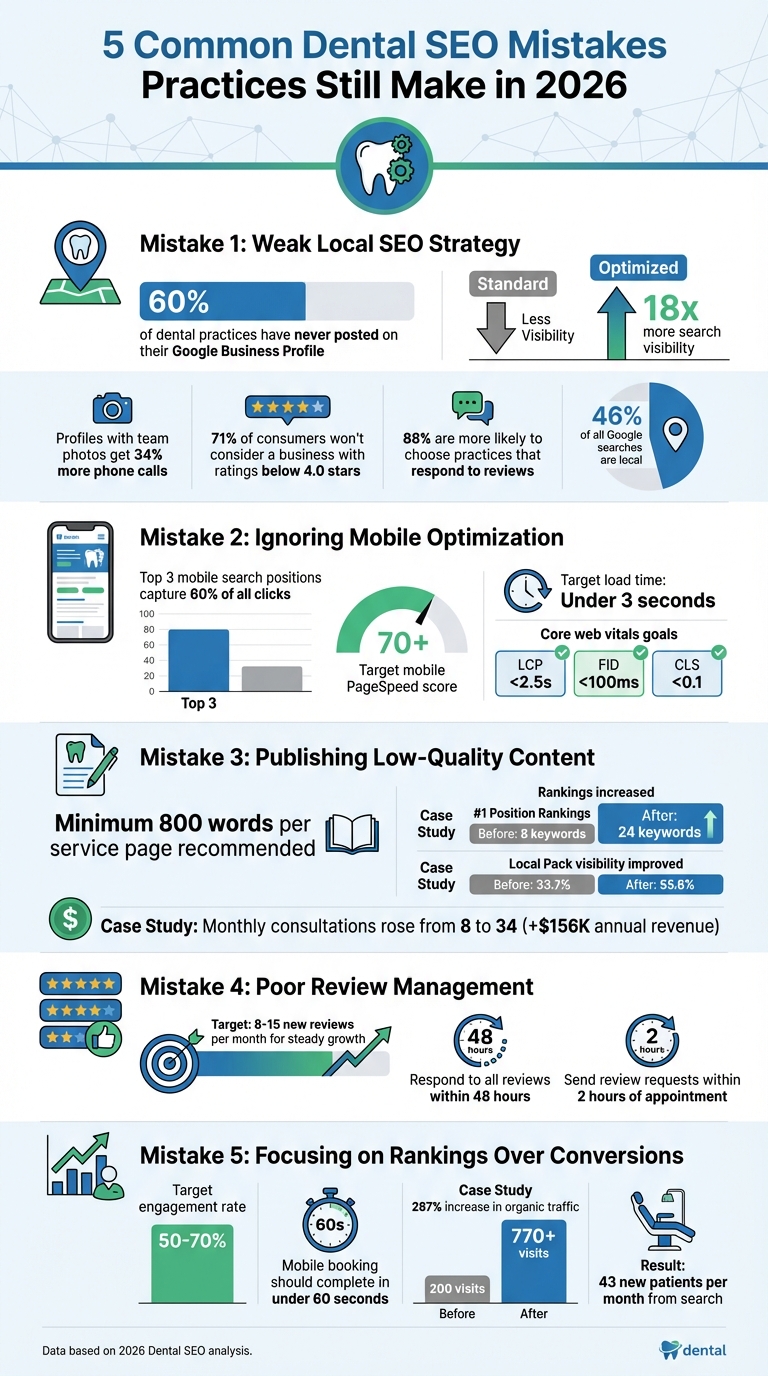
5 Critical Dental SEO Mistakes and Their Impact on Practice Growth in 2026
Top 3 SEO Mistakes Every Dental Practice Makes (Stop Losing Google Rankings!)
Mistake 1: Weak Local SEO Strategy
Local search plays a major role in helping dental practices gain visibility, yet many treat it as a one-and-done task instead of an ongoing effort. Practices with fully optimized and actively managed profiles can see up to 18 times more search visibility compared to those with incomplete profiles. That extra visibility often translates into more calls, appointment bookings, and, ultimately, more patients in your chairs.
Incomplete Google Business Profile
Your Google Business Profile (GBP) is often the first impression potential patients get of your practice. Shockingly, 60% of dental practices have never posted on their profile. While some profiles sit untouched, top-performing practices update theirs every 7–10 days with fresh content.
Missing critical details makes things worse. Many practices skip over essential fields like appointment booking links, specific services (e.g., Invisalign, sedation dentistry, emergency care), and accessibility features. Top practices, on the other hand, include 30–50 high-quality images, while underperformers rely on outdated or poor-quality photos. The difference is huge: profiles featuring team photos see 34% more phone calls.
Reviews are another key factor. 71% of consumers won’t even consider a business with an average rating below 4.0 stars. Additionally, 88% are more likely to choose a practice that actively responds to reviews – both positive and negative. Yet, many practices fail to ask for reviews or ignore them altogether, especially negative ones. An empty Q&A section can further damage credibility, leaving room for incorrect details about office hours or insurance acceptance to surface.
Updating your profile is just the beginning. To really stand out, you need to incorporate local, targeted keywords.
Missing Local Keywords
Generic terms like "dentist" won’t cut it when patients are searching for specific services. Think about phrases like "same-day dental crowns near Midtown" or "pediatric dentist accepting Cigna near [School Name]." Patients are increasingly looking for hyper-local and service-specific solutions.
This shift means practices need dedicated landing pages for key services like dental implants or root canals. Addressing symptom-based searches – such as "why do my gums bleed at night" or "how to fix a chipped front tooth" – can also engage potential patients earlier in their decision-making process.
Voice search and AI tools make this even more important. Patients now ask complete questions like, "Who has emergency dental appointments open today?" AI-driven recommendations favor practices with clear, structured content that answers specific queries, rather than those optimized for broad, city-level keywords.
But even with a strong keyword strategy, inconsistent online listings can undermine your efforts.
Inconsistent NAP Data Across Directories
Your name, address, and phone number (NAP) need to match perfectly across all online directories, social profiles, and insurance listings. Google uses this consistency to verify your legitimacy as a local business. Even minor differences – like "Suite 100" vs. "#100" – can confuse search algorithms and hurt your rankings.
"Even small discrepancies (like ‘Suite 100’ vs ‘#100’) can confuse Google and hurt rankings." – Dentplicity
Search engines increasingly treat businesses as unified entities. If your NAP data doesn’t match across platforms, Google struggles to connect your website, Google Business Profile, and social media into a single authoritative identity. This inconsistency not only lowers your rankings but can also exclude you from AI-generated recommendations that rely on structured data.
For more analytics-driven growth tips to refine your strategy, To fix this, start with discipline. Keep a master spreadsheet with your official practice name, full address, and phone number. Use this as your reference for every directory submission. Perform quarterly audits to catch duplicate listings or outdated information across platforms like Yelp, Healthgrades, WebMD, and insurance directories like Aetna or Cigna. If you have multiple locations, ensure each one has its own unique NAP details and a dedicated landing page. Automation tools can help keep this data synced, but the foundation is maintaining a single, consistent source of truth.
Mistake 2: Ignoring Mobile Optimization
Mobile usability is a game-changer for dental practices. Most patients search for a dentist on their phones, often during urgent situations. Yet, many practices overlook mobile optimization, and it shows in both their search rankings and patient conversions. Even if you invest in a strong local SEO strategy, failing to optimize for mobile can undo all that hard work.
With Google’s mobile-first indexing, a poor mobile experience doesn’t just cost you patients – it can also hurt your search visibility. For instance, dental practices that rank in the top three mobile search positions capture a whopping 60% of all clicks. The stakes are even higher now that AI tools like ChatGPT and Gemini are being used for discovery. These platforms favor websites with clear, structured mobile data. Ignoring mobile optimization compounds other digital mistakes, leading to missed opportunities to attract new patients.
Slow Page Loading Speeds
Mobile users don’t have patience for slow websites. If your site takes longer than three seconds to load, many potential patients will simply move on to a competitor.
To evaluate your site’s performance, use tools like Google PageSpeed Insights. Aim for a mobile score of 70+ and a load time under three seconds. Focus on Core Web Vitals metrics like CLS, LCP, and INP, which assess key aspects of user experience:
| Core Web Vital | What It Measures | Goal for 2026 |
|---|---|---|
| Largest Contentful Paint (LCP) | Speed of main content loading | Under 2.5 seconds |
| First Input Delay (FID) | Interactivity/response time | Under 100 milliseconds |
| Cumulative Layout Shift (CLS) | Visual stability of elements | Under 0.1 |
Common issues include oversized images, uncompressed files, and excessive code. To address these, compress images before uploading, enable browser caching, and remove unnecessary scripts. Also, make sure your site uses HTTPS – Google prioritizes secure websites, especially in healthcare searches. A slow or insecure site can significantly harm your rankings.
Beyond speed, your site’s design must cater to mobile users seamlessly.
Non-Responsive Website Design
A non-responsive website is a major turnoff for mobile users. Text that’s too small, buttons that are hard to tap, or forms that require endless zooming and scrolling create a frustrating experience – and frustrated patients are unlikely to stick around.
Responsive design ensures your website adapts smoothly to any screen size, whether it’s a phone, tablet, or desktop. This is critical since most local searches have immediate intent. Patients are often ready to book right away, and if your site makes that difficult, they’ll turn to a competitor. Just as consistent NAP (Name, Address, Phone) data is essential for local SEO, consistent mobile design is key for capturing patients on the go.
Some common mobile design pitfalls include non-clickable phone numbers, slow-loading booking widgets, and overly complicated forms. To fix these, make your phone number prominently clickable on every page. Use a sticky header or footer with "Call Now" or "Book Online" buttons to simplify navigation. On your mobile homepage, display your address, hours, and a clear "Book Appointment" button front and center.
Patients in 2026 often use their phones to "tour" clinics by browsing high-quality photos before making a decision. Optimize these images for mobile without sacrificing quality. Additionally, with the rise of zero-click searches – where patients get information like hours, location, and reviews directly from search results – having structured data optimized for mobile is crucial. Without it, AI tools won’t prioritize your site in recommendations.
Mistake 3: Publishing Low-Quality Content
The quality of your content plays a huge role in your online visibility. Unfortunately, many practices rely on generic, uninspired content that fails to show expertise or address what patients actually need. If your service pages are filled with vague, copied text, search engines won’t see a reason to rank your site above competitors who invest in detailed, patient-centered content. Worse, this approach erodes patient trust before they even consider contacting you.
Search engines actively penalize duplicate or low-value service content, often ignoring such pages entirely. By 2026, AI-driven search tools like ChatGPT and Google Gemini have become even more sophisticated, prioritizing websites that feature authoritative, in-depth content over those with shallow or outdated pages. For example, a homepage that simply lists services without detailed, standalone pages for each procedure provides little value to search algorithms or potential patients. This kind of template-based content can hurt your credibility and rankings.
Generic Content That Fails to Connect with Patients
A common pitfall is writing service pages in overly clinical or technical language, which alienates patients. For instance, a page titled "Endodontic Therapy" packed with medical jargon won’t resonate with someone searching for "tooth pain relief" or "do I need a root canal?" To connect, you need to speak in terms patients understand and care about.
Each major service page should have at least 800 words of unique, detailed content to avoid thin content penalties. Structure these pages around common patient concerns and questions. Use conversational language – say "bad breath" instead of "halitosis", for example – to align with how people search online. Including FAQs that address long-tail queries like "How much do veneers cost in [your city]?" can also help your pages appear in AI-generated summaries, which are becoming increasingly prominent in search results.
Here’s a real-world example: Discovery Children’s Dentistry & Orthodontics in Carlsbad, CA, saw a significant boost in rankings by adding parent-focused FAQs and optimizing their content for AI interpretation. Between August and November 2025, their number one rankings jumped from 8 to 24, and their Local Pack visibility improved from 33.7% to 55.6%. Because dental content falls under health-related topics, Google applies stricter E-E-A-T (Experience, Expertise, Authoritativeness, Trustworthiness) standards. To meet these standards, include clinician bios, "medically reviewed" statements, and credentials prominently on your site to establish trust.
Without a clear content strategy, even detailed pages can fail to build authority if they’re not part of a larger, cohesive framework.
The Problem with Isolated Pages: Missing Content Clusters
Having service pages without a strategic structure can weaken your site’s authority. Search engines favor practices that demonstrate comprehensive expertise through content clusters. A content cluster typically features a pillar page for a core service (like Dental Implants) linked to 8–12 sub-pages covering related topics such as costs, recovery, candidacy, and specific procedures.
Consider this example: A dental practice in Manchester overhauled its SEO and keyword strategy in late 2025. They created detailed service pages targeting "Invisalign Manchester" and built content clusters around high-value treatments. As a result, monthly Invisalign consultations rose from 8 to 34 within six months, generating an additional $156,000 in annual revenue. By internally linking these cluster pages, they created a "topical web" that signaled to search engines their expertise in Invisalign. To maximize this strategy, ensure every key treatment page is accessible within two clicks from your homepage, making it easy for search engines to crawl and assign authority.
The takeaway? Invest in patient-focused, detailed content of at least 800 words per service and structure it into well-organized clusters. This not only improves search rankings but also builds trust with potential patients. Practices that group their content into clear hubs with pillar pages and supporting articles consistently outperform those with scattered, disconnected pages, even when offering the same services.
Mistake 4: Poor Review Management
To turn online visibility into actual patient appointments, managing reviews effectively is just as important as local SEO and mobile optimization. Online reviews aren’t just ranking factors – they’re trust signals that influence potential patients’ decisions. Unfortunately, many dental practices overlook this, relying on random feedback instead of creating a structured system. This approach leaves "trust gaps" that can hinder local rankings from stabilizing. When paired with strong local SEO, consistent reviews not only boost rankings but also build trust. For instance, a practice with 200 reviews will stand out far more than one with just 15, no matter the clinical quality.
By 2026, Google’s algorithms prioritize practices that maintain a steady flow of reviews over time rather than sporadic bursts followed by silence. Tyson Downs, Founder of Titan Web Agency, explains:
"Reviews do more than influence local rankings. They shape whether patients trust your practice enough to call or book. A strong review presence supports visibility, but its real value shows up in conversions".
No System for Collecting Reviews
Hoping patients will leave reviews on their own? That’s a recipe for inconsistency. Without automation, you’ll likely end up with scattered feedback that doesn’t align with what Google rewards. Instead, automate SMS or email review requests within two hours of the appointment, linking directly to your Google review page. This timing matters – patients are most likely to leave feedback while their experience is still fresh.
Train your front-desk staff to ask for reviews during checkout when a patient seems happy. A simple script like, "We’re so glad you had a great experience – would you mind sharing that online?" can work wonders. Also, avoid directing patients to your homepage. Use Google Business Profile’s "Ask for reviews" short URL, which takes them directly to the review screen. Aim for steady monthly growth – around 8–15 new reviews each month – rather than occasional bursts followed by inactivity. An automated system not only boosts review volume but also lays the groundwork for handling negative feedback.
Ignoring or Mishandling Negative Reviews
Negative reviews themselves won’t hurt your rankings, but ignoring them will. Unanswered reviews signal disengagement to both Google and potential patients. Make it a point to respond to every review – positive or negative – within 48 hours. When addressing negative feedback, remain calm and empathetic. Acknowledge the issue publicly but encourage the reviewer to resolve it offline. This approach protects patient privacy while showing professionalism.
Mistake 5: Focusing on Rankings Instead of Conversions
Getting a top spot in search results might seem like a win, but it doesn’t guarantee success if those clicks don’t turn into actual appointments. The real challenge isn’t just visibility – it’s what happens after someone lands on your website. Many practices celebrate high rankings while their phones remain silent. Why? They’re chasing vanity metrics instead of focusing on what drives revenue. As Prime Dental SEO explains:
"Ranking #1 for a keyword that doesn’t convert patients is worthless. SEO strategy should be built around patient intent".
Your site may rank well but still face "booking friction." This could be anything from non-clickable phone numbers on mobile devices to unclear calls-to-action or slow page load times that drive visitors away before they even explore your services. Practices that prioritize high-value treatments and optimize for conversions often see noticeable increases in both appointment bookings and treatment revenue. Shifting focus from rankings to actionable patient behavior is key to improving results.
No Conversion Tracking Setup
If you’re not tracking conversions, you’re flying blind. Increased traffic might look promising, but without analytics, you won’t know if visitors are calling, booking, or leaving after a few seconds. Setting up tools like Google Analytics 4 (GA4) is essential. Use it to track specific actions like click-to-call events, appointment form submissions, or online booking completions. To do this, go to Configure → Events → Mark as Conversion in GA4 and properly label these events.
For even deeper insights, integrate call tracking tools like CallRail to connect phone calls to specific web pages or search traffic. Assign a dollar value to each conversion – for instance, $350 for a new patient appointment – so you can measure ROI accurately. Linking GA4 with Google Search Console can also reveal which keywords drive not just clicks but meaningful actions. As Tana, Founder of Dental Marketing BFF, puts it:
"If SEO is how you earn visibility, analytics is how you measure impact".
Ignoring User Behavior Data
Beyond tracking conversions, understanding how users interact with your website is critical. Traffic numbers alone don’t tell the full story. For example, a page with 500 visitors a month but no appointment requests clearly has an issue. User behavior data can pinpoint where potential patients are dropping off. Keep an eye on your engagement rate – it should ideally be between 50–70% – and your bounce rate to identify underperforming pages. If engagement is below 50%, your content might not be addressing patient needs, or your page might be loading too slowly.
It’s also a good idea to test your mobile booking process monthly. Make sure it can be completed in under 60 seconds; anything longer could be costing you appointments. To reassure potential patients, place trust signals like star ratings, testimonials, and doctor credentials near booking buttons. Consistency is key – use clear, standardized calls-to-action like "Call Now" for emergencies and "Book Online" for routine visits or cosmetic consultations. As Inzimam Ul Haq, Founder of Codivox, aptly states:
"The most expensive website problem is guessing".
Conclusion
Dental SEO in 2026 revolves around creating a system that consistently attracts new patients. This means focusing on fully optimized Google Business Profiles, maintaining accurate NAP (Name, Address, Phone Number) data, ensuring mobile-friendly websites, and implementing effective conversion tracking. As Tyson Downs, Founder of Titan Web Agency, puts it:
"Local SEO stops working when key local signals fall out of sync, and no one brings them back into alignment."
The rise of zero-click searches and AI-powered summaries has expanded visibility beyond just your website. Patients now find critical information – like phone numbers, business hours, and reviews – directly in search results. To stay competitive, your Google Business Profile needs regular updates, including new photos every week and review responses within 24–48 hours. Additionally, mobile load times under three seconds play a big role in reducing bounce rates and increasing appointment bookings.
These strategies aren’t just theories; they’ve already delivered real results. Take, for example, a Southern California dental group that tackled over 340 technical issues and enhanced their local SEO in early 2026. Within eight months, they saw organic traffic soar by 287% (from 200 to over 770 visits) and averaged 43 new patients per month from search.
The practices that thrive in 2026 will be those that adopt what Vigorant refers to as the new standard:
"In a digital landscape defined by precision and proximity, ethical visibility not manipulation will define the most trusted dental brands of tomorrow."
Start with a fully optimized Google Business Profile, a fast-loading mobile site, and strong conversion tracking. These efforts create lasting value, ensuring your SEO continues to deliver – even during challenging times.
FAQs
How often should I update my Google Business Profile?
Updating your Google Business Profile on a regular basis – ideally once a month – keeps your information accurate and up-to-date. This practice helps you respond to customer reviews quickly and ensures your business remains visible in local search results. Consistent updates can also boost your chances of showing up for relevant local searches.
What’s the fastest way to fix inconsistent NAP listings?
The fastest way to address inconsistent NAP (Name, Address, Phone) listings is to conduct a thorough audit of all the online directories and platforms where your business appears. This includes places like Google Business Profile, social media accounts, and other listing sites. Look for any discrepancies, correct them, and make sure the formatting is consistent everywhere. While automation tools can speed up parts of this process, manually reviewing and updating your listings is crucial to ensure everything is accurate and aligned across the board.
Which conversions should a dental website track in GA4?
Tracking key conversions on a dental website is crucial for understanding how effectively it engages visitors and encourages them to take action. These conversions include form submissions, phone calls, interactions with treatment pages, and any other actions that indicate patient inquiries or appointment requests. By monitoring these metrics, you can gauge how well your website is performing in turning visitors into potential patients.