
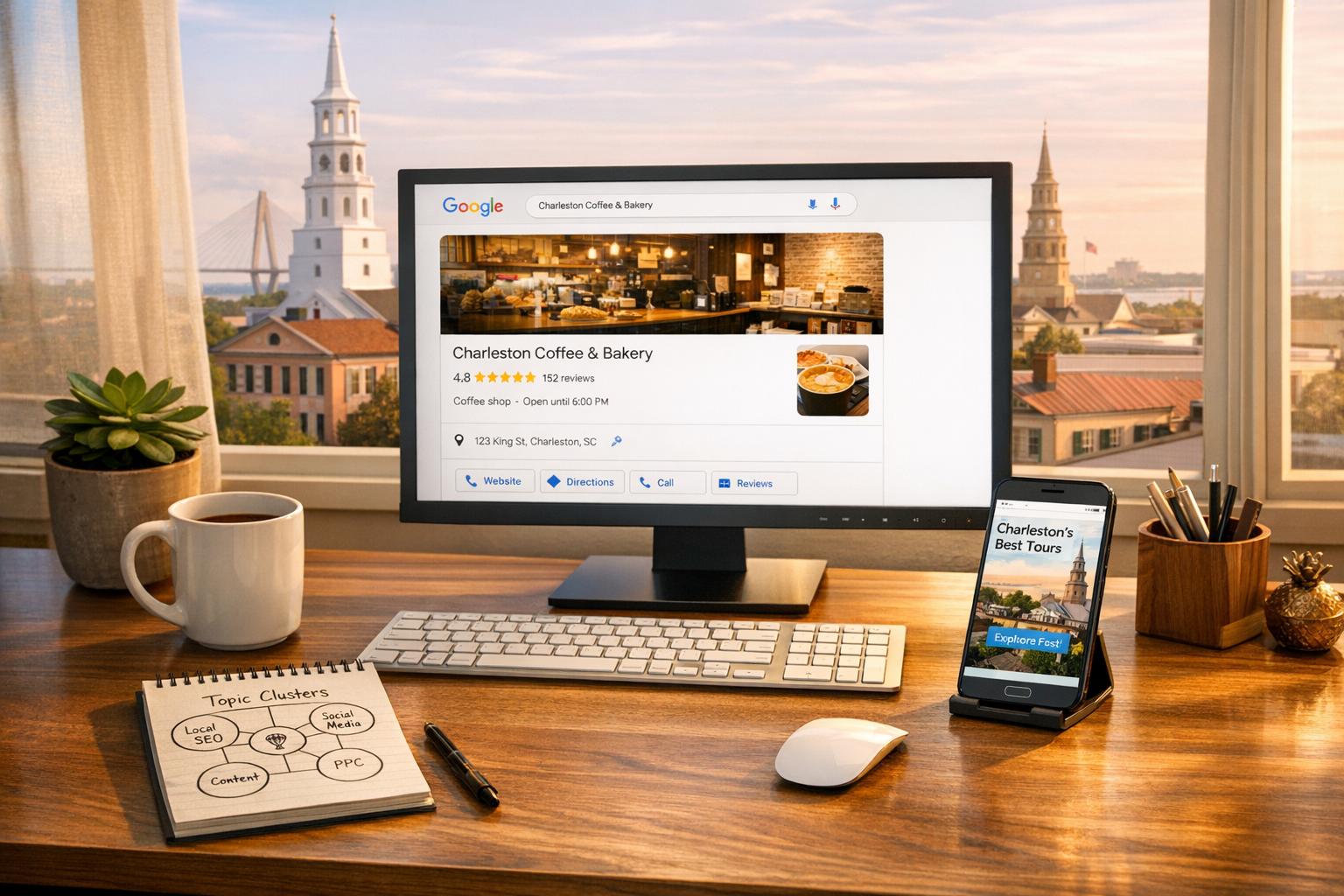
In 2025, nearly half (47%) of Charleston businesses changed their SEO strategies. Why? Google’s three major updates (March, June, December) reshaped how search works, prioritizing entity strength and semantic relevance over keywords. AI tools like ChatGPT and Google AI Overviews now dominate search, favoring businesses with structured data, topic clusters, and mobile-friendly sites.
Key takeaways:
- Local SEO: Weekly Google Business Profile updates, accurate NAP (Name, Address, Phone), and geo-tagged photos are now critical.
- Mobile Optimization: With 60% of local searches on mobile, fast-loading, user-friendly sites are essential.
- Content Hubs: Topic clusters boost visibility in AI-driven search results.
Businesses that embrace these tactics are seeing gains, like a 220% increase in search impressions. Those who don’t risk falling behind. Ready to compete? Start by auditing your site’s mobile performance and updating your Google Business Profile.
Local SEO in 2025: What Actually Works (w/ Joy Hawkins)
Why Charleston Businesses Are Changing Their SEO Strategies
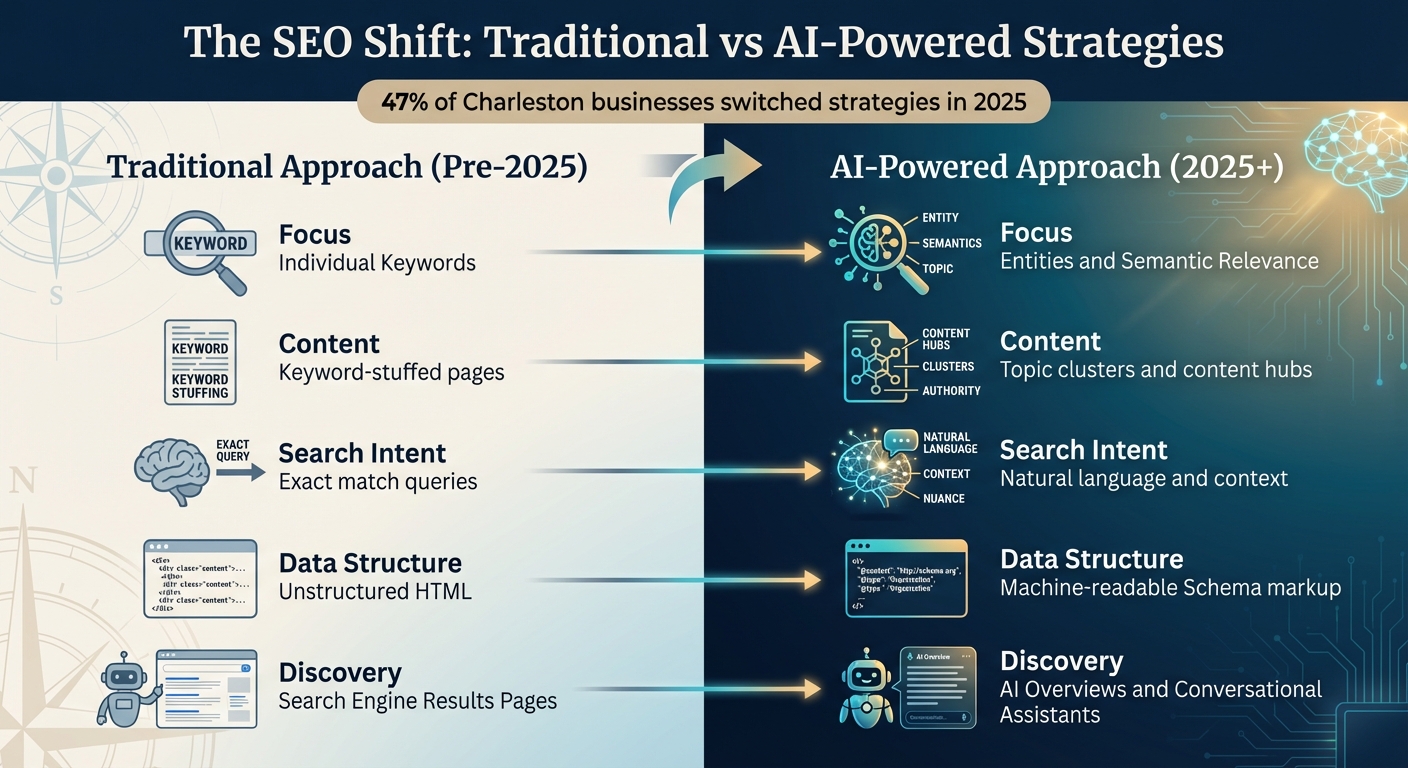
Traditional vs AI-Powered SEO Strategies for Charleston Businesses in 2025
Local Search Algorithm Updates and Google Business Profiles
Google’s local search algorithm has evolved significantly. Instead of focusing solely on keywords, it now emphasizes understanding entities, their relationships, and the intent behind user queries. For businesses in Charleston, this means it’s no longer enough to simply repeat "Charleston SC" throughout your content. You need to demonstrate authentic ties to the area.
The algorithm values "fresh historical data", which involves consistent activity on your Google Business Profile. Weekly updates, regularly uploading photos tagged with Charleston locations, and maintaining a steady flow of clicks and direction requests are key to staying relevant. Additionally, Google increasingly relies on structured data from platforms like Reddit, forums, and social media to train its AI models. This highlights the importance of maintaining a strong presence across multiple platforms.
Accuracy in NAP (Name, Address, Phone Number) details is another critical factor. Even small inconsistencies can confuse the algorithm and hurt your rankings. Technical issues, such as broken links or redirect chains in your Google Business Profile, can further disrupt your "chain of relevance", negatively impacting your local SEO performance.
These optimizations are essential for ensuring a smooth, mobile-friendly experience.
Mobile-First Indexing and Site Performance
With Google prioritizing mobile-first indexing, your rankings now depend primarily on the performance of your mobile site. This shift is particularly crucial in Charleston, where about 60% of local searches come from mobile devices. Mobile users expect fast load times – preferably under three seconds. Any delay can lead to higher bounce rates and lost opportunities.
Google also tracks mobile user engagement signals, such as click-through rates from local search results, phone call conversions, and requests for directions. If your site is slow or challenging to navigate on mobile, potential customers are likely to turn to a competitor. Given that Google Business Profile optimization now accounts for roughly 25% of local ranking factors, mobile usability has become a top priority.
Strong mobile performance lays the groundwork for content strategies centered around topic clusters.
Topic Clusters and AI-Powered Search
Charleston businesses are shifting from targeting individual keywords to creating topic clusters and content hubs. For instance, when someone searches for "best seafood in Charleston SC", AI assistants use natural language processing to interpret the search intent almost instantly. These tools prioritize businesses that demonstrate topical authority – favoring comprehensive resources over keyword-heavy pages.
This approach strengthens your entity’s relevance by incorporating local landmarks and context. While AI-generated summaries might drive fewer total clicks, the traffic they generate is often higher quality and more likely to convert. Businesses that utilize structured FAQs and localized pages also benefit, seeing a 35% increase in retrieval rates within AI summaries. Including structured data is now essential for success in AI-driven search.
| SEO Element | Traditional Approach (Pre-2025) | AI-Powered Approach (2025+) |
|---|---|---|
| Focus | Individual Keywords | Entities and Semantic Relevance |
| Content | Keyword-stuffed pages | Topic clusters and content hubs |
| Search Intent | Exact match queries | Natural language and context |
| Data Structure | Unstructured HTML | Machine-readable Schema markup |
| Discovery | Search Engine Results Pages | AI Overviews and Conversational Assistants |
SEO Solutions for Charleston Businesses
Use Local SEO Tools and Schema Markup
Your Google Business Profile is one of your most powerful tools for local SEO. Start by auditing your business’s NAP (Name, Address, Phone) information across all platforms. Even small inconsistencies can confuse Google’s algorithm and hurt your local rankings. To boost local relevance, regularly upload geo-tagged photos featuring well-known Charleston landmarks. You can further signal your location by following geo meta tags best practices.
Take it a step further by implementing LocalBusiness schema. This structured data helps search engines connect your business to the Charleston area and its landmarks. If you’re unsure where to start, check out SearchX’s guide to schema markup, which provides a step-by-step walkthrough to get your structured data up to code.
These technical tweaks not only improve your local SEO but also set the foundation for better performance in mobile and voice search.
Improve Mobile and Voice Search Performance
In Charleston, mobile search is king, and faster load times can make a noticeable difference in your revenue. Address common technical issues like oversized images, slow server responses, or unoptimized code by using technical SEO services. Follow a mobile SEO checklist to ensure your site loads in under three seconds to keep visitors engaged and reduce bounce rates.
Voice search, on the other hand, requires a different approach. People tend to use natural language queries, like “Where can I find the best seafood near King Street?” To cater to this, structure your content around these conversational queries. Adding FAQ sections that answer common Charleston-specific questions directly can also make your site more appealing to voice assistants and AI-driven search summaries.
Create Topic Clusters and Content Hubs
Once your technical setup is solid, focus on building content hubs to establish yourself as a local authority. Instead of targeting individual keywords, create pillar pages around Charleston neighborhoods or services. For instance, a law firm could have a main page titled "Legal Services in Charleston", with subpages covering topics like estate planning in Mount Pleasant, real estate law in West Ashley, and business contracts on Daniel Island. This approach positions your business as a go-to resource for multiple related topics.
"Traditional SEO helps you rank. AEO helps you get quoted. GEO helps your brand get retrieved by AI models that summarize local results." – PalmettoSoft
To make the most of this strategy, use keyword research services to uncover hyper-local search terms. Then, interlink your related pages to strengthen your site’s topical authority and improve its overall visibility.
SearchX Plans for Charleston Businesses
SearchX has developed plans specifically designed to help Charleston businesses achieve measurable success through smart SEO strategies.
Starter, Growth, and Enterprise Plans
SearchX offers three pricing options to fit businesses at different stages of growth:
- Starter Plan: Priced at $3,000/month, this plan is perfect for small businesses looking to establish a local presence. It includes Google Business Profile (GBP) optimization, ensuring NAP (Name, Address, Phone) consistency across 50+ directories, and local keyword tracking.
- Growth Plan: At $6,000/month, this plan builds on the basics by adding topic clusters, semantic SEO, and content hubs to help businesses dominate Charleston-specific search results. It also includes 6-8 content pieces per month, competitor analysis, and detailed technical audits.
- Enterprise Plan: Starting at $12,000/month, this top-tier option is designed for businesses ready to lead the pack. It incorporates Answer Engine Optimization (AEO) and Generative Engine Optimization (GEO), ensuring your brand is visible when AI models and voice assistants summarize local results. The plan also features 10-15+ content pieces, AI visibility tracking, custom dashboards, and a dedicated team.
| Plan Tier | Monthly Investment | Key Features |
|---|---|---|
| Starter | $3,000 | GBP optimization, NAP consistency, local tracking, 3 content pieces |
| Growth | $6,000 | Topic clusters, semantic SEO, 6-8 content pieces, competitor analysis, technical audits |
| Enterprise | $12,000+ | AEO/GEO strategies, 10-15+ content pieces, AI tracking, custom dashboards, dedicated support |
Free SEO Tools for Quick Wins
SearchX also provides free resources to help Charleston businesses make immediate improvements. Their GMB Audit Tool and Website Audit Tool can uncover issues like incomplete business hours, missing photos, or inconsistent contact details. With over 80% of consumers researching online before visiting a local business, fixing these gaps can lead to rapid improvements in local search rankings.
Tailored SEO Strategies for Charleston Industries
SearchX goes beyond general strategies by offering industry-specific solutions tailored to Charleston’s unique market landscape.
For example, real estate agencies can benefit from creating detailed neighborhood guides for areas like Daniel Island, Summerville, and Mount Pleasant. These guides not only establish authority but also help businesses rank for long-tail local searches. Similarly, tourism and hospitality businesses can leverage structured data optimizations and topic clusters to capture more local traffic. SearchX also offers review management tools and other local SEO tactics to ensure businesses stay competitive as search algorithms evolve.
Conclusion
Charleston’s SEO game has changed dramatically. With 47% of local businesses revamping their strategies, it’s clear that search engines and AI tools are reshaping how local information is presented. The old days of stuffing pages with keywords are gone. Now, Google’s AI-driven overviews and voice assistants are deciding which businesses get highlighted and recommended.
The challenges are undeniable: AI-powered searches are taking over traditional blue link results, and search engines now prioritize semantic relevance over outdated keyword tactics. But here’s the good news – there are practical steps businesses can take to stay ahead. By using structured data markup, keeping Google Business Profiles updated with accurate NAP (Name, Address, Phone) details, and creating content clusters focused on Charleston-specific topics, many businesses are already seeing real improvements. For example, in 2025, a Charleston home services company reported a 220% boost in local search impressions and a 40% increase in organic conversions after adopting location-based schema and earning local backlinks.
Success in this evolving landscape depends on execution. The businesses that thrive are the ones that act consistently and strategically. SearchX offers local SEO services with detailed plans and free tools to help you identify and fix gaps in your SEO approach quickly.
The competition isn’t slowing down. With over 90% of online journeys starting on a search engine and AI now shaping visibility, it’s time to lead the charge – or risk falling behind.
FAQs
How do Google’s recent updates affect local SEO strategies for businesses in Charleston?
Google’s updates for 2025 have made local SEO more dynamic, emphasizing intent-driven searches and semantic connections. While factors like proximity, prominence, and relevance still play a role, Google now also considers how well a business is tied to local landmarks, neighborhoods, and specific services (like "bakery" or "plumber"). For Charleston businesses, this means it’s more important than ever to keep their Google Business Profile up to date, ensure NAP (name, address, phone) details are consistent across directories, and use schema markup to help Google better understand their services and location.
With mobile-first indexing and higher expectations for fast-loading pages, mobile performance has become critical. In Charleston, over 65% of local searches happen on smartphones. That means businesses must have sites that load in under two seconds and include features like click-to-call buttons to meet user needs. On top of this, Google’s AI-driven updates place greater importance on high-quality reviews and local backlinks, which help build trust and improve visibility in search results. To stay ahead, Charleston businesses need a combination of accurate online listings, mobile-friendly design, structured data, and a strong reputation within the local community.
What are the main advantages of using topic clusters for SEO?
Organizing your content with topic clusters can significantly improve your website’s structure and authority. By grouping related articles and posts around a central pillar page, you create a clear framework that helps search engines grasp the connections between topics. This can lead to better relevance and higher rankings in search results.
For visitors, topic clusters simplify navigation, making it easier to find the information they need. This often leads to greater engagement and longer time spent on your site. Beyond the SEO benefits, this method also establishes trust with your audience by offering thorough, interconnected content that meets their needs.
Why is mobile optimization essential for Charleston businesses in 2025?
Mobile optimization is a must for Charleston businesses in 2025. Why? Because most local searches now happen on smartphones. In fact, over 65% of searches in the area are mobile, and nearly 90% of those users end up visiting a local business within 24 hours. If your site is slow or difficult to navigate, potential customers are likely to move on to a competitor.
With Google’s mobile-first indexing, the mobile version of your website is what determines your search rankings. This means having a fast, responsive design isn’t just a nice-to-have – it’s essential, especially for "near me" and voice search queries. By focusing on mobile optimization, you can enhance user experience, boost conversion rates, and improve your visibility in local search results. Key steps include ensuring your site loads quickly, displaying clear contact details, and using structured data to make it easier for on-the-go customers to find and choose your business in Charleston’s competitive market.