

When choosing a domain extension, the decision between ccTLDs (e.g., .us, .de) and gTLDs (e.g., .com, .org) can significantly affect your SEO strategy. Here’s the key takeaway:
- ccTLDs are best for targeting specific countries. They help with local rankings and build trust with local users but are limited in global reach. Managing multiple ccTLDs can be complex and costly.
- gTLDs work well for global or multi-country businesses. They centralize SEO efforts, consolidate link equity, and simplify management. However, they require additional geo-targeting and localization to compete in specific markets.
Quick Overview:
- ccTLDs: Strong for local SEO, limited global visibility, high maintenance for multiple countries.
- gTLDs: Flexible for international SEO, scalable, requires proper localization.
Summary Table:
| Factor | ccTLD (e.g., .de, .fr) | gTLD (e.g., .com, .org) |
|---|---|---|
| Geo-targeting signal | Strong for one country | Neutral; needs setup |
| Local trust & CTR | Higher | Lower without localization |
| Global scalability | Limited | Easier |
| Maintenance complexity | High | Low |
If you’re focused on one or two countries, ccTLDs are a solid choice. For global growth, gTLDs with localized subdirectories are more efficient and cost-effective.
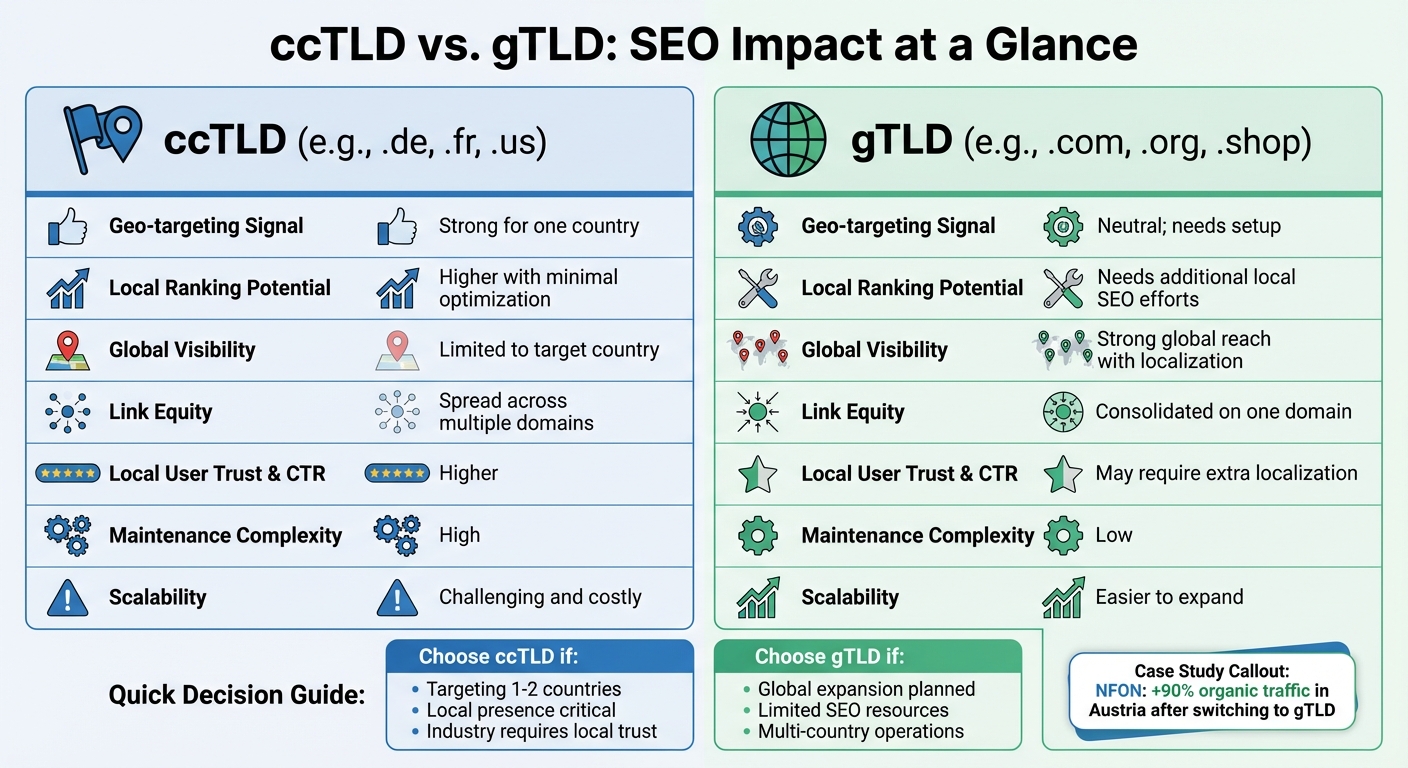
ccTLD vs gTLD SEO Comparison: Key Factors for Domain Selection
Choosing an International Web Structure (ccTLDs, Subdomains, Subdirectories) for International SEO
ccTLDs vs. gTLDs: SEO and Business Effects
Building on the earlier discussion of TLDs, this section dives into their practical impact on businesses. Each type of TLD comes with its own influence on search engine visibility, costs, and management complexity. Understanding these differences is key to choosing the right domain strategy for your goals.
How ccTLDs Affect SEO
Country-code TLDs (ccTLDs) like .de for Germany or .fr for France send a clear signal to search engines about your target audience. This often leads to better rankings for searches within that specific country. Plus, local extensions tend to boost click-through rates because users see them as more relevant and trustworthy.
That said, ccTLDs come with a big limitation: they’re geographically focused. A .de domain, for example, will struggle to rank well in non-German markets like the U.S. or UK, no matter how great your content is. Expanding globally with ccTLDs means using separate domains for each country, which requires individual SEO campaigns, localized content, and unique backlink strategies. While this approach can be effective, it significantly increases costs and management complexity as you scale.
How gTLDs Affect SEO
Generic TLDs (gTLDs) like .com offer flexibility but require a different approach. These domains are considered location-neutral, meaning they can rank anywhere if paired with the right international SEO tactics. This includes using hreflang tags, configuring geo-targeting in Google Search Console, and creating localized content tailored to specific regions.
One major advantage of gTLDs is that they consolidate link equity. All backlinks point to a single domain, boosting its overall authority and making it easier to rank across multiple markets. A great example of this is NFON, a B2B telephony provider. When NFON switched from multiple European ccTLDs to a single gTLD with country-specific subdirectories, their organic traffic in Austria jumped by 90% within five months, and organic leads doubled in the same period. This unified strategy is generally easier to manage and less expensive than juggling multiple ccTLDs. However, it may take extra effort to build the same level of local trust and relevance that ccTLDs naturally offer in regions where users prefer local domains.
Comparison Table: ccTLD vs. gTLD
| Factor | ccTLD (e.g., .de, .fr, .us) | gTLD (e.g., .com, .org, .shop) |
|---|---|---|
| Geo-targeting signal | Strong signal for a specific country | Neutral; requires geo-targeting setup |
| Local ranking potential | Higher in the target country with minimal optimization | Needs additional local SEO efforts |
| Global visibility | Limited to the target country | Strong global reach with proper localization |
| Link equity | Spread across multiple domains | Consolidated on one domain |
| Local user trust & CTR | Often higher due to perceived relevance | May require extra localization for trust |
| Implementation complexity | Requires managing multiple domains | Easier with subdirectories or subdomains |
| Ongoing maintenance cost | Higher due to separate strategies per country | Lower with centralized management |
| Scalability | Challenging and costly for new markets | Easier to expand with localized sections |
For businesses focused on one or two key markets where local preferences dominate, ccTLDs can deliver strong results. On the other hand, if your goal is to build a global presence or target multiple regions, a single gTLD with well-executed localization is often the better choice for scalability and cost-efficiency.
Need help refining your domain strategy for international growth? Reach out to the experts at SearchX for tailored guidance.
How to Choose Between ccTLDs and gTLDs
Selecting the right domain structure depends on your target audience, business goals, and available resources. The best choice will vary depending on your specific circumstances.
When to Use ccTLDs
ccTLDs are ideal if your focus is on a single country and you’re aiming to establish a strong local presence. For instance, a U.S. company setting up operations in Germany – with local staff, euro-based pricing, and German-language customer support – would benefit from a .de domain. As Google’s John Mueller explains:
choose a ccTLD if you primarily target customers in one country.
ccTLDs can also enhance trust, which is critical in industries like banking, healthcare, insurance, and government services. Users often see local domains as more legitimate and relevant. For example, a .fr domain instantly signals to French customers that you understand their market and comply with local regulations.
There are also practical reasons to choose ccTLDs. Some countries, like China and Australia, restrict ccTLD registration to local entities, which might require partnerships or legal arrangements. Additionally, if your business operates as semi-autonomous units or franchises with distinct offerings, pricing, and strategies, managing separate ccTLDs can simplify operations by giving each team control over its own domain.
However, this approach requires significant resources. You’ll need separate SEO campaigns, individual link-building efforts, and tailored content for each market. This strategy works best if you have the budget and team to support multiple sites and if local visibility is a top priority.
If your goal is a unified global presence, a gTLD might be a better fit.
When to Use gTLDs
A gTLD is a better choice when you’re building a global brand or targeting multiple countries from a central operation. For example, a U.S.-based SaaS company serving customers in the U.S., Canada, the UK, and Australia might use a .com domain with localized subdirectories (like example.com/ca/ or example.com/uk/) to maintain brand consistency while catering to each market.
One big advantage of gTLDs is that they consolidate SEO efforts. All backlinks, content marketing, and PR efforts funnel into one domain, boosting its overall authority.
gTLDs also make scaling easier. Expanding into a new market is as simple as adding a subdirectory (e.g., example.com/mx/ for Mexico) instead of launching a new domain. This is especially useful if your SEO resources are limited or if you plan to enter multiple markets over time.
However, success with a gTLD requires proper technical setup. You’ll need to implement geo-targeting in Google Search Console, use hreflang tags, and ensure your localized content is authentic – not just translated. Displaying prices in local currencies (e.g., USD for U.S. visitors, CAD for Canadians) and using the correct date formats (mm/dd/yyyy for the U.S., dd/mm/yyyy for most other regions) are also essential. Without these elements, even a well-chosen gTLD may struggle to perform in local search results.
For many U.S. businesses looking to expand internationally, a .com domain with localized subdirectories offers the best balance of brand consistency, SEO efficiency, and operational simplicity. Save ccTLDs for markets where you’re making a deep, long-term investment with dedicated local operations.
Need guidance on choosing the right domain strategy? The team at SearchX can help analyze your target markets and recommend an approach tailored to your international SEO goals.
Technical Setup and Management for TLDs
After deciding between ccTLDs and gTLDs, the next step is setting up the technical infrastructure. This setup plays a huge role in determining the SEO advantages we’ve covered earlier. Getting it right from the start can save you from major headaches down the line.
Managing Multiple ccTLDs
Handling multiple ccTLDs means treating each domain as an independent website. Google crawls and evaluates each ccTLD separately, assigning its own crawl budget and authority to each domain. This separation impacts everything from hosting to analytics.
For each ccTLD, register it with accurate WHOIS data, use localized hosting or a CDN to ensure fast load times, and set up individual Search Console properties. Managing multiple ccTLDs involves maintaining separate CMS instances, handling individual updates, and conducting uptime checks for every domain. Additionally, content updates, promotions, and legal notices must be tailored for each country. Even link building becomes a domain-specific task – backlinks to your .de site won’t help your .fr or .co.uk domains.
To unify analytics across ccTLDs, you’ll need a centralized setup (like GA4) with filters or custom dimensions to distinguish data by domain and country. Beyond translation, each ccTLD requires a localized keyword strategy that reflects how users in that market search, including local slang and product names. Displaying prices in local currencies, offering country-specific shipping options, and including local trust signals like native reviews are essential. In some regions, such as Australia, local laws may require a domestic partner or entity to own the ccTLD, adding another layer of complexity. This approach demands significant resources, including a dedicated team and budget, to manage multiple sites effectively.
On the other hand, using a single gTLD centralizes much of this work while still allowing for targeted localization.
Managing One gTLD with Localized Sections
With a single gTLD and localized subdirectories (e.g., example.com/us/, example.com/ca/, example.com/uk/), you consolidate domain authority while signaling country-specific targeting. This setup is easier to manage and allows link equity to flow more efficiently across your markets.
Organize your site using country- and language-specific subdirectories, such as example.com/us-en/, example.com/ca-en/, and example.com/fr-fr/. If your brand is U.S.-focused, you can either treat the root domain (example.com/) as the default U.S. site or use a /us/ subdirectory consistently. Avoid mixing inconsistent patterns like /uk/ and /de-de/, as this complicates scaling, hreflang implementation, and analytics.
In Google Search Console, use the International Targeting feature to set country targeting for each subdirectory (e.g., geo-target example.com/uk/ to the United Kingdom). Implement hreflang tags in your HTML head or XML sitemaps to list all alternate regional and language versions of each page, along with an x-default version. Use proper ISO codes (like en-US, en-GB, fr-FR) and ensure reciprocal hreflang annotations across pages.
Keep your site structure consistent and shallow across all locales (e.g., /us/category/product/). Use country-specific navigation and breadcrumbs that link within the same locale, and include a geo-selector or language switcher with clean, crawlable links. A well-structured internal linking strategy ensures that link equity from global campaigns benefits all localized sections.
If you’re migrating from multiple ccTLDs to a single gTLD, create a detailed 1:1 redirect map to preserve SEO signals. Be prepared for a temporary dip in organic visibility, as all old URLs need to be permanently redirected. Retain similar URL paths and avoid major content changes during the migration. Keep the ccTLDs live for a while to serve 301 redirects, and monitor for any 404 errors or redirect chains. When done correctly, consolidating ccTLDs into a single gTLD can combine ranking signals and lower maintenance costs over time, though it requires a careful evaluation of risks for each market.
For personalized strategies to optimize your international SEO setup, check out SearchX.
Conclusion
Choosing between local strength and global scalability depends on your goals. Country-specific domains (ccTLDs) like .de or .fr signal a strong local presence to search engines, often improving local rankings and click-through rates. However, they can spread your SEO efforts thin across multiple markets. On the other hand, generic domains (gTLDs) like .com centralize authority, simplify management, and reduce long-term costs, though they may require additional localization efforts to compete against established local domains.
The right choice comes down to your market focus. If your business targets one or two countries, with dedicated budgets and local teams, ccTLDs can boost trust and visibility in those regions. But for businesses expanding into multiple countries or working with limited resources, a single gTLD paired with localized subdirectories (like example.com/de/ or example.com/fr/) can offer better ROI by consolidating link equity and simplifying technical SEO.
Keep in mind that domain changes can cause short-term disruptions. Redirected URLs often experience temporary ranking drops, so it’s crucial to plan carefully, implement long-term 301 redirects, and monitor performance in key markets closely. Aligning your domain strategy with your broader market goals is key to minimizing risks.
For U.S. businesses focusing primarily on domestic customers with some international reach, a .com gTLD with localized sections strikes the best balance between cost-effectiveness, simplicity, and growth potential. To make this work, ensure proper geo-targeting, implement hreflang tags, and create localized content that adapts to each market’s needs – this includes adjusting pricing, measurements, and references to fit local preferences.
If you’re looking for expert guidance on crafting an international SEO strategy or deciding whether to consolidate domains, SearchX offers technical audits, local SEO solutions, and multi-location strategies tailored to your specific goals and resources.
FAQs
What’s the difference between ccTLDs and gTLDs for SEO?
Country-code top-level domains (ccTLDs) are directly linked to specific countries, which tells search engines that your website is relevant to users in that particular region. This can boost your local search rankings and help establish trust with local audiences.
In contrast, generic top-level domains (gTLDs) aren’t tied to a specific location, making them a great choice for businesses aiming to reach a global audience. That said, if you’re targeting specific countries, you’ll likely need to implement extra local SEO tactics, such as geo-targeting or creating localized content, to achieve strong performance in those areas.
What difficulties come with managing multiple ccTLDs?
Managing multiple ccTLDs comes with its own set of challenges. Each domain demands individual registration and ongoing maintenance, which can quickly escalate costs and add to your administrative workload. On top of that, you’ll need to develop region-specific content and craft SEO strategies tailored to each market to rank well in local search results.
Another hurdle is ensuring consistent branding and a unified user experience across all the markets you’re targeting. Plus, keeping track of performance metrics for each ccTLD can be time-consuming and may require advanced tools to gather accurate data and insights.
How can I use a gTLD to target a global audience effectively?
To connect with a global audience using a gTLD, prioritize creating content tailored to different regions and adopt multilingual SEO strategies. This means optimizing for keywords that resonate globally while ensuring your website is technically equipped for international visitors. Key aspects include fast load times and a mobile-friendly design.
Incorporate hreflang tags to signal specific language and regional preferences, helping search engines deliver the right content to users based on their location. Strengthen your website’s presence by securing backlinks from respected global sources, which can enhance your authority in various markets. Keep a close eye on your SEO performance and make adjustments as needed to stay visible across the globe.