

Adapting SEO strategies for different countries is no longer optional – it’s essential. Search engines customize their algorithms based on local user behavior, competition, and regulations. What works in one market may fail in another. For example:
- U.S. SEO: Focuses on high-quality content, mobile-first indexing, and strict Core Web Vitals benchmarks.
- UK SEO: Prioritizes location-based searches and niche expertise.
- Canada SEO: Requires bilingual content and precise language targeting for English and French audiences.
A tailored approach, including localized keyword research, technical configurations like hreflang tags, and region-specific backlinks, ensures better visibility and traffic. Companies that implement such strategies see measurable results, including higher organic traffic, improved rankings, and increased revenue.
Key Takeaways:
- Localization matters: 60% of non-English speakers avoid English-only websites.
- Tailored algorithms: Updates like Google’s March 2025 Core Update impact regions differently.
- Results-driven: Businesses saw traffic increases of up to 700% and revenue growth of over 50% with localized strategies.
This guide explores actionable steps to optimize SEO for country-specific algorithms, ensuring your content resonates with local audiences and search engines alike.
Igal Stolpner On International SEO: It’s About The Regional Users
How Algorithm Updates Differ by Country
Country-specific algorithm updates require tailored SEO strategies to succeed. For example, during the June 2025 Core Update, the US recorded volatility scores twice as high as those in the UK. This highlights how different regions face unique SEO challenges shaped by user behavior, competition, and regulatory factors.
SEO experts emphasize that even a small ranking drop can translate into significant traffic loss. What works in New York might not deliver results in London or Toronto, as algorithm priorities vary between markets. This means businesses operating internationally must adapt their strategies to each region’s specific needs.
US: Shifting Focus on Content Quality
The US market consistently experiences the highest volatility during core updates. Google’s Helpful Content Update, now a permanent part of the core algorithm, targets content created solely for search engines or automated purposes. This update penalizes low-value pages, favoring content that genuinely serves users.
The March 2024 Google Core Update led to a 45% reduction in low-quality content appearing in search results. Google’s focus on E-E-A-T (Experience, Expertise, Authoritativeness, Trustworthiness) has intensified, with advanced AI tools like MUVERA assessing content depth beyond basic keyword use. As Google Search Central puts it:
Helpful content is created by people with real knowledge of their topic who write primarily to assist their audience rather than to manipulate search rankings.
For US-based sites, mobile-first indexing and Core Web Vitals remain non-negotiable. Metrics like LCP (Largest Contentful Paint) under 2.5 seconds and CLS (Cumulative Layout Shift) below 0.1 are critical. Sites failing these benchmarks often face steeper ranking penalties during updates. Given the competitive landscape, US-focused SEO demands a proactive approach, especially when algorithm changes hit harder.
UK: Prioritizing Local Search and Site Diversity
In the UK, search behavior and algorithm updates differ significantly from the US. While updates tend to have a milder overall impact, the initial 72 hours often see heightened volatility before stabilizing. ProfileTree’s research captures this trend:
The UK index typically shows higher volatility in the first 72 hours after an update compared to stabilized US results. This delay creates a false sense of security.
Recent updates in the UK favor niche sites with first-hand expertise over traditional keyword-focused pages. Matt Janaway, CEO of Marketing Labs, explains:
MUVERA allows Google to match better pages that truly satisfy search intent, even if they don’t look like ‘traditional’ SEO-optimised pages.
British users lean heavily on location-based searches, making local intent a key factor. Trust signals like references to the Financial Conduct Authority (FCA), Solicitors Regulation Authority (SRA), or Companies House carry extra weight. Even small details such as using British English spellings and terminology can build credibility with both users and algorithms. These insights have directly influenced the company’s UK-specific content strategies.
Canada: Addressing Bilingual SEO and Local Pack Shifts
Canada brings its own set of challenges, especially with its bilingual audience and proximity-based rankings. The March 2025 Core Update reshaped local search results, particularly in the Health sector, where 11.2% of local keywords shifted from city-level pages to more specific service or practitioner pages.
Adam Wells, Senior SEO Account Manager at Greenlane Marketing, noted:
The days of generic city pages may be numbered… keywords now rank better when they point to individual listings like hotels or flight routes rather than city-level landing pages.
For Canadian businesses, relying on automated translations isn’t enough. Native speakers are essential for creating culturally and linguistically relevant content in both English and French. Proper use of hreflang tags ensures that French-Canadian and English-Canadian content doesn’t compete against each other, which could dilute authority for both.
Canada also shows a growing preference for specific, detailed listing pages over broad directories. This trend is particularly strong in industries like Health, Travel, and Legal services. As a result, the company has shifted its Canadian strategy to focus on creating detailed pages for individual locations or services, rather than generalized overviews covering multiple cities.
Framework for Country-Specific SEO Adjustments
A country-specific SEO framework isn’t just about translation – it’s about creating a strategy that addresses the unique needs of each market. To tackle the diverse algorithm requirements previously discussed, the company implemented a three-part approach: conducting regional keyword research with content tailored to local contexts, configuring technical settings for precise geographic targeting, and building localized backlink profiles that align with each country’s authority landscape. After all, people search in ways that reflect their language and culture, not just a direct translation. The numbers back this up: 75% of online shoppers prefer content in their native language, and 60% of non-English speakers rarely or never buy from English-only websites. Additionally, 96% of B2B leaders reported positive ROI from localization efforts, with 65% seeing at least a 3× return. This framework serves as the foundation for specific adjustments in keyword research, technical configurations, and backlink strategies.
Regional Keyword Research and Content Development
Native speakers conducting keyword research found that direct translations often fail to capture local search habits or cultural nuances. To address this, the team used SEMrush’s international keyword tools (starting at $120/month) to analyze search volumes and competition levels for each region. Beyond the numbers, they focused on understanding how search intent varied between markets.
Content was then developed to align with regional preferences. For the US, the team prioritized mobile optimization and improving Core Web Vitals, ensuring high technical performance. In the UK, content was adjusted to include local terminology and spelling conventions. In Canada, strategies emphasized culturally relevant language adaptations, such as those needed for Quebec, where capturing cultural context was more important than linguistic accuracy. Automated translation tools were intentionally avoided to maintain quality and relevance.
Technical Setup for Geographic Targeting
Technical configurations played a critical role in the framework. The team implemented hreflang tags on every international page to specify language and region, ensuring that regional content wouldn’t compete with one another. Google Search Console’s geotargeting settings were also used to designate which country each subdirectory served. An x-default hreflang tag was added to direct users to a global landing page when no specific language or region matched their preferences.
Instead of relying on automatic IP-based redirects, the site featured language selectors and banners, allowing users to choose their preferred version. This approach avoided indexing issues caused by search engine bots crawling from a single location, ensuring that all regional content remained accessible.
To further enhance performance, the company deployed Content Delivery Networks (CDNs) to serve content from local edge servers. This reduced latency and improved page speed, a critical ranking factor across all regions. These efforts led to noticeable improvements in Core Web Vitals scores, particularly for users in Canada and the UK.
Building Regional Backlink Profiles
The backlink strategy focused on earning links from locally trusted domains rather than generic international ones. The team mapped out each market’s local authority ecosystem, targeting government sites, local media, and key industry publications.
For the UK, the focus was on securing links from British industry outlets, professional organizations, and regional news sites. In Canada, efforts were tailored to bilingual publications and organizations that resonate with both English and French-speaking audiences. The team aimed for 70% local links in established markets like the US and UK, while targeting 80% local links in newer markets. This localized approach to backlinks complemented the content and technical strategies, creating a cohesive SEO plan.
Regional content preferences were also considered. For example, data-driven guides performed well in technical industries, while visual storytelling resonated more with consumer-focused sectors. The team created linkable assets tailored to these preferences and pitched them to 15–20 key publications identified during their media landscape research.
Localized anchor text was another critical factor. Both internal and external links used translated, culturally relevant anchor text instead of direct English translations. This approach strengthened relevance signals and aligned with native search behaviors.
Implementation by Country
With the framework ready, the company shifted to execution, tailoring strategies to fit the specific needs of each market’s search algorithms. In the US, the priority was mobile optimization and adapting content for local audiences. The UK strategy focused on aligning with regional search habits and building a diverse backlink profile. Meanwhile, in Canada, the emphasis was on bilingual SEO and localized structured data. Each market required a custom approach, blending technical tweaks with content strategies to align with local demands.
US: Mobile Optimization and Core Web Vitals
In the US, the strategy revolved around a mobile-first approach, optimizing Core Web Vitals, and adapting content to fit American search behavior. This included replacing UK-specific terms with American alternatives – like switching "trousers" to "pants." A split test conducted by SearchPilot in March 2021 for a UK-based ecommerce company showed that localizing content for the US led to a 24% increase in organic traffic. Additionally, form fields were updated to reflect US-specific conventions, such as changing "Postcode" to "ZIP code." These adjustments ensured the website resonated with American users and search engines alike.
UK: Meeting Site Diversity Requirements
For the UK, the strategy was fine-tuned to meet local preferences and search behaviors. Content was tailored to favor in-depth, well-researched analysis, which aligns with the preferences of UK audiences. The team also mapped the local authority landscape, targeting prominent UK news outlets and trade associations. This helped build a backlink profile with an ideal mix – 70% local, 20% regional, and 10% global links. On the technical side, en-gb hreflang tags were implemented, and a dedicated Google Search Console property was set up to monitor performance. Veruska Anconitano, a Multilingual SEO and Localization Consultant, summed it up well:
People search the way they speak – not the way you translate.
Canada: Bilingual SEO and Schema Markup
In Canada, the focus shifted to handling the complexities of a bilingual audience. A subdirectory structure (e.g., example.com/en-ca/ and example.com/fr-ca/) was used to consolidate domain authority while clearly separating English and French content. Hreflang tags were added for both language versions with two-way confirmation, and language selectors were implemented to prevent indexing issues caused by IP-based redirects. Care was taken to maintain content symmetry between the English and French sections, with an x-default hreflang tag added as a fallback. Schema markup was also localized for both language versions. The results speak for themselves: ForexSuggest.com, led by Louis Schoeman, demonstrated the power of bilingual SEO, achieving a 435% increase in organic traffic within six months in September 2021. These efforts laid the groundwork for the results detailed in the next section.
Results and Performance Metrics
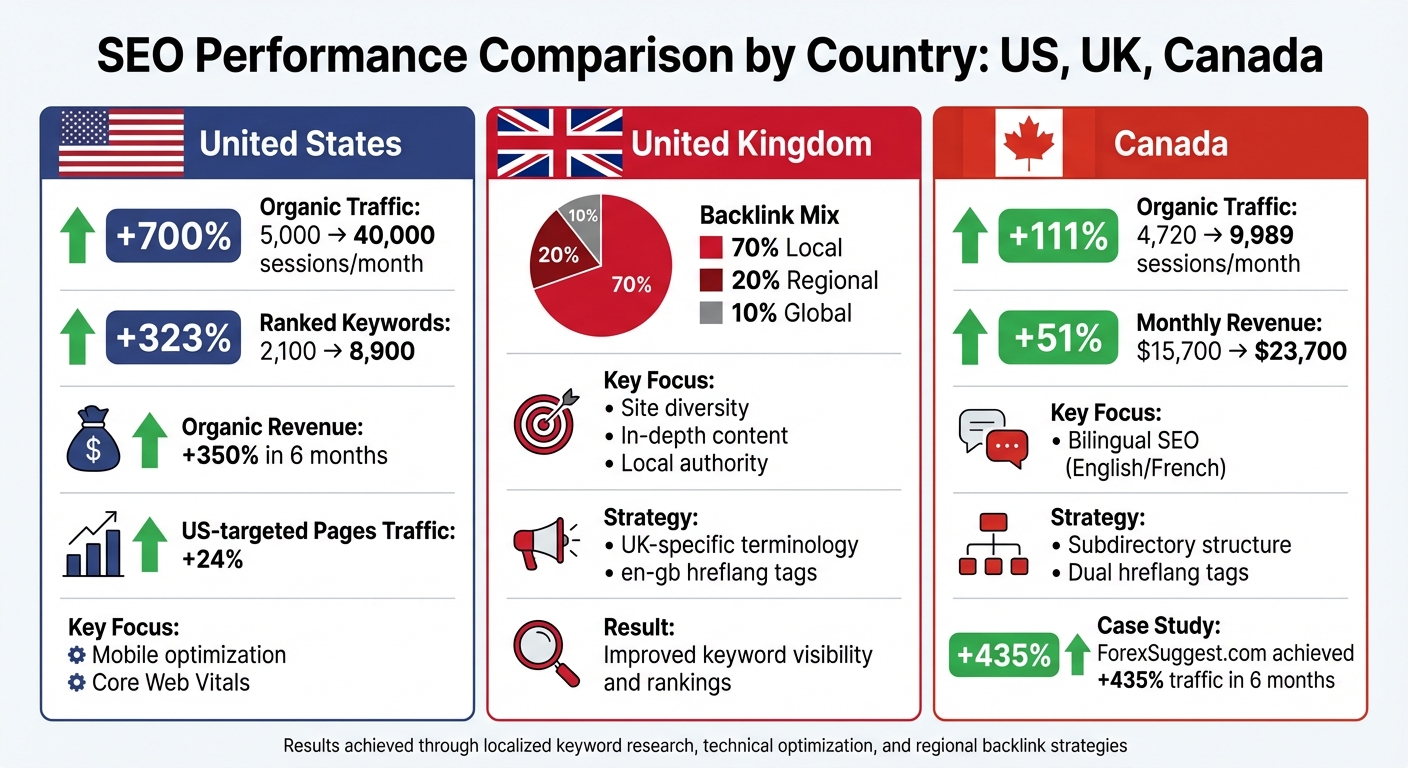
Country-Specific SEO Results: US, UK, and Canada Performance Comparison
The tailored strategies implemented across the US, UK, and Canada delivered measurable outcomes, showcasing the framework’s ability to drive growth. Metrics like organic traffic, keyword rankings, and revenue all saw significant increases, confirming the approach’s success.
Traffic and Keyword Rankings
In the US market, organic traffic soared from 5,000 to 40,000 sessions per month in just 180 days – a staggering 700% increase. Ranked keywords expanded from 2,100 to over 8,900, marking a 323% growth. The localized content strategy also boosted traffic on US-targeted pages by 24%.
In the UK, the focus on a diverse backlink portfolio and region-specific content paid off. These efforts improved keyword visibility and rankings, strengthening the site’s position against competitors.
For Canada, the bilingual content approach proved highly effective. Organic traffic more than doubled, growing by 111% from 4,720 to 9,989 sessions per month. The addition of hreflang tags and localized schema markup ensured that both English and French content performed well in search results.
While traffic improvements were impressive, the strategy’s impact on revenue and conversions was equally noteworthy.
Revenue and Conversion Rates
In the US, the surge in organic traffic translated into a 350% increase in organic revenue within six months. The improved alignment of content with search intent and user preferences also drove higher conversion rates.
In Canada, monthly revenue climbed from $15,700 to $23,700, reflecting a 51% increase (converted from £11,823 to £17,874). The bilingual strategy resonated strongly with Canadian audiences, reinforcing findings that 76% of consumers prefer product information in their native language.
In the UK, enhancements to content quality and a stronger backlink profile led to better user engagement, laying the groundwork for sustained conversion growth.
These results highlight the power of tailoring SEO strategies to local markets. By addressing regional algorithms and user preferences, businesses can attract more valuable traffic and achieve higher conversion rates. The success of this approach provides actionable insights for future international SEO efforts.
Lessons Learned and Practical Takeaways
Successfully navigating country-specific SEO is no easy task. Missteps can cost businesses valuable time and revenue, but understanding these challenges – and how to overcome them – can make all the difference.
Common Mistakes to Avoid
One recurring issue is technical debt, which can cause major headaches for multilingual websites. For instance, a 41-language site faced significant crawl issues due to inconsistent design, layout, and internal linking. By adopting a symmetry strategy to standardize these elements, they reduced crawl costs and improved indexing. The result? A staggering 435% increase in organic traffic over just six months.
Another frequent problem is an asymmetrical site structure. When the primary English version of a site is robust but alternate language versions are thin, search algorithms struggle. A German machinery manufacturer experienced this first-hand. Their site was optimized for German users but lacked international visibility. By reworking their site architecture – adding subdirectories, hreflang tags, and technical landing pages – they saw impressive results, including 73,000 additional clicks and 12,000 new monthly visitors from the US, India, and the UK within a year.
Translation versus localization is another common pitfall. Relying on unsupervised machine translation can harm brand trust and even lead to penalties. Instead, a three-step review process – professional native translation, cultural adaptation, and SEO compliance – can ensure high-quality content. ActiveCampaign applied this approach and saw their Spanish traffic grow by 73% year-over-year, along with a 111% increase in Spanish Help Center usage.
These examples emphasize the importance of adapting to country-specific algorithm updates with precision and expertise. Specialized tools and guidance are often essential for overcoming these challenges.
Tools and Resources for Country-Specific SEO
To tackle the complexities of country-specific SEO, tools like those from SearchX can be game-changers. Their tailored solutions help businesses compete effectively in multiple markets. With services like regional keyword research, technical SEO audits, and localized content creation, SearchX ensures that businesses address the unique demands of each market while maintaining brand consistency.
For bilingual markets like Canada, SearchX provides expertise in hreflang implementation and schema markup optimization – critical technical factors that contributed to ActiveCampaign’s 111% rise in Spanish Help Center usage. They also assist in building region-specific backlink profiles and optimizing for local pack visibility, meeting the nuanced needs of markets like the UK and Canada.
Whether you’re entering new markets or refining your international strategy, SearchX offers scalable solutions to help businesses sidestep common errors and achieve measurable results from their localization efforts.
FAQs
How do I know if I need country-specific SEO?
If your business spans multiple countries, plans to go global, or targets regions with distinct languages and customs, country-specific SEO is a smart move. It helps you stay relevant by aligning with local search behaviors, language preferences, and even legal standards.
Even if you only operate in one country, tweaking your content to reflect local details – like currency or language nuances – can make a big difference. It builds trust with users, encourages engagement, and ensures you’re meeting regional regulations.
Should I use subdomains, subdirectories, or separate domains?
When deciding on a structure for international SEO, it all comes down to your goals and the resources you have. Subdirectories (like example.com/fr/) are a popular choice for businesses taking their first steps into global markets. Why? They centralize domain authority and are simpler to manage.
On the other hand, country-specific domains (like example.fr) send strong signals to search engines about geographic targeting. However, they demand more time, effort, and resources to maintain.
Subdomains are less frequently used in this context, and separate domains are usually avoided unless there’s a specific legal or branding reason to go that route.
What’s the best way to handle bilingual SEO in Canada?
To manage bilingual SEO in Canada effectively, focus on building a website that caters to both English and French-speaking audiences. Start by using hreflang tags to help search engines understand language preferences and avoid any issues with duplicate content. Make sure to research and optimize keywords separately for each language, tailoring them to regional nuances – like using French terms specifically for Quebec audiences.
Adding language schema markup can further enhance your site’s visibility in localized search results. Combining technical SEO practices with well-thought-out, localized content ensures you can connect with both language groups in a meaningful way.